
 Back
Back







Digital transformation stands as a trendsetter in an age wherein technological progress sets the pace for business transformation. Towards the latter end of 2025, knowing and harnessing these developments is critical to those organizations that will continue to be relevant and innovative. Let’s explore what digital transformation entails, why it’s imperative, and the top patterns driving this advancement.
What is Digital Transformation?
Digital transformation refers to the significant changes in business tasks, cycles, and techniques driven by the integration of digital technologies. This shift includes all that from further developing client encounters and functional efficiencies to encouraging advancement and growing new plans of action. It’s not just about embracing new advancements but rather in a general sense reconsidering how organizations work and convey worth to their clients.
Why is Digital Transformation Essential?
Digital transformation is no longer a luxury but a necessity in today’s fast-paced world. It helps companies:
- Improve Effectiveness: Automating routine tasks and advancing work processes smooth out tasks, diminishing time and cost.
- Improve Customer Experience: Personalized Services and Relational Consistency with customers establishes consumer loyalty and happiness.
- Encourage Innovation: Having quick access to frontline technologies opens up new ways to drive innovation for competitive advantage.
- Adjust to Market Changes: Agility and adaptation to change in the market are a sure pathway to living or dying.
- Gain Data-Driven Insights: Business intelligence improves as a whole with data analytics that inform decisions.
Top Digital Transformation Trends Reshaping Businesses in 2026
AI for Cutting Down OPEX
Artificial Intelligence changes the way with which organizations perform their tasks. Through intelligent process automation, AI reduces OPEX and increases productivity by handling repetitive tasks with far greater speed and consistency than manual workflows allow. Some applications of AI include predictive maintenance, AI chatbot development, and automated data analytics. Companies such as Siemens and GE already apply Artificial Intelligence to smoothen the manufacturing process as well as predictive analytics.
Cybersecurity
The faster digital transformation grows in the world of business, the higher the level of risk to cyber threats, requiring only strong cybersecurity measures to protect sensitive information and trust with customers. As for 2026, business trends have reached cutting-edge security measures by implementing zero-trust architecture AI-based threat detection, and comprehensive data encryption. Some prominent organizations leading the way include CrowdStrike and Palo Alto Networks in providing some of the most advanced cybersecurity solutions.
Cloud Computing
One of the backbones of the digital transformation is cloud computing in which businesses enjoy unmatched cost-effectiveness, scalability, and flexibility as compared with traditional IT infrastructures. Hybrid and multi-cloud systems have enabled a faster innovation and even better operations of businesses than before. As part of this shift, certifications in cloud management, often supported by Microsoft AZ-104 Dumps, have become essential for IT professionals aiming to manage platforms like Microsoft Azure.
Low-Code or No-Code Platforms
Low-code and no-code platforms empower businesses to develop applications with minimal coding knowledge. This approach democratizes software development, facilitating the quicker deployment of customised solutions and encouraging cross-departmental creativity. Businesses are using tools like Microsoft’s Power Apps, OutSystems, and Mendix to swiftly and effectively develop customised apps.
AR and VR Integration
Virtual reality and augmented reality are changing the ways of training and the experiences of the client. While virtual reality offers the most realistic training and development simulations, augmented reality in retail provides virtual try-ons and interactive shopping experiences. Two companies applying AR and VR for employee training and product engagement are Boeing and IKEA.
5G Revolution
The rollout of 5G technology is set to change availability, offering quicker paces and lower latency. This headway works with continuous information handling, upholds the development of IoT (Internet of Things) gadgets, and improves versatile encounters. Enterprises like medical care, assembling, and coordinated factors are as of now investigating the capability of 5G to work on functional proficiency and empower new applications.
Everything-as-a-Service (XaaS)
XaaS envelops a scope of administrations conveyed over the web, including Software-as-a-Service (SaaS), Infrastructure-as-a-Service (IaaS), and Platform-as-a-Service (PaaS). This model gives adaptability and versatility, permitting organizations to get to a wide cluster of devices and administrations without significant upfront investments. Organizations like Salesforce, IBM, and Oracle are driving this trend, offering comprehensive solutions to meet assorted business needs.
Real-World Digital Transformation Examples Across Key Industries
- Healthcare: This telemedicine platform and AI-driven diagnostics bring a whole new change to how patients are treated. For instance, Teladoc can afford to have its platform of remote consultations. IBM Watson Health uses AI to assess millions of pages of clinical literature and aid in clinical decision support.
- Retail:E-commerce leaders like Amazon use AI to recommend products and automate logistics. At the other end, Walmart relies on data analytics and robotics in coming up with an optimal management of its inventory and stocking its stores. Many retailers are also digitizing customer loyalty programs to strengthen long-term relationships, encouraging repeat purchases and improving overall customer retention.
- Manufacturing: Industry 4.0 technologies like IoT sensors and AI-driven automation have proven effective in increasing manufacturing efficiency, while companies such as Bosch and Honeywell will combine these technologies and integrate them towards increased productivity and less downtime.
The Impact of Digital Transformation on Product Development Services
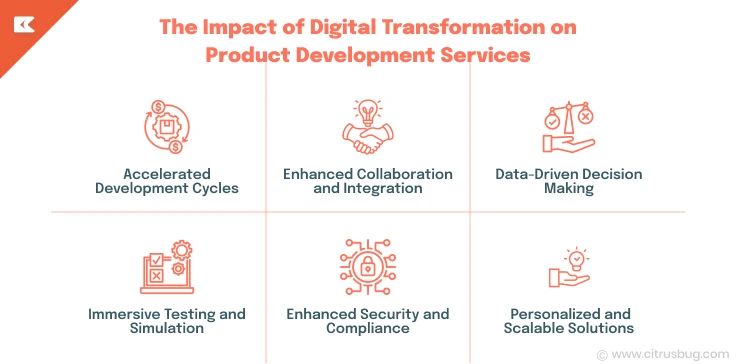
Indeed, as digital transformation is profoundly and far-reaching concerning the impact on product development services, it extends far beyond the mere transformation of how products are designed and, in reality, reshapes how products are conceptualized, tested, and finally marketed to consumers.
1. Accelerated Development Cycles
One of the most significant impacts of digital transformation on product development is the acceleration of development cycles. Low-code platforms combined with agile methodologies facilitate faster iteration and prototyping, giving companies more agility to respond to change and shorten time-to-market and boost the chance of innovating.
These tools can now be relied upon by digital product development services to streamline workflows, cut development time, and bring innovative solutions more rapidly to market.
2. Enhanced Collaboration and Integration
Cloud computing and other collaborative tools really change the way teams work. Basically, the nature of cloud-based services enables development teams to work in real-time, notwithstanding their location. Whenever such tools are integrated, they lead to even better communication, reduced delays, and allow direct access among people regarding the project updates and resources on schedule, while also enhancing lead generation efforts by streamlining contact and collaboration.
3. Data-Driven Decision Making
The ability of AI and advanced analytics to empower the product developer in offering more meaningful insights into data has also helped. With AI and machine learning consulting services and process intelligence software, companies would be able to analyze gigabytes of customer data, predict market trends, and optimize product features more effectively. This data-centric approach, underpinned by strong data governance practices, not only improves product quality and relevance but also sharpens strategic decision-making across the organization.
4. Immersive Testing and Simulation
Augmented Reality and Virtual Reality, which both are changing the product testing and simulation, will enable developers to design a wide range of immersive prototypes and simulate performances virtually before real events. This way, testing will be more accurate and costs associated with real physical products lower. The AR and VR technologies allow the development service to smoothen out product designs, test user interactions, and identify areas where potential issues might arise before their launch in the market.
5. Enhanced Security and Compliance
With digital products becoming more complex with each passing day, there has never been a better time to ensure strong cybersecurity and compliance. For industries such as defense and law enforcement, integrating tactical gear with secure IoT systems exemplifies how digital transformation bridges physical and digital security needs. In fact, strengthening security measures and bringing compliance protocols to every phase of product development falls among the trends which digital transformation proposes. It ensures proper handling of sensitive information, protecting intellectual property, as well as ensuring that products abide by regulatory requirements.
As organizations embrace digital transformation, many are turning to MVP development as a strategic approach to bring products to market faster. This allows companies to create a functional product with core features, test its viability, and iterate based on feedback.
6. Personalized and Scalable Solutions
The model of XaaS will spur the designing of highly personal as well as scalable digital products. Product offerings as services can provide a tailored solution for individual customers, making it possible to adapt to changing requirements yet still provide flexible pricing and update capabilities. The adoption of XaaS frameworks is becoming increasingly popular for services that can focus on customized and scalable approaches in the development of digital products in order to deliver customer satisfaction and increase business agility.
The Future of Digital Transformation in Product Development
The digital revolution is redefining product development through improved efficiency, collaboration, and innovation. Businesses no longer need to compromise between speed and quality, as modern technologies enable both.
Digital product development services leverage AI, cloud platforms, and immersive technologies to build smarter, customer-centric solutions. As these advancements continue to evolve, companies that adopt them early will lead innovation and gain a strong competitive advantage in the digital-first marketplace.
Conclusion
Business is undergoing a radical shift through digital transformation, driven by emerging technologies and evolving market demands. Trends like AI, cloud computing, cybersecurity, and AR/VR are reshaping operations and customer experiences.
Adopting these innovations is no longer optional it’s essential for staying competitive, accelerating growth, and delivering value. Organizations that strategically embrace digital transformation trends will be better positioned to thrive in an increasingly dynamic business landscape.
Digital Transformation Trends Explained: FAQs
Q1. Why are digital transformation trends important for businesses?
→ They help companies stay competitive, improve customer engagement, reduce operational costs, and adapt to changing market demands.
Q2. What are the latest digital transformation trends shaping businesses?
→ Key trends include AI adoption, cloud computing, automation, data-driven decision-making, IoT integration, and low-code/no-code development platforms.
Q3. How does AI contribute to digital transformation?
→ AI enables predictive analytics, chatbots, workflow automation, personalization, and smarter decision-making across business functions.
Q4. What industries benefit the most from digital transformation?
→ Industries like healthcare, finance, retail, manufacturing, logistics, and education benefit significantly from digital transformation initiatives.
Q5. Is digital transformation only for large enterprises?
→ No, small and mid-sized businesses can also adopt digital transformation strategies using scalable cloud solutions and automation tools.