
 Back
Back







Introduction
Django has steadily secured its position as a default framework for teams shipping production web applications, from being an option among the many Python frameworks available. Engineering organizations select it for the predictability of its release cycle, the depth of its built-in functionality, and the maturity of its ecosystem. The latest 2026 Django usage statistics show how strongly that preference is playing out across companies, developer communities, and entire regions.
The framework now sits inside a broader web development industry shaped by cloud migration, API-driven architectures, and a growing reliance on Python backends. Its position can no longer be measured only by community sentiment. Hard market data, version adoption signals, and the share of digital businesses standing on it now tell the real story behind the framework’s continued lead in 2026.
What is Django Usage Statistics?
Django is an open-source Python web framework used to build secure, scalable, database-driven applications. Django usage statistics are the measurable indicators tracking its market share, adoption rate, version distribution, regional concentration, and the technical choices developers make on top of it.
These numbers matter because they signal where engineering talent, enterprise budgets, and tooling investments are heading. Decision-makers use them to gauge framework risk, plan hiring, and benchmark technology choices against what the broader Python community is actually shipping in production today.
Django Market Overview and Industry Position
Django’s Tracked Market Footprint
The Django framework’s commercial relevance shows up in two overlapping markets that together describe its scale. The first is the wider web development services industry that absorbs enterprise custom builds. The second is the narrower Python web frameworks segment where Django competes head-on with peers for engineering attention.
Web Development Services Backdrop
The umbrella market hosting most Django deployments continues to grow steadily, supported by enterprise demand for cloud-native applications and modular software architectures that Python backends serve well.
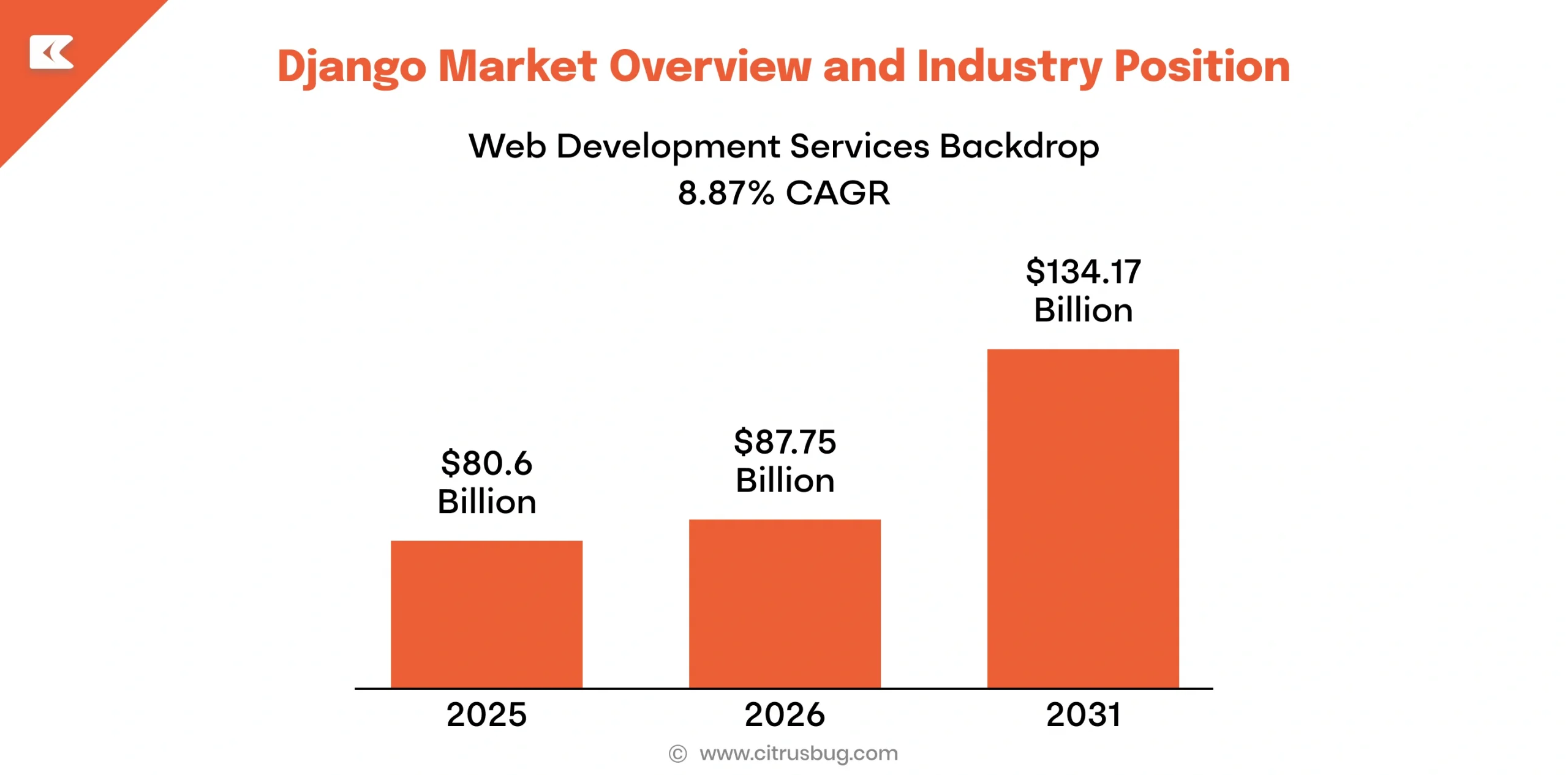
- The web development services market is expanding at a CAGR of 8.87% through the 2026 to 2031 forecast window, providing a stable trajectory for Python and Django-led project pipelines.
- Inside Python tooling specifically, the Python web frameworks software market stood at $8.7 billion in 2025, with Django carrying a meaningful share of full-stack deployments inside that pool.
Full-Stack Framework Segment Leadership
Full-stack frameworks continue to be the most adopted category in Python web development, and Django sits at the head of that segment for production teams that need built-in admin tools, ORM support, authentication scaffolding, and routing out of the box.
- Full-stack offerings captured 42.3% market share of the Python web framework space in 2025, with Django driving most of that segment’s commercial footprint and developer attention.
- The lead over microframework and asynchronous-only alternatives shows how production teams gravitate toward batteries-included tooling that shortens time-to-deployment for enterprise builds.
Django’s Tracked Market Footprint
Beyond category-level data, Django’s own usage signal is visible through tracked technology adoption indicators that capture how many production stacks include it today.
- Django holds an estimated 32.24% market share among tracked web frameworks entering 2026, placing it near the front of the broader web framework category.
- This share level explains why Django usage statistics remain a benchmark reference for enterprise architecture teams evaluating Python backends against javascript and other competing stacks.
Django Adoption and Developer Usage Patterns
Adoption signals for Django are strongest at the developer level, where survey data reveals not just usage rates but how engineers actually configure the framework, which versions they trust, and how they split work between professional and personal projects.
Primary Framework Selection Among Python Developers
Developer surveys consistently rank Django as the dominant Python web framework, both in commercial production and in side-project use, reflecting strong loyalty across experience levels.
- A reported 74% of Python web developers name Django as their primary framework, marking it as the default selection for Python-based web work in 2025.
- Around 70% of Django users build with the framework for both work and personal, educational, or side projects, indicating cross-context loyalty that few competing frameworks command.
Version Adoption and Upgrade Behavior
The Django release cadence is closely followed by working teams, with newer stable releases gaining ground quickly each cycle. Migration discipline is a defining trait of the community.
- Approximately 75% of developers choose the latest stable release when starting a new project, showing strong willingness to adopt current versions rather than lag behind for stability reasons.
- Around 35,774 active companies currently appear as customers across publicly tracked technology adoption indexes. This demonstrates that Django usage statistics translate into measurable enterprise deployments at scale and why many organizations choose to hire Django developers to implement future-ready and efficient web solutions.
Regional Market Share and Growth Insights
Django adoption is geographically uneven, with mature Python ecosystems concentrated in a handful of countries while emerging tech markets contribute the fastest pace of new framework deployments worldwide.
- North America: The region accounts for 28.7% in 2025, supported by a deep base of fintech, SaaS, and AI infrastructure teams that lean heavily on Python backends.
- Asia Pacific: The region leads the Python framework space with 38.5% in 2025, driven by rapid digitization of services and the maturing developer base across India and Southeast Asia.
- United States: The country hosts 11,757, the largest national base of Django deployments and a meaningful contributor to the framework’s commercial footprint.
- India: Around 4,450 currently build on Django, reflecting the country’s position as the second-largest national source of Django implementations and a key talent pool for Python web engineering.
Django usage statistics from these markets continue to shape framework roadmap priorities, with hiring volume and active deployment counts informing how core contributors prioritize features for the next release cycles.
Future Outlook and Forecast Trajectory
Forward-looking data points to sustained expansion across the markets Django operates inside, with both the broader web development industry and the Python framework segment projected to grow throughout the rest of the decade.
- The global web development services market is projected to reach USD 134.17, expanding the addressable revenue pool for Python-led builds and Django-based platforms.
- The Python web frameworks software market is forecast to climb to $16.2 billion over the next decade, providing further runway for Django to retain its category lead.
- Full-stack frameworks alone are anticipated to reach $7.14 billion in segment revenue across the forecast period, reinforcing the durability of Django’s positioning inside the full-stack category.
- Looking further out, Asia Pacific is projected to hold 39.2% of global market share within the Python web framework segment, sustaining its position as the fastest expanding region for Django adoption.
Taken together, these Django usage statistics suggest the framework will keep operating inside a structurally expanding market rather than a stagnant one through the second half of the decade.
Django Market Segmentation Insights
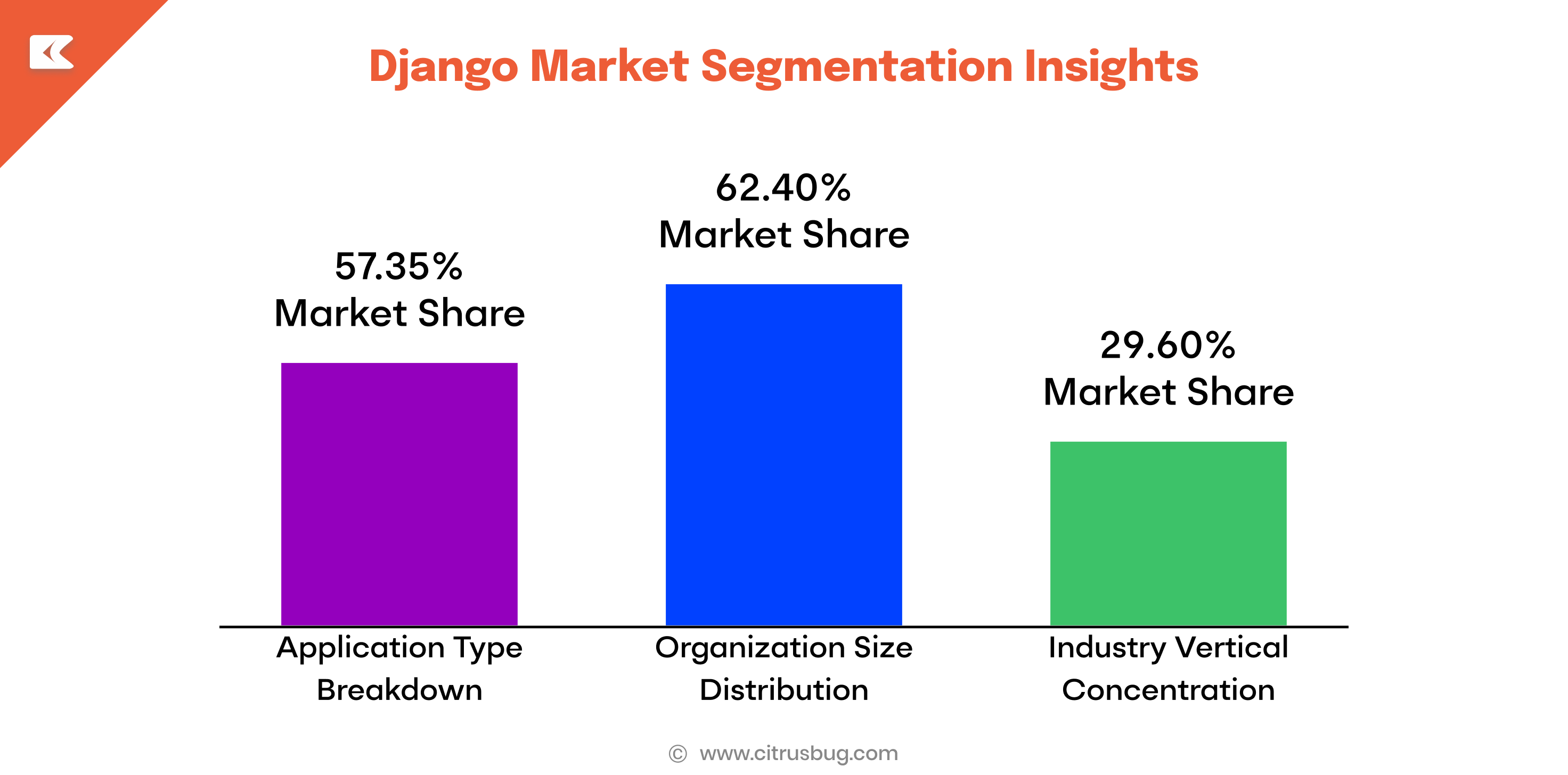
The market that Django operates inside breaks down across application type, organization size, and industry vertical. Each cut reveals where most of the spending and engineering activity concentrates, and helps explain why certain Django configurations are more common than others.
Application Type Breakdown
Web applications continue to absorb the majority of development services revenue, which aligns with Django’s core strength as a server-side framework for content-heavy and transactional builds.
- Web applications led the wider web development services market with 57.35% revenue share in 2025, capturing the dominant slice of project spend across both new builds and modernization work.
Organization Size Distribution
Larger organizations make up a disproportionate share of framework demand because of their need for compliance-heavy, multi-tenant, and integration-heavy systems that Django supports out of the box.
- Large enterprises controlled 62.40% market share of web development services in 2025, reflecting the heavy concentration of Django adoption inside organizations that prioritize maintainability and long-term framework support.
Industry Vertical Concentration
Retail and e-commerce platforms remain a central source of demand for Python web builds, with Django frequently chosen for inventory, catalog, order management, and content services behind storefronts.
- Retail and e-commerce users retained 29.60% revenue share of the web development services market in 2025, sustaining their position as the largest vertical end-user cluster.
Key Emerging Trends Reshaping Web Framework Adoption
The framework landscape around Django is shifting toward delivery models and runtime patterns that emphasize performance, offline capability, and infrastructure abstraction. These trends matter because they reframe what production Python stacks look like over the coming years.
Rise of Progressive Web Applications
Progressive web applications are gaining ground as a delivery format that combines native-like behavior with web-based deployment, and Python backends including Django are a common pairing on the server side.
- The progressive web app segment is growing at a CAGR of 13.45% through 2031, marking it as one of the fastest expanding delivery formats inside the broader web development market.
Acceleration of Serverless Architectures
Serverless deployment patterns are reshaping how Python frameworks ship into production, with cold-start, packaging, and runtime considerations directly informing how Django teams architect new builds.
- Serverless architectures post the highest projected segment growth at a CAGR of 18.10% through 2031, signaling a structural shift in how Python web applications are deployed across enterprise environments.
Core Technical Stack Surrounding Django
The picture of Django usage statistics is incomplete without the surrounding tooling that production teams pair with the framework. Templating, database choice, and integration layers reveal how the framework is actually wired together in real codebases.
Template Engine and Rendering Choices
Server-side template rendering remains a core part of how Django teams build user interfaces, particularly for admin tooling, content portals, and applications where SEO and progressive enhancement matter more than client-side richness.
- Around 83% of Django developers rely on the built-in Django templates engine for rendering, making it by far the most common templating choice across the user base.
Database Stack Preferences
Database selection inside Django projects skews heavily toward open-source relational engines, with PostgreSQL emerging as the dominant choice for new builds because of its feature depth and compatibility with Django’s ORM.
- Approximately 76% of Django teams use PostgreSQL as their primary database, cementing it as the standard relational backend across the Django ecosystem in 2025.
Conclusion
Django remains the dominant Python web framework heading into 2026, supported by deep developer loyalty, strong enterprise adoption, and a market trajectory that points clearly upward across regions. The current set of Django usage statistics shows a framework that has graduated from a popular tool to a default infrastructure choice for production web work.
For teams planning the next phase of their Python backend strategy, the data points toward continued investment in Django-based platforms, modernization of legacy services, and selective adoption of progressive and serverless delivery patterns that increasingly sit alongside the framework. Engaging with a skilled Django development company can help organizations leverage these trends efficiently and deliver robust, scalable web applications.