
 Back
Back







Key Takeaways
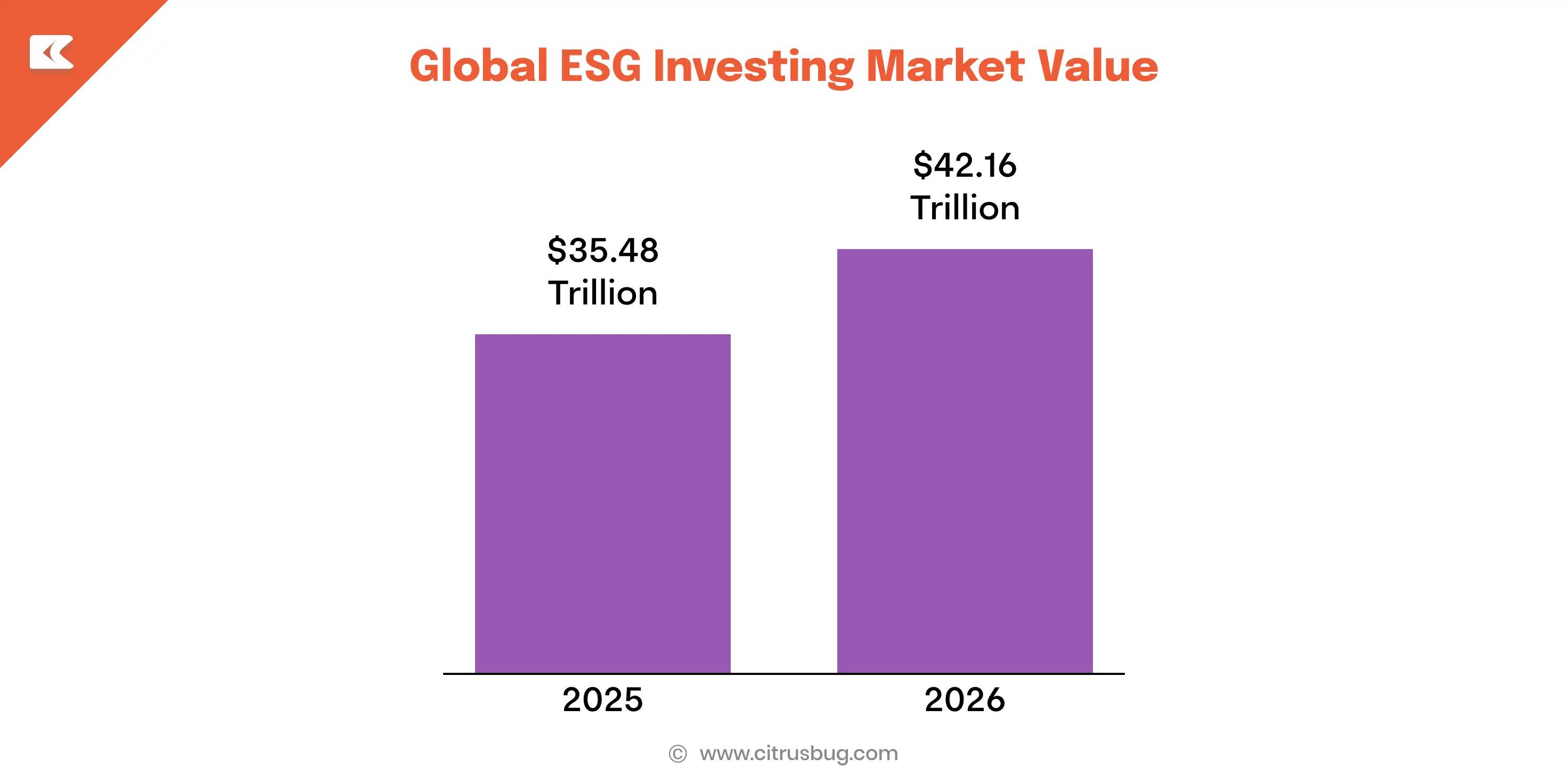
- The global ESG investing market reached $35.48 trillion in 2025 and is projected to climb to $42.16 trillion in 2026.
- 85% of surveyed institutional investors expect their ESG-related assets under management to grow over the next two years.
- Europe leads ESG adoption with 44% global market share, reflecting its longer regulatory history around sustainability disclosure.
- Nearly 48% of organizations cite inconsistent ESG metrics as a key barrier, with 40-50% of global assets still outside disclosure frameworks.
- Individual investor interest in sustainable investing climbed to 92% globally in 2026, with most believing returns and impact can coexist.
Sustainability has moved from a corporate talking point to a core investment discipline. Fund managers, institutional allocators, and individual investors now weigh environmental, social, and governance factors alongside traditional financial metrics when they build portfolios. The ESG investing market reflects this shift. It captures how capital moves toward companies and funds that meet defined sustainability standards.
Regulatory pressure, investor demand for transparency, and growing awareness of climate risk continue to reshape how asset managers allocate capital. Financial institutions across regions now offer dedicated sustainable investment products, expand advisory services, and integrate ESG data into daily decision making. Where this activity stands today, and where it moves next, matters for anyone who tracks the broader direction of global finance.
What Is ESG Investing?
ESG investing is an approach to allocating capital that weighs environmental, social, and governance factors alongside financial performance.
Investors apply ESG criteria to screen companies and funds based on carbon impact, labor practices, and governance standards before committing capital.
This approach matters because it links long-term risk management with investment decisions. Companies with strong governance and lower environmental exposure often face fewer regulatory penalties.
Asset owners increasingly treat ESG factors as a standard part of due diligence rather than a separate ethical consideration.
ESG Investing Market Overview
Capital allocation toward sustainability-linked assets has accelerated across institutional and retail channels alike.
Growth shows up both in headline market valuation and in the broader pool of sustainable fund assets under management.
Global Market Valuation and Growth Rate
Headline figures point to steady, measurable expansion across major asset classes and geographies rather than growth concentrated in one segment.
- Global Market Value, 2025: The market reached an estimated $35.48 trillion in overall value during 2025. That total spans equities, fixed income, and multi-asset sustainable strategies across major economies. This scale places sustainability-linked capital among the largest categories in global finance today.
- Global Market Value, 2026: That figure is projected to climb up to $42.16 trillion in 2026. The gain extends a multi-year growth pattern in sustainability-linked capital allocation among institutional and retail investors alike, and it outpaces growth seen in many conventional asset categories over the same period.
- Long-Term Growth Rate: The market continues to expand at a compound annual growth rate (CAGR) of 18.8% through 2030. That pace outstrips many traditional asset categories and points to sustained structural demand rather than a temporary cycle tied to one economic period.
Sustainable Fund and Investment Assets
Fund-level figures tell a similar story of continued capital commitment to dedicated sustainability vehicles, even as flows shift between individual fund types and regions from quarter to quarter.
- Sustainable Fund Assets: Global sustainable fund assets closed 2025 at roughly $3.9 trillion. That total underscores continued investor commitment to ESG-labeled funds even amid periodic outflows in specific quarters and regions, and fund managers have kept launching new products despite that short-term volatility.
- Broader Responsible Investment Assets: Global sustainable and responsible investment fund assets reached $16.7 trillion, an increase of nearly 49% over the prior two years. New fund launches and rising allocations from large asset owners drove much of that increase, a pace that is unusual for a fund category of this size.
Taken together, these figures describe a market that keeps expanding in both breadth and depth.
New capital continues to enter alongside existing funds that are broadening their own sustainable allocations, and the pattern holds across both public equity strategies and private capital vehicles worldwide, from large pension systems down to smaller boutique asset managers.
ESG Adoption and Investor Usage Patterns
Adoption signals extend beyond market size. Investor sentiment, strategy allocation, and analytics tool usage all point toward deepening engagement with the ESG investing market across institutional and alternative investment channels. These behavioral patterns often move ahead of headline valuation figures rather than trailing them.
Investor Sentiment and Strategy Allocation
Surveyed investors continue to signal confidence that sustainability-linked capital will keep expanding rather than plateau in the near term.
- Institutional Growth Expectations: A large majority of surveyed investors, 85%, expect their ESG-related assets under management to grow over the next two years. That confidence extends across most institutional investor categories rather than a narrow subset of early adopters.
- Hedge Fund Strategy Shift: Within alternative investments, 36% of hedge fund investor interest is now directed specifically toward ESG-focused strategies. That marks a notable shift for a segment once viewed as slow to adopt sustainability screens, and it suggests these criteria are moving into parts of finance built around short holding periods.
Growth in ESG Analytics and Intelligence Tools
Institutional demand for dedicated ESG analytics has grown alongside broader market expansion. Investment teams increasingly rely on specialized platforms to score portfolios, screen holdings, and track ongoing compliance obligations across multiple jurisdictions at once.
- Analytics Spending, 2024: Spending on ESG investment analytics platforms reached $51.28 billion worldwide in 2024. That spending covers tools used for portfolio scoring, risk modeling, and sustainability reporting across asset classes of varying complexity.
- Analytics Spending, 2025: That figure grew further to $57.93 billion in 2025. The gain reflects expanding use of dedicated scoring, screening, and reporting tools across asset managers of varying sizes, with smaller firms appearing to close the gap with the largest institutions.
Investor behavior and technology spending point in the same direction. Confidence in continued growth is translating into real budget commitments for the systems needed to support that growth over the next several years, particularly among firms that manage assets across multiple regions and asset classes at once.
Regional Market Share and Growth Insights
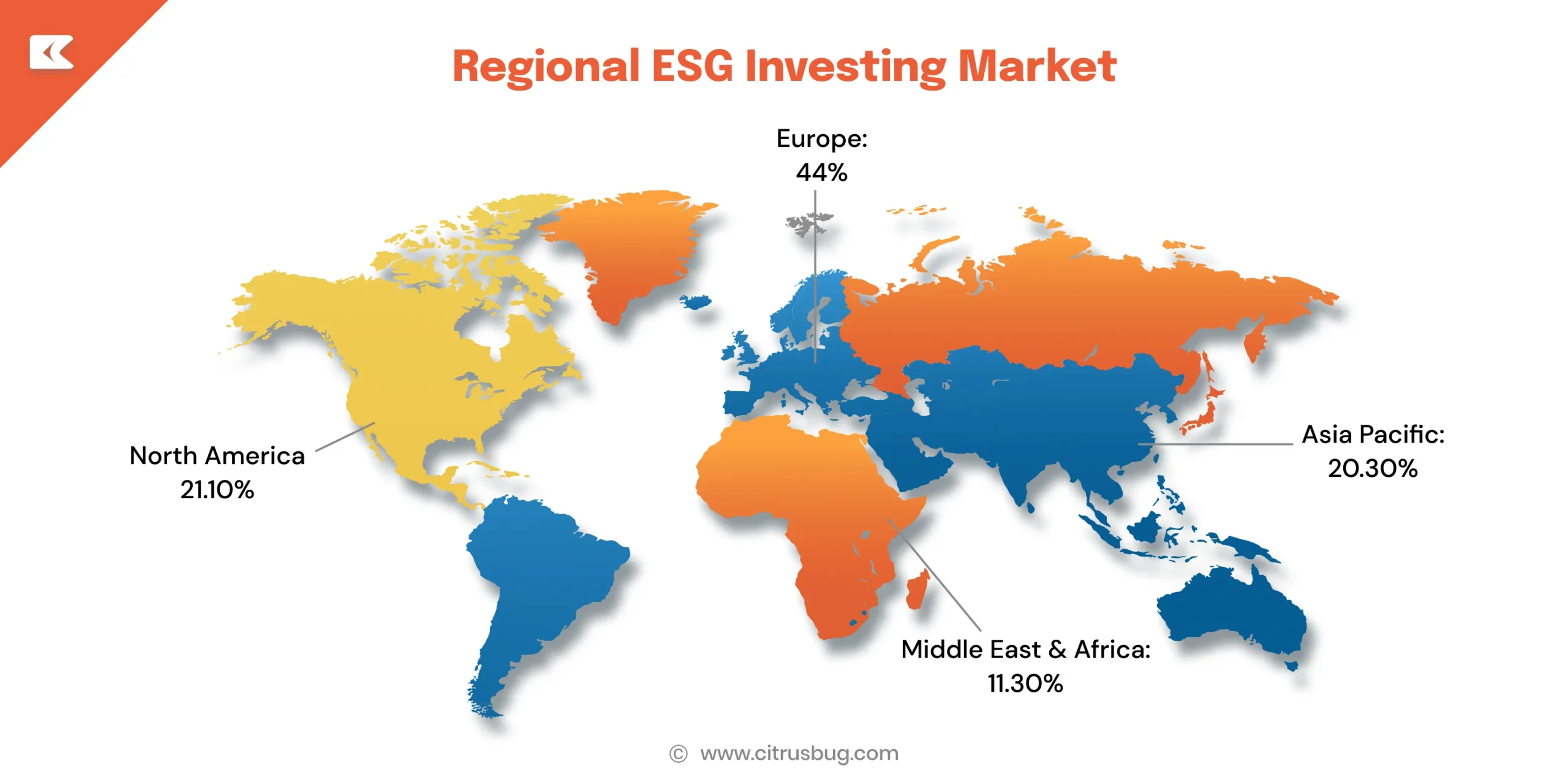
Regional participation in the ESG investing market varies by the maturity of financial regulation and investor demand. Four regions currently account for the large majority of global activity, each shaped by a distinct mix of policy, market structure, and investor preference.
Europe
Europe led global activity in 2025. The region accounted for roughly 44% of the market at an estimated $17.18 trillion in assets. That share is projected to carry the region to approximately $19.97 trillion in 2026.
This lead keeps Europe well ahead of every other region in absolute terms and largely reflects a longer regulatory history around sustainability disclosure and fund labeling.
Asia Pacific
Asia Pacific held close to 20.30% of the global share in 2025, with a market value of roughly $7.93 trillion. Growth is expected to lift the region to nearly $9.49 trillion in 2026.
Expanding digital financial infrastructure and rising participation from domestic asset managers both support that trajectory as local sustainability-linked products continue to launch.
North America
North America accounted for about 21.10% of the market in 2025, valued at approximately $8.24 trillion. Regional value is projected to reach close to $9.46 trillion in 2026.
Institutional mandates continue to build out dedicated sustainability allocations across pension and endowment portfolios of varying sizes throughout the region.
Middle East and Africa
Middle East and Africa represented roughly 11.30% of global activity in 2025, worth an estimated $4.42 trillion. That figure is expected to rise to about $5.21 trillion in 2026.
This pace marks one of the faster relative growth paths among the four regions as sovereign and institutional funds expand sustainability mandates within their existing portfolios.
Across all four regions, growth between 2025 and 2026 holds a broadly similar shape, even where the starting base differs. That consistency points to a global rather than a purely regional demand pattern, one reinforced by shared investor expectations rather than isolated local policy alone.
[Source: Fortune Business Insights]
Capital Distribution Across ESG Investment Categories
Capital within the ESG investing market does not move as a single block. Distinct pools of institutional allocation, financing instruments, professional services, and technology spending each show measurable scale on its own, and each grows at its own pace.
Sustainable and Impact-Focused Strategies
Dedicated sustainability and impact vehicles form one of the fastest-scaling categories within the broader ecosystem.
These vehicles span both public markets and private capital in roughly equal measure, with new products launching across both established and emerging financial centers each year.
- Sustainable Finance Segment: The global sustainable finance segment continues to expand alongside broader market momentum, covering financing instruments tied directly to environmental and social outcomes across corporate and sovereign issuers worldwide.
- Impact Investing Segment: Impact investing, a more targeted subset focused on measurable social and environmental outcomes, continues to draw sustained capital. These assets span both private funds and direct project financing aimed at specific, trackable results rather than broad portfolio screens.
- Dedicated ESG Finance Instruments: The global ESG finance segment covers instruments such as green bonds and sustainability-linked loans. It remains one of the larger dedicated financing channels within the wider category, with issuance continuing to broaden across sectors and geographies.
Advisory and Consulting Services
Demand for outside expertise has grown alongside reporting complexity. That demand supports a distinct advisory and consulting segment separate from direct fund allocation.
- Consulting Segment Value: The global ESG consulting segment reflects steady demand for outside expertise in reporting, disclosure, and compliance work across mid-size and large organizations that lack in-house sustainability teams of their own.
Software and Analytics Platforms
Technology spending forms a third distinct category, separate from advisory work and direct fund allocation, though all three increasingly overlap in practice.
- Software Segment: The global ESG software segment continues to see steady enterprise investment in dedicated reporting, scoring, and compliance tracking platforms used by asset managers and corporate issuers alike, with adoption extending well beyond the largest institutions.
When financing instruments, advisory work, and software spending are viewed together, the broader ecosystem surrounding core allocation continues to expand. That growth shows how much economic activity now sits around the market’s central investment figures.
Key Trends Shaping Sustainable Investment Strategies
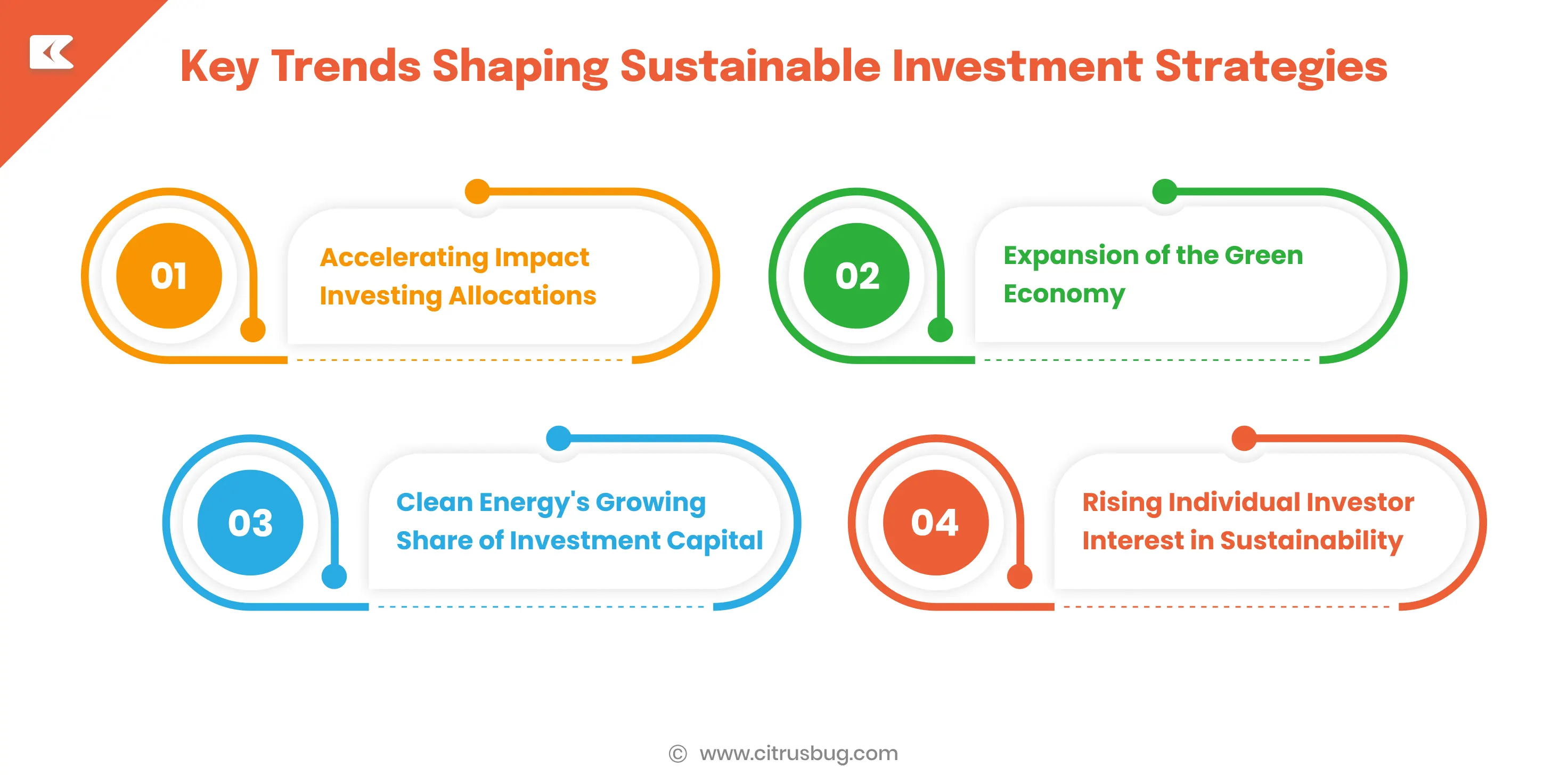
Beyond raw market size, several distinct patterns describe how sustainability-linked capital behaves across regions, asset types, and investor categories over time.
Accelerating Impact Investing Allocations
Impact-focused strategies have expanded at a pace that outstrips many adjacent categories within the wider market. That pattern has held steady across recent years rather than fading after an early surge.
- Impact investing assets under management have expanded at a compound annual rate of 21% over the past six years. That figure includes an 11% jump in the most recent year alone, an acceleration that suggests the category is not simply coasting on earlier momentum.
Expansion of the Green Economy
Activity tied directly to environmental outcomes has grown into one of the larger segments of the global economy rather than a narrow niche confined to specialist finance.
- The global green economy reached a value of $7.9 trillion. That total makes it the second-fastest growing sector worldwide after technology, and few other sectors have matched that combination of scale and growth speed over the same period.
Clean Energy’s Growing Share of Investment Capital
Energy-related allocations within sustainability portfolios continue to tilt heavily toward renewable and low-carbon sources rather than a balanced mix of energy types.
- Clean energy now attracts 64% of total energy-related investment activity. That share reflects a sustained shift away from traditional energy financing toward lower-carbon alternatives across both public and private capital.
Rising Individual Investor Interest in Sustainability
Retail investor enthusiasm for sustainability-linked products continues to climb year over year rather than leveling off after early adoption.
- Rising Interest: Interest in sustainable investing among individual investors climbed to 92% globally in 2026, up from 88% the prior year. That gain spans multiple age groups rather than one narrow demographic segment.
- Belief in Dual Outcomes: More than 80% of individual investors believe strong financial returns and positive sustainability outcomes can both be achieved through the same portfolio. That view has grown more common as track records have lengthened across more market cycles.
Across all four trends, the direction of movement is consistent. Capital, investor sentiment, and sector-level activity are all expanding together rather than pulling in different directions, a pattern that tends to reinforce itself as more performance data becomes available to investors over time.
Challenges and Barriers in Sustainable Investing
Growth in the market has not eliminated structural friction points. A few consistent obstacles continue to surface across investor and organizational surveys, and most center on data quality rather than investor demand itself, which remains strong across nearly every major region.
- Inconsistent Metrics: Nearly 48% of organizations cite the lack of standardized ESG metrics as a key operational constraint. This gap can complicate consistent reporting across portfolios and business units of different sizes.
- Data Integration Gaps: About 38% of firms report difficulty integrating ESG data from multiple sources into existing systems. Many are actively working to resolve this through better tooling and clearer internal processes.
- Disclosure Coverage Gaps: An estimated 40 to 50% of global assets, such as large institutional mandates and private-market holdings, still sit outside formal sustainability disclosure frameworks. That gap leaves a meaningful shortfall in comparable data across the market.
Even so, none of these obstacles appears to have slowed overall growth in the near term, and most organizations describe them as manageable rather than disqualifying.
Future Outlook and Emerging Opportunities
Forward-looking estimates point to continued expansion across most sustainability-linked asset categories through the early part of the next decade. Several distinct growth channels stand out from the broader trajectory rather than moving at a single uniform pace across every asset type and region.
- Overall Market Trajectory: The global market is projected to reach approximately $79.71 trillion by 2030. That trajectory continues the market’s current growth pattern well beyond the current decade, and the projected total roughly doubles today’s figure.
- Institutional Segment Forecast: The institutional investor segment alone is projected to reach $82,844.8 billion by 2033. That segment is expected to grow at a compound annual rate of 18.6% between 2025 and 2030 as pension funds and insurers expand dedicated mandates.
- Global AUM Milestone: Global ESG assets under management are forecast to surpass $40 trillion by 2030. That total represents more than a quarter of projected worldwide assets under management across all strategy types combined.
- ESG Finance Expansion: The global ESG finance segment is expected to reach $16.5 trillion by 2031. Continued growth in dedicated financing instruments such as green bonds and sustainability-linked loans supports that pace, issued by both corporates and governments.
- Advisory Segment Growth: The global ESG advisory segment is projected to climb to nearly $59.59 billion by 2030. That growth reflects sustained enterprise demand for specialized sustainability guidance as regulatory requirements continue to shift.
- Consulting Segment Forecast: The global ESG consulting segment is expected to reach $28.7 billion by 2032. That segment is expected to grow at a compound annual rate of 13% as reporting requirements continue to expand across mid-size organizations.
- Software Segment Momentum: The global ESG software segment is expected to grow at a compound annual rate of 14.3% through 2032. That pace points to continued investment in dedicated technology platforms that support reporting and compliance work.
Together, these projections describe a market where growth extends well past core fund allocation into financing instruments, advisory work, and the supporting technology built around it. Each channel is expanding on its own timeline rather than following a single shared curve, which suggests the broader ecosystem is maturing into several distinct markets rather than one uniform category.
Conclusion
The scale and pace of change across the ESG investing market reflect a broader shift in how capital evaluates risk and opportunity. Institutional commitment, larger fund assets, and wider regional participation all point toward sustainability becoming a permanent fixture of mainstream finance rather than a passing preference.
As reporting requirements grow more complex and investor expectations continue to rise, organizations that build reliable data and analytics capabilities will be better positioned to meet demand. The direction is clear, and the pace shows no sign of slowing.