
 Back
Back







Introduction
Insurance companies are moving quickly to bring generative AI into everyday operations, from claims handling to customer communication. The Generative AI in Insurance Market reflects this shift, capturing how insurers are replacing manual, time-consuming processes with automated systems that read documents, draft responses, and flag risks in real time. Underwriting teams use these tools to summarize policy files faster, while claims departments rely on them to review large volumes of paperwork without added staff.
Executives across the industry increasingly view generative AI as a strategic priority rather than an experimental add-on. Investment plans, governance structures, and customer-facing pilots are expanding across major insurance carriers worldwide, reshaping how insurers price risk, process claims, and communicate with policyholders. This growth is visible in how quickly generative AI tools move from pilot programs into core operational workflows across the sector.
What Is Generative AI in Insurance?
Generative AI in insurance refers to AI systems that produce text, summaries, and recommendations directly from data such as claims forms, medical records, or policy documents. These systems interpret unstructured information and generate outputs that resemble human-written reports and risk assessments.
Insurance carriers use this technology because manual review of claims and policy paperwork consumes significant staff time and often introduces errors. Automating these tasks allows underwriting and claims teams to process higher volumes while maintaining consistency, giving carriers a practical way to manage growing data without expanding headcount.
Generative AI in Insurance Market Overview
Global spending on generative AI tools built for insurance carriers has climbed steadily as underwriting, claims, and customer service functions adopt automation. Valuation figures from the past two years show a market moving from early pilots into sustained commercial deployment, with carriers of every size raising their technology budgets to support these tools.
Global Market Valuation
Enterprise procurement of generative AI insurance technology accelerated sharply between 2024 and 2026. Carriers shifted from isolated department trials toward organization-wide rollouts during this window, and valuation figures track that shift closely.
- The global market reached USD 1,081.61 million in 2024, as claims and underwriting teams began piloting automated document review tools across major carriers.
- Valuation climbed to USD 1.09 billion in 2025 as insurers expanded proof-of-concept projects into production environments. This shift moved generative AI out of innovation labs and into daily claims workflows.
- By 2026, the market is projected to reach USD 1.45 billion, supported by wider adoption of claims automation, underwriting support, and policy servicing tools across mid-size and large carriers alike.
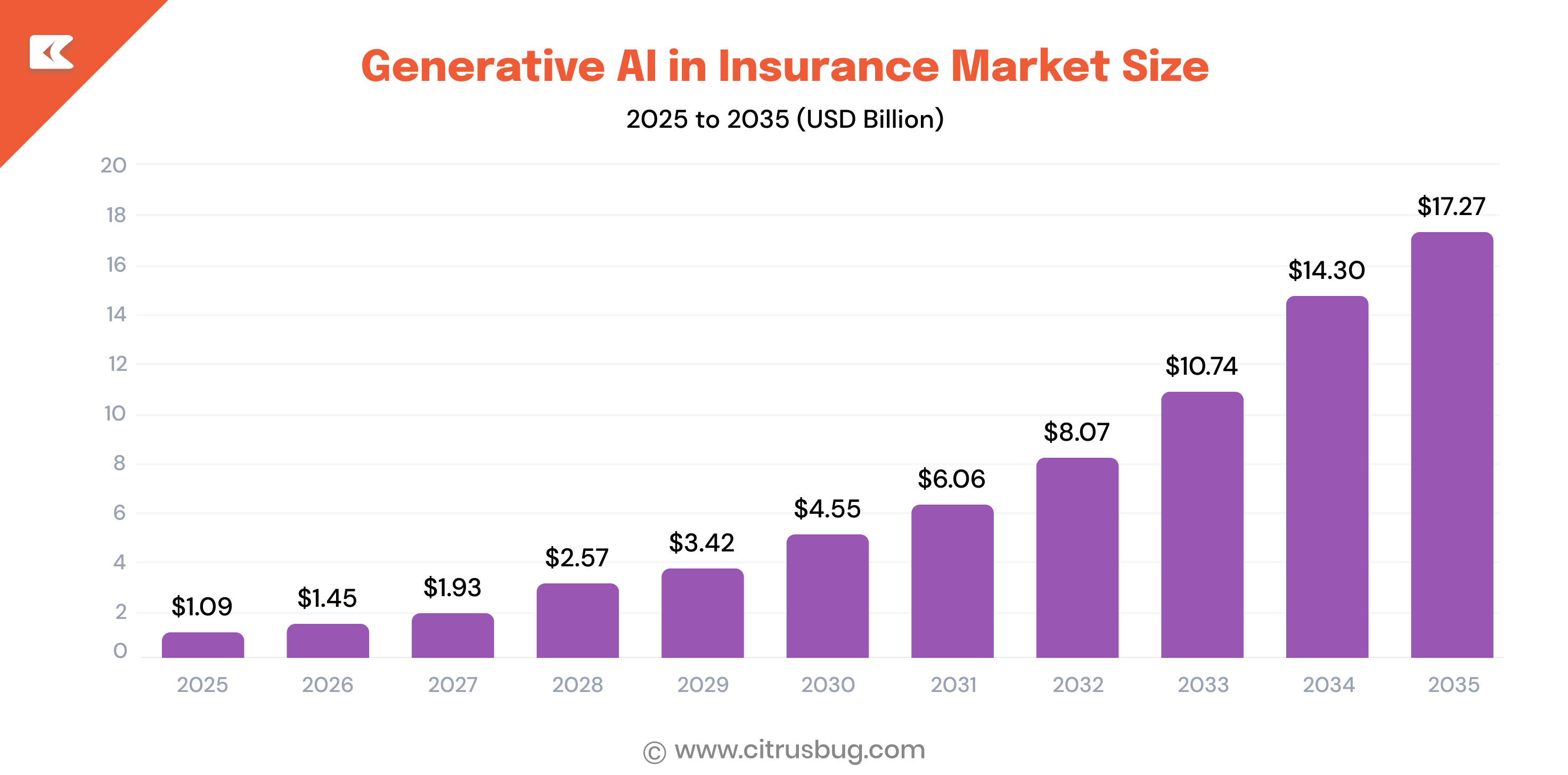
These figures sit inside a broader wave of insurtech statistics, showing technology budgets rising across claims, underwriting, and policy administration well beyond generative AI alone.
Growth Trajectory and Market Momentum
Beyond raw valuation, the pace of growth tells its own story about how central this technology has become to insurance operations. Carriers are no longer treating generative AI as a side project confined to innovation teams.
- The market expanded at a 28.33% CAGR since 2019, a pace that shows insurers moving generative AI from experimental testing into funded, recurring technology budgets rather than one-off pilot spending.
This growth trajectory suggests that carriers view generative AI in insurance market investment as a long-term operational necessity rather than a short-term efficiency project. Budget commitments are increasingly tied to measurable outcomes in claims turnaround time and underwriting accuracy, and that link keeps procurement cycles active even as individual vendor tools mature and consolidate.
Generative AI Adoption and Usage in Insurance
Adoption patterns reveal how insurers are moving past isolated pilot testing into structured, organization-wide deployment. Leadership sentiment and enterprise-level rollout data both point toward accelerating internal usage across claims, underwriting, and customer service functions.
Leadership Sentiment on Generative AI
Executive attitudes toward generative AI often determine how quickly budget and staffing follow behind early pilot programs. Where leadership views the technology as an opportunity, funding tends to move faster through internal approval processes.
- More than half of insurance chief executives, 51% of insurance CEOs, currently view generative AI as a genuine business opportunity rather than a compliance risk. This growing confidence at the executive level often precedes larger technology budget approvals that later filter down into underwriting and claims automation projects.
Enterprise and Deployment Adoption
Deployment choices show where carriers are placing their technology investments as generative AI insurance projects scale beyond initial testing into standard practice.
- Cloud-based deployment now accounts for 72.8% of implementations, as carriers favor faster rollout timelines and lower upfront infrastructure costs over on-premises builds.
- Large enterprises represent 70.3% of current adoption. Carriers with bigger claims volumes and established data infrastructure tend to move first on generative AI insurance technology, ahead of smaller regional carriers.
Together, these figures point to a market where deployment decisions increasingly favor cloud infrastructure and centralized enterprise rollouts over smaller, isolated pilot programs. Mid-size carriers appear likely to follow the pattern already set by larger organizations running production-scale systems.
Generative AI in Insurance Market Regional Market Share and Growth Insights
Regional distribution shows where insurers are investing most heavily in generative AI in insurance market technology right now, with clear gaps between mature and emerging insurance markets.
North America
- North America holds the largest share of the global market at 44% North America market share, with regional market value reaching USD 210.77 million in 2025 as major carriers accelerate claims automation and underwriting AI projects.
United States
- The United States alone accounts for USD 337.64 million of market value in 2025, backed by large national carriers scaling automated underwriting and fraud detection tools across their claims operations.
Europe
- Europe’s market reached USD 105.39 million in 2025, supported by carriers investing in automated compliance documentation and multilingual customer service tools across fragmented national markets.
Asia-Pacific
- The Asia-Pacific region reached USD 84.62 million in 2025, with growth concentrated among carriers modernizing legacy claims systems and expanding digital-first insurance products for younger policyholders.
Middle East & Africa
- Middle East and Africa recorded USD 20.76 million in market value during 2025. This reflects early but growing interest among regional carriers in automated policy servicing and digital claims intake.
These regional gaps highlight how carrier size, existing digital infrastructure, and regulatory readiness continue to shape where generative AI insurance spending concentrates first.
Future Outlook for Generative AI in Insurance
Forecasts through the early 2030s show continued expansion as carriers move generative AI in insurance market projects from department-level tools into core infrastructure investments spanning entire organizations.
Market Value Forecasts Through 2032
Multiple forecast horizons point toward sustained multi-billion-dollar valuation as adoption widens across underwriting, claims, and customer engagement functions industry-wide.
- The market is projected to reach USD 3,776.93 million by 2029, as claims automation and underwriting support tools move from pilot programs into standard operating procedure across major carriers.
- Longer-range forecasts place the market at USD 4.83 billion by 2030, supported by expanding use of generative AI for policy documentation and customer communication across both commercial and personal lines.
- By 2032, projections place market value at USD 14.4 billion as the technology expands into new insurance product lines and additional geographic markets beyond current core regions.
CAGR and Growth Trajectory
Growth rate projections vary by forecast window but consistently point toward strong double-digit expansion through the next several years.
- Between 2024 and 2029, the market is expected to grow at a 28.41% CAGR, driven by expanding claims and underwriting automation budgets across mid-size and enterprise carriers alike.
- A separate forecast window from 2023 to 2032 projects a 34.4% CAGR, a sign of accelerating investment as more carriers move beyond pilot programs into full production deployment.
These projections suggest that generative AI in insurance market spending will keep compounding well past 2030, as carriers integrate automated underwriting, claims processing, and customer service tools deeper into daily operations rather than treating them as standalone technology pilots. Carriers that begin infrastructure planning now are likely to capture efficiency gains earlier than competitors still running exploratory pilots.
Emerging Trends in Generative AI Insurance Adoption
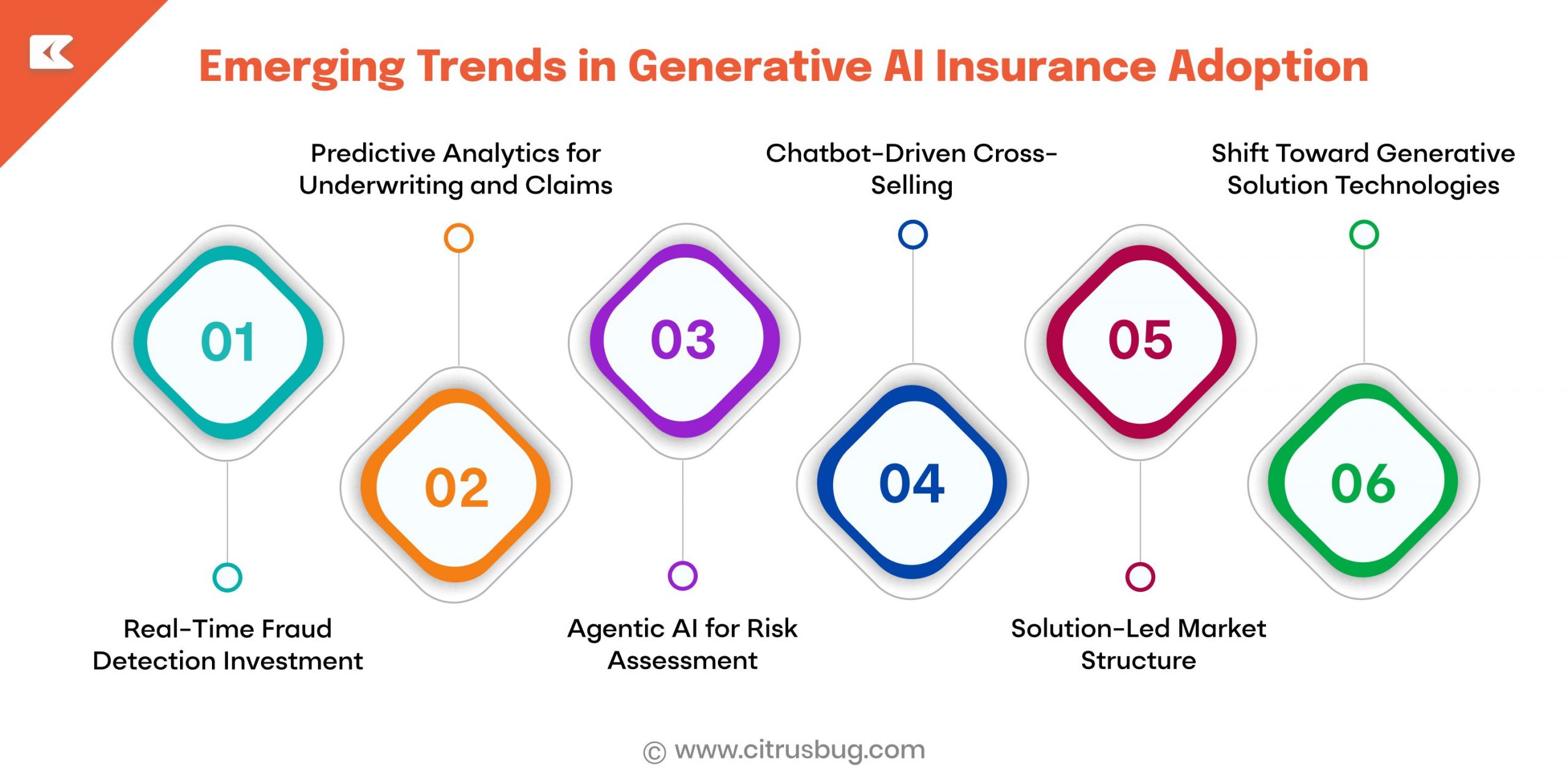
Several distinct patterns are shaping how carriers apply generative AI insurance technology in day-to-day operations, moving well beyond simple chatbots into core risk and underwriting functions.
Real-Time Fraud Detection Investment
Fraud detection has become one of the most heavily funded generative AI applications inside insurance carriers, particularly among commercial and property lines handling high claim volumes.
- Roughly 78% of insurers investing in real-time GenAI fraud detection are building tools that use pattern recognition to flag suspicious claims before payout, reducing losses tied to staged or exaggerated claims.
Predictive Analytics for Underwriting and Claims
Underwriting teams are turning to predictive tools to speed up risk evaluation without sacrificing accuracy on complex commercial policies.
- About 74% of insurers prioritizing predictive analytics for underwriting and claims decisions are using generative models that summarize risk factors faster than manual review allows, shortening quote turnaround times.
Agentic AI for Risk Assessment
A newer category of tools is extending generative AI beyond text generation into semi-autonomous decision support for risk teams.
- Close to 69% of insurers focusing on agentic AI on risk assessment and mitigation are directing development toward tasks that once required a dedicated risk analyst working through spreadsheets and historical loss data.
Chatbot-Driven Cross-Selling
Customer service chatbots are increasingly being repositioned as revenue tools rather than pure support channels.
- About 68% of insurers investing in chatbots for cross-selling are using routine service interactions, such as policy renewals, as opportunities to present relevant add-on coverage without additional agent involvement.
Solution-Led Market Structure
The way insurers buy generative AI technology is also shifting, with packaged solutions outpacing standalone consulting engagements.
- The Solution segment holds a 68% revenue share of the broader market, showing that carriers increasingly prefer ready-built platforms over custom-built services requiring long implementation timelines.
Shift Toward Generative Solution Technologies
Beneath the platform layer, the underlying model types insurers rely on are also diversifying beyond basic text generation.
- Generative Adversarial Network based tools account for a 34% revenue share within the broader technology mix, a sign of growing use of synthetic data generation for model training and testing on sensitive claims data.
Taken together, these trends show carriers extending generative AI insurance investment well beyond customer-facing chat tools into fraud prevention, underwriting support, and risk modeling functions that touch core profitability.
Real-World Use Cases for Generative AI in Insurance
Several carriers and technology partners have already moved generative AI insurance projects into live production, offering a clearer picture of practical applications beyond pilot testing. These use cases show how far generative AI development has progressed, moving from experimental chatbots into production-grade claims and underwriting tools.
Automated Document Analysis
A generative AI platform used in claims operations reached 95% accuracy in document analysis, letting claims teams review policy files, medical reports, and repair estimates without manual line-by-line reading. This level of accuracy allows adjusters to focus attention on flagged exceptions rather than routine paperwork, cutting the time spent on straightforward claims.
Workforce Training for AI-Powered Consulting
A large-scale training initiative set a target of training 10,000 consultants on cloud-based generative AI tools to prepare a workforce capable of deploying insurance-specific automation projects at scale. This kind of investment signals how seriously technology partners treat long-term demand for implementation support in the sector.
Automated Claims Summarization
Claims departments use generative AI to condense lengthy incident reports, medical records, and repair estimates into short summaries that adjusters can review in minutes rather than hours. This reduces the manual reading burden during high claim volume periods, such as after severe weather events, without requiring additional temporary staff.
Health insurers in particular are extending this into dedicated health insurance software development projects, using generative AI to summarize medical records and speed up claims adjudication for complex care cases.
Personalized Policy Recommendations
Some carriers use generative AI to match customer profiles against available coverage options, generating tailored policy suggestions during the quoting process. This helps agents present relevant add-on coverage without manually cross-referencing multiple product catalogs, shortening the gap between initial inquiry and bound policy.
Virtual Customer Support Agents
Generative AI powers virtual agents that answer policy questions, process simple claims updates, and route complex cases to human representatives when needed. These systems handle routine inquiries around the clock, freeing call center staff to focus on cases requiring judgment or sensitive customer communication.
Challenges and Barriers in Generative AI Insurance Adoption
Despite strong investment momentum, several adoption barriers continue to slow how quickly generative AI insurance tools reach full customer-facing deployment across the industry.
- Only 29% of policyholders comfortable with GenAI virtual agents currently feel at ease interacting with automated systems, which limits how far carriers can push automated customer service before satisfaction scores decline.
- Just 26% of customers trust the accuracy of GenAI-generated advice, which creates pressure on carriers to keep human reviewers involved in higher-stakes coverage conversations.
- More than half of insurers, according to figures on 56% of insurers governing GenAI teams via centralized model, still manage initiatives through centralized governance, which can slow department-level experimentation and delay smaller-scale use case testing.
These gaps in trust and governance speed explain why many carriers still pair automated tools with human oversight rather than removing manual review entirely from higher-risk workflows.
Conclusion
The generative AI in insurance market is moving from scattered pilot projects into structured, budget-backed deployment across underwriting, claims, and customer service. Rising executive confidence, expanding cloud-based rollouts, and steady regional investment all point toward a technology that insurers now treat as core infrastructure rather than an experimental add-on.
Trust gaps and governance structures still shape adoption speed, but the underlying trajectory remains upward. As insurance software development continues to evolve alongside generative AI, carriers building well-governed AI systems now stand to gain in claims speed, underwriting accuracy, and customer retention as the market matures.