
 Back

Key Takeaways
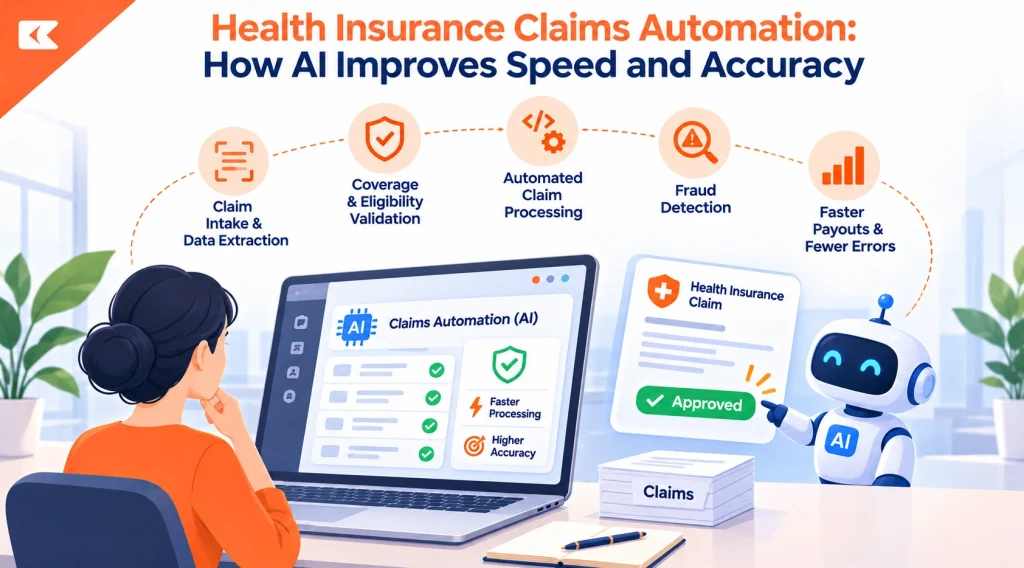
- Health insurance claims automation has two sides. Providers automate coding, claim validation, and denial prevention. Payers automate intake, adjudication, and payment integrity.
- Speed and accuracy are both measurable. Track turnaround time, auto-adjudication rate, clean claim rate, denial rate, and appeal overturn rate against your own baseline.
- AI can safely automate approvals, routing, and data checks. Adverse medical-necessity decisions belong with licensed clinicians, and California law already requires this.
- The rules are moving fast. Federal prior authorization deadlines took effect in 2026, and payer API requirements follow on January 1, 2027.
- Start narrow. Fix intake data, automate one rules-based step, add AI with a review queue, then measure.
Health insurance claims automation is the use of rules engines, robotic process automation (RPA), and artificial intelligence (AI) to move claims through intake, validation, adjudication, and payment with minimal manual work. Exceptions still go to people. Done well, it makes claims faster and more accurate. Done badly, it produces fast denials that end up in front of regulators.
This guide covers both sides of the claim: the provider that builds it and the payer that decides it. It shows where AI fits, which metrics prove it works, and where a licensed human still has to decide. It is general guidance, not legal advice.
What Is Health Insurance Claims Automation?
Health insurance claims automation replaces manual claim steps with software that applies rules, reads documents, and predicts outcomes. The goal is a claim that is correct the first time and decided without anyone retyping it. It covers both the provider, which builds and submits the claim, and the payer, which decides and pays it.
Both sides meet at the same electronic data interchange (EDI) transactions. Those transactions follow the X12 standard published by the Accredited Standards Committee X12 (ASC X12).
| Stage | Provider automates | Payer automates | Shared standard |
|---|---|---|---|
| Eligibility | Real-time coverage checks at registration | Eligibility and benefits responses | X12 270/271 |
| Prior authorization | Request assembly from clinical notes | Criteria review and routing | X12 278 or FHIR API |
| Claim | Coding, claim generation, validation | Intake, edits, adjudication | X12 837 |
| Payment | Payment posting, denial follow-up | Pricing, payment, remittance | X12 835 |
| Disputes | Appeal drafting and tracking | Appeal review | Payer portals |
Federal rules from the Centers for Medicare & Medicaid Services (CMS) require impacted payers to support Fast Healthcare Interoperability Resources (FHIR) application programming interfaces (APIs) for prior authorization exchange starting in 2027. X12 remains the standard for claims and payments.
The Four Types of Automation in Claims
Engineering texts list four types of automation: fixed, programmable, flexible, and integrated. In claims work, a more useful split is:
- Rules engines apply benefit, contract, and coding edits. They are deterministic and easy to audit.
- RPA copies clicks between systems that lack an API, such as payer portals. It breaks when screens change.
- Workflow automation routes work items, sets deadlines, and escalates.
- AI reads unstructured documents, suggests codes, and scores risk. It is probabilistic, so it needs thresholds and review.
Most production claims systems combine all four approaches. AI sits on top of the rules engine. It does not replace it.
How a Health Insurance Claim Moves Today, and Where It Breaks
A claim passes through about eight steps, and most delays come from data that was wrong or missing at the start. Every handoff is another chance for a field to fail an edit.
- Check eligibility and benefits.
- Obtain prior authorization, where required.
- Capture charges and code the encounter.
- Generate and validate the claim.
- Submit the claim through a clearinghouse.
- Receive and adjudicate the claim (payer).
- Pay the claim and send the remittance (payer).
- Follow up on denials and appeals.
Electronic claims transactions have already reduced administrative costs across the US healthcare system. The 2025 CAQH Index estimated that electronic transactions helped avoid $258 billion in administrative costs in 2024. Yet another $21 billion in potential savings remained from fully automating manual and partially manual transactions, according to the same February 2026 release.
Administrative efficiency, however, does not eliminate claim errors or denials. KFF’s analysis of federal data found that insurers on HealthCare.gov denied 19% of in-network claims in 2024, with rates ranging from 3% to 36% across insurers. Administrative issues accounted for 25% of reported denial reasons, compared with 5% attributed to lack of medical necessity.
Provider-side data points to similar problems upstream. In Experian Health’s 2025 State of Claims survey of 250 healthcare professionals, 41% of providers reported denial rates of 10% or higher. Respondents identified missing or inaccurate data (50%), authorization issues (35%), and patient registration errors (32%) as leading causes of denials.
These findings point to a practical opportunity for health insurance claims automation: catch incomplete data, eligibility mismatches, authorization gaps, and coding errors before submission, while helping payers apply adjudication rules consistently. Preventing avoidable errors early can reduce rework, shorten payment cycles, and leave fewer claims requiring manual intervention.
How Is AI Used in Health Insurance Claims Processing, Step by Step?
AI is used at nearly every step of a claim, but its job changes by step. Early on, it reads and checks data. Later, it suggests codes, scores risk, and drafts appeals. The use of artificial intelligence for health insurance claims automation works best when each model has one narrow task.
Step 1: Claim Intake and Intelligent Document Processing
Payers still receive paper claims, faxes, and PDF attachments. Intelligent document processing (IDP) uses optical character recognition (OCR) and language models to extract fields and classify documents. Low-confidence fields go to a reviewer with the source page attached.
Step 2: Eligibility, Benefits, and Prior Authorization
Automated eligibility checks catch coverage problems before service, when they are cheapest to fix. For prior authorization, AI can match clinical facts from notes to the payer’s criteria. Requests that do not clearly meet criteria go to a clinician.
Step 3: AI-Driven Coding Assistance
AI-driven coding assistance reads clinical documentation and suggests diagnosis codes, procedure codes, and modifiers. Diagnosis codes come from the International Classification of Diseases, 10th Revision, Clinical Modification (ICD-10-CM). Procedure codes come from Current Procedural Terminology (CPT) or the Healthcare Common Procedure Coding System (HCPCS).
Coding assistance exists to catch under-coding and over-coding before a claim leaves the building. A certified coder still confirms the codes, because the provider is accountable for them.
Step 4: Claim Generation and Claim Validation (Scrubbing)
Automated claim generation builds the claim directly from charge data and the electronic health record (EHR), which removes keying errors and speeds submission. Claim validation, often called scrubbing, is the step where AI algorithms check the generated claim for errors. It runs after claim generation and before submission to the clearinghouse or payer.
Validation applies payer-specific edits, checks code pairs and modifiers, and flags missing documentation. This validation layer sits at the core of any well-built healthcare claim management software. Rules catch known errors. Models catch patterns the rules miss.
Step 5: Auto-Adjudication and Pricing
On the payer side, auto-adjudication applies benefit rules, contract pricing, and coordination of benefits (COB) to decide a claim with no manual touch. The industry also calls this straight-through processing. AI predicts which pending claims can be safely released and routes the rest to the right examiner.
Step 6: Fraud, Waste, and Abuse Screening
Payment integrity models compare a claim against provider history and peer patterns to flag duplicates, unusual billing, and likely errors. A flag should hold a claim for review or trigger a records request. It should not deny the claim on its own. Our guide to AI in insurance fraud detection covers these models in more detail.
Step 7: Predictive Analytics for Denial Management
Predictive analytics for denial management scores each claim’s denial risk before submission, names the likely reason, and sends the claim back for correction. The point is prevention, not faster rework. After submission, the same models help teams decide which denials to appeal first.
In the feature extraction step, denial prediction models typically weigh:
- Payer, plan, and product
- Coverage status on the date of service
- Diagnosis and procedure codes and modifiers
- Prior authorization status
- Provider, specialty, and place of service
- Billed amount
- Documentation completeness
- Time to submission against timely filing limits
- Historical denial rate for that payer and code combination
Step 8: Appeals, Payment, and Communication
AI can assemble appeal packets, draft letters for staff review, and post electronic remittance advice (ERA) automatically. A person signs off on anything that goes out as a decision.
How Does AI Improve Speed and Accuracy? The Metrics That Matter
AI improves speed by removing manual touches and improves accuracy by catching errors before a decision is made. An automation rate alone proves neither. A system that denies faster but loses more appeals is less accurate, not more efficient. Track these metrics together:
| Metric | What it Measures | How AI moves it | Reference Point |
|---|---|---|---|
| Turnaround time | Time from request or submission to decision | Routes complete items straight through | CMS-0057-F caps prior authorization decisions at 72 hours expedited and 7 days standard for Medicare Advantage, Medicaid, and the Children’s Health Insurance Program (CHIP) |
| Auto-adjudication rate | Claims decided with no manual touch | Releases safe pended claims | Your own baseline |
| Clean claim rate | Claims accepted on first submission | Scrubbing and coding checks | Your own baseline |
| Denial rate | Share of claims denied | Pre-submission denial prediction | 19% in-network on HealthCare.gov, 2024 (KFF) |
| Appeal overturn rate | Appealed denials that are reversed | Better evidence at the first decision | HealthCare.gov insurers upheld 66% of 2024 internal appeals (KFF) |
| Manual touches per claim | Human steps per claim | Document intake, routing, auto-posting | Your own baseline |
Auto-adjudication rate tells you how fast the system is. Overturn rate tells you how right it is. A rising denial rate paired with a high overturn rate means the model is denying claims it should not.
From our delivery work, one habit matters most: audit a sample of auto-decided claims every month, and report accuracy next to speed.
Claims Automation Results: Published Case Studies
We worked with Ember, a US AI revenue cycle platform, to build pipelines that combine clinical notes with billing records. The team also developed natural language processing (NLP) coding models and a scoring engine to flag risky claims before submission. Results reported after the six-month engagement included a 47% reduction in initial claim denials, a 35% decrease in claims processing time, and a 28% increase in clean claim rate.
For Anterior’s prior authorization platform, which automates reviews for US health plans, Citrusbug Technolabs combined large language model (LLM) summarization with rules engines and human review. Anterior reports 99.24% agreement with medical-necessity criteria and a 76% increase in auto-approvals. It also reports a 60% reduction in turnaround time across more than one million authorizations annually.
Payers have also developed AI tools internally. In 2019, Aetna described an NLP tool designed to resolve complex-contract claims overnight, with projected annual savings of $6 million in processing and rework. Although this is an older example, it illustrates how AI can target specific, resource-intensive steps in claims processing.
All figures in this section are client-reported or company-reported.
Is AI Denying Healthcare Claims?
Investigative reporting and lawsuits allege that some insurers used automated systems to deny claims with little or no human review, and the insurers dispute those allegations. Regulators have responded by requiring human judgment and faster, explained decisions. The question for builders is where AI may decide.
Legal challenges have also raised concerns about automated claim denials. A class action filed against Cigna in July 2023 alleged that the insurer used automated systems to deny claims without adequate individual review. These remain allegations, not established findings of wrongdoing.
Physicians have also raised concerns about AI in coverage decisions. In a February 2025 American Medical Association (AMA) survey, 61% of physicians said health plans’ use of AI was increasing prior authorization denials. Respondents reported handling an average of 39 prior authorizations per week, requiring 13 hours of physician and staff time. AMA President Bruce A. Scott, M.D., criticized automatic AI-driven denials, saying they were not the reform physicians and patients wanted.
Four federal and state measures, now in force or in testing, shape where AI may decide:
| Rule | Who it Covers | What It Requires | Timing |
|---|---|---|---|
| CMS-0057-F fact sheet | Medicare Advantage, Medicaid and CHIP, federal exchange plans | Prior authorization decisions in 72 hours or 7 days with a specific denial reason; exchange plans exempt from the timeframes; drugs excluded | Decision rules from Jan 1, 2026; APIs from Jan 1, 2027 |
| California Senate Bill 1120 (SB 1120) | California health plans and disability insurers | Medical-necessity decisions by a licensed physician or qualified health professional, not an AI tool alone | Effective Jan 1, 2025 |
| National Association of Insurance Commissioners (NAIC) AI Model Bulletin (adoption map, PDF) | Insurers in adopting states | Governance and risk controls for AI systems | Adopted by NAIC Dec 4, 2023; state adoption varies |
| CMS WISeR Model (Wasteful and Inappropriate Service Reduction) | Selected traditional Medicare services in six states | Prior authorization with technology-assisted review; non-affirmations need a human clinician | Jan 1, 2026 to Dec 31, 2031 |
State-level protections continue to evolve, with laws addressing human oversight, individualized clinical review, and disclosure of AI use. Requirements vary by state and coverage type, and proposed federal policies could affect how some state protections apply. KFF’s May 2026 review summarizes the current landscape and the policy questions still under debate.
For teams building claims automation systems, the practical implication is that AI should not be treated as an unrestricted decision-maker. Systems need clear decision boundaries, traceable reasoning, appropriate clinical review, and documented escalation paths for complex or disputed cases. Automation can speed up routine processing, but coverage decisions must still meet the applicable legal, contractual, and clinical requirements.
Where Must Humans Stay in the Loop?
Humans must stay in the loop wherever a decision is both adverse and clinical. The design we recommend is asymmetric: let AI approve, route, and prepare, and send any adverse medical-necessity decision to a licensed clinician with the evidence attached. We call this “automate approvals, review denials.”
| Decision | AI May | Human Role | What to Log |
|---|---|---|---|
| Clean claim that meets contract rules | Approve and pay | Monthly sample audit | Rule and model version |
| Missing data or attachments | Hold and request | Staff resolve exceptions | Request and response |
| Code suggestion | Suggest only | Certified coder confirms | Suggested vs final code |
| Prior authorization that meets criteria | Approve | Spot-check | Criteria matched |
| Possible medical-necessity denial | Recommend and summarize | Licensed clinician decides | Evidence, reviewer, reason |
| Suspected fraud | Flag and hold | Investigator decides | Signals that fired |
When I review a claims AI design, I look at the denial path first. If a model can deny without a named reviewer, the design is wrong, whatever its accuracy score. Our guide to AI automation in healthcare gathers practitioner views on where human oversight still matters.
Is AI Replacing Medical Billing and Claims Staff?
No. AI removes repetitive work, but demand for the people who code, bill, and manage records is still growing. The US Bureau of Labor Statistics projects employment of medical records specialists to grow 8% from 2025 to 2035, with about 14,000 openings a year.
What changes is the work inside billing and claims roles. Keying and status calls give way to exceptions, appeals, audits, and reviewing model outputs.
AI Claims Automation Software for Health Insurers: What to Look For
Good AI claims automation software for health insurers explains every decision, connects to your core admin system and EDI flows, and lets your team change rules without a release. Use this checklist to compare claims processing software or scope a custom build:
- Explainability: each automated decision shows the rules and evidence behind it.
- Configurable rules: benefit, contract, and payer edits change without a code deployment.
- Confidence thresholds: you decide what auto-processes and what goes to review.
- Standards coverage: X12 837, 835, 270/271, 276/277, and 278, plus FHIR APIs.
- Audit trail: inputs, model version, output, and human action logged per claim.
- Monitoring: accuracy, overturn rate, and model drift tracked after launch.
- Security: encryption, role-based access, and a signed business associate agreement (BAA).
- Data ownership: your claims data and trained models stay yours.
One caution: the Health Insurance Portability and Accountability Act (HIPAA) has no certification, and the US Department of Health and Human Services (HHS) does not recognize private certifications for the Security Rule. If a product is described as “HIPAA certified,” ask for its specific safeguards and a signed BAA instead.
We build claims automation for health plans, third-party administrators (TPAs), and the platforms that serve them. Our health insurance software development engagements start with discovery: benefit configuration, payer rules, X12 837 and 835 flows, and where claims pend today. We then design the adjudication rules engine, the AI models for document intake and risk scoring, and the human review queues those models feed.
Audit logging, role-based access, and HIPAA safeguards go into the architecture from the first sprint. After go-live, we monitor model accuracy and update rules as payer contracts change.
Build, Buy, or Outsource Claims Automation?
Build when your rules or product are your advantage, buy when your process is standard, and outsource when volume swings or staff are short. Whichever you choose, accountability for coverage decisions stays with the plan, so adverse medical-necessity decisions and model governance stay in-house.
| Factor | Build | Buy | Outsource |
|---|---|---|---|
| Best fit | Unique products, complex contracts, platform companies | Standard workflows on a supported core system | Variable volume, staffing gaps |
| Time to value | Longest | Medium | Fastest to start |
| Control of rules and models | Full | Limited to configuration | Low |
| Compliance accountability | Yours | Yours, with vendor controls | Still yours |
| Cost model | Upfront build, then maintenance | Recurring license fees | Per transaction or per full-time equivalent (FTE) |
| Main risk | Delivery and talent | Lock-in and roadmap fit | Quality and data access |
Keep these in-house whatever your model: adjudication and medical policy, adverse medical-necessity decisions, final appeal decisions, and model governance. Good candidates for health insurance claims automation outsourcing are document intake, data entry, eligibility verification, and claim status follow-up.
How to Automate Claims Processing: A Practical Roadmap
Automate claims processing in stages: measure where claims stall, fix the data feeding them, automate deterministic steps, then add AI with human review. Each stage should show a measurable gain before the next starts.
- Map where claims are delayed, denied, or sent for manual review, by payer and claim type.
- Baseline turnaround, auto-adjudication rate, clean claim rate, denial rate, and overturn rate.
- Fix intake data first: eligibility, demographics, and authorization fields.
- Automate high-volume, rules-based steps such as edits, routing, and remittance posting.
- Add AI for one narrow task, such as denial prediction or document intake, with a review queue.
- Govern with thresholds, audit logs, and a named owner for every model.
- Measure monthly, and expand only when accuracy holds.
What Breaks Between Pilot and Production
- Payer companion guides. Each payer adds its own edits on top of X12. A scrubber tuned on one payer’s claims fails on another’s.
- Intake data quality. Missing or inaccurate data is the top cause of denials in Experian Health’s 2025 survey. No model fixes bad inputs.
- Code-set changes. Diagnosis and procedure codes update every year. Models trained on last year’s codes drift quietly.
- Two prior authorization pathways. CMS allows an all-FHIR prior authorization API, but many partners still send X12 278. Plan to support both.
- Review capacity. If thresholds are too strict, review queues grow and the speed gain disappears.
On most projects I scope, the model is not the hard part. The hard part is the payer rules and the data that arrive before the model ever runs.
The Bottom Line on Health Insurance Claims Automation
Health insurance claims automation pays off when it makes claims right the first time, not just fast. Put AI where it removes manual touches, keep licensed people on adverse clinical decisions, and watch overturn rate as closely as speed.
For healthcare organizations looking to reduce administrative work and improve claims accuracy, the right technology starts with existing workflows, data quality, and clear decision rules. Citrusbug Technolabs builds custom healthcare automation solutions that help healthcare teams streamline operations, integrate systems, and automate repetitive processes while retaining appropriate human oversight.
Frequently Asked Questions
In Which Step Are AI Algorithms Used to Validate Generated Claims?
AI algorithms validate generated claims in the claim validation step, also called claim scrubbing, which runs after claim generation and before submission to a clearinghouse or payer. AI and rules check codes, modifiers, eligibility, authorization, and documentation, then return flagged claims for correction.
Which Factors Does AI Use to Predict Claim Denials?
AI denial prediction models typically use the payer and plan, coverage status on the date of service, diagnosis and procedure codes with modifiers, and prior authorization status. They also weigh provider and place of service, billed amount, documentation completeness, timing against filing limits, and the historical denial rate for that payer and code combination.
What Benefit Does Automating Claim Generation Provide?
Automating claim generation builds claims directly from charge capture and electronic health record (EHR) data, which removes keying errors and speeds submission. It also raises the share of claims accepted on the first pass, so billing teams see fewer denials and less rework.
Does CMS-0057-F Apply to Every Health Plan?
No. CMS-0057-F covers Medicare Advantage organizations, Medicaid and CHIP programs and their managed care plans, and qualified health plans on the federal exchanges, but employer-sponsored plans are not impacted payers. Its 72-hour and 7-day prior authorization decision timeframes do not apply to exchange plans, and drug authorizations are excluded.