
 Back
Back







Key Takeaways
- Companies were evaluated on healthcare industry experience, compliance practices, technical capability, and long-term support, not just pricing.
- An HMS development partner should be fluent in HIPAA, HITECH, HL7, FHIR, ICD-10, and CPT, treated as design principles, not checkboxes.
- Integration with EHR, PACS, laboratory, and billing systems is essential; ask for specific case studies, not just a feature list.
- Security review should cover encryption, access controls, audit logging, and secure APIs throughout development, not just at launch.
- Confirm code, infrastructure, and data ownership in writing before signing, since this affects long-term platform control.
Hospitals are under constant pressure to modernize not just to keep up with patient expectations, but to keep departments talking to each other. A well-built hospital management system (HMS), sometimes called a hospital information system (HIS), connects registration, billing, pharmacy, and clinical teams on one platform, automates the routine paperwork, and gives staff real-time access to the information they need at the point of care.
Every healthcare organization runs on different workflows, carries different compliance obligations, and has different long-term technology goals, so the right development partner for one hospital may be the wrong fit for another.
Below, we’ve compiled the leading hospital management system development companies in USA based on healthcare expertise, technical depth, client feedback, industry reputation, and delivery quality.
How We Selected the Best Hospital Management System Development Companies
Building hospital software well requires healthcare knowledge as much as engineering skill. We evaluated each company against criteria that actually predict software quality, long-term scalability, and successful healthcare rollouts:
- Healthcare industry experience: Proven expertise in hospital operations, patient workflows, and the regulatory landscape that shapes HMS development.
- Client reviews and market reputation: Independent review platforms show how consistently a company delivers projects and maintains client relationships over time.
- Technical development expertise: Depth in cloud architecture, enterprise applications, AI, healthcare integrations, APIs, and scalable system design.
- Security and compliance practices: Since HMS platforms handle sensitive patient data, we looked for secure development practices and regulatory compliance built in from the start.
- Customization and scalability: The ability to build flexible systems that keep supporting an organization as it grows, rather than needing a rebuild.
- Innovation and product strategy: Partners who contribute ideas on usability, patient engagement, and long-term product direction, not just code.
- Post-launch support: Ongoing maintenance, enhancements, and responsive technical support after go-live.
Leading Hospital Management System Development Companies in USA
The companies below have demonstrated strong capabilities in healthcare software engineering, enterprise application development, and hospital technology solutions. Each brings a different strength, so it’s worth reading past the ranking to see which profile matches your project.
Compare the Top Hospital Management System Development Companies
| Sr. No. | Company | Clutch Rating | Location |
|---|---|---|---|
| 1 | Citrusbug Technolabs | 4.7 | USA, India |
| 2 | ScienceSoft | 4.8 | McKinney, TX, USA |
| 3 | Scopic | 4.8 | Marlborough, MA, USA |
| 4 | Chetu, Inc. | 4.3 | Sunrise, FL, USA |
| 5 | Intellectsoft | 4.9 | Palo Alto, CA, USA |
| 6 | Taction Software LLC | 4.6 | Cheyenne, WY, USA |
| 7 | DICEUS | 4.9 | Wilmington, DE, USA |
1. Citrusbug Technolabs
Citrusbug Technolabs builds intelligent healthcare software, enterprise-grade platforms, and AI-powered digital solutions for hospitals and healthcare organizations worldwide.
As one of the leading hospital management system development companies in USA, the team specializes in secure, HIPAA-aware HMS platforms that streamline clinical workflows, simplify administrative processes, and support better patient outcomes.
The company has also worked across multiple healthcare verticals, including diagnostics, telehealth, and hospital administration platforms.
What Makes Citrusbug Technolabs Stand Out
What sets Citrusbug apart is how closely its engineering process mirrors real hospital operations. Rather than adapting a generic template, the team studies clinical workflows, patient journeys, and administrative bottlenecks before writing code.
This healthcare-first mindset, paired with strong AI and automation capabilities, results in hospital management systems built around how a facility actually runs.
Their combined US and India presence supports faster, more responsive development cycles without compromising security, data privacy, or long-term platform scalability for growing healthcare organizations.
Location: USA, India
Google Rating: 5.0
Clutch Rating: 4.7
Awards: Clutch, GoodFirms, Upwork, ISO
Hourly Rate: $25 – $49

2. ScienceSoft
With decades in healthcare IT, ScienceSoft has developed hospital management systems for medical organizations and healthcare technology providers across multiple markets.
Its engineering teams design solutions that streamline clinical workflows, improve operational visibility, and integrate cleanly with existing hospital infrastructure from EHR platforms to billing systems.
The company also holds multiple ISO certifications, reflecting its focus on structured, security-conscious development processes.
What Makes ScienceSoft Stand Out
ScienceSoft stands out for treating hospital software as enterprise infrastructure rather than a standalone application.
Its engineers approach every hospital management system with a structured, process-driven methodology honed over decades of enterprise IT work across regulated industries.
This shows in how thoroughly the platform integrates with existing EHRs, laboratory systems, and billing tools rather than operating in isolation. Healthcare organizations working with ScienceSoft typically value the predictability of its delivery process as much as the technical depth behind it.
Location: McKinney, TX, USA
Google Rating: 4.6
Clutch Rating: 4.8
Awards: IAOP Global Outsourcing 100, Clutch Top 1000 recognition, ISO 9001, ISO 27001, ISO 13485
Hourly Rate: $50 – $99
3. Scopic
Scopic builds healthcare software, enterprise applications, and digital health platforms for organizations that need a dependable technology partner.
Its hospital management systems centralize clinical operations, automate administrative tasks, and improve coordination across departments from patient registration to discharge.
The company’s distributed team structure allows it to take on niche integration requirements that many larger firms tend to avoid.
What Makes Scopic Stand Out
Scopic differentiates itself by refusing to treat hospital management system development as a template exercise. Every engagement starts with an in-depth look at how a specific hospital or clinic actually operates, then builds outward from there.
Its globally distributed engineering team brings a wide range of technical specializations, which makes it easier to support unusual integration requirements or niche clinical workflows.
Healthcare organizations with unconventional operational needs often find Scopic more adaptable than larger, more standardized development shops.
Location: Marlborough, MA, USA
Google Rating: 4.1
Clutch Rating: 4.8
Awards: Top 100 Software Companies in USA (Techreviewer, 2026)
Hourly Rate: $50 – $99
4. Chetu, Inc.
Chetu, Inc. develops custom healthcare software and digital transformation solutions for providers of every size, from independent clinics to multi-facility hospital networks.
Its hospital management systems improve operational efficiency, simplify administrative work, and support coordinated care through integrated healthcare technology.
Its broad technology stack coverage makes it a practical option for hospitals running mixed or legacy IT environments.
What Makes Chetu, Inc. Stand Out
Chetu’s advantage lies in the sheer breadth of its in-house technical bench, which spans dozens of technology stacks and healthcare integration types.
This lets the company take on hospital management projects ranging from small clinic tools to multi-facility enterprise platforms without switching vendors mid-project.
Its development teams tend to work close to the client, adapting quickly as requirements shift. For healthcare organizations that expect their needs to evolve during the build, that flexibility is often the deciding factor.
Location: Sunrise, FL, USA
Google Rating: N/A
Clutch Rating: 4.3
Awards: Inc. 5000 (multiple years), Gold Globee Award – Company of the Year, Technology (mentioned in press)
Hourly Rate: N/A
5. Intellectsoft
Intellectsoft brings enterprise software development experience across healthcare, cloud platforms, and digital modernization projects.
Its hospital management systems strengthen operational control, improve patient services, and help healthcare organizations retire outdated legacy processes.
The company frequently works with healthcare organizations undergoing broader digital transformation initiatives beyond just HMS development.
What Makes Intellectsoft Stand Out
Intellectsoft’s strength shows most clearly in hospital modernization projects rather than greenfield builds. The company has built a reputation around migrating healthcare organizations off legacy systems and into cloud-based, API-driven architectures without disrupting daily operations.
Its consulting-led approach means conversations often start with a technology audit before any development begins, which helps hospitals avoid rebuilding around the same structural problems.
Organizations juggling outdated infrastructure alongside new digital transformation goals tend to find this approach particularly valuable.
Location: Palo Alto, CA, USA
Google Rating: N/A
Clutch Rating: 4.9
Awards: Recognized on various Clutch and design directories for enterprise software
Hourly Rate: $50 – $99
6. Taction Software LLC
Taction Software LLC focuses on healthcare software engineering, custom medical applications, and enterprise healthcare technology.
Its hospital management platforms help organizations automate routine operations, improve coordination between departments, and deliver a better patient experience.
Its smaller team size allows for closer day-to-day collaboration throughout the development process.
What Makes Taction Software LLC Stand Out
Taction Software LLC operates more like a specialized boutique than a large development shop, which shows in how closely its team works alongside hospital stakeholders throughout a project.
Rather than handing over a finished product, the company tends to stay involved through iterative feedback cycles, adjusting the hospital management system as clinical and administrative teams identify real-world friction points.
Healthcare organizations that want a hands-on, collaborative build process rather than a hands-off vendor relationship often gravitate toward this approach.
Location: Cheyenne, WY, USA
Google Rating: 4.8
Clutch Rating: 4.6
Awards: Clutch, ISO, Techviewer
Hourly Rate: $25 – $49
7. DICEUS
DICEUS develops enterprise software and healthcare technology platforms for organizations operating in regulated industries.
Its hospital management systems improve information accessibility, automate administrative processes, and give healthcare providers secure, scalable software they can build on.
The company’s experience in regulated sectors gives it a strong foundation for handling healthcare compliance requirements.
What Makes DICEUS Stand Out
DICEUS built its reputation working inside regulated industries, and that shows in how it approaches hospital management system development.
Compliance and data governance aren’t treated as an afterthought bolted onto a finished platform they’re built into the architecture from the earliest planning stages.
Its engineering talent, based largely in Eastern Europe, combines strong technical depth with genuine product thinking, meaning conversations often go beyond feature requests into how a system should actually function. This suits hospitals prioritizing long-term compliance.
Location: Wilmington, DE, USA
Google Rating: 4.7
Clutch Rating: 4.9
Awards: Recognized on Clutch Top provider lists, GoodFirms recognitions
Hourly Rate: $25 – $49
How to Choose the Right Hospital Management System Development Company
Picking the right development partner takes more planning than it looks like at first, mostly because hospital management software touches nearly every operational process inside a healthcare organization. Looking past pricing alone will help you make a better long-term technology investment.
- Define your hospital’s operational priorities first. Decide whether the project centers on patient registration, billing, pharmacy management, laboratory integration, inventory, scheduling, or full hospital administration before you start discussing technical solutions.
- Look for healthcare-specific development experience. Teams with hospital software experience already understand clinical workflows, administrative processes, compliance expectations, and the interoperability requirements that make or break a rollout.
- Evaluate integration capabilities carefully. Your HMS needs to connect cleanly with EHR platforms, laboratory systems, pharmacy software, PACS, and billing applications ask for specific integration case studies, not just a feature list.
- Review security and compliance practices thoroughly. Since hospital systems handle confidential patient data, verify encryption methods, access controls, audit logging, secure APIs, and regulatory compliance throughout development, not just at launch.
- Consider scalability before development begins. Hospital operations expand over time. A scalable architecture lets you add departments, users, and digital services later without rebuilding the platform from scratch.
- Assess long-term collaboration and support. Reliable maintenance, regular updates, responsive communication, and ongoing technical assistance matter as much after launch as they do during development.
Compliance Standards Every Hospital Software Development Company Should Know
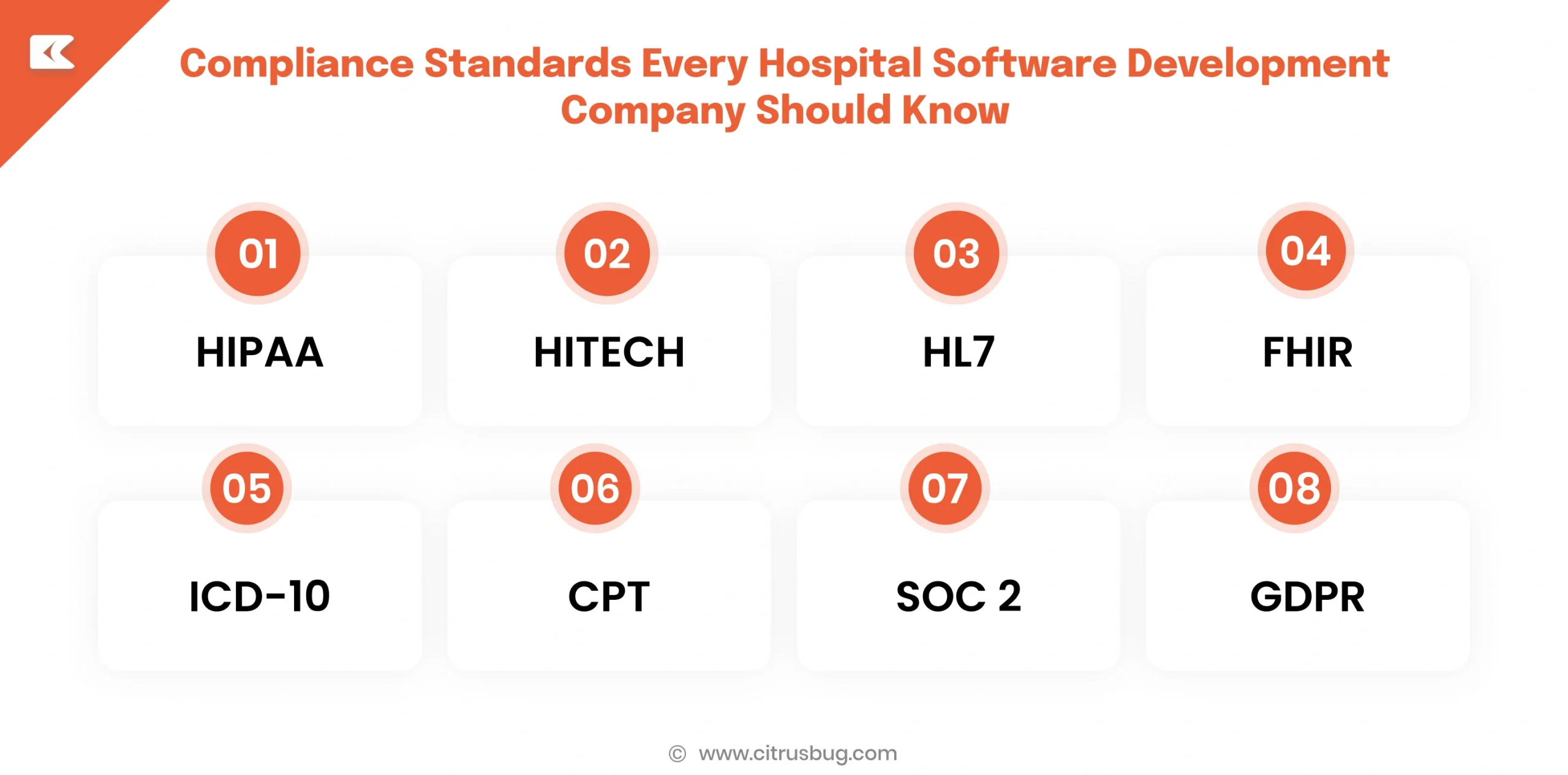
A hospital management system lives or dies on its compliance posture. Before evaluating any development partner’s portfolio, it helps to understand the regulatory and technical standards their engineering team should already be fluent in:
- HIPAA: The Health Insurance Portability and Accountability Act sets the baseline US standard for protecting patient data privacy and security. Any hospital management system handling patient records needs to be built around HIPAA-compliant data handling from day one.
- HITECH: The Health Information Technology for Economic and Clinical Health Act strengthens HIPAA enforcement and encourages meaningful use of electronic health records, directly shaping how EHR-integrated HMS platforms are audited and secured.
- HL7: Health Level Seven is a long-standing messaging standard that lets different healthcare systems exchange clinical data — admissions, lab results, billing — in a consistent format across a hospital’s software ecosystem.
- FHIR: Fast Healthcare Interoperability Resources is the modern, API-based successor to older HL7 messaging, making it easier for hospital management systems to exchange data with EHRs, mobile apps, and third-party healthcare tools.
- ICD-10: The International Classification of Diseases, 10th revision, is the diagnostic coding standard used for medical records and insurance claims. An HMS needs accurate ICD-10 support for clinical documentation and billing accuracy.
- CPT: Current Procedural Terminology codes describe the medical, surgical, and diagnostic procedures performed. Reliable CPT support inside a hospital management system is essential for accurate medical billing and revenue cycle management.
- SOC 2: This audit standard evaluates how a software vendor handles security, availability, and confidentiality of data. A development partner with SOC 2 practices demonstrates disciplined internal controls around sensitive patient information.
- GDPR: The General Data Protection Regulation governs data privacy for EU residents. Hospitals serving international patients, or partnering with vendors operating in Europe, need an HMS development company familiar with GDPR obligations as well as HIPAA.
If a development company can’t speak fluently to these standards, or treats them as a checkbox rather than a design principle, that’s worth treating as a warning sign early in your evaluation.
Questions to Ask Before Hiring a Hospital Management System Development Company
A strong sales pitch isn’t the same as a strong delivery track record. These FAQs help surface the difference before you sign a contract:
Have you built hospital management systems for facilities similar in size and specialty to ours?
Ask for concrete examples and, where possible, references from comparable healthcare settings.
How do you ensure HIPAA, HITECH, and other compliance requirements are addressed throughout development?
Compliance should be built into the architecture from day one, not added right before launch.
Which EHR, PACS, laboratory, or pharmacy systems have you integrated with before?
Prior experience with your specific systems lowers implementation risk and timeline surprises.
What does your post-launch support and maintenance model look like?
Look for clear SLAs, response times, and update commitments rather than vague assurances.
Can you share references or case studies from similar healthcare clients?
Direct references let you verify delivery quality and communication style with past clients.
How is patient data encrypted, stored, and protected against unauthorized access?
The vendor should clearly explain its encryption standards, access controls, and audit logging.
What is your process for handling scope changes mid-project?
A defined change-request process protects both your budget and your timeline as needs evolve.
How do you approach interoperability standards such as HL7 and FHIR?
Native support for these standards makes future integrations and data exchange far easier.
What does a typical project timeline look like from discovery to go-live?
Timelines vary, but the vendor should break the process into clear, milestone-based phases.
Who owns the source code, infrastructure, and data after the project is complete?
Confirm in writing that you retain full ownership of code, infrastructure, and patient data.
Final Thoughts: Choosing the Right Hospital Management System Development Company
Choosing among the leading hospital management system development companies in USA comes down to balancing healthcare expertise, technical capability, security standards, and long-term scalability.
Every healthcare organization has its own workflows and digital priorities, so careful evaluation matters more here than in most software categories.
Use this list, along with the compliance checklist and interview questions above, as a practical starting point while you look for a hospital management system development company that fits your long-term healthcare objectives.