
 Back
Back







Key Takeaways
- The global market reached $7.59 billion in 2024 and is projected to hit $10.3 billion in 2026 at an 11.82% CAGR through 2035.
- Retail investors represent an estimated $80 trillion in potential assets, pushing vendors to build platforms serving individuals and institutions alike.
- Cloud deployment captured 62.32% of the wealth management platform market in 2025, driven by demand for mobile, real-time access.
- Nearly 70% of financial services firms had adopted machine learning by 2026 to sharpen predictive accuracy and flag market anomalies.
- North America leads with 45% global market share, while regulatory reporting demands remain one of the most durable growth drivers.
Financial firms are replacing spreadsheets and manual reporting with dedicated platforms built for portfolio oversight, compliance, and client reporting.
The investment management software market reflects this shift and spans tools used by banks, asset managers, and wealth advisors to track holdings and automate reporting. Cloud delivery and artificial intelligence are reshaping how these platforms are built and sold.
Asset managers now operate across more jurisdictions, asset classes, and client types than they did a decade ago, and legacy systems built for simpler portfolios often cannot keep pace. Vendors are responding with modular, API-first platforms that plug into existing data feeds and scale alongside a firm’s complexity.
What Is Investment Management Software?
Investment management software is a category of financial technology that helps banks, asset managers, and advisory firms track holdings, execute trades, and generate compliance reports from a single platform.
It replaces manual spreadsheets with automated workflows built around live market data. As portfolios span more asset classes, currencies, and regulatory regions, manual processes become slow and error-prone.
This software gives firms a consistent way to monitor risk, satisfy reporting rules, and respond to market moves without adding headcount for every new client or product line.
Investment Management Software Market Overview
Global spending on these platforms has moved past the early-adoption phase into steady, multi-year expansion.
Buyers now range from global custodians running front-to-back operations to boutique advisory shops managing a handful of client accounts, and vendors are pricing and packaging products to fit both ends of that spectrum.
Growth is also becoming less concentrated among a handful of large deals, as more mid-sized firms replace aging in-house tools. The figures below track the market’s current trajectory across recent reporting periods.
Global Market Valuation and Growth Trajectory
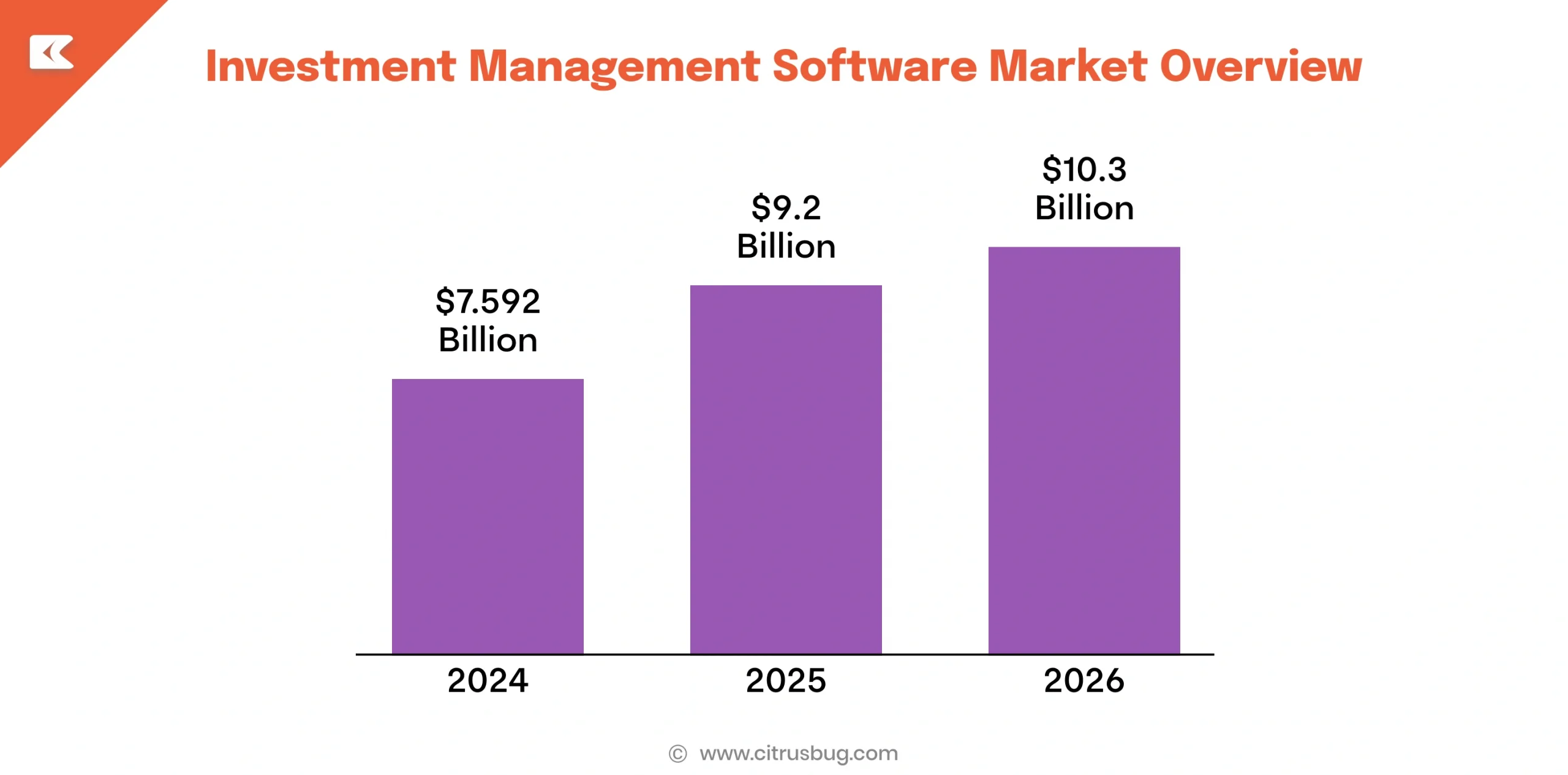
Global market value reached USD 7.592 billion in 2024 and continues to expand at an 11.82% compound annual growth rate through 2035, a pace that reflects steady replacement of legacy systems rather than a short-term spike in spending.
Vendors are using this stretch of predictable demand to invest in longer product roadmaps instead of reacting to quarter-to-quarter budget swings.
Market size climbed to more than USD 9.2 billion in 2025, with an estimated USD 10.3 billion projected for 2026. This pace shows that growth has held up even as broader technology budgets face closer scrutiny, and it suggests investment management tools are increasingly viewed as essential infrastructure rather than a discretionary upgrade.
Year-on-year growth measured 13.50% in the most recent annual comparison. The pace reflects steady demand across asset managers of every size, and smaller firms appear to be contributing a growing share of new purchases rather than large institutions alone.
Rising Investor Participation
Beyond institutional demand, individual investors are becoming a meaningful growth driver in their own right. This shift is pushing software providers to design tools that work for both a multi-billion-dollar pension fund and a single retail account, often within the same underlying platform.
Retail investors now represent an estimated USD 80 trillion in potential assets worldwide, a scale that is pushing vendors to build platforms serving individual clients alongside large institutions.
Reaching this segment typically means simpler onboarding, lower account minimums, and mobile-friendly reporting rather than the dense, terminal-style interfaces built for institutional trading desks.
Adoption and Usage Statistics
Firms adopting new platforms within the investment management software market increasingly favor cloud-first pilots over full on-premises rollouts.
Adoption also varies sharply by firm size and by how digitized a team’s existing workflow already is, which shapes how vendors structure onboarding and pricing tiers.
Firms that already run other cloud-based finance tools also tend to move faster through evaluation and procurement.
Enterprise and Asset Manager Uptake
Small and medium-sized enterprises accounted for around 38% of global adoption in 2024, driven by subscription-based platforms priced for smaller teams that cannot justify a large upfront licensing fee.
This segment tends to prioritize quick setup over deep customization, since most smaller firms lack a dedicated technology team to manage complex deployments.
More than 78% of global asset managers reported active initiatives to modernize their core technology infrastructure in 2025.
Much of this modernization effort is aimed at consolidating multiple point solutions into a single platform that covers portfolio accounting, compliance, and client reporting together, which reduces the number of vendor relationships a firm needs to manage.
Cloud and Wealth Platform Usage
Cloud solutions captured 62.32% of the wealth management platform market in 2025, ahead of on-premises deployments, as advisors increasingly expect mobile access and real-time collaboration from any device.
Multi-tenant cloud architecture also lets vendors ship new features to every client at once instead of scheduling separate upgrade cycles for each firm.
Roughly 62% of single-family offices aim to abandon spreadsheets for integrated reporting platforms by 2026.
Family offices in particular need a consolidated view across private equity, real estate, and public market holdings that a spreadsheet simply cannot maintain accurately at scale.
Regional Market Share and Growth Insights
Demand for these platforms varies by region, shaped by the size of the local asset management industry and the maturity of financial regulation.
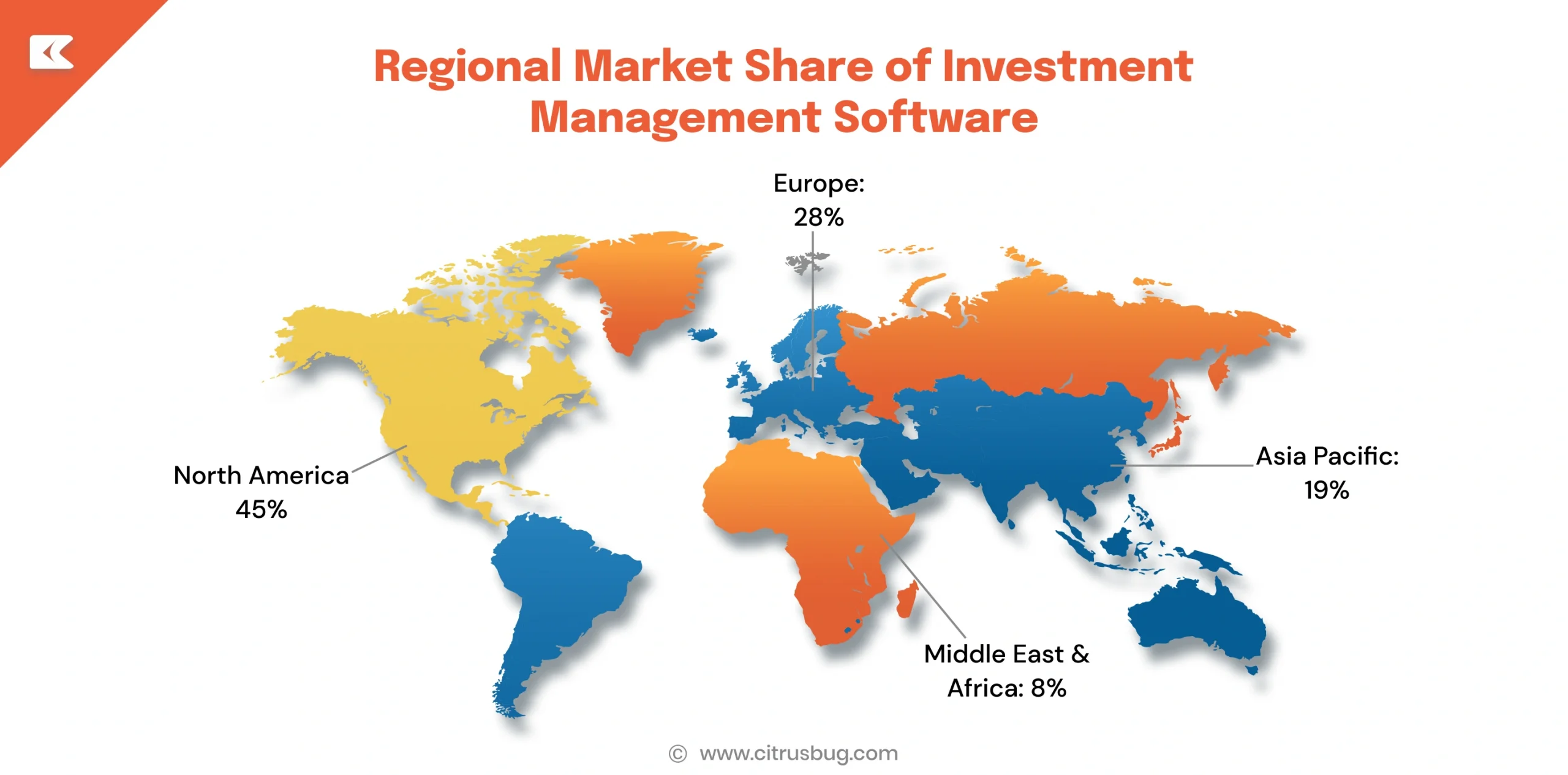
The regional split below reflects current global revenue distribution and highlights where vendors are concentrating expansion efforts.
- North America holds 45% of the global market, supported by a dense concentration of asset managers and long-running demand for compliance automation.
- Firms in the region continue to prioritize integrated reporting and risk oversight tools. Deep vendor competition here also means clients can expect frequent feature updates and aggressive pricing on renewal.
- Europe accounts for 28% of the market, aided by strict regulatory standards that push firms toward automated compliance and risk reporting.
- Cross-border asset management adds further pressure to standardize reporting formats. Firms operating across multiple European jurisdictions favor platforms that can adapt to different local tax and disclosure rules without separate custom builds.
- Asia-Pacific captures 19% of global share. Fast-growing wealth pools and rising retail investor participation across the region continue to push that share higher, and mobile-first platforms remain a common entry point for new users.
- Local fintech partnerships are helping global vendors adapt their products to regional payment habits and language requirements.
- Middle East & Africa represents approximately 8% of the market, with adoption concentrated among financial institutions modernizing legacy back-office systems.
- Sovereign wealth activity in parts of the region adds further demand for multi-asset reporting tools. Growing appetite for digital-first banking is also encouraging smaller regional firms to adopt cloud platforms rather than build internal systems from scratch.
[Source: Business Research Insights]
Segmentation Insights
Segment-level data shows where firms are actually spending, beyond the headline market figures. The breakdown below covers deployment model, component, product type, and advisory format, each of which points to a slightly different buyer profile.
Cloud Deployment Model
The cloud deployment segment of the broader market was valued at approximately USD 3.796 billion in 2024. Firms favor cloud delivery for faster rollout, lower upfront hardware costs, and easier remote access for distributed teams.
On-premises deployment still holds a meaningful share among the largest institutions, mainly because of internal data residency rules that limit how far sensitive portfolio data can travel outside a firm’s own servers.
Software Component
The software component, which covers portfolio systems, order management, and compliance tools, accounted for 63.4% of total market revenue in 2025, equal to roughly USD 3.68 billion.
This segment leads because purpose-built analytics still replace manual, error-prone workflows more effectively than generic spreadsheets.
Services such as implementation and ongoing support remain the smaller half of total spending, but they grow alongside the software itself as deployments become more complex and firms lean on outside consultants for configuration.
Portfolio Management Solutions
Portfolio management software, viewed as its own product category within the wider ecosystem, was valued at roughly USD 5.5 billion in 2025.
Demand centers on real-time performance tracking and reporting across diverse asset classes, from public equities to alternative and illiquid holdings.
Buyers in this category range from individual investors managing a personal portfolio to large financial institutions running multiple books at once, which keeps the product category unusually broad.
Advisory Service Models
Robo advisory platforms represent nearly 38% of the wealth management software market, driven by retail investors who prefer low-cost, automated portfolio tools.
Human advisory platforms still led overall revenue with a 57.1% share in 2025. This split reflects continued demand for personal guidance among higher-net-worth clients even as automation expands elsewhere.
Many firms now blend both models and pair automated portfolio construction with scheduled check-ins from a human advisor, a combination that is proving popular with clients who want lower fees without giving up personal contact entirely.
Key Trends Reshaping the Market
Cloud infrastructure and artificial intelligence are the two forces doing the most to reshape spending patterns across the investment management software market right now.
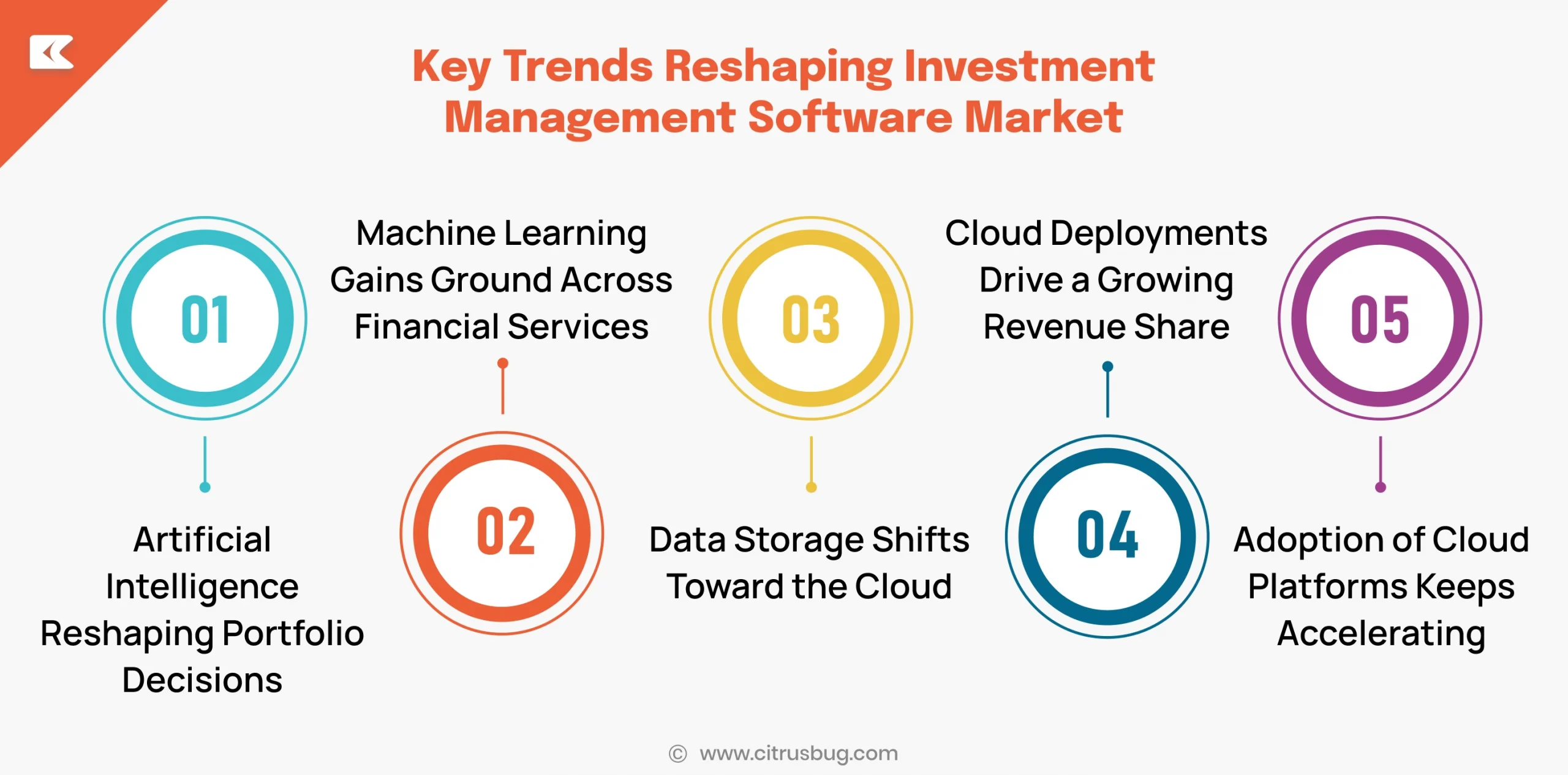
The five trends below capture where that shift is furthest along, and together they explain why product roadmaps look so different from just a few years ago.
1. Artificial Intelligence Reshaping Portfolio Decisions
Investment software platforms had embedded machine learning capabilities to help optimize investment strategies and flag emerging market patterns.
Vendors are building these features directly into core portfolio modules rather than offering them as separate add-ons, which is quietly raising the baseline functionality clients now expect from any serious platform.
2. Machine Learning Gains Ground Across Financial Services
Nearly 70% of financial services firms had adopted machine learning to sharpen predictive accuracy as of 2026, with some models flagging market anomalies at high success rates.
Adoption is no longer limited to the largest institutional players, as smaller firms increasingly access the same capabilities through shared cloud infrastructure.
3. Data Storage Shifts Toward the Cloud
Over 60% of business data tied to these platforms is now stored in the cloud, as multi-cloud and hybrid strategies let firms balance security with faster rollout of new features.
This scale of migration is also opening high-end analytical tools to smaller hedge funds and family offices that previously could not justify the cost of dedicated servers.
4. Cloud Deployments Drive a Growing Revenue Share
Cloud-based deployments accounted for approximately 47.3% of total market revenue in 2025, up sharply from earlier in the decade.
Vendors including several large custody-linked platforms have launched cloud-first product lines in response, often bundling analytics and reporting features that would previously have required a separate purchase.
5. Adoption of Cloud Platforms Keeps Accelerating
Adoption of cloud-based investment management software is expected to increase by more than 20% in the coming years, a pace that outstrips growth in on-premises deployments.
Firms cite lower maintenance overhead and simpler multi-location access as the main draw, particularly as more advisory teams work across several offices or fully remote setups.
Factors Accelerating Market Growth
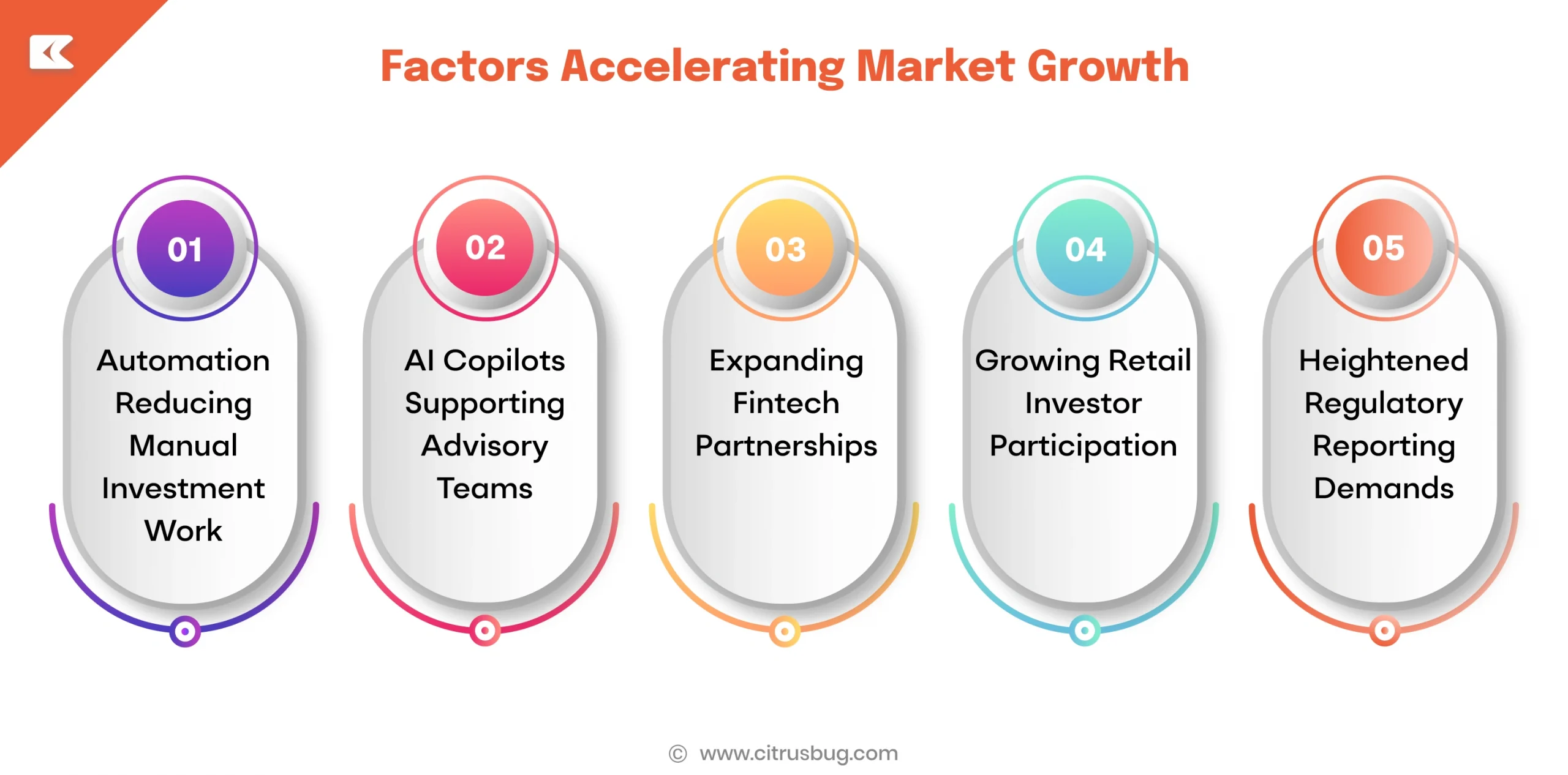
Beyond the raw growth figures, a handful of structural forces explain why firms keep replacing legacy systems rather than patching them. Each factor below plays a distinct role in that shift.
Automation Reducing Manual Investment Work
Automating trade processing, reconciliation, and compliance checks through modern finance software development removes routine, error-prone manual work from daily operations. Firms free up staff time for analysis and client relationships instead of data entry.
This shift, part of the broader financial automation market, also lowers the operational cost of running larger, more complex portfolios and makes it easier to onboard new accounts without adding proportional headcount.
AI Copilots Supporting Advisory Teams
Generative tools that draft meeting notes, rebalancing orders, and investment policy statements are giving advisors back meaningful hours each week.
AI voice agents can also support advisory teams by handling routine client questions, scheduling interactions, and providing basic account or service information before a human advisor steps in.
Natural-language interfaces let less technical staff query complex datasets directly instead of navigating multiple dashboards. This lets smaller advisory teams serve more clients without lowering service quality or adding headcount.
Expanding Fintech Partnerships
Software vendors are partnering with fintech firms to add payment rails, data feeds, and niche analytics without building everything in-house. These partnerships shorten development cycles and broaden what a single platform can offer.
Distribution also improves as partners bring their own client bases along, and smaller vendors gain access to markets they could not reach through direct sales alone.
Growing Retail Investor Participation
A larger, more diverse base of retail investors is pushing vendors to build simpler, mobile-first tools alongside institutional-grade platforms. This broadens the addressable market well beyond banks and asset managers.
Vendors that serve both segments well gain a durable pricing advantage, since the same underlying platform can be resold across very different client tiers.
Heightened Regulatory Reporting Demands
Expanding compliance obligations across major markets are forcing firms to automate audit trails and disclosure workflows rather than handle them manually.
Software that keeps pace with new reporting rules reduces the risk of penalties and shortens the time compliance teams spend preparing for external audits.
This need is proving to be one of the most durable, non-discretionary demand drivers in the market, since firms rarely delay a purchase tied directly to regulatory exposure, even when other technology budgets are under pressure.
Future Outlook and Emerging Opportunities
Forecasts through the early 2030s point to continued expansion, with cloud infrastructure and adjacent wealth technology markets growing in step with the core platform. Much of that growth is expected to come from firms upgrading existing systems rather than first-time buyers, since adoption among large institutions is already broad.
The broader market is projected to reach USD 18,383 million by 2032, more than double its 2024 value. That trajectory points to sustained demand well beyond the current wave of cloud migration projects, and it suggests vendors have room to keep investing in new features rather than competing mainly on price.
The wealth management platform market, a close adjacent category, is expected to climb to USD 11.82 billion by 2031 at an 11.63% compound annual growth rate. Family offices and independent advisors are expected to account for a growing share of that spending as they replace informal, spreadsheet-based processes.
The portfolio management software segment is forecast to advance toward USD 11.8 billion by 2032 at a 14.2% compound annual growth rate. This pace outstrips the broader market and suggests portfolio-specific tools are capturing a larger share of new technology budgets.
The investment portfolio management software segment is expected to reach USD 21.08 billion by 2030 at a 9.10% compound annual growth rate. Continued growth at this scale suggests portfolio tracking and reporting will remain a core, non-negotiable feature rather than a premium add-on for firms of any size.
Conclusion
The investment management software market is moving well past its early growth phase, with valuations, adoption rates, and regional demand all pointing toward sustained expansion through the early 2030s. Cloud delivery and artificial intelligence have shifted from optional add-ons to baseline expectations for any serious platform.
Firms that pair automation with strong compliance and reporting capabilities are best placed to serve a client base that now spans large institutions and individual retail investors alike. Custom-built investment software will likely play a growing role as firms look for tools that fit their specific asset mix and regulatory footprint rather than generic, one-size-fits-all software.