
 Back
Back







NLP is growing fast, and 2026 is bringing big changes in how it’s used. Many companies now choose custom NLP development to build solutions that fit their needs, improve automation, and boost customer service. This article shares the latest NLP statistics, market growth, trends, and real-world uses shaping different industries.
Natural Language Processing Market Statistics
The world’s natural language processing (NLP) market is growing rapidly, as AI tools like chatbots or voice assistants are becoming more popular. This is a look at its annual increase.
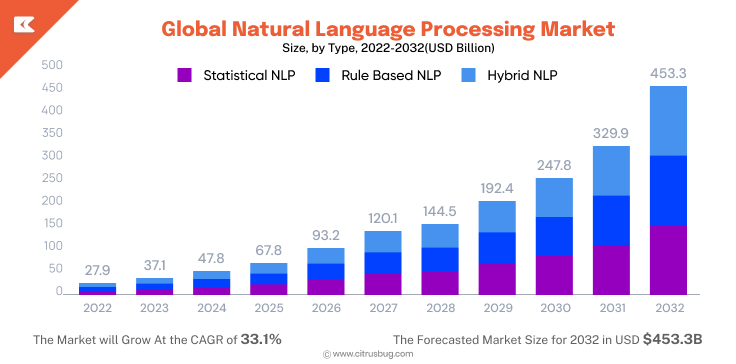
The Natural Language Processing (NLP) market has exploded over the past few years, registering an impressive CAGR of 38.7%. According to the most recent NLP statistics, the market worldwide was estimated at USD 59.7 billion in 2024. This is due to the increasing demand for smart technology across various industries.
In 2024, the market was USD 59.70 billion and is estimated to reach USD 85.76 billion by 2025. The growth was driven by the usage of AI tools such as chatbots and voice assistants in business.
The trend continued until 2025, when revenues reached USD 67.8 billion. It increased by USD 93.2 billion in 2026. It will then reach USD 120.1 billion by 2027. Businesses are increasingly adopting new technology to improve efficiency and customer service.
In the midst of emerging NLP trends, hybrid NLP models, which combine rules-based and statistical techniques, have become more well-known and are boosting the growth of the market. The market is expected to grow to USD 144.5 billion by 2028. It will then reach USD 192.4 billion in 2029.
As we begin the new decade, NLP use is predicted to increase even more rapidly across all industries. It is expected to grow to USD 247.8 billion by 2030. The market will reach USD 329.9 billion by 2031 and USD 453.3 billion by 2032.
This accelerated market is changing industries like finance, healthcare, education, and customer service. It allows systems to understand and react to the use of human language, increase communication and efficiency.
Natural Language Processing (NLP) market share statistics by industry
Natural Language Processing (NLP) market share data for the industry. Natural Language Processing (NLP) has a major impact across industries and is changing how data is perceived and utilised. According to the most recent NLP statistics, the adoption of specific industries is rapidly increasing, with the business, healthcare, media, and finance industries leading the way.
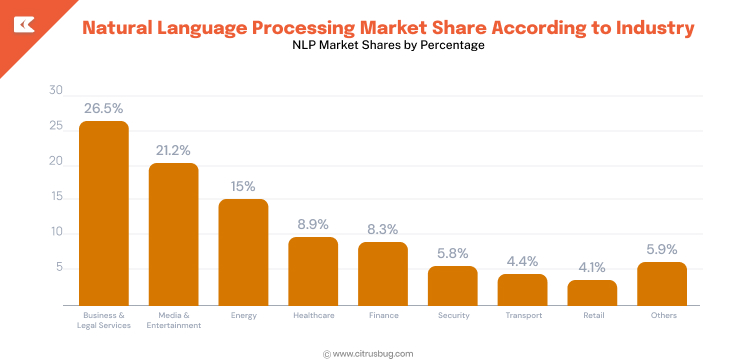
The legal and business sector has the highest part of NLP market, which is 26.5%, which shows the extent to which NLP statistics reflect the growing demand to automate document analyses and solutions for legal intelligence.
Media & Entertainment accounts for 21.2% of market share, which shows its wide use in production, distribution, and audience analysis.
The energy sector accounts for 15.01% of the total market share, which is driven by NLP statistics and trends showing increased adoption of predictive maintenance, extraction of data as well as smart grid analytics.
Healthcare accounts for 8.86% of the market, which highlights the increasing use of NLP solutions for healthcare, such as documents for medical use, data analysis and clinical decision-making support.
Finance, which includes the banking industry, financial services and insurance, accounts for 8.25% of the NLP market, powered via its application in regulatory compliance, document processing and customer interaction.
Security holds 5.82% of the market and is utilised in the detection of threats, compliance monitoring and live risk assessment in real time.
Transportation is the largest sector, accounting for 4.39% in the NLP market, with major applications in voice interfaces, logistics optimisation and improving customer experience.
Retail is responsible for 4.12% of the total market, using technology for personalisation, recommendation engines, as well as analytics on customer reviews to improve the shopping experience.
Other industries contribute 5.86% of this NLP market, which covers a variety of sectors such as education, manufacturing, retail, and others.
Recent NLP Trends & Emerging Applications (2026)
As natural language processing continues to evolve, it is driving transformative changes across industries. From advanced AI models to workplace automation, here are the key trends shaping NLP in 2026.
1. Chatbot & Conversational AI Adoption
- According to recent NLP statistics, 84% of chatbots in 2023 were powered by NLP to interpret user intent accurately
- 60% of chatbot platforms now incorporate sentiment analysis for better emotional intelligence in responses
- In finance, 72% of institutions use AI chatbots for customer support, and chatbots now handle over 30% of global banking inquiries
2. Automated Text Analytics & Market Segments
- Sentiment Analysis tools are improving customer retention by 20% and process over 80 million reviews annually
- Automatic Summarisation holds an 18% share of NLP applications; sentiment analysis and content management each account for around 17%, based on current NLP statistics and trends
- Text Analytics is expected to command 31.8% market share by 2025, fueling insights from Big Data in multiple sectors
3. Advanced Model Trends: RAG & Transformers
- By 2025–2026, over 50% of NLP tools and applications will use transformer-based models like BERT and GPT
- Approximately 80% of enterprises now adopt Retrieval-Augmented Generation (RAG) over fine-tuning due to better data grounding and efficiency
- The global RAG market is projected to rise from USD 1.85 billion in 2025 to USD 67.42 billion by 2034 (CAGR 49.12%)
4. Emerging Trends & Global Workforce Impact
- By 2025, 72% of global employees were using generative AI tools as part of daily work routines
- NLP in chatbots is reshaping onboarding, employee training, and internal support systems in enterprises via RAG-connected knowledge portals
Top NLP Applications & Use Cases
From NLP tools and applications powering clinical documentation to real-time machine translation driving global e-commerce, natural language processing has moved well beyond research labs. Below are the five highest-impact NLP use cases shaping industries in 2026, backed by data from authoritative sources.
1. Machine Translation & Multilingual NLP
Machine translation remains one of the most commercially scaled applications of computational linguistics, enabling real-time cross-lingual communication across 100+ language pairs.
- The global machine translation market was valued at $1.26 billion in 2026 and is projected to reach $2.19 billion by 2031, growing at a CAGR of 11.69%
- Google Translate, powered by neural machine translation (NMT), processes over 100 billion words daily across 133 languages the largest publicly available multilingual NLP deployment in the world
- Most consumers prefer purchasing products with information available in their native language, making multilingual NLP and semantic search essential for global e-commerce (CSA Research / Common Sense Advisory)
- Microsoft Translator supports over 100 languages and powers translation features across 50+ Microsoft 365 products and services, integrating real-time natural language understanding (NLU) at enterprise scale
- Multilingual named entity recognition (NER) and cross-lingual intent detection are now embedded in enterprise translation pipelines, enabling structured information extraction across language boundaries without retraining separate models for each language pair
- Low-resource language NLP covering languages with limited training data received significant research investment in 2024–2025, with Meta AI’s No Language Left Behind project achieving quality translation across 200 languages in a single model
2. Healthcare NLP & Clinical Documentation
Healthcare is among the fastest-growing verticals for NLP solutions in healthcare, driven by the explosion of unstructured clinical data in electronic health records (EHRs), radiology reports, and patient notes.
- The healthcare NLP market is projected to grow from $4.13 billion in 2024 to $16.01 billion by 2030, at a CAGR of 25.3%, driven by demand for AI-assisted clinical decision support and automated medical coding
- Approximately 80% of all healthcare data is unstructured text, including physician notes, discharge summaries, and referral letters making NLP-powered text mining a critical infrastructure layer for health systems (NIH National Library of Medicine)
- Microsoft Nuance Dragon Medical One, the leading AI-powered clinical documentation solution, is used by over 500,000 physicians globally, using ambient speech recognition and natural language understanding to generate real-time clinical notes
- NLP-based automated medical coding reduces billing errors by up to 30% and significantly shortens claims processing time, improving revenue cycle management for healthcare organizations (HIMSS)
- NLP-powered radiology report analysis tools reduce imaging result turnaround time by up to 50%, helping radiologists prioritize critical findings through automated anomaly flagging and report summarization (RSNA / radiology literature)
3. Voice Assistants & Automatic Speech Recognition (ASR)
Speech recognition AI, a core branch of NLP, has reached near-human accuracy levels in 2026, fueling adoption across consumer devices, enterprise platforms, and accessibility tools.
- The global speech and voice recognition market is projected to reach $23.11 billion by 2030, growing at a CAGR of 19.1%, driven by rising demand for hands-free interfaces and conversational AI
- Automatic speech recognition (ASR) accuracy now surpasses 95% word error rate, parity with human transcription for major languages, including English, Mandarin, and Spanish
- Mobile Google searches are now voice-based, reflecting the growing consumer preference for natural speech interaction over typed keyword queries, a shift that demands more sophisticated intent detection and NLU
- Amazon’s Alexa ecosystem has surpassed 100 million Alexa-enabled devices sold globally, with developers building over 130,000 Alexa skills that leverage NLP for real-time command parsing, entity extraction, and slot filling
4. Sentiment Analysis & Customer Experience Intelligence
Sentiment analysis, also referred to as opinion mining is one of the most commercially deployed NLP techniques. By applying text classification models to customer reviews, social media data, and support interactions, businesses extract actionable signals that directly improve retention and brand perception.
- The global sentiment analytics market was valued at $4.68 billion in 2024. The market is projected to grow at a CAGR of 14.40% during 2025 to 2034.
- Sentiment analysis tools powered by deep learning have been shown to improve customer retention rates by up to 20% by enabling faster, more personalized service responses and proactive issue resolution
- 92% of consumers trust peer reviews and organic user-generated content more than traditional advertising making NLP-driven opinion mining and review summarization a high-ROI investment for e-commerce and SaaS brands
- Social media monitoring platforms using NLP process over 500 million posts per day to extract brand sentiment, trending topics, and crisis signals, providing marketing teams with real-time competitive intelligence
- In financial services, hedge funds and asset managers using NLP-based sentiment analysis on earnings call transcripts, news articles, and SEC filings report improvements in short-term stock movement prediction accuracy compared to models using price data alone
- E-commerce platforms integrating NLP-powered review analysis and aspect-level sentiment scoring report a 30% reduction in product return rates, as they gain a better understanding of customer expectations
Challenges & Risks: Statistics on NLP Limitations
Despite its rapid growth, natural language processing faces significant technical, ethical, and regulatory challenges that are shaping how organizations adopt and govern AI systems.
Understanding these limitations is essential for any enterprise building production-grade NLP solutions.
1. Hallucination & Factual Inaccuracy in Large Language Models
Large language models (LLMs) are prone to hallucination, confidently generating outputs that sound accurate but are factually incorrect or entirely made up, which makes them unreliable in high-stakes domains like healthcare, law, and finance.
This limitation stems from the way these models predict text based on patterns rather than grounded understanding of truth.
While techniques such as retrieval-augmented generation (RAG) and knowledge graph grounding have helped reduce these errors, hallucination remains an unsolved challenge that demands careful human oversight in any production NLP deployment.
2. Bias & Fairness in NLP Systems
NLP models trained on large-scale internet data inevitably learn and reproduce societal biases around gender, race, religion, and geography, leading to unfair or discriminatory outputs in tasks like text classification, sentiment detection, and language generation.
These biases are often subtle and difficult to detect until a model is deployed at scale, at which point the damage to users and brand trust can be significant.
Addressing this requires intentional efforts in diverse dataset curation, fairness-aware model training, and ongoing bias auditing as a standard part of the NLP development lifecycle.
3. Data Privacy & Regulatory Compliance
NLP systems depend on large volumes of sensitive text data from medical records and legal documents to personal communications which creates serious privacy risks, especially when models inadvertently memorize and reproduce training data.
Compliance with regulations like GDPR, HIPAA, and CCPA adds significant complexity to how NLP pipelines are designed, trained, and deployed, particularly in enterprise and healthcare settings.
Privacy-preserving approaches such as federated learning, differential privacy, and on-device inference are gaining traction, but striking the right balance between model performance and data protection continues to be one of the hardest problems in applied NLP.

Conclusion
The rapid expansion in the NLP market is a sign of how deeply this technology is transforming contemporary industries. With growing NLP use cases in chatbots, sentiment analysis, automated summarisation, and advanced AI models, companies are improving efficiency, decision-making, and customer interaction. From healthcare and finance to retail and media, NLP is becoming an essential instrument for innovation, proving its role as a driving force in the future of digital transformation.