
 Back
Back







Key Takeaways
- The global pharmaceutical management software market reached $3.67 billion in 2026, growing at an 11.67% CAGR through 2031.
- 87% of pharmaceutical and biotechnology organizations have already deployed quality management software, making it a baseline requirement.
- Cloud adoption is now standard even for GxP-validated workloads, with quality management systems reaching 77.02% cloud/web-based deployment.
- CAPA (corrective and preventive action) management holds the largest functional share at 30%, tied directly to regulatory audit compliance.
- North America leads with 42% global revenue share, while Asia-Pacific is the fastest-growing region as manufacturing capacity expands.
Pharmaceutical organizations are under more pressure than ever to digitize operations across manufacturing, compliance, distribution, and dispensing. The pharmaceutical management software market has become a central pillar of that transformation.
These structured platforms connect operational data, reduce manual errors, and ensure regulatory readiness across the drug lifecycle. As drug pipelines grow more complex and compliance expectations intensify globally, digital infrastructure has moved from optional to essential across the sector.
The forces shaping this market go beyond simple IT adoption. Rising drug complexity, stricter manufacturing standards, and the demand for real-time quality visibility are pushing companies to replace fragmented, paper-based processes with integrated software ecosystems.
The result is a market expanding rapidly across all major sub-segments, from manufacturing execution and quality management to medication dispensing and enterprise resource planning.
What is Pharmaceutical Management Software?
Pharmaceutical management software refers to digital platforms built for pharmaceutical organizations to manage core operations. These tools cover manufacturing processes, inventory tracking, quality management, regulatory documentation, and dispensing workflows within a single or interconnected system environment. They replace the manual systems they were designed to eliminate.
These platforms improve data integrity across the drug lifecycle, support compliance with international regulatory standards, and reduce the risk of quality failures that affect product approvals, commercial continuity, and patient safety.
Their value lies in connecting operational data across departments into a review-ready, auditable record.
Pharmaceutical Management Software Market Scale and Segments
This market sits at an intersection of healthcare urgency and technology adoption. Investment is accelerating across product categories as organizations prioritize quality assurance, regulatory compliance, and manufacturing efficiency in parallel.
Market Valuation and Growth Trajectory
Distinct categories within the pharmaceutical management software space are reporting strong growth, with double-digit CAGR figures across the most active sub-segments.
- The global pharmaceutical management software market reached USD 3.67 billion in 2026 and is projected to grow at a CAGR of 11.67% through 2031. The trajectory reflects sustained investment in digital operations management across drug manufacturing and dispensing infrastructure.
- The pharmaceutical manufacturing software segment was valued at USD 3.41 billion in 2025. It grew from USD 3.10 billion in 2024 and is expanding at a 10.1% CAGR through 2030, driven by the expanding scale of production monitoring, batch documentation, and automation requirements across drug production facilities worldwide.
Specialized Segments Driving the Market
Quality management and medication dispensing represent two of the fastest-growing functional categories within the broader pharmaceutical software landscape, each supported by dedicated regulatory and operational demand.
- The pharmaceutical quality management software segment expanded from USD 2.35 billion in 2025 to USD 2.66 billion in 2026 and advances at a 13.07% CAGR as quality oversight demands increase globally and regulators expect validated digital audit trails across all manufacturing and dispensing activities.
- The medication management software segment reached USD 9.11 billion in 2026 from USD 8.17 billion in 2025 and is growing at a 12.45% CAGR as hospitals and pharmacy networks invest in platforms that standardize drug dispensing protocols and reduce medication administration errors across large multi-facility operations.
How Pharma Organizations Are Deploying These Solutions
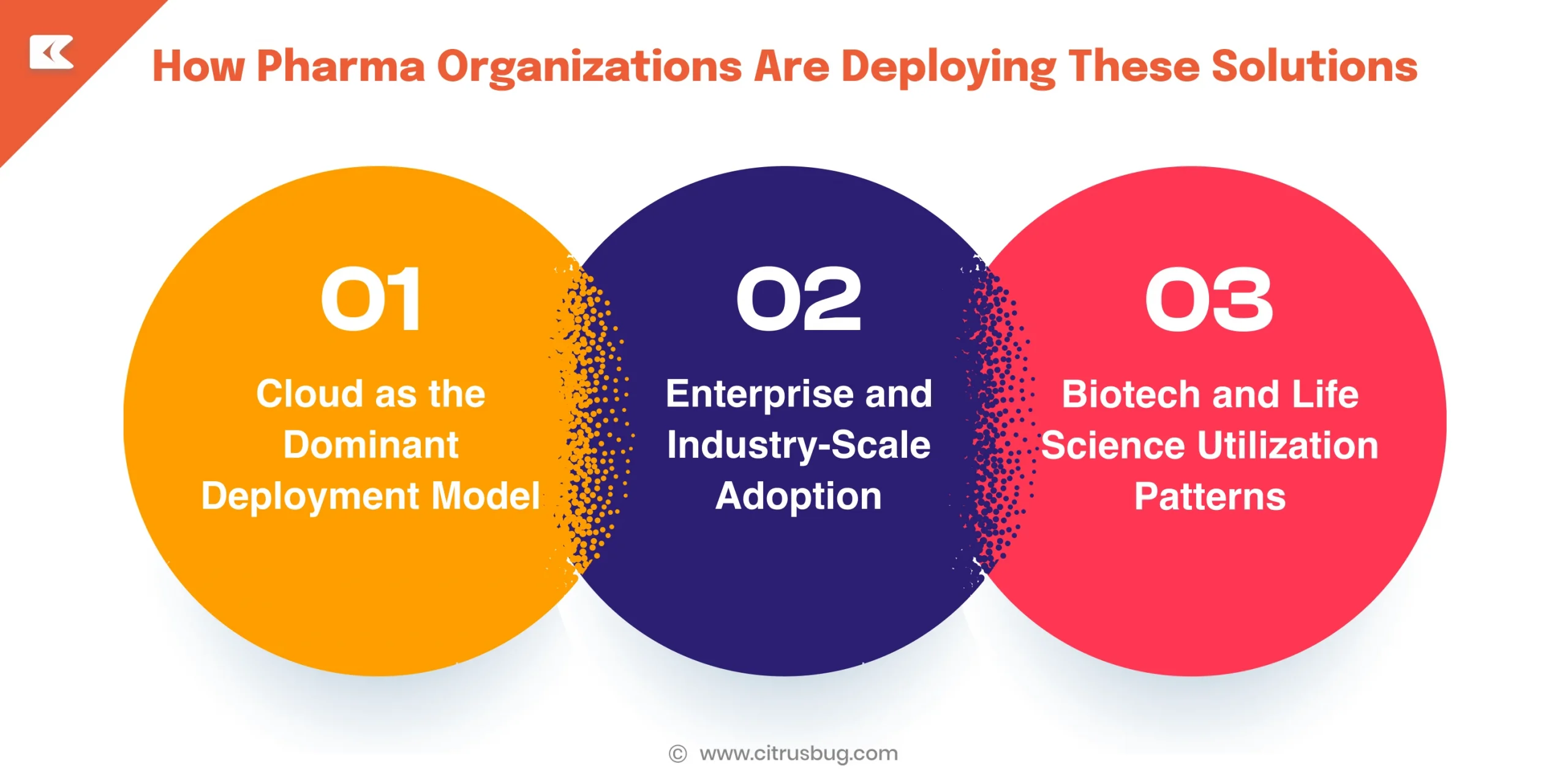
Deployment patterns across the pharmaceutical management software market show a clear and accelerating shift toward cloud-first infrastructure.
Organizations of all sizes are moving digital adoption forward, with measurable differences in platform preference by company scale, functional area, and application type.
Cloud as the Dominant Deployment Model
Cloud adoption has crossed from a preference to a default across most pharmaceutical management software categories that include compliance-sensitive and GxP-validated data environments.
- Cloud-based products accounted for 12.63% of this market. The figure signals a clear preference for scalable, remotely accessible platforms over on-premises installations that require intensive internal IT infrastructure and ongoing hardware investment.
- Within pharmaceutical quality management systems specifically, cloud and web-based deployment captured 77.02% of the market in 2024 and confirms that even compliance-sensitive workloads are migrating to hosted environments as validation frameworks and security standards for regulated cloud infrastructure have matured considerably.
Enterprise and Industry-Scale Adoption
Large pharmaceutical manufacturers and established biotech companies are leading adoption, with broad deployment of manufacturing and quality systems across their production and commercial operations.
- Manufacturing execution systems, a critical class of pharmaceutical management tools used for production tracking, batch documentation, and operational compliance, were adopted by 68% of large pharmaceutical firms globally. The figure reflects the industry’s push to automate compliance-critical production activities at the facility level.
- Across pharmaceutical and biotechnology organizations, 87% have deployed pharmaceutical quality management software systems, a figure that positions quality infrastructure as a baseline operational requirement across established manufacturers rather than a competitive differentiator.
Biotech and Life Science Utilization Patterns
The life science sector has become a consistent driver of pharmaceutical management software demand. Biotech companies lead adoption for both quality and manufacturing applications that scale with pipeline and commercial growth.
- Pharmaceutical and biotechnology manufacturers account for 45% of all pharmaceutical quality management software end users in 2025 and represent the most significant buyer group in the market, well ahead of contract manufacturers and hospital systems in overall software spend.
- In the biotech quality management segment specifically, cloud-based deployment holds a 67% market share in 2025. This reflects the sector’s structural reliance on flexible, scalable infrastructure that grows with clinical pipeline development and commercial manufacturing buildout timelines.
- Cloud deployment accounts for 51.61% of the global life science software market in 2026 and confirms that cloud has become the default infrastructure mode across the life science technology stack, not only for quality systems but for manufacturing and compliance platforms more broadly.
Breaking Down the Market by Segment and Scale
This software category is not a single, undifferentiated product market. Clear market structures have formed based on how the software is used, who is buying it, and the scale at which it operates. These structural patterns indicate where demand is concentrated and where growth is accelerating most quickly.
Application and Functional Priorities
Corrective and preventive action management is the most adopted functional application within pharmaceutical quality management systems globally.
CAPA management held a 30% market share in 2025, driven by its direct connection to regulatory inspections and audit compliance requirements across FDA and EMA-regulated environments.
Pharmaceutical and biotech manufacturers must document, investigate, and resolve quality deviations systematically. CAPA software has become a foundational investment in regulated manufacturing environments.
Other widely deployed modules include document control, audit management, and training management, which together define the quality infrastructure backbone for most regulated manufacturers globally.
Industry End-User Composition
Biotechnology and pharmaceutical companies are the dominant end-user group across pharmaceutical software categories.
These organizations represented 40.57% of the global life science software market in 2026 and maintain their position as the largest buyers by revenue across the full software landscape.
Within biotech quality management platforms specifically, life sciences applications account for 58% of market share in 2025.
This reflects the sector’s structural dependence on validated quality and compliance infrastructure to manage product safety documentation and regulatory approval timelines simultaneously.
Organization Size and Enterprise Mix
Enterprise scale significantly shapes which pharmaceutical management software platforms are selected, how they are implemented, and at what investment level.
Large pharmaceutical enterprises account for 60% of global pharmaceutical ERP software usage, while small and mid-sized businesses represent 25% of usage, and contract research organizations account for the remaining 15%.
This distribution reflects the capital and infrastructure requirements of full enterprise ERP implementation in regulated environments.
Larger firms deploy integrated, multi-module platforms, while smaller organizations increasingly adopt modular, cloud-first solutions that reduce upfront investment while still meeting regulatory documentation standards.
Regional Distribution and Market Leadership
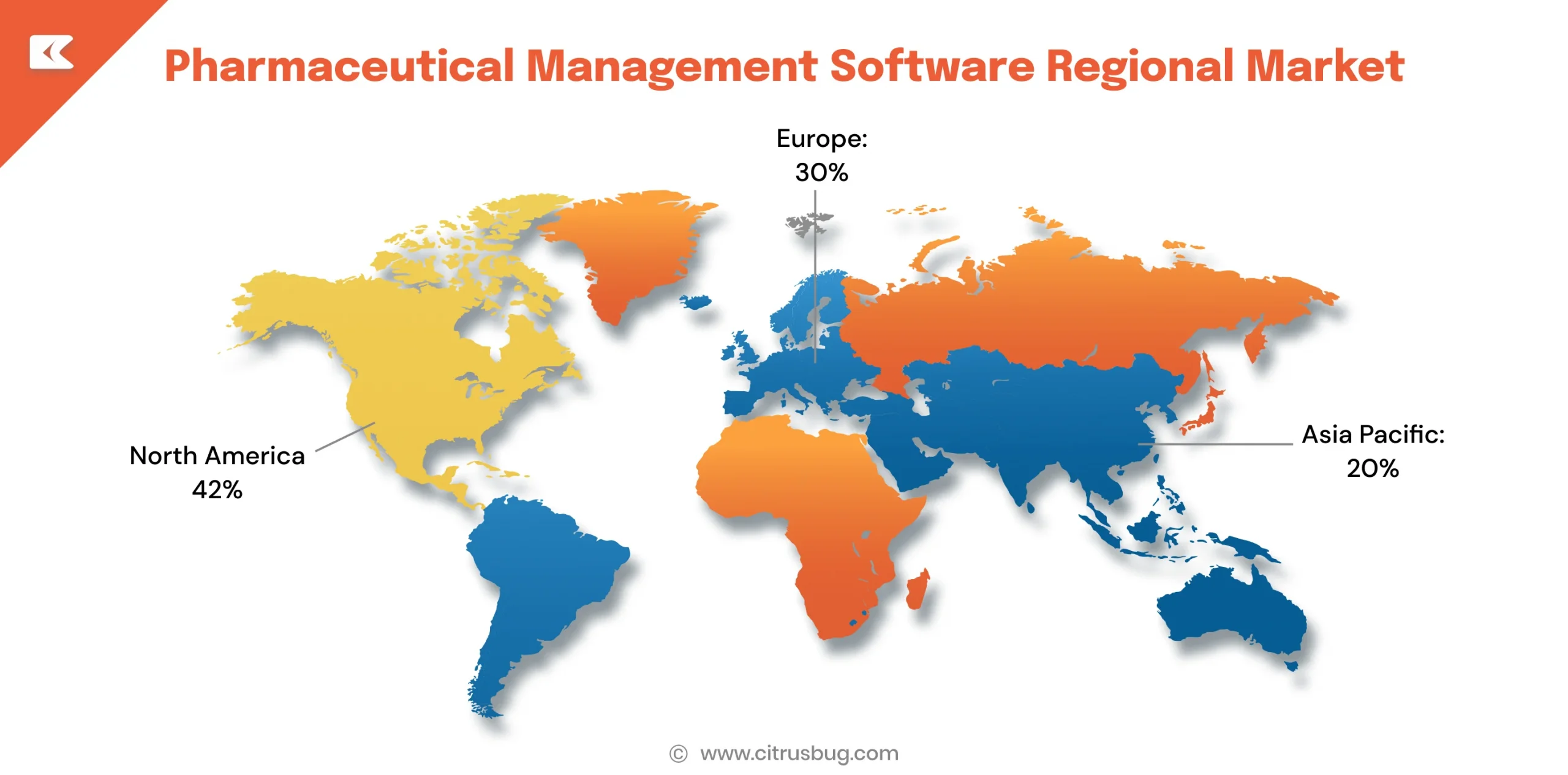
Geographic concentration in pharmaceutical software investment closely mirrors where established manufacturing and R&D infrastructure operates, though investment from emerging regions is actively narrowing historical gaps in adoption.
- North America holds a 42% revenue share of the global pharmaceutical software market, equivalent to approximately USD 14.19 billion of the USD 33.79 billion total. The region also commands a 37.8% share of the global pharmaceutical manufacturing software market in 2025, a position reinforced by the density of FDA-regulated manufacturers, integrated health systems, and biotech organizations that require end-to-end digital compliance infrastructure.
- Europe accounts for 30% of the global pharmaceutical software market. This translates to approximately USD 10.14 billion in absolute market value, supported by EMA regulatory requirements that drive ongoing investment in quality documentation, pharmacovigilance systems, and validated electronic records across the region’s established drug manufacturing base.
- Asia-Pacific holds a 20% share of the global market, approximately USD 6.76 billion, and is the fastest-growing region as pharmaceutical manufacturing capacity expands in India, China, and South Korea and as regulatory alignment with FDA and ICH standards accelerates software adoption across export-focused manufacturers.
Key Trends Shaping the Pharmaceutical Software Market
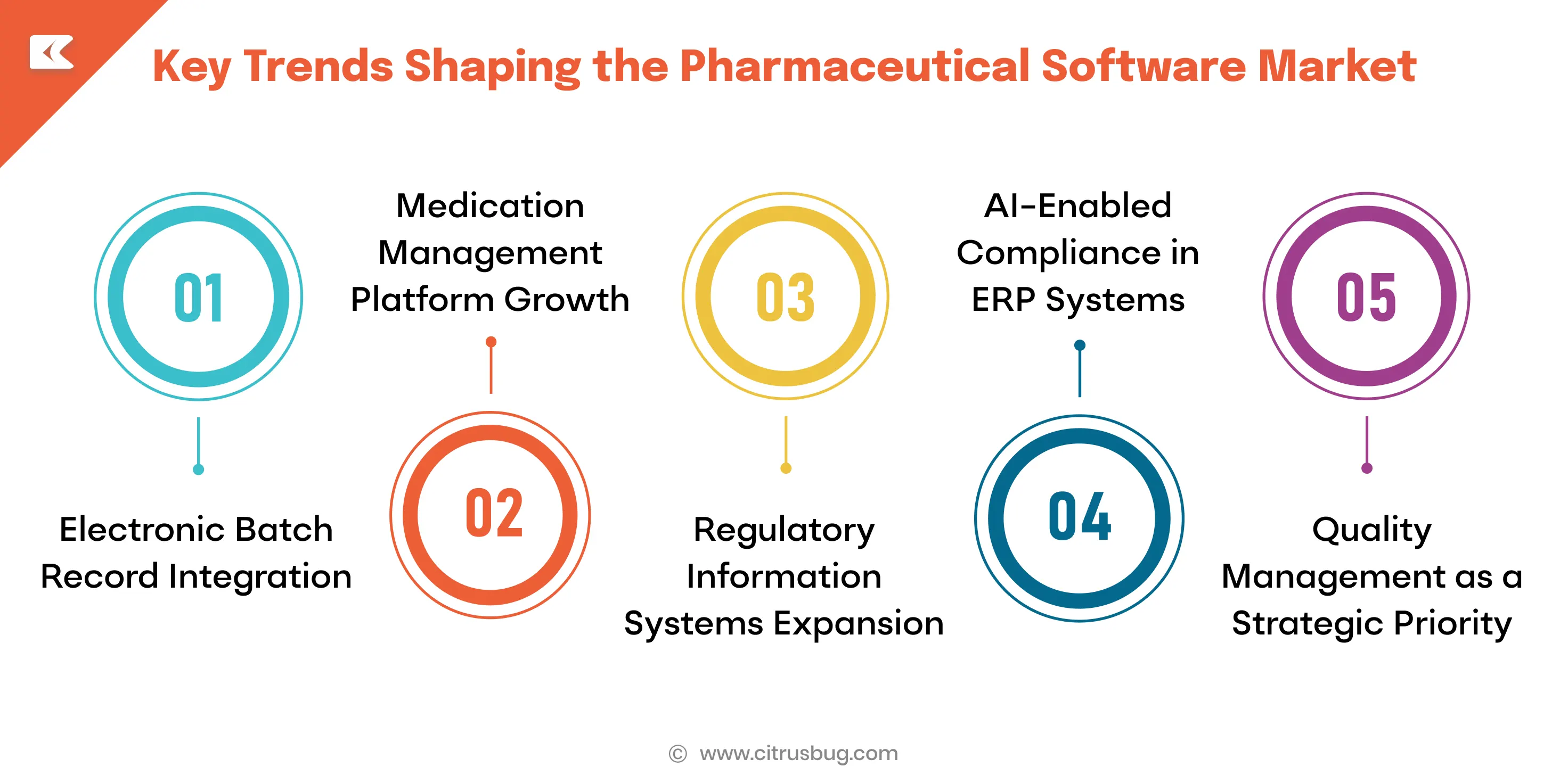
Technology investment and operational requirements are evolving in parallel across the pharmaceutical sector. Several active trends are changing the scope of pharmaceutical management software, the functions it covers, and the return organizations expect from their investments.
Electronic Batch Record Integration
- Replaces paper-based batch records with real-time digital tracking
- Cuts manual data entry errors across production lines
- Speeds up batch release and reduces review cycle time
- Enables instant deviation flagging during manufacturing
- Improves audit trail visibility for regulators
- Integrates directly with MES and ERP systems
- Supports faster root-cause analysis during investigations
Medication Management Platform Growth
- Rising demand for centralized prescription and inventory tracking
- Growing adoption of AI-driven dosage and interaction alerts
- Expansion into home healthcare and remote patient monitoring
- Increased focus on medication adherence tracking tools
- Integration with EHR/EMR systems for unified patient data
- Strong uptake among long-term care and senior care facilities
- Push toward mobile-first platforms for patients and caregivers
Regulatory Information Systems Expansion
- Growing need to manage multi-region regulatory submissions
- Increased automation of compliance document tracking
- Real-time updates on changing global regulatory requirements
- Centralized dashboards for registration and renewal status
- Better traceability across the product lifecycle documentation
- Reduced submission errors through structured data validation
- Rising demand from companies scaling into new markets
AI-Enabled Compliance in ERP Systems
- AI flags compliance risks before they become violations
- Automated monitoring of regulatory changes within ERP automation workflows
- Predictive analytics for audit readiness and risk scoring
- Reduced manual compliance checks across departments
- Faster identification of process deviations in real time
- Smarter reporting for regulatory submissions and audits
- Lower compliance costs through automated documentation
Quality Management as a Strategic Priority
- Shift from reactive QC to proactive quality strategy
- Rising investment in integrated QMS platforms
- Stronger focus on CAPA tracking and closure speed
- Quality metrics increasingly tied to business KPIs
- Greater emphasis on supplier and vendor quality oversight
- Real-time quality dashboards for leadership visibility
- Quality is positioned as a competitive differentiator, not just compliance
Factors Driving Growth Across the Market
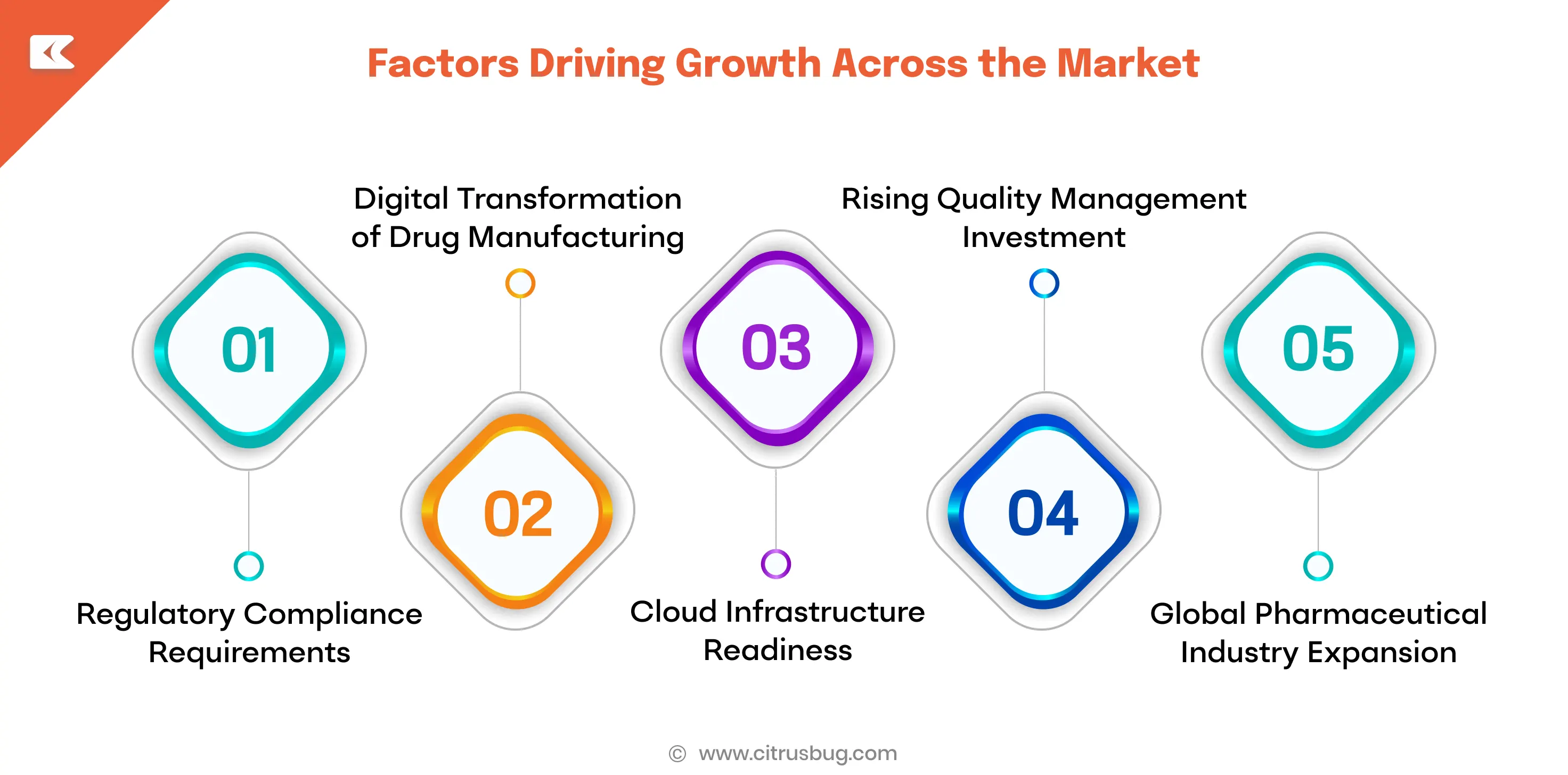
Several structural dynamics are creating sustained demand for pharmaceutical management software investment across geographies, company sizes, and software categories regardless of broader economic conditions.
Regulatory Compliance Requirements
Regulators including the FDA, EMA, and WHO continue to raise expectations around documentation, process validation, and traceability.
Organizations operating across multiple jurisdictions must maintain validated, audit-ready systems for all manufacturing and quality activities.
Software that supports regulatory compliance reduces the risk of failed inspections, import alerts, and product recalls.
Compliance infrastructure has become a primary investment driver across pharmaceutical manufacturing operations globally.
Digital Transformation of Drug Manufacturing
Pharmaceutical manufacturers are driving digital transformation in manufacturing by replacing paper-based operations with connected production environments that generate real-time data across every process step.
Pharma 4.0 initiatives are driving adoption of manufacturing execution systems, process analytical technology, and real-time quality monitoring.
These programs require software that connects equipment data, batch records, and quality systems into a single, inspection-ready operational environment that supports both efficiency and compliance objectives simultaneously.
Cloud Infrastructure Readiness
Cloud computing has become viable for pharmaceutical workloads, including GxP-validated environments.
Major cloud providers now offer compliance-ready infrastructure that meets FDA 21 CFR Part 11 and EU Annex 11 requirements. This has removed a historically significant barrier to adoption.
Organizations can now migrate quality systems, document management, and ERP workloads to cloud platforms without compromising their validated regulatory standing.
Rising Quality Management Investment
The financial cost of quality failures in pharmaceuticals, measured in recall expenses, lost production, and regulatory penalties, has created a compelling business case for proactive quality management investment.
Companies are building systems that detect deviations earlier, automate investigations, and track corrective actions across global manufacturing sites.
Quality management software has evolved into a production performance tool that protects batch yield, approval timelines, and commercial continuity.
Global Pharmaceutical Industry Expansion
The pharmaceutical industry continues to grow, with biosimilar development, specialty drug manufacturing, and generic production scaling across new geographies.
More production sites, more product variants, and more regulatory markets to navigate create proportional demand for software that manages complex global operations at scale.
Emerging manufacturing hubs in Asia-Pacific, Latin America, and the Middle East are actively building digital compliance infrastructure to meet international quality standards for export market access.
Future Outlook and Market Opportunities Through 2032
The pharmaceutical management software market is projected to grow significantly across all major categories through 2030 and 2032, driven by regulatory investment, cloud platform maturity, and expanding technology integration across pharma operations globally.
- The pharmaceutical quality management software market is projected to reach USD 3.85 billion by 2030 at a 12.99% CAGR as quality compliance requirements deepen globally and pharmaceutical companies scale digital quality infrastructure to manage expanding product portfolios and international manufacturing footprints.
- The pharmaceutical manufacturing software market is forecast to reach USD 5.52 billion by 2030. This reflects continued investment in production monitoring, batch management, and manufacturing intelligence platforms as drug manufacturers modernize operations and automate facility-level compliance activities.
- The pharmacy management system segment, which covers dispensing, inventory, and patient medication management platforms across retail and hospital pharmacy operations, is projected to reach USD 248.76 billion by 2035 at a 10.67% CAGR. This projection reflects the scale of digitization underway across global pharmacy operations and the integration of dispensing systems with broader clinical and health record infrastructure.
- More than 30% of new pharmaceutical ERP deployments by 2027 are expected to include AI-enabled compliance monitoring and predictive analytics capabilities. This marks a shift toward intelligent ERP platforms that proactively identify regulatory risk and operational deviation rather than simply documenting activity after the fact.
Conclusion
The pharmaceutical management software market is supported by deep structural demand across manufacturing, quality, dispensing, and compliance functions.
Regulatory pressure, cloud infrastructure maturity, and expanding pharmaceutical production globally are combining to drive consistent investment across every major sub-segment and product category.
Organizations that invest in a pharmaceutical management software development company today are building the operational and compliance foundation that modern drug development, manufacturing, and distribution require.
As sub-segment markets approach their 2030 and 2032 forecast values, integrated platforms that connect quality, manufacturing, and regulatory functions will define how efficiently pharmaceutical companies scale and sustain complex global operations.