
 Back
Back







Key Takeaways
- RAG narrows hallucinations but doesn't eliminate them; wrong retrieval still produces fluent, confident, incorrect answers.
- A RAG pipeline has five components, and accuracy is only as strong as the weakest one, not the strongest.
- Retrieval failures, not the LLM itself, cause most accuracy problems teams trace back after launch.
- Adding a re-ranking step alone boosted retrieval accuracy by an average of 15 percentage points in enterprise benchmarks.
- RAG suits fast-changing, proprietary knowledge with near-instant updates; fine-tuning suits changing a model's tone or reasoning style.
A RAG-based chatbot answers questions by retrieving relevant information from your own documents before generating a response, instead of relying only on what a language model learned during training. Done well, this can cut hallucination rates by roughly half. Done poorly, a chatbot with “RAG” in its architecture diagram can still confidently invent answers, because retrieval quality, not the presence of retrieval, is what actually determines accuracy.
Most teams that build a RAG-based chatbot get the concept right and the execution wrong. They wire up a vector database, connect an LLM, and assume grounding alone will fix hallucinations. It won’t. A Stanford RegLab study found that RAG-based legal research tools built by well-funded companies still produced fabricated citations in 17 to 33 percent of test queries, proof that retrieval augmentation reduces the hallucination problem without solving it.
This guide covers what actually moves the accuracy needle, from architecture decisions to the step-by-step build process and the mistakes that quietly undo good retrieval. It also covers where RAG chatbots are already running in production, often without users realizing it, and when the smarter move is a custom build instead of an off-the-shelf platform.
What Is a RAG-Based Chatbot and Why Accuracy Is Still a Challenge
Retrieval-augmented generation pairs a language model with a search step that runs before generation. When someone asks a question, the system retrieves the most relevant chunks of your documents, feeds them to the LLM as context, and the LLM writes an answer grounded in that context rather than guessing from memory. That’s the entire premise, and it explains why so many teams assume adding RAG is a fix rather than a starting point.
The catch is that RAG doesn’t remove a model’s ability to hallucinate; it just narrows what the model hallucinates about. If retrieval pulls the wrong document, or a document that’s technically related but doesn’t answer the question, the LLM will still generate a fluent, confident, wrong answer. In chatbots answering questions from cancer information sources, models without retrieval hallucinated in roughly 40 percent of responses, while the RAG-grounded versions dropped to 19 to 35 percent depending on the underlying model. A real improvement, but nowhere near a fix.
Where Traditional Chatbots Fail (And Why RAG Fixes It)
Traditional chatbots run on two approaches, and both have a ceiling on accuracy. Rule-based bots only handle scripted paths, breaking the moment a question falls outside their decision tree. Standalone LLM chatbots handle open-ended language well but answer from training data that’s static and often months out of date by the time it ships. Neither approach can correctly answer something like “what’s our current return policy for orders over $500,” because neither one is looking at the actual, current policy document.
This is the exact gap a RAG-grounded chatbot closes. Grounding responses in a live, queryable knowledge base means it answers from what’s actually true today, not a frozen training snapshot, which is why RAG became the default architecture for support and knowledge-base bots rather than a niche technique.
Core Architecture of a High-Accuracy RAG-Based Chatbot
A RAG chatbot has five components, and accuracy is determined by the weakest one, not the strongest. Teams that pour engineering time into the LLM while treating chunking as an afterthought consistently end up disappointed with output quality, because a great model given the wrong context still writes a wrong answer.
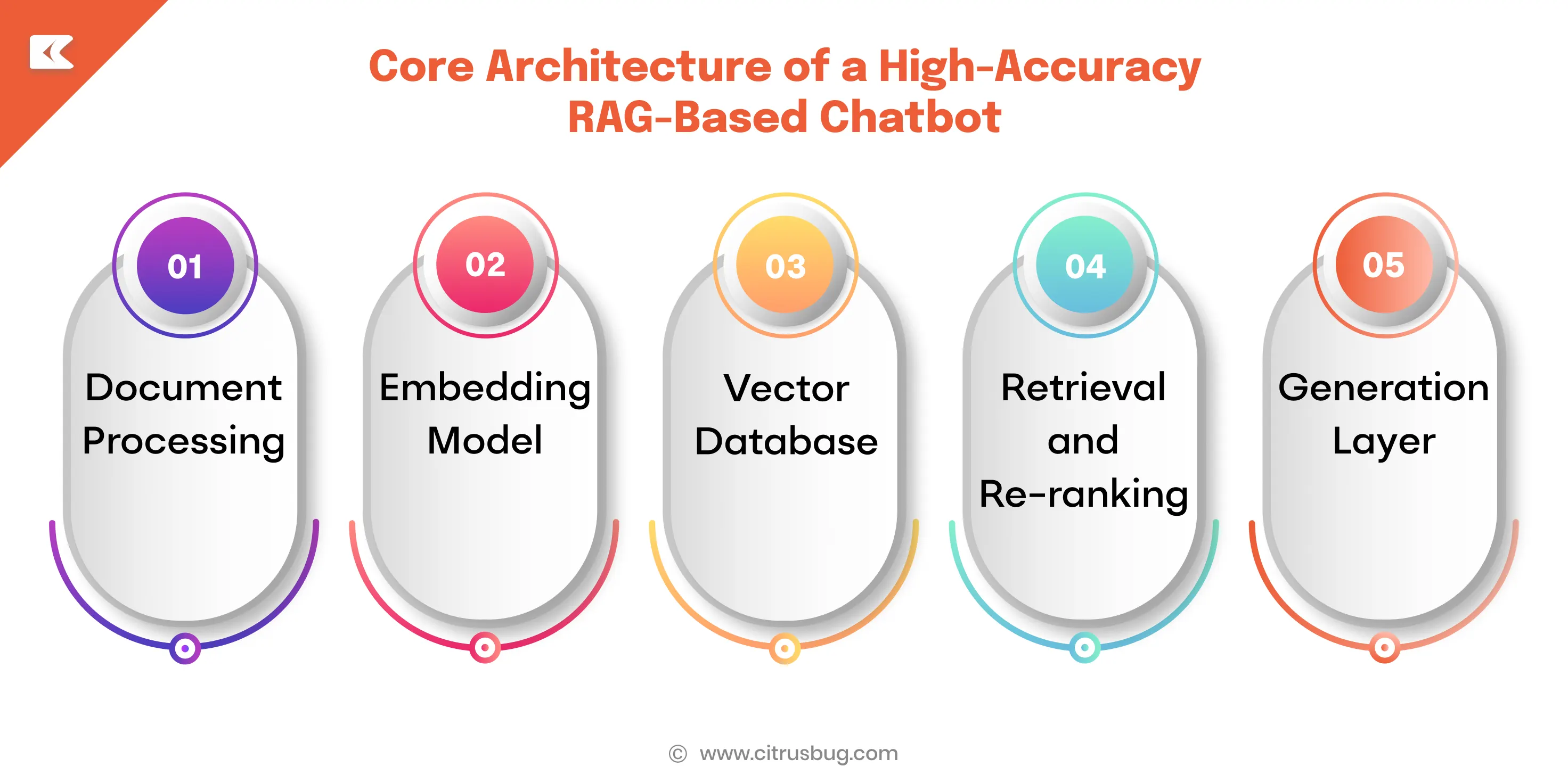
- Document Processing: source content gets cleaned, parsed, and broken into chunks sized for retrieval, not for human readability
- Embedding Model: converts each chunk and each incoming query into vectors that capture meaning, not just keywords
- Vector Database: stores those vectors and returns the closest matches to a query in milliseconds
- Retrieval and Re-ranking: pulls an initial candidate set, then reorders it so the most relevant chunks actually reach the LLM
- Generation Layer: the LLM writes the final answer using only the retrieved context, ideally citing where each claim came from
The generation layer gets the most attention because it’s the visible part of the product, but it’s rarely the layer that actually fails. Retrieval failures (the wrong chunk returned, a stale document still in the index, a query phrased differently than the source) cause the majority of accuracy problems teams trace back after launch.
Step-by-Step Guide to Building a RAG-Based Chatbot
Building a RAG-based chatbot is less about picking the “best” model and more about making seven sequential decisions correctly, each one narrowing the room for error in the next.
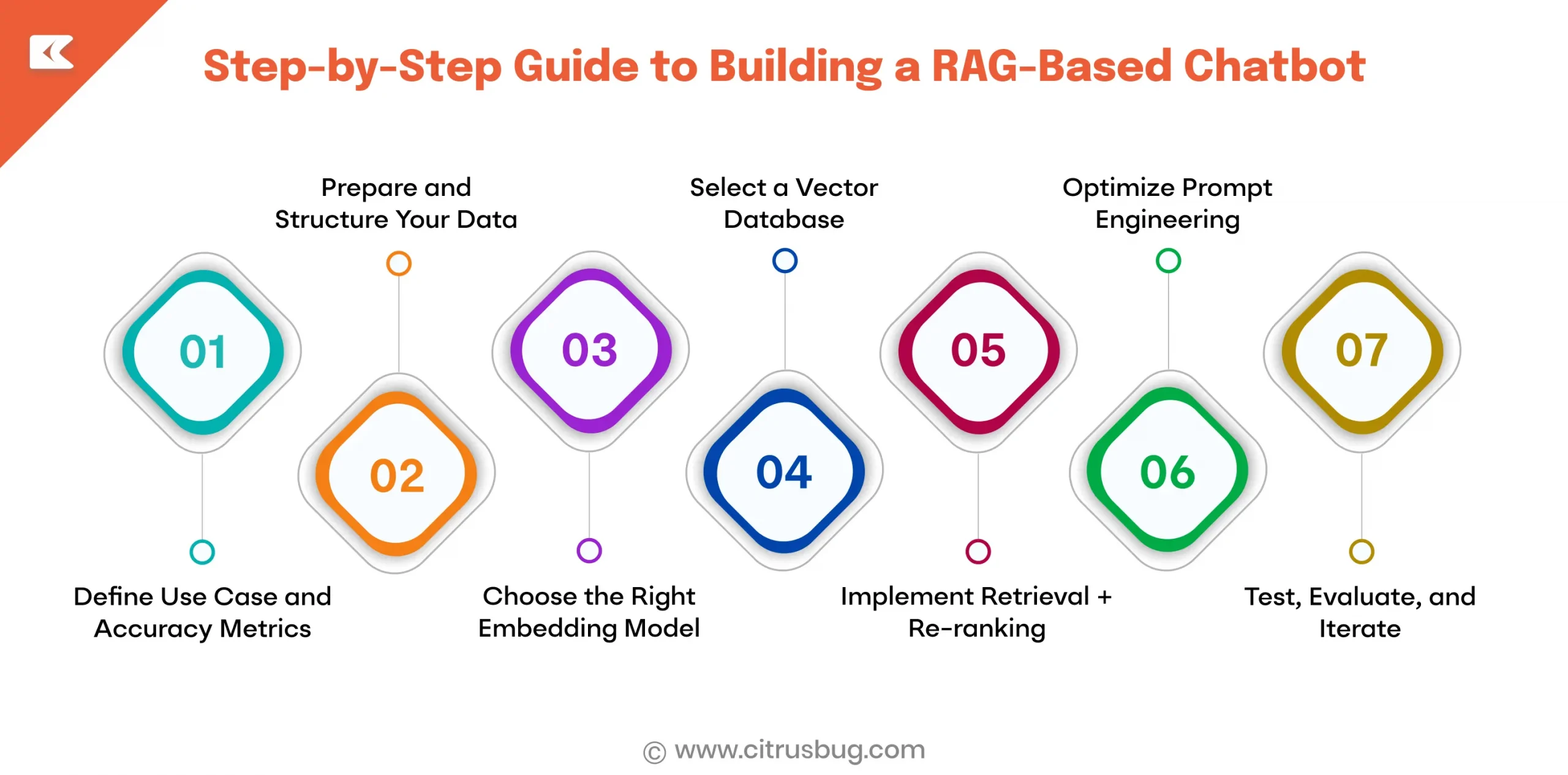
Step 1: Define Use Case and Accuracy Metrics
Decide what the chatbot needs to answer and how you’ll know if it’s right, before writing any retrieval logic. A support chatbot needs a different accuracy bar than an internal engineering assistant, and that bar should be a number (percentage of answers a human reviewer marks correct against a test set), not a vague sense of “good enough.”
Step 2: Prepare and Structure Your Data
Clean, deduplicate, and chunk your source documents before anything else happens. How you integrate external knowledge bases into the pipeline matters more than which vector database you eventually pick, since a well-chunked, well-tagged knowledge base (with metadata like document date, source, and access level) makes every downstream retrieval decision easier. Poorly structured data is the single most common root cause behind accuracy complaints traced back after launch.
Step 3: Choose the Right Embedding Model
General-purpose embedding models work fine for broad content, but domain-specific vocabulary (medical terminology, legal language, internal product names) often needs a model trained or fine-tuned on similar text. A model that’s never seen your jargon will place semantically related chunks farther apart than it should.
Step 4: Select a Vector Database
The right vector database for a large-scale RAG system depends less on raw benchmark speed and more on how it handles your actual retrieval pattern. Weigh these before committing.
- Scale: whether it can handle your document volume without a re-architecture in a year
- Hybrid search support: combining keyword and semantic search catches queries pure vector search misses
- Metadata filtering: lets you narrow results by date, source, or access level before similarity ranking runs
- Update latency: how quickly new or changed documents become searchable
Step 5: Implement Retrieval + Re-ranking
Retrieval pulls a broad set of candidate chunks, then a re-ranking model reorders them so the most relevant ones land at the top of what the LLM sees. This step alone is worth the added latency. It is reported that adding reranking to their vector search boosted retrieval accuracy by an average of 15 percentage points on their enterprise benchmarks, a meaningful jump for the added latency it usually costs.
Step 6: Optimize Prompt Engineering
The prompt sent to the LLM should instruct it to answer only from the retrieved context, state when the context doesn’t contain enough information rather than filling the gap from general knowledge, and cite which chunk supported each claim. Giving the model explicit permission to say “I don’t know” prevents more hallucinations than any amount of prompt polish aimed at making answers sound more confident.
Step 7: Test, Evaluate, and Iterate
Log every retrieved document alongside the generated answer, then compare both against a held-out test set with known correct answers. Measuring retrieval accuracy separately from generation accuracy matters, because a chatbot that retrieves the right document but answers it wrong needs a different fix than one that never finds the right document at all.
Techniques That Actually Improve RAG Accuracy (Advanced Layer)
Once the base pipeline works, a handful of open-source frameworks and techniques for retrieval-augmented generation push accuracy further without a full rebuild.
- Hybrid search: fusing keyword and semantic search catches exact-match queries (product codes, names) that pure vector search often misses
- Query rewriting: an LLM rewrites an ambiguous or poorly phrased query before retrieval runs, giving the search step a cleaner signal
- Agentic RAG: the chatbot can run multiple retrieval passes, or hand off to a specialized AI agent for a sub-task, rather than answering from a single retrieval pass
- Context-graph grounding: structuring retrieved knowledge as a graph rather than flat text chunks helps the chatbot catch contradictions between documents that flat retrieval tends to miss
None of these replace a solid base architecture, they compound on top of it. Teams that skip Steps 1 through 7 above rarely get much value from bolting on agentic RAG or hybrid search afterward.
Common Mistakes That Reduce RAG Chatbot Accuracy
The mistakes that quietly reduce RAG accuracy rarely show up in a demo. They show up months later, once the knowledge base has grown and users start asking questions the original test set never covered.
- Stale documents left in the index: outdated policies or old product specs keep getting retrieved and cited as current
- Chunk sizes that split ideas apart: a chunk that cuts off mid-explanation gives the LLM half a fact to work with
- No re-ranking step: relying on raw vector similarity alone lets loosely related chunks outrank the actually correct one
- No fallback for low-confidence retrieval: instead of saying it can’t find an answer, the chatbot generates one anyway
- Treating evaluation as a launch-day task: accuracy monitoring stops the day the chatbot ships, so drift goes unnoticed
Real-World Use Cases Where RAG Chatbots Improve Accuracy
Most people interact with a RAG-based chatbot regularly without realizing that’s what they’re using. Naming the exact chatbot use case first makes the pattern easier to spot, and easier to apply to a business’s own knowledge base.
Answering questions from a live, changing set of sources. Perplexity doesn’t answer from a fixed training set, it retrieves and ranks current sources for every query, then generates an answer grounded in what it just found. That’s the same reason it can cite exactly where each claim came from, and the same reason its answers change as the underlying sources change.
Searching a private, unstructured dataset that only one user owns. Notion AI answers questions about a workspace by retrieving across that specific user’s own notes and pages first. Its accuracy depends entirely on how well it retrieves within one person’s private documents, since the model has never seen that content during training.
Resolving customer support questions from a help center. Intercom’s Fin sources the exact help articles relevant to a customer’s question before generating a response, rather than answering from general knowledge about the product. It’s the same retrieval-then-generate pattern most support-focused chatbot development projects are built around, and it’s why a support bot can answer correctly about a policy that changed last week.
Answering internal company questions from scattered documents. Glean layers enterprise search over a knowledge graph, so an employee asking about an internal policy gets an answer grounded in the actual current wiki page or document, not a guess based on how similar companies usually handle it.
RAG vs Fine-Tuning: Which One Should You Choose?
RAG and fine-tuning solve different problems, and the cost question only makes sense once that distinction is clear.
| Factor | RAG | Fine-Tuning |
|---|---|---|
| Best for | Fast-changing, proprietary, or frequently updated knowledge | Changing a model’s tone, format, or specialized reasoning style |
| Upfront cost | Lower, no training run required | Higher, needs labeled data and compute for training |
| Ongoing cost | Retrieval infrastructure and query-time compute | Standard inference cost once trained, no retrieval step |
| Update speed | Near-instant, update the index | Slow, requires retraining |
| Data privacy | Easier to keep sensitive data in a controlled store | Data gets baked into model weights |
RAG’s costs are ongoing rather than front-loaded. Vector database hosting, embedding calls, and reranking add up per query, while fine-tuning is expensive once and cheap to run afterward. That’s the real tradeoff behind the table above. RAG costs more to run day to day; fine-tuning costs more to set up and change later. If it is still unclear which approach fits a specific use case, RAG consulting services can help evaluate the right path.
How to Measure and Continuously Improve Chatbot Accuracy
Accuracy isn’t a launch metric; it’s a maintenance discipline. The RAG chatbots that stay accurate a year in are the ones with monitoring built into the pipeline from day one.
- Retrieval precision: percentage of retrieved chunks that were actually relevant to the query
- Answer correctness: sampled human review against a rotating test set, not just the original launch set
- Groundedness rate: percentage of answer statements traceable to a retrieved chunk
- User correction rate: how often users flag or rephrase a query because the first answer missed
Document lifecycle management (expiring stale content, tagging authoritative sources, flagging contradictions) has produced some of the largest measured accuracy gains reported in production RAG deployments, often bigger than swapping the embedding model or vector database.
When You Need a Custom RAG-Based Chatbot (Not Off-the-Shelf)
Off-the-shelf RAG platforms work fine for straightforward document Q&A over a small, static knowledge base. They stop working once requirements get specific: strict access controls by user role, integration with internal systems that don’t have a plug-and-play connector, or accuracy requirements tight enough that generic retrieval settings won’t cut it.
That’s the point where finding reputable RAG development expertise stops being optional. A custom build starts with the specific accuracy bar and data constraints a business actually has, rather than fitting the business into a generic platform’s defaults, and it’s the difference between a chatbot that passes a demo and one that still answers a year into production correctly.
Conclusion
The chatbots that hold up in production aren’t the ones with the fanciest model behind them, they’re the ones where every layer- chunking, embedding, retrieval, re-ranking, prompt design- got the same level of attention. Skip any one of those and accuracy problems show up eventually, usually after the knowledge base has grown past what the original test set covered.
That is the real gap between a RAG chatbot that performs well in demos and one that stays reliable over time. It is also where investing in building a RAG chatbot with the right architecture and evaluation approach makes a difference. The challenge is rarely in setting up the initial pipeline, but in refining retrieval quality and data governance decisions that only surface under real usage.
FAQs
Do AI chatbots use RAG?
Many do, though it’s often invisible to the end user. Search-first tools like Perplexity, workspace assistants like Notion AI, and customer support bots like Intercom’s Fin all retrieve information before generating an answer. Not every chatbot uses RAG, simple scripted bots and some narrow-task assistants don’t need it, but any chatbot answering open-ended questions from a specific knowledge base almost certainly does.
Why is RAG so expensive?
RAG’s cost comes from what happens at query time, not at setup. Every question triggers an embedding call, a vector database lookup, and often a re-ranking pass before the LLM even starts generating, and those costs scale with usage rather than staying fixed the way a one-time fine-tuning run does. Larger context windows and hybrid search add further compute on top of that.
Can RAG completely eliminate hallucinations in chatbots?
No, and anyone claiming otherwise is oversimplifying. RAG reduces hallucinations meaningfully compared to a model working from memory alone, but retrieval failures still produce confidently wrong answers. Teams that need near-zero tolerance for fabricated information add a verification or confidence-scoring layer on top of RAG rather than relying on retrieval alone.