
 Back
Back







Key Takeaways
- IDX is NAR's Policy Statement 7.58 plus the software that shows another broker's MLS listings on your site. The MLS is the database. IDX is the rulebook and the delivery.
- Nobody owns IDX. NAR sets policy, each MLS runs its feed, listing brokers hold the listings, and vendors sell the software.
- NAR says an MLS must act on an IDX feed request within 5 business days, with exceptions. Vendors report longer waits.
- IDX costs money: vendor plans, plus MLS fees in some markets. Leads come from traffic and content, not from the feed itself.
- Rules vary by MLS. Check yours before you build.
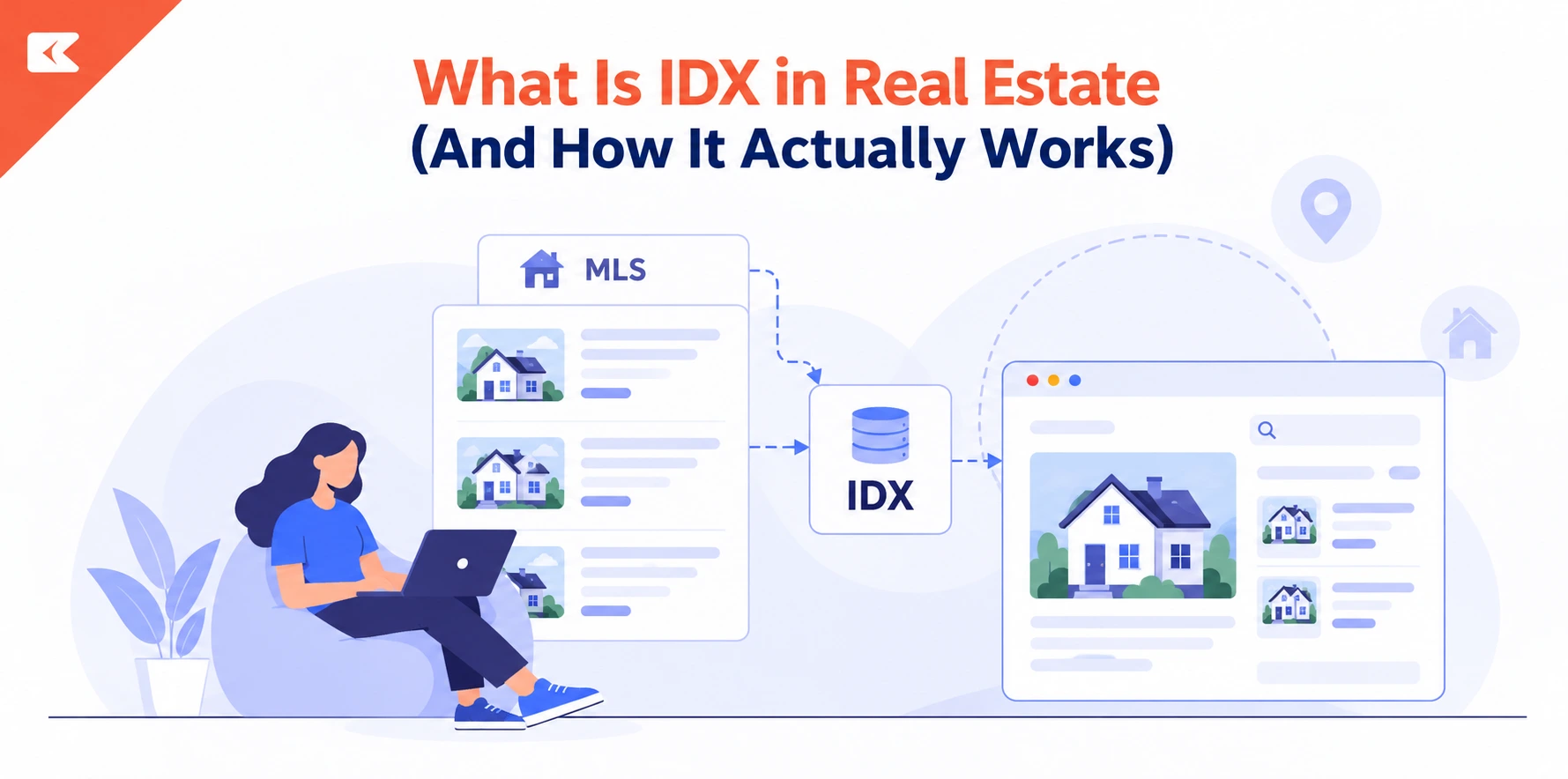
What is IDX in real estate? IDX, short for Internet Data Exchange, is the policy that lets brokers show each other’s Multiple Listing Service (MLS) listings on their own sites. The term also covers the software that carries that data there.
The National Association of REALTORS® (NAR) writes the policy. Each local MLS decides how to apply it.
If you have ever seen a broker’s site full of homes that broker never listed, you have seen IDX at work. This guide covers how it works, who controls it, what it costs, how long approval takes, and where its limits are.
What Is IDX in Real Estate? A Plain Definition
Internet Data Exchange (IDX) is a policy and a delivery system. The policy is NAR’s Policy Statement 7.58. The delivery system is the software that pulls listing data from the MLS and shows it on a broker’s site, such as a vendor product or a plugin. Vendors also call it broker reciprocity, because brokers trade permission.
In short, IDX is the NAR policy that lets participating brokers authorize limited online display of their listings on other participants’ websites, mobile apps, and audio devices, while the display stays under the participant’s control.
Two words in that definition matter most. “Limited” means only part of the MLS data goes public. “Participants” means the broker members of an MLS, not the general public.
NAR first adopted the IDX policy in May 2000 and has revised it several times since.
IDX is not the MLS. It is not a website. It is not one company’s product. The next sections separate each of those.
What Is the Purpose of IDX in Real Estate?
IDX exists so a broker can offer a full local home search without owning every listing. Brokers trade permission: you allow other participants to show your listings, and they allow you to show theirs. Buyers get one search that covers the local market.
Listing brokers get wider exposure for their listings. A small brokerage can offer the same breadth of search as a large one.
How Does IDX Work, Step by Step?
IDX works by moving listing data from the MLS to a website through an approved feed, under rules the MLS enforces. A participant asks the MLS for a feed; the MLS reviews and approves it, and a vendor, plugin, or developer connects it. The site then displays the listings and refreshes them.
- Enter the listing in the MLS. The listing broker does this. Under NAR’s policy, the broker’s consent to display is presumed unless the broker tells the MLS it refuses. A seller can also direct that a listing or its address be withheld from internet display.
- Request an IDX feed from the MLS. The participant must tell the MLS it plans to display IDX data and give the MLS direct access to check the site.
- Pass MLS review and approval. The MLS looks at the participant and at the vendor that will handle the data.
- Connect the feed. A vendor, plugin, or developer does this. The MLS issues credentials, and the site pulls listings through them.
- Display the listings and refresh them. NAR requires participants to refresh MLS downloads at least every 12 hours. The display must name the participant’s brokerage and the listing firm.
Here is the same path in one line:
Listing broker → MLS → consent and seller-withhold check → data feed → vendor or plugin → your website
The technology under the feed. Feeds travel over one of two standards. The Real Estate Transaction Standard (RETS) is the older one. The Real Estate Standards Organization (RESO) publishes the newer RESO Web API, a modern application programming interface (API) for listing data. RESO says RETS is deprecated and no longer supported.
Ask your MLS which one it offers, because the standard shapes the integration work. For a custom brokerage platform, the MLS integration is one part of the broader software architecture, alongside listing search, agent workflows, user accounts, and other brokerage functions covered in real estate brokerage software development.
Sites display listings in one of two ways. Some use an iframe, which is a window that shows another page inside yours. Others pull the data through the feed and build their own pages. The choice affects design, speed, and search visibility.
What Is the Difference Between IDX and MLS?
The MLS is the member-only database where brokers enter listings. IDX is the policy and delivery system that lets part of that data appear on public websites. The MLS is the source, and IDX is the rulebook and the pipe.
Other terms get mixed into this question, so here is the full map:
| Term | What it is | Who uses it |
|---|---|---|
| MLS | Member-only listing database | Broker members and their agents |
| IDX | Policy and delivery for public display | Participants’ websites and apps |
| Virtual Office Website (VOW) | Site that requires visitor registration first | Participants who want registered users |
| Portals | Public sites such as Zillow, Trulia, Realtor.com | Consumers |
| RESO Web API | Current data standard for feeds | MLSs and vendors |
| RETS | Older, deprecated data standard | Legacy feeds |
A Virtual Office Website (VOW) is a different kind of display. IDX Broker, an IDX vendor, describes registration as a VOW’s defining feature: visitors enter an email address and receive a password before they see listing data. NAR’s policy lets a participant’s site offer VOW features alongside IDX, and those features fall outside the IDX policy.
Who Owns IDX in Real Estate?
No single company owns IDX. Ownership is layered, and each layer controls something different. NAR writes the policy, the local MLS runs the feed and sets fees and local rules, the listing broker holds the listing, and the vendor owns its software.
| Layer | What it controls |
|---|---|
| NAR | Writes the policy, Statement 7.58 |
| Local MLS | Adopts the policy, runs the feed, sets fees and local rules |
| Listing broker | Holds the listing, and consent is presumed unless refused |
| Vendor | Owns its software and sells access to it |
“IDX Broker” is a company, not the concept. According to RISMedia, Elm Street Technology acquired IDX Broker in June 2020.
Who Can Use IDX, and What Changed in 2026?
Participants can display IDX listings. Individual agents can do so only where the MLS allows it and their broker consents. A participant is the principal broker who holds MLS membership. A subscriber is a non-principal member, such as an agent.
NAR’s policy lets an MLS choose to let non-principal brokers and licensees use IDX data on their own sites, subject to the affiliated participant’s consent and control. So an agent who wants IDX on a personal site should ask the broker first, then the MLS.
NAR updated its MLS rulebook for 2026. It announced 18 updates to its Handbook on Multiple Listing Policy on November 17, 2025, and called them the most extensive update to the Handbook in 20 years.
Kevin Sears, NAR’s 2025 president, told REALTOR® Magazine the changes “align MLS policies with how real estate professionals do business today.”
What that means for IDX, based on NAR’s summary of 2025 MLS changes:
- Two local options were deleted. The summary shows them struck from the IDX policy. One let an MLS limit IDX display to participants who are REALTORS®. The other let an MLS require separate searches for IDX listings and listings from other sources.
- Sellers gained named options. Statement 8.14, Multiple Listing Options for Sellers, replaced the old office exclusive policy. It includes delayed marketing, where a seller delays public marketing through IDX and syndication for any period the local MLS allows.
- Syndication now has a definition. New Statement 8.15 defines it as the MLS’s display of listings on its public site and its distribution of listings to third-party sites.
- MLSs had to self-certify. Each had to confirm its local rules meet the mandatory policies effective January 2026.
Check these against your local MLS rules. Local rules can go further.
What Are the Benefits of Using IDX?
The main benefit is a broader home search on your own website. Instead of limiting visitors to listings from your own brokerage, IDX can bring eligible listings from other participating brokers into the same search experience. That gives buyers more inventory to browse without leaving your site.
IDX can also extend the reach of your listings. Under applicable IDX rules, participating brokers can display listings from other participants, while your own listings may appear on other eligible IDX sites. The exact display rights depend on the MLS’s rules and the listing broker’s or seller’s display restrictions.
There is a trade-off. A broker that opts out of IDX display may lose the ability to show other participants’ listings on its own site. That makes the decision less about simply adding more listings and more about how the brokerage wants to balance inventory, exposure, and control.
IDX does not replace the role of an agent. NAR’s 2025 Profile of Home Buyers and Sellers reports that 88% of buyers purchased through an agent or broker. An IDX-enabled website can therefore serve as an online property-search and lead-generation channel while agents remain part of the buying process.
Once visitors begin registering, saving properties, or submitting inquiries, the next challenge is qualifying and responding to those leads. Tools such as AI chatbots in real estate can help automate parts of that process, particularly when a brokerage receives inquiries outside normal business hours.
What Are the Disadvantages of IDX, and Does It Help SEO?
IDX has real limits: fees, compliance duties, shared data, and no guaranteed traffic. Vendor plans and some MLS fees add up, and you must follow attribution, refresh, and no-other-use rules. Every participant can show the same listings, so your listing pages are not unique. A feed puts homes on a page but does not bring visitors to it.
Does IDX help search engine optimization (SEO)? On its own, only in limited ways. Here is what is documented and what is not.
| What is documented | Common claims without support |
|---|---|
| NAR’s policy does not require participants to block search-engine indexing of IDX listings. | “iframe content is invisible to search engines.” Google’s own statements do not support this. |
| In a 2017 Google hangout, John Mueller said Google may index the page that embeds an iframe as well as the framed page. | “IDX pages are always thin or duplicate.” That depends on what you add around the listings. |
| No primary source promises that IDX raises rankings. | “IDX alone lifts organic traffic.” Rankings depend on the pages and content you build around the listings. |
Mueller’s comment dates from 2017, so treat detailed IDX search advice as practitioner guidance rather than Google policy. Common recommendations include neighborhood pages, original content around listings, API-based display, and canonical tags.
How Long Does MLS IDX Approval Take?
NAR says an MLS must act on an IDX feed request within five business days, but the clock has exceptions, and vendors report longer waits. The exceptions cover questions about a person’s qualification for MLS participation and the review of how the participant and vendor will use the data.
When an exception applies, the MLS must issue an estimated approval or denial time.
| Source | What it says | Date | Type |
|---|---|---|---|
| NAR Statement 7.58 | Act within 5 business days, with exceptions | Edition of January 1, 2026 | Rule |
| Placester help article | Up to 10 business days after the agent and broker sign the IDX paperwork | April 25, 2023 | Vendor claim |
The Placester figure is from 2023, so confirm current timing with your MLS.
What slows approval:
- Paperwork errors. Placester says errors and slow MLS responses can delay approval.
- Qualification review. The MLS checks whether you qualify to participate.
- Vendor-use review. The MLS checks how your vendor will handle the data.
- Extra MLSs. Showing listings from more than one MLS requires participatory rights in each.
How Much Does IDX Cost?
IDX is not free. IDX Broker, a vendor, says typical IDX solutions cost $50 to $200+ per month, depending on features and whether a hosted website is included. An MLS may add its own fees on top.
IDX Broker’s plans:
| Plan | Starting monthly price | What it adds |
|---|---|---|
| Core | $60 | Map search, lead capture for an existing site |
| Engage | $99 | Market reports, sold data |
| Elite | $149 | A hosted, designed website with IDX |
MLS fees vary by market. NAR’s policy lets an MLS charge the costs of adding or improving its download capacity, tied to the actual costs.
| MLS or vendor | Fee |
|---|---|
| ARMLS | 5 free IDX and back-office feeds per brokerage, then $150 a month per extra feed |
| MLSListings | Charges approved IDX vendors a quarterly fee; rates start around $100 a month |
| Showcase IDX | Passes MLS fees through to customers, $5 to $30 a month |
Here is an illustrative example, not a quote. Assume an agent takes a $99 plan and the MLS passes through a $30 monthly fee, the top of Showcase’s range. The total is $129 a month, or $1,548 a year. Get every fee in writing from your vendor and your MLS.
How Do You Add IDX to a Website?
You pick a route, get MLS approval, connect the feed, and test the display against your MLS’s rules. The three routes are a hosted website, a plugin on your existing site, or a direct build on the RESO Web API. Effort runs from low for a hosted site to high for a direct build.
| Route | Fits | Trade-off | Effort |
|---|---|---|---|
| Hosted IDX website | Solo agents, small teams | Less design control | Low |
| IDX plugin on your site | Agents with a site already | You maintain the site | Low to medium |
| Direct RESO Web API build | Brokers, developers | You own upkeep and compliance | High |
IDX Broker’s Core and Engage plans are built to add to an existing site, and Elite includes a hosted one. A direct build makes sense when listing data must feed your own systems, and it is the route that needs engineers.
Search speed is often the first thing to suffer as listing volume grows. In Citrusbug’s work with Just Home, a German homeownership platform, the team built the search architecture behind more than 50,000 property listings.
The Just Home case study reports search responses under 250 milliseconds and 99.9% platform availability. It also reports a 30% increase in inquiry conversions after the team improved the search experience and added financing tools. That project was not an MLS or IDX build, but it shows the load a listing search must handle at volume.
Some brokerages eventually need more than a plugin can provide. If MLS listings need to flow into a customer relationship management (CRM) system, route new leads to the right agent, or match saved searches against live inventory, a custom integration may make more sense than a packaged IDX solution.
That approach usually starts with mapping the brokerage’s workflow and MLS dependencies, followed by the search experience, integrations, testing, deployment, and ongoing support. If the IDX project is part of a larger brokerage platform, real estate CRM development can cover the systems that sit around the listing feed.
IDX Compliance Checklist: What You Must Get Right
Compliance comes from NAR’s baseline rules plus your own MLS’s rules, so follow both. This checklist summarizes Policy Statement 7.58 in the 2026 Handbook.
- Get your broker’s permission, and tell the MLS you plan to display IDX data.
- Give the MLS direct access to check your site.
- Show your brokerage’s name and the listing firm, with its phone or email.
- Refresh feeds at least every 12 hours.
- Use IDX data only for IDX display.
- Hide listings and addresses that sellers have withheld.
- Choose which listings to show only by objective criteria, such as location or price.
- Keep a way to receive accuracy comments, and fix false data.
This is general guidance, not legal advice. Your MLS’s rules control.
What Does IDX Mean for Home Buyers and Sellers?
Buyers: an IDX listing comes from the MLS, but the site may lag. NAR sets a floor of one refresh every 12 hours, so a compliant site can be hours behind.
Sellers: you can direct your listing broker to withhold the listing or its address from internet display, and it must not show up through IDX. Under Statement 8.14, you can also choose an office exclusive or delayed marketing. Ask your listing agent which options your MLS offers.
Conclusion
IDX is what turns a brokerage site from a showcase of your own listings into a full local home search. The concept is simple, but the details, such as approval timelines, fees, and display rules, depend on your MLS. Settling those first makes every later decision easier, from picking a vendor to deciding whether you need a custom build.
The feed is only the starting point. What keeps buyers on your site and turns them into leads is the experience around it: fast search, useful local content, and a smooth handoff to your team. If an off-the-shelf plugin can’t give you that, our real estate software development services can help you design and build a platform that fits how your brokerage works.
Frequently Asked Questions
What is the difference between IDX and MLS?
The MLS is the member-only database where brokers enter listings, and it holds the data. IDX is the NAR policy, along with the software built to follow it, that controls which part of that data appears on public websites and how it is displayed.
Can an agent show IDX listings without the broker’s permission?
Usually not, because NAR’s policy lets an MLS allow agents to use IDX data on their own sites only subject to the affiliated broker’s consent and control. Rules differ by MLS, so get the broker’s approval first, then confirm the MLS’s own requirements.
Is IDX free?
No. IDX Broker, a vendor, puts typical IDX solutions at about $50 to $200 or more per month, and some MLSs add their own feed fees. ARMLS, for example, gives each brokerage five free IDX and back-office feeds, then charges $150 a month per extra feed.
How often must IDX listings refresh?
NAR’s policy requires participants to refresh MLS downloads, and any displays fed automatically by those downloads, at least every 12 hours. Many vendors refresh more often, some hourly, but that is a vendor practice rather than the NAR minimum, so check your vendor’s schedule.
Can a seller stop their home from showing on IDX sites?
Yes. If a seller directs the listing broker to withhold the listing or its address from internet display, NAR’s policy says it must not be accessible through IDX. Newer MLS options also let sellers choose delayed marketing or an office exclusive.
IDX rules, MLS fees, and vendor prices change often. We last verified the NAR policy text, the 2026 Handbook changes, and the pricing in this article on September 29, 2026.