
 Back
Back







AI medical scribe statistics paint a clear picture showcasing the clinical documentation is undergoing a fundamental shift. Healthcare organizations across North America, Europe, and Asia Pacific are deploying AI-driven scribing tools at scale. The goal is to reduce the administrative hours that have long pulled physicians away from direct patient care.
This shift is supported by investment, infrastructure, and policy alignment. EHR adoption has created the integration foundation, physician burnout has created the urgency, and generative AI has delivered the underlying technology.
The market numbers captured here reflect that transition in measurable terms. From software segments to regional share to long-range forecasts, the data confirms that AI medical scribing has crossed from experimentation into mainstream clinical infrastructure.
What is an AI Medical Scribe?
An AI medical scribe is software that listens to patient-physician conversations and automatically generates clinical documentation, including diagnosis notes, treatment plans, and follow-up instructions.
It operates in real time and integrates directly with electronic health record systems to produce structured records without requiring manual physician input.
These tools reduce the documentation burden on clinicians after each patient encounter. They are used across specialties from primary care to surgery. Any healthcare facility that prioritizes accurate, efficient record-keeping stands to benefit from their deployment.
AI Medical Scribe Statistics: A Global Market Snapshot
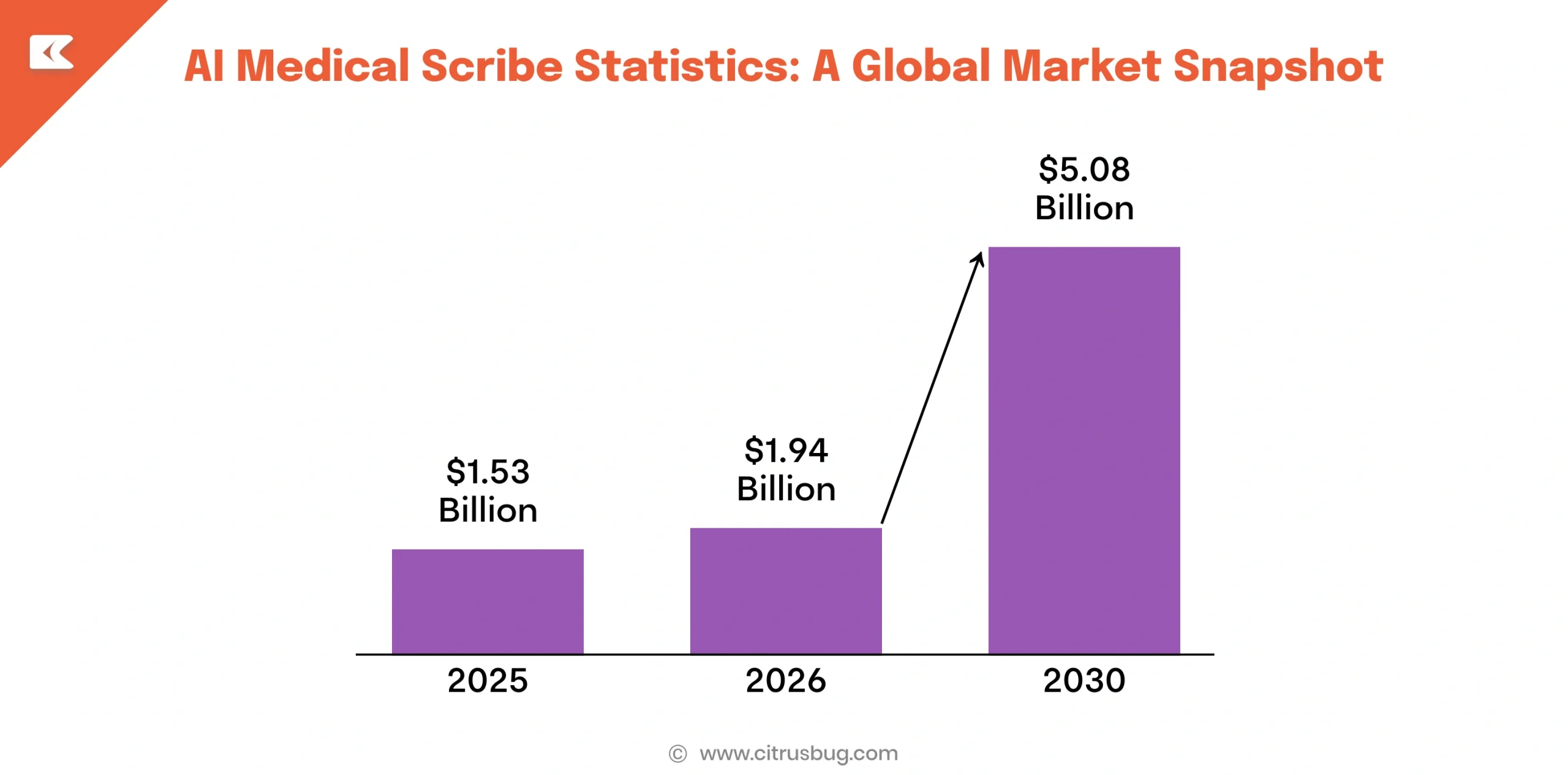
The AI medical scribing sector has expanded across multiple market layers, from core scribing software platforms to generative AI documentation tools and broader clinical documentation improvement systems.
Global AI Medical Scribe Software Benchmarks
The AI medical scribe software segment covers the most precise market definition: tools built specifically for physician scribing and clinical note generation. Revenue figures in this segment reflect software-only procurement and exclude broader implementation or consulting spend.
- The AI Medical Scribe Software market reached USD 1.53 billion in 2025, driven by EHR adoption, rising physician burnout, and accelerating healthcare digitization across major markets globally.
- The market expanded to USD 1.94 billion in 2026 at a 26.9% CAGR. That rate places it among the fastest-growing subsegments in the healthcare software category for this period.
Generative AI for Clinical Documentation
Generative AI has introduced a distinct documentation capability layer that goes beyond transcription to produce structured, codeable patient records directly from unstructured clinical conversation. This segment is tracking faster growth than scribing software broadly.
- The generative AI for clinical documentation market was valued at USD 0.79 billion in 2025, as health systems began integrating large language models into EHR-connected scribing workflows at an enterprise scale.
- The segment expanded to USD 1.05 billion in 2026 at a 33.30% CAGR, as hospital network deployments grew alongside rising physician acceptance of AI-generated note accuracy and completeness.
Clinical Documentation Improvement and Automation
AI medical scribing operates within a broader ecosystem that includes coding automation, compliance tools, and quality management platforms.
These adjacent markets reflect the full scope of institutional investment flowing into clinical documentation technology and provide important context for the scribing category’s total scale.
- The AI in clinical documentation market grew from USD 0.98 billion in 2025 to USD 1.15 billion in 2026 at a 21.46% CAGR as EHR-native AI workflows gained consistent traction across health systems.
- The global clinical documentation improvement market was valued at USD 5.26 billion in 2025 at a 7.90% CAGR across AI-assisted and conventional documentation management platforms serving hospital and health system settings.
- Clinical documentation integrity automation crossed USD 2.1 billion in 2025 at a 14.50% CAGR, with software converting unstructured clinical narrative into structured, codeable records for billing and compliance systems.
How AI Medical Scribes Are Being Deployed
The AI medical scribe statistics data reveal clear patterns in how clinical facilities are choosing to implement these tools.
Cloud-first delivery, hospital-centered adoption, and ambient scribing as the lead application have emerged as consistent trends across the U.S. market and beyond.
These patterns point to a standardized deployment model forming across health systems of different sizes and specialties.
Deployment Model Preferences
Cloud infrastructure has become the default delivery model for AI medical scribing and healthcare solutions.
Its rapid rollout timelines, automatic update cycles, and compatibility with enterprise EHR environments have made it the practical choice for health systems managing multi-site deployments and growing user bases.
- Cloud-based deployment led the U.S. AI medical scribing market with a 78.51% revenue share in 2024, supported by its compatibility with multi-location health systems, reduced upfront infrastructure requirements, and automatic software update delivery without IT intervention.
- The U.S. AI in medical scribing market grew to USD 621.66 million in 2026, up from USD 496.85 million the prior year. This growth reflects sustained investment from mid-size and large health networks that are expanding their AI scribing infrastructure across departments.
End-User Adoption by Facility Type
Hospitals have emerged as the primary institutional adopters of AI scribing tools. Their high patient volumes, complex documentation compliance requirements, and the staffing pressures inherent to inpatient environments create a strong operational case for automating clinical charting at the point of care.
- Hospitals held a 54.44% share of the U.S. AI medical scribing market in 2024, driven by stringent EHR documentation requirements and the high cost of manual charting at scale across inpatient and outpatient settings.
Dominant Application Within AI Scribing
Among the specific functions AI scribing tools perform, ambient clinical scribing has established itself as the most widely deployed capability.
Its ability to operate passively during encounters without requiring physician interaction has driven adoption across a broad range of specialty and primary care settings.
- The clinical documentation automation segment captured a 64.32% revenue share in the AI platform for clinical conversations market in 2025. This confirms that documentation automation is the primary function that health systems are seeking from AI-powered clinical conversation platforms.
AI Medical Scribing Software by Market Segment
Market-level segmentation data shows where investment in AI medical scribing is concentrated, which delivery architectures are winning institutional contracts, and which geographic markets are driving the largest share of adoption. These distinctions help clarify where growth is structurally anchored and where market entry competition is intensifying.
Software as the Core Component
Software commands the largest share of clinical documentation automation investment. This reflects how AI scribing has become fundamentally an intelligence and modeling product rather than a service.
In the CDI integrity automation market, the software component is projected to hold a 72.4% share in 2026, as algorithmic models convert unstructured physician narrative into structured clinical codes without manual review.
Platforms trained on specialty-specific clinical vocabulary consistently outperform services-heavy alternatives. Software-led delivery also continues to reduce per-encounter charting costs without requiring additional headcount from health system operators.
Cloud-Based Delivery as the Preferred Model
Cloud infrastructure dominates clinical documentation delivery across both new deployments and existing system migrations. It wins on the operational and financial logic of centralized management and continuous model improvement.
The cloud-based segment is projected to hold an 81.2% share of the CDI integrity automation market in 2026, with health systems prioritizing it for reduced upfront infrastructure investment and compatibility with centralized EHR platforms.
It also supports continuous machine learning model updates without requiring on-premise server maintenance or dedicated IT resource allocation from clinical operations teams.
North America’s Commanding Position
North America accounts for the highest concentration of AI medical scribing market activity among all global regions, anchored by healthcare IT maturity and the physician burnout crisis that has made documentation automation a clinical operations priority.
The AI in medical scribing market attributed USD 1.2 billion in revenue to North America in 2025. This reflects the region’s advanced procurement infrastructure and depth of EHR integration.
In the broader clinical documentation improvement market, North America maintained a 39% revenue share, supported by Medicare and Medicaid documentation requirements and near-universal EHR adoption mandates across inpatient and outpatient settings.
Regional Presence and Market Distribution
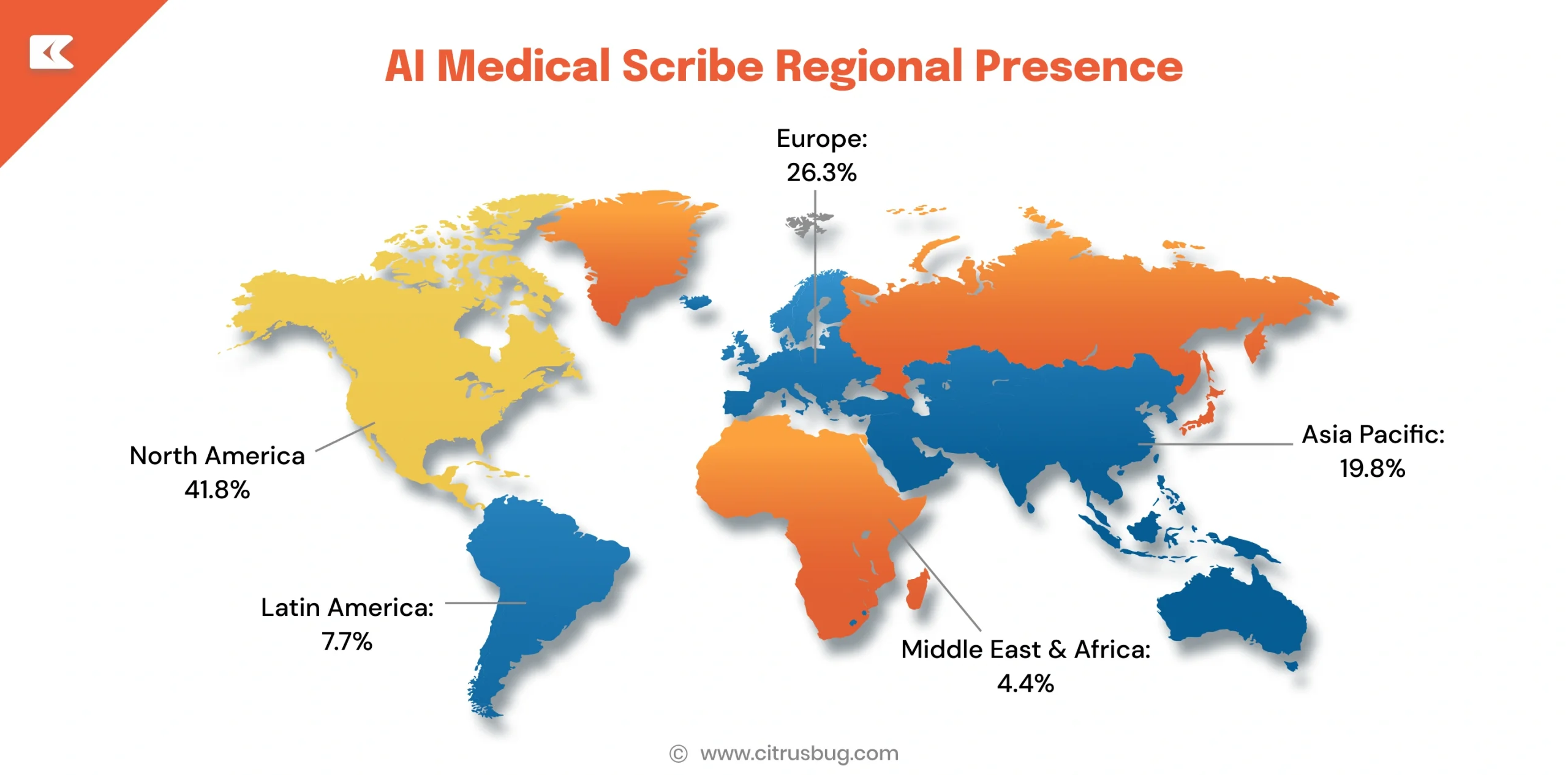
The global reach of AI medical scribing reflects a tiered market structure, with North America holding the dominant revenue position, Europe in second place, and Asia Pacific driving the fastest growth trajectory among all regions tracked.
The geographic distribution of adoption reflects infrastructure readiness, regulatory frameworks, and the pace at which health systems have invested in EHR modernization and clinical AI procurement programs.
North America
- North America held USD 1.17 billion and a 41.8% revenue share of the global AI medical scribe software market in 2025, supported by near-universal EHR adoption and strong institutional demand from health systems prioritizing physician documentation relief.
- The region’s advanced clinical AI procurement frameworks and deep insurance payer documentation requirements have both accelerated enterprise deployment programs.
Europe
- Europe captured approximately 26.3% of global AI medical scribe software revenue in 2025, with the UK, Germany, France, and the Nordic countries leading adoption.
- National health services in these markets are integrating AI documentation tools into existing clinical IT environments as public healthcare systems seek efficiency improvements without expanding physician headcount.
Asia Pacific
- Asia Pacific held a 19.8% revenue share in 2025 and ranked as the fastest-growing region globally. Digital health investments in China, India, Japan, South Korea, and Australia are driving rapid AI scribing platform adoption.
- Government-led health modernization programs and expanding private hospital networks provide both funding and procurement volume for vendors active in the region.
Latin America
- Latin America accounted for approximately 7.7% of the global AI medical scribe software market in 2025. Brazilian and Mexican healthcare conglomerates have led regional adoption as EHR mandates expand and private hospital networks invest in AI-driven documentation infrastructure to manage growing patient volumes and tightening reimbursement documentation standards.
Middle East & Africa
- The Middle East and Africa collectively held approximately 4.4% of the global AI medical scribe software market in 2025. GCC countries are driving regional adoption through Vision 2030 healthcare modernization programs.
- Digital hospital initiatives and integrated care center buildouts are creating consistent institutional demand for AI scribing tools across public and private health systems.
[Source: Dataintelo]
Factors Driving the AI Scribing Market Forward
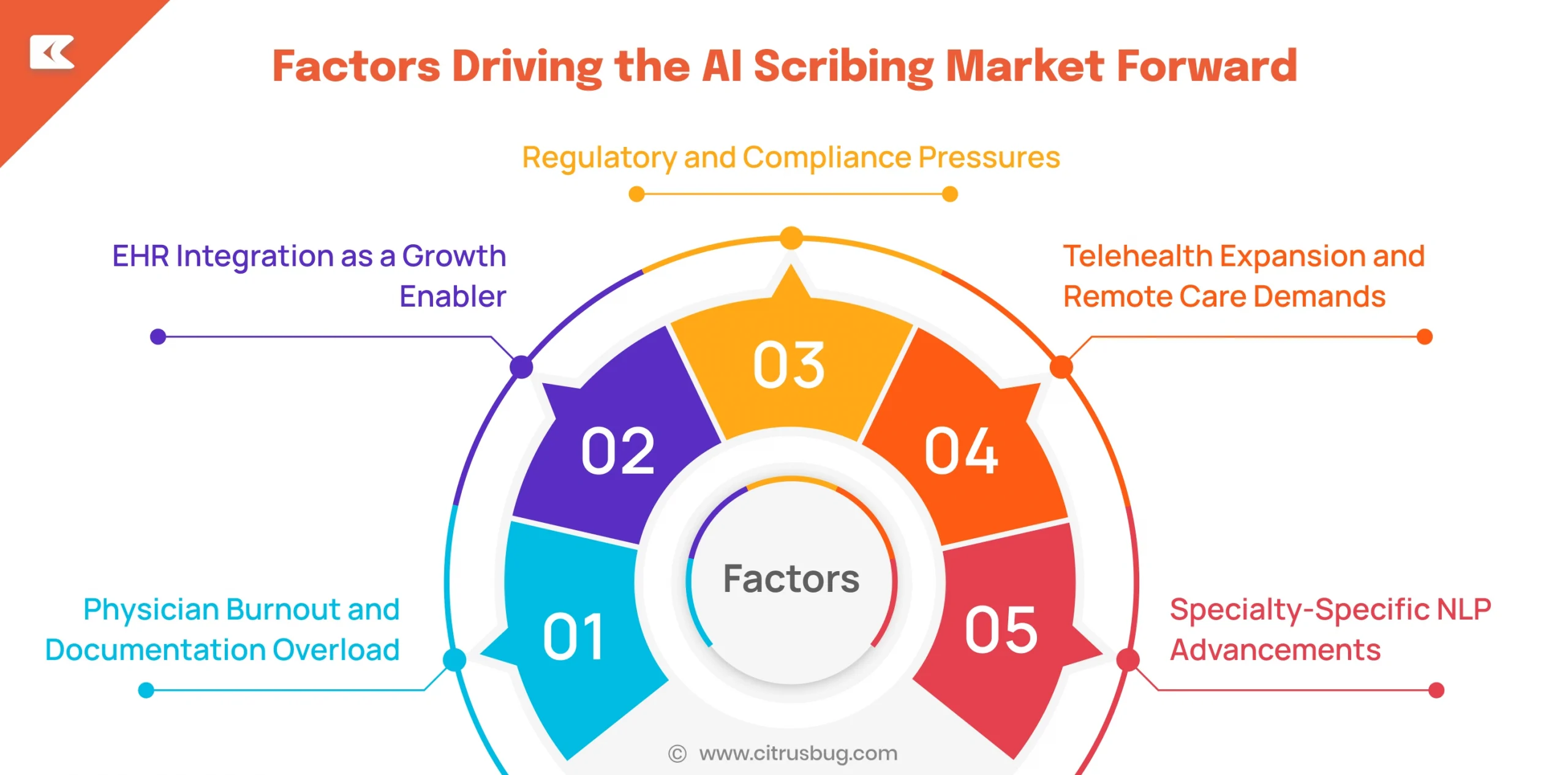
Several structural forces have aligned to make AI medical scribing a strategic priority for health systems across markets.
Understanding these drivers explains both the pace of adoption and the depth of institutional commitment that distinguishes AI scribing from previous waves of healthcare IT investment.
Physician Burnout and Documentation Overload
Physicians in the United States and across developed markets spend a disproportionate share of working hours on EHR charting rather than direct patient interaction.
This sustained documentation burden has created institutional urgency to reduce time-on-record without compromising note quality or regulatory completeness.
AI scribing tools address this directly by generating clinical notes in real time during patient encounters and returning productive hours to clinicians without changing the structure of the visit itself.
EHR Integration as a Growth Enabler
The near-universal adoption of electronic health records across North America and Europe has created a standardized technical foundation for AI scribing deployment.
As EHR systems become the universal standard for clinical record management, AI documentation tools gain a consistent integration target with established data protocols and vendor relationships.
This maturity shortens implementation timelines significantly and reduces the technical friction that previously slowed clinical AI procurement and deployment at enterprise scale.
Regulatory and Compliance Pressures
Value-based care models and payer documentation standards have raised the bar for note completeness and clinical coding accuracy across health systems.
Incomplete or inconsistent documentation leads to claim denials, audit exposure, and reimbursement delays that directly affect hospital revenue cycles.
AI scribing tools help providers meet these standards by producing structured, codeable notes that align with billing requirements consistently across every recorded patient encounter, independent of individual physician documentation habits.
Telehealth Expansion and Remote Care Demands
The growth of telemedicine has introduced new documentation requirements across virtual patient interactions that traditional transcription tools were not built to handle.
AI scribing platforms capable of processing audio from video and telephone appointments have become essential for telehealth providers managing high appointment volumes without proportional increases in administrative staff.
Their adaptability across synchronous and asynchronous care formats makes them a practical fit for the hybrid healthcare delivery models now standard at large health systems.
Specialty-Specific NLP Advancements
Natural language processing models have improved their ability to interpret specialty-specific clinical vocabulary across areas including oncology, orthopedics, cardiology, and behavioral health.
This precision has expanded the addressable market for AI scribing tools well beyond primary care, where early deployments were concentrated.
Health systems can now deploy AI scribing in complex specialty environments without requiring extensive post-generation note correction from physicians or clinical informatics teams. Total implementation costs drop accordingly.
What the AI Medical Scribe Market Looks Like Through 2031
The AI medical scribe statistics forecast picture is consistent across market tiers: software, automation, and CDI platforms are all projected to grow at rates well above healthcare IT averages through 2031.
These projections rest on current adoption trajectories, EHR integration trends, and the rising institutional spending on clinical automation that has characterized the past two years across hospital networks and ambulatory care settings.
The following projections cover distinct segments of the clinical documentation market, each with its own growth drivers and endpoint values within the 2030-2032 forecast window.
- The AI Medical Scribe Software market is projected to reach USD 5.08 billion by 2030, driven by expanding telehealth infrastructure, continuous AI technology improvements, and enterprise-wide health system deployments that are replacing earlier departmental pilots across hospital networks.
- The AI in clinical documentation market is forecast to reach USD 3.05 billion by 2031, as EHR-native AI deployment and enterprise CDI automation programs scale across hospital networks, regional health systems, and specialty care organizations building out AI-assisted documentation infrastructure.
- The CDI market as a whole is forecast to grow at a 7.3% CAGR from 2024 to 2032. Regulatory compliance requirements and NLP-powered coding accuracy improvements serve as the primary drivers behind this growth trajectory across hospital revenue cycle and compliance programs.
Conclusion
AI medical scribe statistics capture a market defined by rapid expansion, deep institutional adoption, and sustained investment across every geographic tier. From ambient scribing to generative AI documentation platforms, the data reflects a healthcare documentation ecosystem that has moved past experimentation into mainstream clinical infrastructure.
Organizations developing software for clinical environments should take note of these trends. Healthcare providers are actively investing in AI healthcare solutions, and the market’s long-range trajectory points to continued platform consolidation and specialization through 2031 and beyond.