
 Back
Back







Finding the right home healthcare software development company can shape how efficiently your organization delivers care outside traditional clinical settings. With many software development companies offering healthcare expertise, cloud engineering, and compliance experience, comparing portfolios, pricing, and delivery track records can quickly get difficult.
This guide breaks down seven leading home healthcare software development companies of 2026, comparing their ratings, experience, and pricing so you can shortlist a partner suited to your patient management, remote monitoring, or caregiver scheduling project with confidence.
Quick Comparison: Top Home Healthcare Software Development Companies
Here’s how the top 7 home healthcare software development companies stack up at a glance before you dive into the full profiles below.
| Sr No. | Company | Clutch Rating | Founded | Location |
|---|---|---|---|---|
| 1 | Arkenea Inc | 4.9 | 2011 | USA |
| 2 | SolGuruz LLP | 4.9 | 2019 | India |
| 3 | Citrusbug Technolabs | 4.7 | 2013 | USA, India |
| 4 | SoftDoes | 5.0 | 2019 | Mission, KS, USA |
| 5 | Saritasa | 4.8 | 2005 | Newport Beach, CA, USA |
| 6 | Intuz | 4.8 | 2008 | San Ramon, CA, USA |
| 7 | ZSI.AI | 5.0 | 2001 | New York, NY, USA |
How We Selected the Leading Home Healthcare Software Development Companies
Selecting healthcare technology partners requires balancing technical expertise with practical industry knowledge. We reviewed each company using six consistent evaluation standards to identify organizations capable of delivering reliable home healthcare software solutions.
- Healthcare Industry Experience: Organizations with practical experience building healthcare applications understand clinical workflows, patient engagement, regulatory expectations, and operational challenges more effectively.
- Client Reviews and Market Reputation: We reviewed trusted industry platforms, client feedback, and long-term customer satisfaction to understand how consistently each company delivers successful projects.
- Technical Expertise: Strong development capabilities across cloud platforms, mobile applications, AI, IoT, interoperability, and modern software architectures were considered during evaluation.
- Compliance and Security Knowledge: Healthcare software requires careful attention to HIPAA, GDPR, data privacy, secure authentication, and protected patient information throughout development.
- Communication and Project Delivery: We looked for companies that maintain transparent collaboration, realistic planning, timely delivery, and continuous support during every project stage.
- Scalability and Innovation: Businesses need technology that grows alongside changing patient demands. We considered each company’s ability to build flexible, future-ready healthcare platforms.
Top 7 Home Healthcare Software Development Companies
The organizations below were selected after evaluating healthcare expertise, delivery capabilities, technical strengths, and market reputation. Each company offers different advantages depending on your business goals, project complexity, and long-term product vision.
1. Arkenea Inc
Arkenea Inc specializes in healthcare software development with a strong emphasis on digital health products, connected patient experiences, and medical technology solutions. The company has worked with startups and healthcare organizations to build platforms that simplify home-based care delivery while maintaining secure and compliant systems.
Why Choose Arkenea Inc for Home Healthcare Software?
- Specializes in healthcare software with a strong focus on digital health products
- Experience building connected patient experience platforms and medical technology solutions
- Works with both startups and established healthcare organizations
- Emphasizes compliant, secure systems for home-based care delivery
- Healthcare-first team that understands clinical workflows before development begins
- Supports both web and mobile digital health product development
- Strong Clutch rating reflecting consistent healthcare project delivery
Google Rating: 4.1
Clutch Rating: 4.9
Awards: GHP Awards, Clutch
Hourly Rate: $50 – $99
2. SolGuruz LLP
SolGuruz LLP builds custom healthcare applications using modern technologies for web and mobile environments. Its development teams emphasize flexible product engineering while helping healthcare businesses create intuitive solutions for patient engagement, scheduling, caregiver management, and connected digital services.
Why Choose SolGuruz LLP for Home Healthcare Software?
- Builds custom healthcare applications for both web and mobile environments
- Flexible, objective-driven engineering rather than fixed delivery templates
- Focus on intuitive design for patient engagement and scheduling tools
- Experience supporting caregiver management and connected digital services
- Adapts development approach around each healthcare organization’s specific goals
- Competitive entry-level pricing suited to smaller healthcare startups
- India-based delivery model supporting cost-conscious healthcare projects
Google Rating: 5.0
Clutch Rating: 4.9
Awards: Clutch
Hourly Rate: < $25
3. Citrusbug Technolabs
Citrusbug Technolabs develops reliable home healthcare software solutions that support providers delivering care beyond hospitals and clinics. Its teams combine healthcare knowledge with modern engineering practices to create scalable platforms for patient management, remote monitoring, caregiver coordination, and connected healthcare experiences.
Why Choose Citrusbug Technolabs for Home Healthcare Software?
- Combines healthcare domain knowledge with modern engineering practices
- Builds scalable platforms for patient management and remote monitoring
- Supports caregiver coordination tools and connected healthcare experiences
- Focus on secure development standards across the full software lifecycle
- Recognized through Digital Excellence Awards and Manifest agency listings
- Works with providers across the complete home healthcare software lifecycle
Google Rating: 5.0
Clutch Rating: 4.7
Awards: Clutch, ISO
Hourly Rate: $25 – $49

4. SoftDoes
SoftDoes develops tailored digital products for organizations seeking modern healthcare software solutions. The company combines product strategy with engineering expertise to create applications that improve communication, workflow visibility, and operational efficiency across distributed healthcare environments.
Why Choose SoftDoes for Home Healthcare Software?
- Combines product strategy with engineering expertise for healthcare clients
- Builds applications that improve communication across distributed care teams
- Collaborative delivery process with close client interaction throughout
- Focus on workflow visibility and operational efficiency improvements
- Iterative approach that refines features based on real feedback
- Strong Clutch rating built on consistent client satisfaction
- Works well with organizations that value close, hands-on collaboration
Google Rating: N/A
Clutch Rating: 5.0
Awards: Clutch
Hourly Rate: $50 – $99
5. Saritasa
Saritasa delivers custom healthcare software for organizations building connected care ecosystems and patient-focused digital products. Its experience spans mobile applications, cloud platforms, IoT integrations, and enterprise healthcare systems that support care teams across home-based and clinical environments.
Why Choose Saritasa for Home Healthcare Software?
- Experience spans mobile, cloud, IoT, and enterprise healthcare systems
- Builds connected care ecosystems supporting both home and clinical settings
- Multidisciplinary teams adaptable to evolving regulations and requirements
- Years of healthcare technology delivery inform practical development processes
- Supports patient-focused digital products across multiple care environments
- Large volume of Clutch reviews reflecting broad project experience
- Suited to organizations with larger budgets seeking enterprise-grade delivery
Google Rating: 4.2
Clutch Rating: 4.8
Awards: N/A
Hourly Rate: $100 – $149
6. Intuz
Intuz creates digital healthcare platforms that combine cloud technologies, AI capabilities, and scalable application development. The company works with healthcare businesses looking to modernize patient engagement, automate operational workflows, and build connected solutions supporting remote healthcare delivery.
Why Choose Intuz for Home Healthcare Software?
- Cloud-first engineering approach supporting flexible, scalable healthcare platforms
- Combines AI capabilities with modern application development practices
- Experience automating operational workflows for healthcare businesses
- Supports remote healthcare delivery and patient engagement modernization
- AWS Consulting Partner status backing cloud infrastructure expertise
- DesignRush accreditation reflecting recognized agency-level delivery standards
- Well-suited for organizations prioritizing AI and cloud-native healthcare platforms
Google Rating: 4.0
Clutch Rating: 4.8
Awards: Clutch, AWS, DesignRush
Hourly Rate: $25 – $49 / hr
7. ZSI.AI
ZSI.AI develops AI-driven software that helps healthcare organizations turn operational and clinical data into practical digital solutions. Its capabilities extend across intelligent automation, predictive analytics, and custom healthcare applications that support more informed decisions for providers delivering care at home.
Why Choose ZSI.AI for Home Healthcare Software?
- Specializes in AI-driven software for healthcare organizations
- Focus on predictive analytics and intelligent automation capabilities
- Builds solutions that turn clinical and operational data into insights
- Supports providers managing large home-based patient populations
- Combines data science expertise with healthcare application development
- Suited for organizations prioritizing data-driven decision-making tools
- Works best with providers looking to scale AI-powered monitoring insights
Google Rating: 5.0
Clutch Rating: 5.0
Awards: Clutch
Hourly Rate: $50 – $99 / hr
Website: https://zsi.ai
How to Choose the Best Home Healthcare Software Development Company
Finding the right technology partner starts with understanding your long-term business goals. Beyond technical expertise, you should evaluate how well a company understands healthcare operations, compliance requirements, and patient-centered product design.
- Look for healthcare domain expertise. You should prioritize companies that have delivered healthcare applications before. Experience with caregiver workflows, patient management, remote monitoring, and digital health products usually reduces project risks.
- Review security and compliance capabilities. Your software will handle sensitive patient information, making security essential. Ask how the development team approaches HIPAA, GDPR, secure authentication, encryption, and ongoing compliance requirements.
- Evaluate technical flexibility. Your platform may require integrations with EHR systems, wearable devices, payment gateways, or telehealth services. Choose a company comfortable working across multiple technologies and third-party systems.
- Understand the delivery process. Clear communication keeps projects moving smoothly. Discuss project planning, sprint reviews, testing practices, documentation, and post-launch support before finalizing your development partner.
- Check scalability for future growth. Your software should continue performing as patient numbers increase. A scalable architecture makes it easier to introduce new services, additional users, and advanced healthcare features later.
- Balance cost with long-term value. Lower development costs may appear attractive initially, but long-term reliability often delivers greater business value. Consider experience, product quality, support, and maintainability alongside pricing.
Types of Home Healthcare Software Solutions
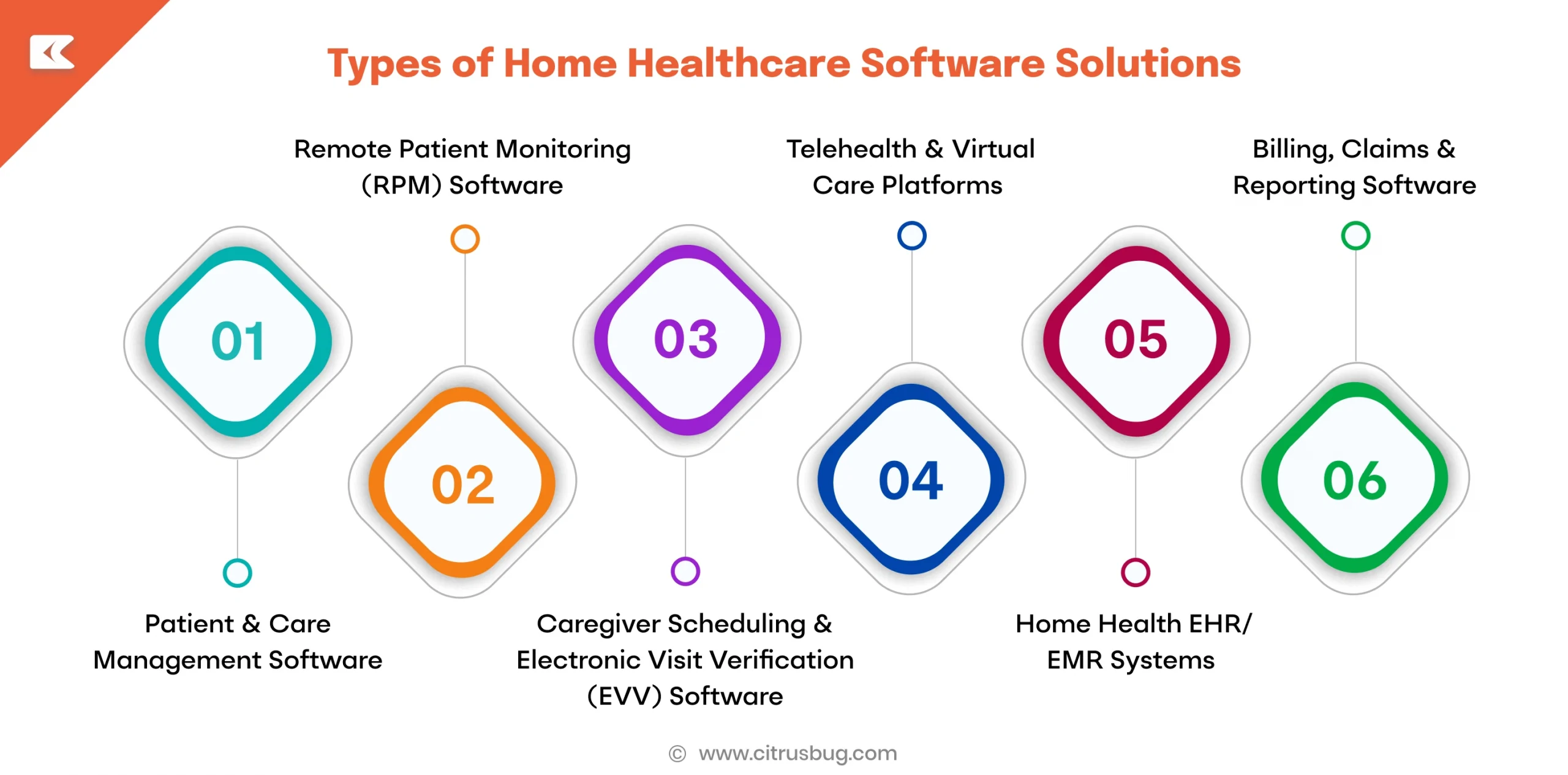
Home healthcare technology isn’t a single product most organizations rely on a combination of tools working together. Understanding these categories helps you scope your project more accurately before approaching a development partner.
1. Patient & Care Management Software
This software centralizes patient records, care plans, and progress notes so caregivers, nurses, and administrators can stay aligned on treatment goals. It typically acts as the core system that other home healthcare tools connect to, making it easier to track outcomes over time.
- Tracks care plans, visit history, and patient outcomes in one place
- Supports role-based access for caregivers, nurses, and administrators
- Often serves as the central hub connecting other healthcare tools
2. Remote Patient Monitoring (RPM) Software
RPM software collects real-time health data from wearables and connected devices, helping care teams catch warning signs before they turn into emergencies. It reduces the need for frequent in-person visits while keeping providers informed about patient status between scheduled check-ins.
- Integrates with wearables, sensors, and connected medical devices
- Sends automated alerts when readings fall outside safe ranges
- Reduces need for in-person visits for routine check-ins
3. Caregiver Scheduling & Electronic Visit Verification (EVV) Software
This software manages caregiver assignments, shift scheduling, and visit tracking, while verifying that scheduled visits actually took place. It helps home health agencies stay organized and compliant with state-mandated EVV requirements that apply to Medicaid-funded services.
- Automates scheduling based on caregiver availability and patient needs
- Verifies visit start/end times using GPS or telephony
- Helps agencies stay compliant with state EVV mandates
4. Telehealth & Virtual Care Platforms
Telehealth platforms enable secure video consultations between patients and providers, removing the need for an in-person visit for many routine or follow-up appointments. This expands access to care, particularly for patients facing mobility limitations or transportation barriers.
- Supports secure, HIPAA-compliant video and messaging
- Often includes e-prescribing and virtual visit documentation
- Expands access to care for patients with mobility limitations
5. Home Health EHR/EMR Systems
These systems store structured clinical records and support interoperability with hospitals, labs, and other care providers. They help reduce duplicate data entry and give care teams a more complete view of a patient’s medical history across settings.
- Maintains structured clinical documentation and history
- Supports HL7/FHIR-based data exchange with external systems
- Reduces duplicate data entry across care settings
6. Billing, Claims & Reporting Software
This software handles invoicing, insurance claims, and financial reporting specific to home-based care billing models, which often differ from standard clinical billing. It reduces manual errors and helps agencies track reimbursements and operational performance more accurately.
- Automates claims submission and reimbursement tracking
- Generates compliance and operational reports for stakeholders
- Reduces billing errors tied to manual data entry
Conclusion
Choosing the right companies is about finding a partner that understands both healthcare delivery and software engineering. Every organization has different priorities, so your decision should reflect your operational goals, compliance needs, and future growth plans.
This list is a practical starting point for comparing experienced home healthcare software development providers. As you evaluate potential partners, focus on execution quality, healthcare expertise, and long-term collaboration rather than comparing features or pricing alone.
Home Healthcare Software Development Companies: Frequently Asked Questions
What features should home healthcare software include?
⇒ Core features include patient management, caregiver scheduling, EVV, telehealth, billing, reporting, and EHR integration.
How long does it take to develop home healthcare software?
⇒ Most projects take four to twelve months, depending on feature complexity and compliance requirements.
Why is HIPAA compliance important for healthcare software?
⇒ HIPAA protects patient health information and reduces legal risk while strengthening user trust.
Should you build custom software or purchase an existing platform?
⇒ Custom software suits unique workflows, while ready-made platforms suit standard operational needs.
How much does home healthcare software development cost?
⇒ Costs vary by features, integrations, and compliance needs, so a discovery phase gives the most accurate estimate.
Can home healthcare software integrate with existing healthcare systems?
⇒ Yes, modern platforms commonly integrate with EHR, billing, and wearable device systems through secure APIs.
What should you evaluate before hiring a development company?
⇒ Review healthcare experience, security practices, communication style, and past project outcomes before deciding.