
 Back
Back







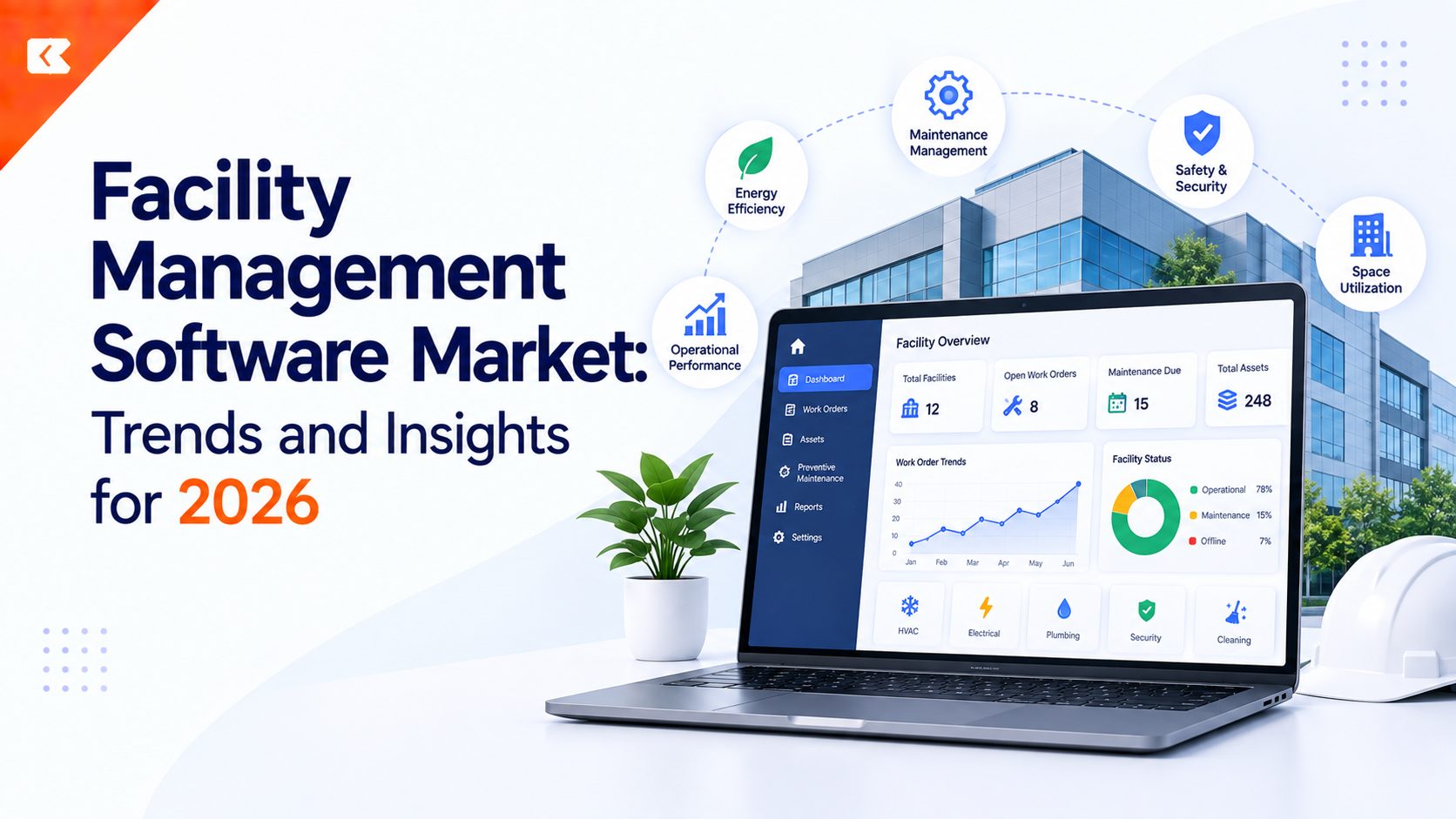
Commercial buildings, hospitals, campuses, and industrial sites depend on coordinated systems to keep daily operations running smoothly. As property portfolios grow larger, spreadsheets and manual work orders can no longer keep pace with maintenance schedules and compliance demands. This gap has pushed the facility management software market into a central role for organizations managing physical assets at scale.
Cloud platforms, mobile work order systems, and connected sensors are replacing fragmented, paper-based processes across industries. Facility teams now expect real-time visibility into asset health, energy use, and space utilization instead of periodic manual audits.
Understanding where this space stands heading into 2026 gives businesses a clearer basis for evaluating their own technology investments and operational priorities.
What Is Facility Management Software?
Facility management software is a digital platform that helps organizations plan, track, and manage the physical assets, maintenance schedules, and daily operations of buildings and facilities.
It centralizes work orders, space records, equipment data, and compliance documentation into one system accessible from desktop or mobile devices.
This technology matters because it replaces scattered spreadsheets and paper logs with organized digital records that reduce downtime and missed maintenance. Facility teams gain clearer visibility into costs and asset conditions, which supports more efficient use of building resources.
Facility Management Software Market Size and Growth
Global spending on digital facility platforms has climbed steadily as organizations replace manual processes with connected systems. Current figures capture the overall size of this space and how revenue splits across deployment models and company sizes.
These figures give businesses a clearer baseline for benchmarking their own technology budgets against the broader industry, particularly as more finance teams begin tracking facility software as its own line item rather than folding it into general IT spending.
Global Market Value and Deployment Trends
Total market revenue and deployment preferences show how quickly organizations are formalizing their facility technology spending rather than treating it as a minor operating expense.
- Global spending on facility management software reached USD 3.79 billion in 2024, a figure that points to steady enterprise investment in digital building operations.
- This scale reflects a shift away from ad hoc maintenance tracking toward dedicated software budgets across commercial real estate, healthcare campuses, and industrial sites.
- Cloud-based platforms accounted for 60.34% of total market revenue in 2024, a share that confirms a clear preference for remote-accessible systems over locally installed tools.
- Facility teams increasingly favor subscription-based platforms that let multiple sites and outside vendors view the same maintenance data at the same time, without maintaining separate local servers.
Enterprise Adoption and Growth Trajectory
Company size and growth expectations further define how this market is expected to develop over the next several years of technology budgeting.
- Large enterprises represented 67.80% of market revenue in 2024, since bigger property portfolios need more advanced coordination tools than smaller operations.
- Multi-site organizations typically require dedicated modules for asset tracking, vendor management, and compliance reporting that smaller facilities can often operate without, since single-site operations rarely need enterprise-grade vendor coordination or multi-region compliance documentation.
- The market is projected to grow at a compound annual rate of 13.37% between 2026 and 2032, a pace that signals sustained enterprise demand for centralized building management tools.
- This growth trajectory suggests that budget allocation for facility technology will keep rising well beyond current spending levels through the decade, as more organizations move past pilot deployments and commit to multi-year software contracts.
Together, these figures point to a market moving from early, department-level adoption toward standardized, portfolio-wide technology budgets that finance and operations teams plan for on an annual basis.
Adoption and Usage Patterns Across Facility Teams
As the facility management software market matures, adoption figures show how deeply these platforms have moved into daily operations rather than remaining pilot projects confined to a handful of buildings.
Enterprise and Portfolio-Level Adoption
Multinational corporations and large service providers are integrating specialized modules at a notable pace as portfolios grow more complex and harder to manage manually.
- Around 47% of multinational corporations had integrated centralized operations management software into their facility workflows as of 2025.
- This level of integration allows regional teams to work from one shared operations record instead of separate local spreadsheets that are difficult to reconcile across sites.
- Close to 41% of major service providers introduced predictive maintenance software upgrades in 2025 to reduce unplanned equipment failures.
- These upgrades typically use sensor data and historical repair records to flag equipment before it breaks down. This early detection approach helps reduce emergency callouts and the higher costs that typically come with reactive, last-minute repairs handled outside normal scheduling.
- Roughly 58% of large organizations had implemented workplace optimization software by 2025 to manage space allocation and desk usage more effectively.
- This kind of software helps property teams identify underused floors and adjust leasing or layout decisions accordingly instead of relying on periodic manual walkthroughs.
[Source: Business Research Insights]
Daily Technology Utilization Among Facility Teams
Day-to-day usage patterns among facility managers reinforce how central these platforms have become to routine operational decisions, from single offices to large industrial campuses with dozens of buildings.
- About 70% of facility managers now rely on technology tools to improve daily operational efficiency across their portfolios.
- This reliance spans work order tracking, vendor scheduling, and reporting that once required manual coordination between departments and outside contractors.
- Software solutions made up close to 61% of the workspace management software segment in 2025, ahead of standalone hardware components.
- This balance shows that organizations are prioritizing the analytics and scheduling layer of workplace technology over sensors and hardware purchased on their own, since software is what turns raw occupancy data into decisions facility teams can act on.
Facility Management Software Segmentation Insights
Spending patterns within the facility management software market differ sharply depending on deployment choice and product category. These choices shape how vendors design, price, and support their platforms for different types of buyers.
Deployment Model Preferences
On-premises systems still captured 54.20% of facility management software revenue in 2025, a share that highlights how many organizations with strict data governance needs continue to favor locally hosted infrastructure.
This preference remains common among regulated industries such as government agencies and healthcare facilities that manage sensitive operational records and cannot easily move workloads off internal servers.
Many of these organizations plan gradual, multi-year migrations rather than a single rapid switch to cloud infrastructure. Legacy systems typically keep running alongside newer tools throughout this kind of extended transition period.
Procurement teams in these sectors often require lengthy security reviews and vendor audits before approving any new hosting arrangement, which further slows the pace of change.
Product Category Breakdown
Product-level figures show where buyers are directing new budget within the broader facility technology space.
Computer-aided facility management platforms reached a market value of USD 4.98 billion in 2024, a total that points to steady demand for tools managing space, assets, and maintenance from a single interface.
Integrated workplace management systems followed closely, valued at USD 6.14 billion in 2025 as organizations sought broader platforms connecting real estate, space, and maintenance data under one dashboard.
Building management system software tied to facility operations added USD 1.2 billion in 2024, a segment shaped by demand for centralized control over mechanical and electrical building systems.
Together, these product categories show that buyers are increasingly willing to pay for platforms connecting multiple functions rather than single-purpose tools that only address one part of facility operations.
Regional Market Share and Growth Insights of Facility Management Software
Momentum in the facility management software market varies widely by geography, shaped by infrastructure funding, regulatory programs, and construction activity across different economies.
North America
North America held 37.46% of global facility management software revenue in 2025, a share supported by widespread digital adoption across large commercial portfolios and mature property management practices.
Established real estate and healthcare sectors in the region continue to replace legacy maintenance systems with modern platforms.
This ongoing replacement cycle keeps the region as the largest single contributor to global revenue, even as growth rates elsewhere begin to close the overall gap.
Asia-Pacific
The Asia-Pacific facility management software market is expanding at a projected 26.30% compound annual rate between 2026 and 2031, a pace tied to rapid commercial construction and smart building initiatives across the region.
New office towers, hospitals, and retail developments across the region are adopting real estate technology and digital facility systems from the outset.
This built-in adoption pattern is helping the region close the gap with more established markets, particularly as commercial developers standardize on digital-first specifications for new construction.
Europe
Germany directed roughly EUR 500 million toward integrated workplace management and energy platforms following its 2024 building performance policy revision.
This funding is aimed at helping commercial building owners meet stricter national energy reporting requirements. Similar policy-driven programs are expected across other Western European markets in the coming years, as national governments align building codes with regional climate targets.
India
India’s Smart Cities Mission earmarked USD 1.2 billion for facility management software procurement across municipal and commercial infrastructure projects in 2025.
This funding supports municipalities adopting shared digital platforms to manage public buildings, utilities, and civic infrastructure together.
It also creates a procurement pathway for software vendors that serve public sector clients across municipal governments, utilities, and public healthcare facilities.
[Source: Mordor Intelligence]
Key Trends Shaping Facility Management Technology
Several distinct shifts are changing how organizations select, deploy, and use facility software day to day, from deployment choice to which building types are prioritized first.
Rising Cloud Adoption in India
Cloud-based deployment accounted for 58% of facility management activity in India in 2025, a level tied to fast-growing commercial construction and a preference for scalable, remotely accessible systems.
This pattern is closely linked to the pace of new commercial and IT park development across major Indian cities, where new buildings tend to adopt cloud platforms from day one rather than retrofitting older systems.
Property developers in these markets often treat cloud-based facility software as a standard part of new building specifications rather than an optional upgrade added after construction is complete.
Continued Reliance on On-Premises Systems Globally
On-premises deployment still held 56.9% of the global facility management market in 2024, a share that shows many large organizations have not fully shifted toward cloud infrastructure.
Data sensitivity and long procurement cycles continue to slow migration in several industries, particularly where legacy systems remain deeply embedded in existing IT infrastructure.
Replacing these systems often requires coordination across IT, security, and facility teams before a migration can even begin, which is one reason on-premises platforms remain common even as newer buildings default to cloud options.
Hard Services Leading Service Demand
Hard services, which include mechanical, electrical, and structural maintenance, represented 50.62% of the global facility management market in 2026.
This share highlights ongoing demand for software that schedules and tracks physical asset upkeep rather than soft service tasks such as cleaning or landscaping alone.
Vendors serving this segment often build deeper asset history and compliance tracking features into their platforms, since mechanical and electrical systems typically carry stricter inspection and safety documentation requirements than soft services such as cleaning or grounds upkeep.
Healthcare Emerging as a Priority Vertical
Healthcare facilities accounted for 25.71% of the global facility management market in 2026, a share that reflects the sector’s need for strict compliance tracking and continuous equipment monitoring.
Hospitals and clinics increasingly depend on software that documents maintenance history for regulatory audits and helps prevent costly equipment downtime in patient-critical areas, mirroring broader healthcare software trends toward compliance-first design.
This dependence is pushing vendors to build healthcare-specific compliance modules into their healthcare software development platforms, since general-purpose maintenance tools rarely cover the audit trails that hospital accreditation bodies expect.
Factors Accelerating Market Growth
A combination of regulatory, financial, and workplace pressures continues to push organizations toward more capable digital tools for managing their buildings.
Energy Efficiency Requirements
Rising pressure to cut building energy use is pushing facility teams toward software that tracks consumption in real time.
Energy management tools made up 25.1% of the building management systems software segment in 2024, a share that reflects how central this function has become.
Organizations use this data to meet efficiency targets and reduce utility costs across large property portfolios.
Sustainability and Building Performance Standards
Facilities that adopt energy-efficient practices can reduce energy consumption by 30%.
Software that monitors equipment performance and flags inefficiencies helps facility teams reach these savings without relying on manual inspections or guesswork about which systems need attention.
Workplace Experience Expectations
About 78% of employees consider workplace quality an important factor in job satisfaction.
This expectation is pushing facility teams to use software that manages air quality, space comfort, and maintenance responsiveness as part of a broader occupant experience strategy across office and campus environments.
Aging Infrastructure and Preventive Maintenance
Many commercial buildings rely on equipment that is decades old, which makes unplanned breakdowns more frequent and costly to resolve.
Facility teams are turning to preventive maintenance software to schedule inspections before failures occur.
This approach reduces emergency repair costs and extends the working life of core building systems such as HVAC and electrical infrastructure.
Portfolio Growth and Multi-Site Coordination
As organizations expand across multiple locations, manual coordination of maintenance, vendors, and compliance becomes difficult to sustain at scale.
Centralized software gives facility leaders a single view across every site in their portfolio.
This visibility helps standardize processes and reduce the administrative burden that comes with managing scattered properties across different regions.
Future Outlook and Emerging Opportunities
Forecast figures point to continued expansion as more regions and business segments adopt dedicated facility software solutions over the coming years. This growth extends well beyond the deployment and adoption patterns already covered above.
Global spending on facility management software is projected to reach USD 53,525.23 million by 2032, supported by a compound annual growth rate of 12.4% between 2024 and 2032.
This trajectory points to a market that is expected to grow well beyond its current scale as more businesses formalize their facility technology budgets and expand existing deployments into additional buildings and business units.
Computer-aided facility management platforms alone are expected to reach USD 1,904.24 million by 2032 as more organizations adopt dedicated maintenance and asset tracking tools.
This growth suggests that maintenance-focused software will remain a distinct and expanding product category rather than being folded entirely into broader platforms.
Facility management software tied to building management systems is projected to grow at more than 16.5% annually through 2032, a pace that reflects rising demand for centralized building control platforms.
This growth is closely tied to new construction projects that build automation and facility software into a single connected system from the start rather than adding it later as a separate purchase.
European Green Deal-funded programs are expected to digitally transform more than 1 billion square feet of infrastructure by 2026, a shift that expands the addressable base for facility software vendors across the region.
Public buildings undergoing this transformation are expected to require ongoing software support well beyond the initial rollout phase. This continuing need creates longer-term service opportunities for vendors that stay involved after initial deployment.
Conclusion
Statistics on the facility management software point to a sector shifting from manual, fragmented processes toward connected, data-driven platforms.
Market value, deployment patterns, and regional funding programs all show that organizations are prioritizing centralized systems for maintenance, space planning, and compliance.
As adoption continues to widen across enterprises, regions, and building types, these figures offer businesses a clearer picture of where facility technology investment is headed through 2026 and beyond.