
 Back

Key Takeaways
- AI for tenant screening and leasing can automate inquiry responses, identity checks, income verification, document review, and report preparation while leaving rental decisions to qualified reviewers.
- The most practical starting points are repetitive leasing tasks and document verification. Automated risk scoring requires stronger controls and ongoing monitoring.
- The Fair Housing Act and Fair Credit Reporting Act (FCRA) can apply to AI-assisted screening. Housing providers must understand their responsibilities when a screening report influences an adverse decision.
- Screening costs include report fees, staff review, system integrations, and compliance work. Custom development may make sense when packaged tools cannot support a property's workflow.
- A successful implementation needs explainable outputs, applicant correction procedures, audit logs, and clear responsibility for every decision.
AI for tenant screening and leasing can take repetitive work off property managers’ plates, from answering inquiries and checking documents to preparing lease paperwork. Tools that use AI agents in real estate, such as leasing assistants and document-analysis software, can now handle many of these steps.
That does not mean everything should be automated. Routine communication and document verification are good starting points. Rental decisions, adverse-action notices, and exception handling still need accountable people, because errors can affect an applicant’s access to housing and create legal risk under fair housing and consumer reporting laws.
This guide explains how AI tenant screening works, which leasing tasks to automate first, where it can fail, what US law requires, and how costs and build-versus-buy decisions compare. It provides general information, not legal advice.
What Is AI for Tenant Screening and Leasing?
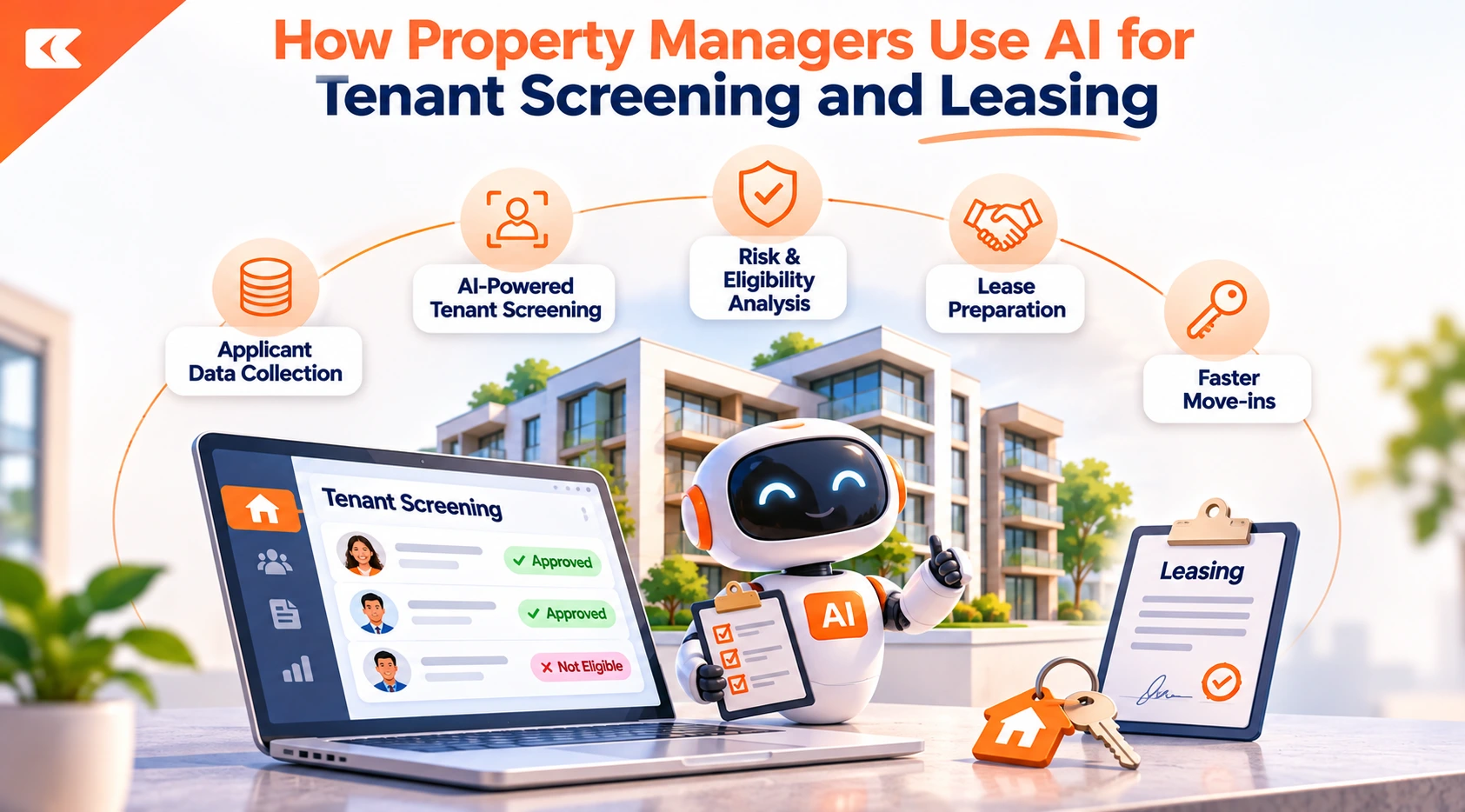
AI for tenant screening and leasing is the use of artificial intelligence software to handle repetitive rental application tasks, verify applicant information, flag potential inconsistencies, and assist with the process from initial inquiry to signed lease.
Property managers can use these tools to answer prospective tenants’ questions, collect application information, check supporting documents, organize screening reports, schedule property tours, and prepare lease documents. Staff can then focus on reviewing evidence, resolving exceptions, and making decisions.
Consider a property manager receiving dozens of applications across several properties. Each application may contain identification documents, income records, rental history, and credit information. Reviewing these records manually takes time, especially when information is missing or inconsistent.
AI can organize the information and highlight discrepancies. It cannot establish that every flagged discrepancy indicates fraud, nor does a risk score automatically establish whether someone will be a reliable tenant.
Two related processes are worth distinguishing:
- Tenant screening: Evaluating an applicant’s identity, financial information, rental history, and other legally permissible criteria.
- Leasing automation: Managing inquiries, pre-qualification, tour scheduling, application collection, lease preparation, and related communications.
Screening is one stage of leasing, not the entire process. A useful AI implementation connects these activities without removing the human judgment required at consequential decision points.
How Does AI Tenant Screening Work?
AI tenant screening typically combines data retrieval, document analysis, verification rules, and report generation. The exact process depends on the provider, the records available, and the property’s screening policy.
1. Confirm Applicant Identity
Identity verification checks whether an applicant’s identifying details match the documents and records supplied.
Depending on the system, this may involve comparing names, dates of birth, addresses, identification documents, and other permitted identifiers. A mismatch should trigger further review rather than an automatic rejection.
Identity checks also help reduce mistaken-identity problems when multiple people have similar names.
2. Verify Income and Employment
Income verification compares the information provided in an application with supporting records.
For example, a system may extract salary figures from a pay stub and compare them with bank deposits or payroll records when the applicant has authorized access to those sources. It can flag inconsistent dates, unusual deductions, or figures that do not reconcile.
These discrepancies are signals for investigation, not proof of dishonesty. Variable income, recent employment changes, self-employment, and document formatting differences can all require manual review.
3. Detect Potential Document Fraud
Document-analysis tools can examine pay stubs, bank statements, identification documents, and other application files for suspicious inconsistencies.
Checks may include:
- Conflicting totals or dates.
- Inconsistent fonts, layouts, or formatting.
- Signs of image manipulation or unusual document metadata.
- Differences between stated information and independently verified records.
No single signal reliably establishes fraud. A legitimate document may look unusual because it was scanned, converted, or exported from another system.
4. Assemble the Screening Report
A screening platform can combine information from authorized sources and present it in a structured report.
The report may contain identity-verification results, credit information, rental history, permitted criminal-record information, document flags, and a score or recommendation.
Property managers should be able to examine the underlying records and understand why the system raised a concern. A summary score without supporting evidence makes it harder to identify errors and explain decisions.
5. Route Exceptions for Review
The system should identify cases that need additional attention, such as conflicting records, missing information, or a document that cannot be verified.
A reviewer can request clarification, investigate a discrepancy, or correct an inaccurate record before proceeding.
This exception-handling step is essential. Automation should make relevant evidence easier to examine, not turn uncertainty into an automatic denial.
How AI Fits Into the Inquiry-to-Lease Workflow
AI can support nearly every stage of leasing, but different tasks require different levels of oversight.
| Leasing stage | What AI can do | Where staff step in |
| Initial inquiry | Answer routine questions and collect basic information | Handle complex questions and individual circumstances |
| Pre-qualification | Apply consistent, written criteria to supplied answers | Review exceptions and accessibility needs |
| Property tours | Offer available appointments and send reminders | Handle special arrangements and access issues |
| Application collection | Organize documents and identify missing information | Resolve submission problems and obtain clarification |
| Document verification | Extract data and flag inconsistencies | Verify whether flags are meaningful |
| Screening | Assemble authorized records and prepare reports | Review the underlying evidence and applicable policy |
| Rental decision | Organize relevant information for consideration | Make and document the decision |
| Lease preparation | Populate approved terms in a document template | Check terms, resolve exceptions, and authorize the agreement |
The best starting point is often inquiry response, appointment scheduling, and document organization. These tasks are repetitive, measurable, and generally easier to separate from the final rental decision.
Chatbot-based pre-qualification, a common use of AI chatbots in real estate, requires more care. Questions and criteria should be objective, relevant to tenancy, and applied consistently. Applicants should also have a way to speak with a person when an automated conversation does not address their circumstances.
What Should AI Decide, and What Should a Person Decide?
AI should primarily support information gathering, verification, analysis, and workflow coordination. The appropriate role of a human reviewer depends on the task, the applicable law, and the consequences of an error.
A practical control framework looks like this:
| Task | Appropriate automation | Required control |
| Inquiry response | Answer approved questions | Escalate uncertain or sensitive requests |
| Document review | Extract information and flag discrepancies | Verify flags before taking action |
| Screening report | Organize records and identify relevant findings | Review source records and correct errors |
| Risk assessment | Explain how supplied evidence relates to defined criteria | Test for errors, bias, and unsupported assumptions |
| Rental decision | Prepare information for consideration | Assign responsibility for the decision and document the rationale |
| Adverse-action notice | Populate a notice using approved information | Verify accuracy and meet applicable notice requirements |
| Lease preparation | Draft documents from authorized terms | Review the agreement before execution |
A meaningful human-review process requires more than adding an approval button. The reviewer needs access to the relevant evidence, enough time to assess it, authority to override an automated recommendation, and a way to record the reasons for the decision.
For example, a screening system might flag an income discrepancy because a self-employed applicant receives irregular deposits. A reviewer should be able to consider appropriate supporting evidence rather than treating the flag as proof that the applicant failed the criteria.
What Do Adoption and Rental-Fraud Statistics Tell Us?
Available research points to concerns about application fraud, screening errors, and reliance on automated recommendations. However, the findings should be interpreted in the context of each study’s sample and methodology.
AppFolio’s 2026 benchmark survey covered 1,617 US residential property management professionals surveyed between September 26 and November 3, 2025. According to the vendor’s findings, 56% of respondents reported encountering application fraud in the preceding year. Among managers who encountered fraud, 65% reported seeing more than one type.
TechEquity Collaborative’s April 2025 research examined landlords in California, Georgia, and North Carolina. It reported that 60% of surveyed landlords received AI-enabled screening reports. The organization’s research found that approximately 36.5% of landlords reportedly followed screening recommendations without additional review.
These findings suggest two important implementation priorities:
- Improve verification. Inconsistent information and manipulated documents need a structured process for investigation.
- Make screening recommendations reviewable. Property managers should understand what influenced a recommendation and have a way to challenge inaccurate inputs.
The Consumer Financial Protection Bureau’s November 2022 consumer snapshot also documented complaints involving tenant-screening reports. The report recorded approximately 26,700 complaints from January 2019 through September 2022. Complaints do not establish that every report was inaccurate, but they illustrate why record accuracy and dispute procedures matter.
These figures come from different sources and research designs. They should not be combined into a single industry-wide adoption or error rate.
Where Does AI Tenant Screening Fail?
AI-assisted screening can produce harmful outcomes when the underlying data is incorrect, the criteria are inappropriate, or reviewers treat recommendations as definitive.
Incorrect or Mismatched Records
A report may associate an applicant with another person’s criminal, eviction, or credit records. Duplicate entries and incomplete case outcomes can also distort the result.
Control: Match records using multiple identifiers, verify relevant source information, and provide a documented process for applicants to dispute errors.
Overreliance on Risk Scores
A score can hide important details about the information used, the assumptions made, and the uncertainty in the result.
Control: Require access to the underlying records, understandable explanations for flags, and a documented review before adverse decisions.
Biased or Inappropriate Inputs
A model can reproduce unfair outcomes when its inputs or decision rules disadvantage protected groups. Even apparently neutral criteria can create discriminatory effects.
Control: Review the relevance of each criterion, test outcomes for disparities, investigate unexpected patterns, and document corrective action.
Thin Credit Files or Alternative Income
Applicants with limited credit histories, nontraditional employment, or variable income may not fit a standard model’s assumptions.
Control: Do not treat missing information as proof of risk. Define appropriate alternatives for verifying income and evaluating applications under the same written policy.
Forged or Unverifiable Documents
Fraud-detection software may miss sophisticated alterations or flag legitimate documents incorrectly.
Control: Use multiple verification methods, examine supporting evidence, and route uncertain results to trained staff.
Inconsistent Application of Screening Rules
Different reviewers may interpret the same report differently, or staff may apply different criteria to similar applicants.
Control: Maintain version-controlled screening criteria, train reviewers, log decisions, and periodically examine whether the policy is being applied consistently.
The broader lesson is to evaluate both technical accuracy and real-world effects. A system can process documents quickly and still be unsuitable if its recommendations cannot be explained or its errors cannot be corrected.
Is AI Tenant Screening Legal in the United States?
AI-assisted tenant screening is not categorically prohibited in the United States. However, the use of AI does not remove existing obligations under housing, consumer-reporting, privacy, and applicable state or local laws.
The following distinctions are important.
Fair Housing Act
The federal Fair Housing Act prohibits discrimination in housing based on protected characteristics. AI-assisted screening does not exempt a housing provider from those requirements.
A policy can create concerns even if it does not explicitly use a protected characteristic. For example, a criterion may disproportionately exclude a protected group without being appropriately related to tenancy.
Housing providers should examine their screening criteria, how those criteria are applied, and whether the resulting decisions create unjustified disparities.
Fair Credit Reporting Act
The FCRA regulates consumer reporting agencies and the use of consumer reports for specified purposes, including tenant screening.
When a housing provider takes adverse action based in whole or in part on a consumer report, FCRA notice requirements may apply. Adverse action can include denying an application or imposing certain unfavorable rental terms.
The notice generally needs to identify the consumer reporting agency and explain the applicant’s rights to dispute inaccurate information and obtain a free copy of the report if requested within 60 days.
See the Federal Trade Commission’s guide to tenant background checks and applicant rights.
The housing provider should not assume that a screening vendor will automatically satisfy every obligation on its behalf. Responsibilities depend on the parties’ roles and the applicable requirements.
Regulatory Guidance Has Changed
HUD’s 2024 guidance discussed how the Fair Housing Act applies to tenant screening, including algorithmic systems. In April 2026, HUD published a notice withdrawing eight fair-housing guidance documents. The notice is available through the Federal Register.
The withdrawal of guidance should not be confused with the repeal of the Fair Housing Act itself. Housing providers should check current agency materials and applicable law rather than relying on an older guidance document as though it remains current.
Similarly, the CFPB withdrew multiple guidance documents in May 2025. That action does not, by itself, eliminate statutory FCRA obligations.
Colorado’s Automated Decision-Making Law
Colorado enacted SB 26-189 in May 2026, addressing automated decision-making technology used in consequential decisions, including housing. The legislation includes requirements concerning technical documentation, disclosures, record retention, and human review, with provisions scheduled to apply from January 1, 2027.
Review the Colorado General Assembly’s official bill page for the enacted text, implementation details, and subsequent updates.
Property managers operating across states should review the rules applicable to each market. State and local requirements may also govern source of income, criminal-history screening, application fees, and how screening information can be used.
No screening tool is automatically compliant simply because its vendor markets it that way. Compliance depends on the criteria, data, implementation, review procedures, and decisions involved.
This section provides general information, not legal advice. Consult qualified counsel to assess the requirements that apply to your properties and screening process.
How to Compare AI Tenant Screening and Leasing Tools
Different tools address different stages of the rental process. Comparing them by function is more useful than assuming that one platform can handle every task equally well.
| Tool category | Primary purpose | Examples | Questions to ask |
| Screening report providers | Credit, criminal, eviction, and other permitted reports | TransUnion SmartMove, RentSpree, TurboTenant | Can reviewers access source records and correct errors? |
| Document and fraud detection | Identify suspicious or inconsistent documents | Snappt, Resistant AI | Can the system explain why a file was flagged? |
| AI leasing assistants | Handle inquiries, pre-qualification, and tour scheduling | EliseAI, LetHub | Does it integrate with the existing property management system? |
| Property management platforms | Manage property operations and related screening workflows | AppFolio, Buildium, Entrata, RealPage | Which screening functions are included, and which require additional providers? |
| Screening decision platforms | Organize evidence and support or automate recommendations | Findigs | How are recommendations explained, reviewed, and challenged? |
These examples are not a ranking or an endorsement. Product capabilities, availability, integrations, and pricing can change, so verify each provider’s current offering before making a decision.
Seven Questions to Ask Before Choosing a Vendor
- Can we define our criteria? Confirm whether the tool supports your documented screening policy and applicable requirements.
- Can we inspect the evidence? Review whether staff can access source records instead of relying only on a score.
- How are errors corrected? Understand how applicants can challenge inaccurate information and how updates reach decision-makers.
- Can the model’s outputs be explained? Ask for clear reasons behind flags and recommendations.
- How is performance monitored? Review the vendor’s approach to accuracy, changes in data, and potential discriminatory outcomes.
- Does it integrate with our existing systems? Confirm how the tool connects with your property management system, application portal, document storage, and communication workflows.
- Who owns each decision? Establish responsibility for review, notices, recordkeeping, and exceptions before implementation.
Request demonstrations using realistic scenarios and test cases. A polished product demonstration is not a substitute for checking whether the tool works with your actual workflow and responsibilities.
How Much Does AI Tenant Screening Cost?
AI tenant-screening costs depend on the report provider, features, applicant volume, integrations, and level of automation.
Per-report fees can be relatively predictable, while AI leasing assistants and document-fraud detection platforms may use subscription pricing, usage-based charges, or custom contracts.
The following figures are indicative examples from the pricing pages cited in the original research. Confirm current prices, plan eligibility, taxes, and permitted fee arrangements directly with each provider before budgeting.
| Provider | Indicative screening price | Payment considerations |
| TransUnion SmartMove | $25 Basic, $40 Plus, and $49 Premium, plus tax | Landlord or applicant payment options may vary |
| TurboTenant | $55 on Free and Pro plans; $45 on Premium | Applicant payment may apply |
| RentSpree | Up to $49.99 | Confirm the current plan and who pays |
These are screening-report examples, not the total cost of implementing AI for tenant screening and leasing.
A complete budget should also account for:
- Staff time: Reviewing flagged applications, contacting applicants, and resolving exceptions.
- Software subscriptions: Leasing assistants, screening tools, document analysis, and property management platforms.
- Integration work: Connecting applications, screening providers, document systems, and existing databases.
- Compliance and security: Reviewing criteria, access controls, retention policies, and notice templates.
- Maintenance: Updating integrations, monitoring output quality, and adapting to changes in vendor services or regulations.
Application-fee limits and other local rules may restrict what can be charged to applicants. Verify those requirements before passing screening costs on to them.
How Much Does Custom AI Tenant Screening Software Cost?
Custom AI tenant screening software can cost approximately $20,000 to $100,000 or more, depending on the screening workflows, AI capabilities, third-party integrations, security requirements, and application scale.
A basic minimum viable product with applicant data collection, identity verification, document processing, and a reviewer dashboard may fall toward the lower end. More advanced platforms with AI-assisted risk assessment, multiple verification integrations, automated reporting, role-based access controls, and detailed audit logs may require a larger investment.
The final cost depends on the features included in the initial release, the complexity of integrating external screening providers, and the level of automation required.
Should You Buy or Build AI Screening and Leasing Software?
Buying is usually the practical starting point for AI for tenant screening and leasing when your workflow is standard and an existing product meets your integration and compliance requirements. Custom software development becomes more relevant when packaged tools cannot support your operating model or when automation is part of a product you intend to offer.
| Factor | Buy an existing tool | Build custom software |
| Workflow | Standard inquiry-to-lease process | Specialized or multi-region processes |
| Time to launch | Usually faster when integrations are available | Requires discovery, development, and testing |
| Pricing | Subscription or usage fees | Higher initial investment and ongoing maintenance |
| Integrations | Supported connectors and APIs | Greater control over integration design |
| Customization | Limited to vendor capabilities | Tailored workflows and interfaces |
| Control | Dependent on the vendor’s product roadmap | More control over features and technical decisions |
| Responsibility | Your policy obligations remain; vendor responsibilities depend on its role | You take on additional design, testing, security, and maintenance responsibilities |
Before deciding, calculate the total cost of ownership rather than comparing a subscription fee with a development estimate alone. Include staff time, integration work, ongoing support, data handling, and the cost of correcting errors.
When Does Custom Development Make Sense?
A custom build may be appropriate when:
- Your organization manages a large portfolio across several regions with different workflows.
- Your existing property management system cannot support required integrations.
- You need specialized document verification, exception routing, or reporting.
- You are developing a PropTech product that includes screening or leasing capabilities.
- Per-unit or per-report costs become difficult to justify at your operating volume.
Citrusbug Technolabs develops custom software and AI-powered workflows; it does not sell a proprietary tenant-screening SaaS product.
For example, Citrusbug developed a machine learning platform for Handoff, a real estate software client, to estimate renovation material and labor costs using location-specific data. The project demonstrates experience building data-driven real estate applications, although it is not a tenant-screening implementation.
For tenant screening, the same development approach can support document processing, verification integrations, reviewer workflows, and reporting. Screening criteria, human review, and applicable fair housing requirements should be defined before automating any part of the process.
Our AI agent development services can support the design and engineering of these workflows, including integrations with existing business systems. The objective is to automate repetitive work while keeping consequential decisions explainable and accountable.
How to Implement AI Tenant Screening and Leasing Automation
A successful rollout of AI for tenant screening and leasing starts with a clearly defined process, not with a scoring model. Begin with repetitive tasks, measure their results, and introduce more sensitive automation only after the necessary controls are in place.
Step 1. Document the Existing Workflow
Map the journey from inquiry to signed lease. Identify where staff spend time collecting information, checking documents, answering questions, and resolving exceptions.
Document the current systems, data sources, approval responsibilities, and recurring problems.
Step 2. Define the Screening Criteria
Write down the criteria used to assess applicants, ensuring they are relevant to tenancy and consistent with applicable law.
Specify which information is required, how missing information is handled, and which cases require additional review. Record the criteria version used for each decision.
Step 3. Automate Low-Risk, Repetitive Tasks
Start with inquiry response, appointment scheduling, application completeness checks, and document organization.
Workflow automation for these tasks can reduce administrative work without immediately introducing automated scoring into the rental decision.
Step 4. Integrate Screening and Property Management Systems
Connect approved screening providers and document workflows to your existing property management system where supported.
Plan how data will move between systems, who can access it, how errors are corrected, and what happens when an integration fails.
Step 5. Establish Review and Escalation Rules
Define who reviews discrepancies, who makes rental decisions, who sends required notices, and how applicants can challenge errors.
Test whether staff can override recommendations and record a clear reason for doing so. Do not allow a technical integration to silently convert a flag into a denial.
Step 6. Monitor Performance After Launch
Measure the workflow regularly and investigate unexpected outcomes.
Useful metrics include:
- Time from completed application to decision.
- Lead-to-lease conversion rate.
- Number of document discrepancies confirmed after review.
- Frequency of false-positive flags.
- Percentage of decisions changed after review or appeal.
- Staff time spent per application.
- Integration failures and unresolved exceptions.
Track performance across relevant applicant groups where legally appropriate, and protect sensitive information in reporting. Faster processing is valuable only if accuracy, fairness, and applicant communication remain acceptable.
For a broader view of post-lease workflows, Citrusbug’s guide to automated rent collection software covers payment processing, settlement timing, fees, and related operational considerations.
What Should Applicants Know About AI Tenant Screening?
Applicants should know what information may be reviewed, how screening reports affect rental decisions, and how to correct inaccurate information.
Under the FCRA, when a housing provider takes adverse action based on a consumer report, the required notice must identify the reporting agency and explain the applicant’s rights. An applicant can generally request a free copy of the report from the reporting agency within 60 days of the notice and dispute inaccurate information.
Property managers should make their screening process understandable, explain how applicants can ask questions, and provide an accessible way to contact a person.
Applicants should also be cautious about sharing sensitive documents with general-purpose AI tools. Social Security numbers, bank statements, identification documents, and income records should not be entered into a tool without reviewing its data-handling terms, access controls, retention practices, and suitability for that information.
Clear communication builds trust and makes it easier to resolve errors before they lead to an adverse outcome.
Turn Your Leasing Workflow Into a Clear Build Plan
If your current leasing process relies on manual document checks, disconnected systems, or repetitive applicant communication, the first step is to identify which tasks can be automated safely.
Citrusbug Technolabs can help assess your workflow, define integration requirements, and plan a custom implementation around your existing systems. Our property management software development capabilities can support broader leasing workflows, system integrations, and AI-powered functionality tailored to your requirements.
Discuss Your Project to outline the scope, technical requirements, review checkpoints, and next steps for your tenant screening workflow.
Frequently Asked Questions
What is AI tenant screening?
AI tenant screening uses software to organize applicant information, verify identity and income, examine documents, and prepare screening reports. Depending on the tool, it may also flag discrepancies or generate a recommendation. Property managers should review the underlying evidence and follow applicable decision-making requirements.
Can AI automatically deny a rental applicant?
Some systems can automatically generate or execute a denial, but technical capability does not establish that doing so is appropriate or legally compliant. Housing providers should ensure that screening decisions follow applicable law and policy, and that required notices, review procedures, and applicant rights are respected.
What tenant screening tools do property managers use?
Options include dedicated screening providers such as TransUnion SmartMove and RentSpree, document-analysis tools such as Snappt, leasing assistants such as EliseAI, and property management platforms with integrated screening features. Compare current capabilities, record accuracy, explainability, integrations, fees, and dispute procedures before choosing.
Is AI tenant screening compliant with fair housing laws?
Using AI does not remove obligations under the Fair Housing Act, FCRA, or applicable state and local laws. Compliance depends on the criteria, data, implementation, and decisions involved. Property managers should have qualified counsel review their policies and workflows.
Should property managers build or buy AI leasing software?
Buy when existing products meet your needs and integrate with your property management system. Consider custom development when your workflows are specialized, integrations are missing, or automation is part of a software product you plan to offer. Compare total ownership costs and ongoing responsibilities before deciding.
What is the safest way to introduce AI into leasing?
The safest way to introduce AI for tenant screening and leasing is to start with inquiry handling, scheduling, and document organization. Define screening criteria, establish human-review procedures, test integrations, and measure accuracy before introducing more consequential automation. Keep a record of decisions and provide a process for correcting inaccurate information.