
 Back
Back







Imagine a world where hospital queues decrease due to AI diagnosing patients in mere seconds; where financial fraud is detected before it occurs; where supply chain disruptors can be accommodated in real-time; and where students learn at their own pace with intelligent virtual tutors. This is not a view of a distant future, this is happening now, the world waking up, quietly powered by Artificial Intelligence in sectors that we engage with daily.
Yet, beyond the buzzwords and hype, the true story of AI lies in its numbers and the AI trends asking us to pay attention to what’s changing.
AI development statistics reveal where the technology is truly making an impact, how fast it’s evolving, and where opportunities are ripe for businesses to innovate. Whether you are a startup founder launching a new idea, an enterprise strategist defining where to go next, or an investor looking for clarity, these numbers reveal the speed of innovation that is occurring in healthcare, fintech, logistics, e-learning, e-commerce, and real estate.
Why AI Adoption Matters for Industries Today
AI is no longer limited to laboratories but is instead changing how businesses operate by leveraging efficiency, decision-making, and improving the customer experience.
According to McKinsey’s State of AI 2025 report, AI has been integrated within at least one business function at 88% of organizations (up from 78% the prior year), and roughly one-third of organizations have begun to scale their AI programs across the enterprise. In addition, the global AI market is expected to grow to $3,497.26 billion by 2033, indicating its more prevalent role in business strategies.
AI is delivering measurable outcomes across industries:
- Logistics: An AI-powered route optimization tool and predictive analytics can lower logistics costs by as much as 15%. Both tools can ultimately increase supply chain resilience.
- Real Estate: AI tools help streamline property valuation and transaction process and reduce the time to complete a transaction by as much as 30%.
- E-commerce: AI-powered personalization can increase revenue by 10-15% while lowering customer acquisition costs by 30%.
- Customer Service: AI chatbots are expected to save businesses $80 billion by 2026 and improve service response times.
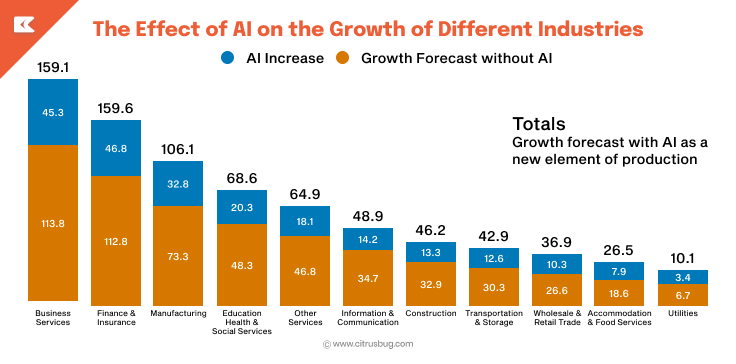
These AI development statistics present the idea that it would no longer be a question of whether to invest in AI. Organizations that want to remain competitive will increasingly be required to leverage AI as technology to optimize operations, grow quickly, and future-proof their business in a frequently changing environment. This holds whether you’re investing in your own AI software development to support the advancement of your strategy.
Industry-Wise Breakdown of AI Development Statistics
AI in Healthcare
Artificial Intelligence revolutionizes healthcare by enhancing diagnoses, reducing costs, and relieving clinicians of work burdens.
Rapid Adoption
Recent AI development statistics in healthcare reveal its rapid integration and tangible value. The integration of AI into healthcare is already widespread:
- 86% of health systems are using AI, with 60% of them identifying diagnoses and patterns that humans may miss.
- 60% of healthcare executives are spending more on AI than traditional IT, suggesting its growing strategic importance
- AI healthcare companies raised $1.68 billion by early 2025, while AI-based digital health funding accounted for 40% of all digital health funding in Q1 2024, higher than the 33% in 2023.
Economic Impact
AI is also driving significant cost savings:
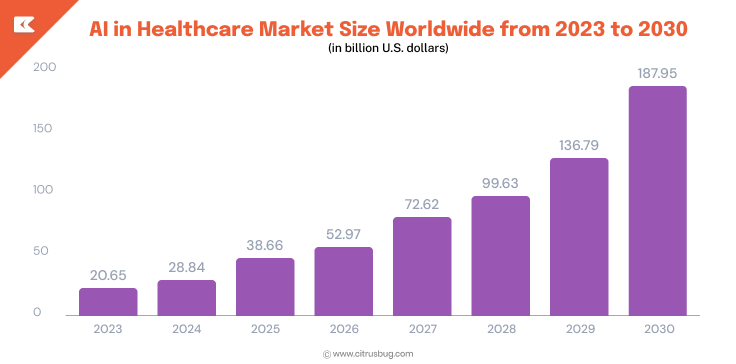
- The generative AI healthcare market is valued at $2.64 billion in 2025 and is projected to reach approximately $39.70 billion by 2034, growing at a CAGR of 35.17%.
- AI and machine learning are expected to save healthcare systems $13 billion by 2025.
- AI chatbots alone are expected to save $3.6 billion worldwide by 2025.
Reducing Administrative Burden
AI is helping clinicians spend more time with patients:
- AI ambient listening saves clinicians 60-90 minutes of documentation, down to 30 minutes or less each day, and enables clinicians to spend more time on care.
- 80% of UK GPs using AI scribes have reported time savings, improved connections with patients, and increased satisfaction for patients and providers.
- 92% of AI users report that generative AI enabled the organization to operate more efficiently and 65% report the use of generative AI expedited decision-making.
Despite excellent strides towards adoption and use of AI in healthcare, challenges remain; 72% of the healthcare organizations cite that data privacy is a significant challenge in deploying AI systems for organizational use. The sanctity of patient trust and compliance with statutes like HIPAA are critical hurdles to unlock the full promise of generative AI in healthcare.
AI in Fintech
AI is rapidly transforming the fintech space and shaping the future of financial services by driving growth and increasing security while also enhancing the customer experience for the entire financial services spectrum.
Rapid Market Growth
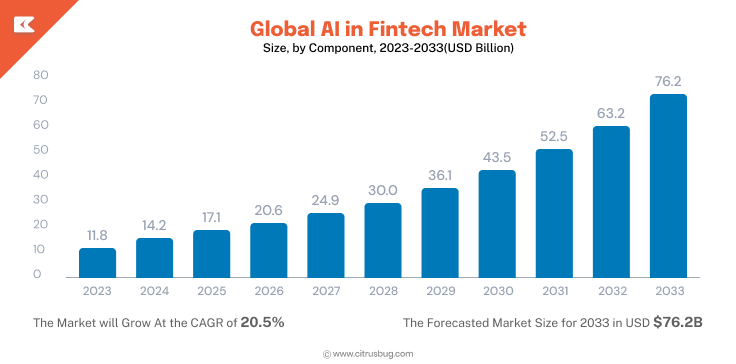
The Global AI in Fintech Market value is expected to reach around USD 100.5 billion by 2034, up from USD 21.2 billion in 2025, with a compounded annual growth rate (CAGR) of 18.34%, for the forecasted period from 2024 to 2033. The growth is being propelled by the increasing demand for smarter, faster, and more secure financial services, with AI in the financial services sector and fintech being nearly 20% annual growth between 2020 and 2025.
The investment in AI within fintech is just as robust as the world of AI in Fintech is witnessing global AI funding in fintech exceed $30 billion by 2023. In January 2025 and with AI as the focus 5.7 billion was raised in funding in Fintechs, this reflects 22% of all global venture funding during the month.
Enhancing Fraud Detection and Security
AI is now a key component of fraud prevention in fintech. As much as 60%–90% of financial institutions are now using AI for fraud detection and for their anti-money laundering activities. For instance, Mastercard’s AI ecosystem underpins 159 billion transactions yearly with a projection of improving the ability to detect fraud by up to 300%.
AI-driven fraud prevention systems have reduced false positives by 80–90%, cutting industry losses by $10 billion annually while enabling real-time detection of over 90% of suspicious transactions and reducing false declines by 22%.
Improving Customer Service with AI
The implementation of virtual assistants and chatbots has revolutionized customer support in the fintech sector, resolving 75% of inquiries through AI powered chatbots. In addition, automation enables 24/7 customer support, leading to faster response times and projected savings of $80 billion by 2025.
Reducing Costs and Boosting Operational Efficiency
The automation of services in AI-powered systems continues to improve fintech profitability, with the AI for customer service market projected to grow from USD 12.06 billion in 2024 to USD 47.82 billion by 2030 (CAGR 25.8%), and 87% of financial institutions and fintechs now report that fraud prevention efforts save more money than they cost.
Personalization and Onboarding Automation
The application of AI technology has led to automated marketing and issued personalized recommendations within 48 to 55% of companies. Not only this, but AI takes care of 70% of the onboarding task granting banks the ability to acquire new customers while reducing manual mistakes, allowing them to scale customer acquisition.
Strategic Priority Across the Industry
AI is now considered a strategic priority across the financial sector. Between 72% and 80% of banking executives see AI as critical to their operational and innovation strategies, expecting it to become core infrastructure by 2030. Citi projects that AI adoption could boost banking profits by $170 billion over the next five years, increasing global banking profits from $1.44 trillion to $1.99 trillion by 2028.
The consumer demand also aligns with this, as currently, 41% of Millennials and Gen Z investors use AI-powered financial products now, as compared to older generations, indicating the future-ready demand for AI-powered fintech products.
AI in Logistics
Artificial Intelligence is changing the logistics industry as predictive operations improve delivery speeds, increase cost-effectiveness, and enhance the overall experience for customers. As logistics companies will be under increasing pressure to improve efficiency while decreasing environmental impact, AI has become a necessary driver of change across the supply chain.
Rapid Market Growth
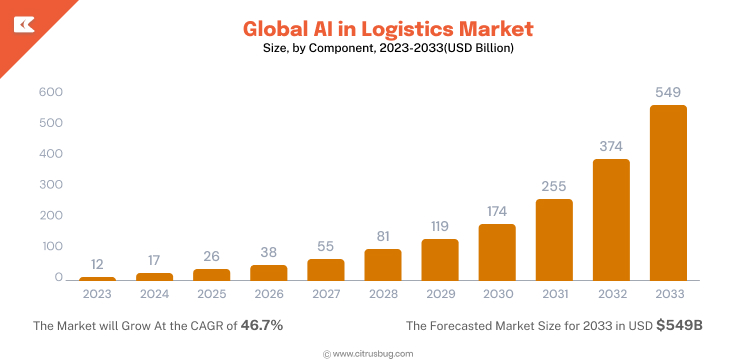
The Global AI in Logistics Market has been projected to reach approximately USD 198.58 Billion by 2034, growing from USD 20.1 Billion in 2024 with a CAGR of 25.9% during the forecast period of 2025 to 2034.
The pace of adoption is rising substantially; 64% of logistics companies are already applying AI to their supply chain processes, with 52% using AI for warehouse automation. In total, 70% of logistics providers are planning to invest more in AI in the next two years, based upon the efficacy of AI, in improving efficiency and accuracy. 82% of logistics companies reported achieving ROI within two years of adopting AI.
Operational Efficiency and Cost Reduction
AI is significantly improving operational efficiency across logistics. AI-powered route optimization has reduced delivery times by 30% while cutting transportation costs by 15–20%. Predictive maintenance powered by AI reduces equipment and truck downtime by 25–50%, and 68% of logistics firms now use AI for maintenance planning to avoid costly disruptions.
In warehouses, AI-driven automation increases productivity by 20–30% and reduces operational costs by 25–45%. This technology also improves pick-and-pack accuracy to 98% while reducing stockouts by 25–35%, ensuring goods reach customers on time with minimal errors. Additionally, AI improves demand forecasting with 50–85% accuracy, helping companies reduce stockouts by 30–40% and lead times by 20%.
[Source]
Using AI as a component of an overall logistics program enables cost savings of up to 20%, so it is clearly vital for businesses looking to leverage their operations and become more profitable.
Enhancing Customer Experience
AI is helping logistics companies improve customer service while reducing operational stress. Companies using AI report a 55–60% improvement in customer satisfaction, thanks to faster updates, accurate delivery tracking, and proactive communication. AI-powered chatbots now handle 60–80% of customer inquiries, reducing response times by 50–80%.
AI-driven predictive analytics increases supply chain visibility by 15%, while forecasting disruptions with approximately 85% accuracy. This helps companies avoid delays and manage inventory more efficiently, reducing excess stock by 12–20%.
Driving Sustainability
Sustainability is another major benefit of AI adoption in logistics. AI helps reduce carbon emissions and fuel consumption by 10–30% through optimized routing and predictive maintenance. In last-mile delivery, AI has cut costs by up to 40%, reduced emissions by 18%, improved delivery times by 22%, and increased on-time delivery rates to 95%.
Overall, sustainability initiatives supported by AI in logistics are expected to save $500 Billion for the logistics industry by 2030. This demonstrates the long term sustainability strategy business case for AI and logistic operations for purposes of both the planet and its peoples.
[Source]
Real-World Examples
Several industry leaders illustrate the impact of AI in logistics:
- Uber Freight uses AI to reduce empty truck miles by 10–15%, cutting fuel use and emissions while optimizing load matching. Its AI-powered chatbot has reduced driver wait times from five minutes to just 30 seconds, managing over $20 billion in freight since 2023.
- Penske Truck Leasing’s Catalyst AI generates 300 million data points every day by utilizing more than 433,000 trucks, enabling predictive maintenance and more efficient operations to reduce down time and maintenance costs.
- Amazon is making bold selections in AI-powered robotics in logistics and scored a 25 % reduction rate in costs in its Louisiana facility last year in order to save upwards of 10 billion dollars annually as a part of its wider strategy of investing 25 billion across AI and logistics.
AI in eLearning
Artificial Intelligence is revolutionizing the eLearning industry by allowing for personalized learning, adaptive assessments and efficiency in operations, throughout the education and corporate training industry.
Rapid Market Growth
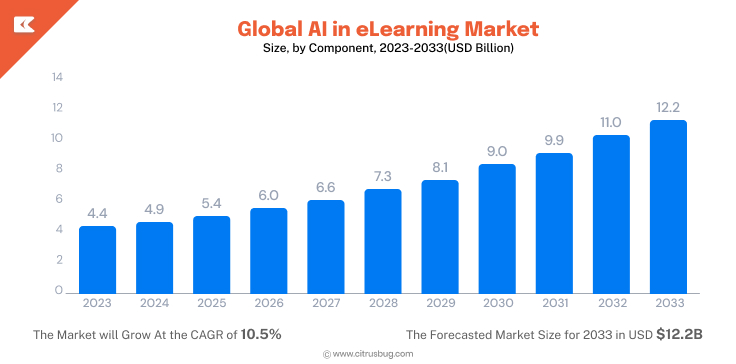
The Global AI in eLearning Market size is anticipated to be valued at around USD 136.79 Billion by 2035, up from USD 7.05 Billion in 2025, growing at a CAGR of 34.52% during the forecast period of 2026 to 2035. The rapid growth is due to demand for personalized learning and efficient learning systems utilizing AI, which continues to rise across the world.
Widespread Adoption Across Institutions
AI adoption is no longer experimental in eLearning:
- 70% of eLearning platforms contain AI powered features,
- 54–65% of educational institutions are using or planning to roll out AI in the next 2 years.
- 80% of EdTech companies are investing in AI to expand and improve learning solutions.
- 63–67% of learning professionals believe that AI significantly improves the learner experience.
[Source]
Improved Learning Outcomes
AI is proving effective in enhancing learning results:
- AI-adaptive learning systems can raise student performance by 30–50% and accelerate course completion speed by 15–50%.
- Intelligent tutoring systems outperform traditional methods in 92% of controlled studies, often boosting learners’ performance from the 50th to the 75th percentile.
- AI-based analytics can identify learners who are at risk 85% of the time, with the potential to decrease the dropout rate by 20%.
- Personalized AI tutors and recommendation engines can improve student retention by 25–42%, student engagement by 30–60%, and impact student comprehension at rates from 36–50%.
Efficiency and Cost Reduction
AI gives educators and organizations the chance to save time, energy, and money:
- Automated grading reduces grading time by 40–70%, saving educators up to 6 hours weekly.
- AI chatbots lower learner support costs by 30–60% while providing real-time assistance.
- AI-driven content creation and curation reduce eLearning development time by 30–50% and can cut training time by up to 50%.
- Organizations using AI in corporate training have reported a 26% increase in revenue per employee and a 25% higher ROI.
- AI-powered translation systems now support 100+ languages, helping institutions deliver localized learning experiences globally.
[Source]
AI in eCommerce
Artificial Intelligence is changing eCommerce by helping companies personalize shopping, increase efficiency in customer service, accurately forecast demand, and effectively prevent fraud. This allows businesses to maximize sales, cut operating costs, and provide a seamless shopping experience that customers expect.
Widespread Adoption and Growing Investment
AI development statistics in eCommerce confirm how businesses are utilizing AI for personalization, fraud prevention, and operational efficiency. The Global AI in E-commerce Market size will be valued at around USD 9.07 Billion in 2026 and expected to reach USD 47.87 Billion by 2033, growing at a CAGR of 25.7% during the forecast period 2026 – 2033. North America maintained a leading market share of around 40.8% in 2026.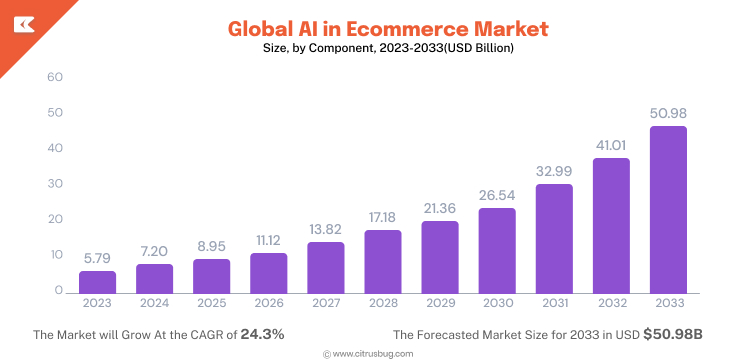
AI is becoming a core part of eCommerce operations:
- 84 – 85% of eCommerce businesses are now using AI, in various forms, including chatbots, product recommendations, and demand forecasting.
- Almost 50% of retailers are increasing their AI budget by 30% – 50% in 2024, and 89% of retailers are increasing their AI investments in the next 12 months.
- Retailers are actively testing new trends, including, 68% of retailers are using voice search, 62% are using virtual try-ons, and 33% are testing AI-based video shopping experiences.
[Source]
Personalization that Drives Conversions
AI-powered personalization has become a shopper expectation:
- 84% of consumers expect personalized experiences while purchasing online, and 73-80% prefer AI-driven personalization while purchasing.
- AI-generated recommendations for products account for 20-35% of total eCommerce revenues, and Amazon has stated that 35% of sales come from recommendations.
- Businesses that use AI see a 15-25% increase in conversion rates, 12-20% growth of average-dollar-order volume, and a 30% decrease in bounce rates.
- AI algorithms can predict customer preferences with 85% accuracy, meaning that businesses can generate hyper-targeted marketing campaigns and product placements.
[Source]
Faster and Smarter Customer Service
AI chatbots are transforming customer support in eCommerce:
- They now handle 75-95% of customer inquiries, cutting customer service costs by 30% and halving the time it takes to reach a customer resolution.
- AI chatbots can communicate 20+ languages and offer real-time assistance, from anywhere in the world.
- 60% of customers indicate that they prefer assistance from AI chatbots, and 80% of customers report that personalized experiences impact their purchasing decisions.
[Source]
Efficient Operations and Inventory Management
AI helps eCommerce businesses operate efficiently:
- 62% of eCommerce companies apply artificial intelligence (AI) to control inventory and demand forecasts, cutting stock-outs rates by 30%, lost sales by 65%, and warehousing costs by 10-40%.
- AI also reduces shipping costs by 12–18%, increases fulfillment efficiency by 30%, and automates 50–70% of back-office operations.
Advanced Fraud Detection
AI significantly improves fraud prevention in eCommerce:
- AI systems reduce fraudulent transactions by 40–60% while maintaining over 99% accuracy in processing transactions.
- For example, TickPick recovered $3 million in lost revenue over three months using AI-powered fraud detection.
Reducing Cart Abandonment
AI is a critical factor to recover potential lost sales:
- AI-based recommendations and assistance at-checkout can reduce rates of cart abandonment by 20%.
- Interestingly, 34% of consumers allow AI to make purchases, while 66% prefer to manually decide where and how to shop.
Delivering Tangible ROI
Businesses investing in AI see clear financial benefits:
- 80% of eCommerce providers have measured ROI in the first 12-24 months of adopting AI.
- Forecasts suggest that automation in eCommerce powered by AI could save them $1 trillion per year in savings resulting from R&D in supply chain, marketing and customer support generated efficiencies by 2030.
AI in Real Estate
AI is radically changing the real estate sector by providing better property valuations, easing transactions, enhancing marketing, and improving operational efficiencies throughout the industry.
Rapid Market Growth
The Global AI in Real Estate market size is anticipated to be worth approximately $1303.09 Billion by 2030, from $301.58 Billion in 2025, growing at a compound annual growth rate CAGR of 33.9% during the forecast period of 2025 to 2030.
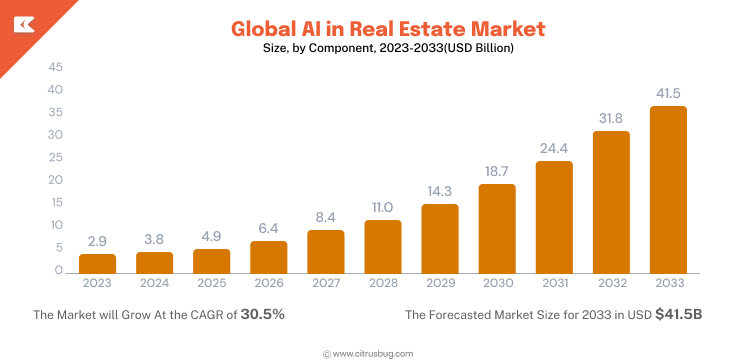
The generative AI segment of real estate was valued at USD $351.9 million in 2022 and projected to reach $1.047 billion by 2032. There is currently a high level of activity in this space. North America currently comprises 38.5% of the market, and is anticipated to account for over 41% of global revenue in 2024.
Venture capital confidence in AI real estate solutions is also supported by over USD $10 billion invested in AI start ups focused on real estate since 2017; 72% of real estate owners are investing in AI solutions.
High Adoption Across the Industry
AI adoption across the industry is rapidly increasing:
- 65–67% of real estate firms have used AI for automated property valuations.
- 67% of real estate firms have used automated valuation models (AVMs) to improve pricing accuracy.
- 72% of real estate firms anticipate increasing their investment in AI over the next two years.
- 90% of real estate firms plan to increase their investments in AI over the next three years.
- 73% of commercial real estate investors consider AI critical for maintaining a competitive edge.
[Source]
Driving Operational Efficiency
AI technology is bringing high efficiency gains:
- Reduces property buying time by up to 50%.
- 55% of property managers use AI for dynamic rental pricing.
- 45% of developers employ AI for project management.
- Predictive maintenance using AI increases uptime by 35% while discovering issues in 47% of properties.
- AI-based energy optimization in smart buildings decreases energy costs by 25%.
- Transaction fraud is decreased by 20–85% through the use of AI-powered fraud detection tools.
- AI-powered automation saves real estate agents 40 hours per year, with 63% of real estate agents using AI-enhanced tools saying they have better communication as a result.
[Source]
Improving Marketing and Customer Engagement
AI is also transforming the customer experience:
- 42% of Realtors are using AI-powered tools to generate listing descriptions.
- Virtual tours and AR-powered walkthroughs increase property inquiries by 200%, depending on implementation.
- AI-enhanced virtual staging can increase inquiries by 30%.
Practical Implications for Businesses
After looking broadly and with real numbers at how AI is transforming industries, the next question is: What should my business do about it? These AI development statistics provide clear evidence of where the technology is creating measurable impact across industries.
The first step is to see AI not as a future trend, but as a viable technology and enterprise AI strategy for resolving your everyday operational challenges, from cost-saving, customer experience, and even speed of making decisions.
Start small. Look for one opportunity where AI could add immediate value to your business, such as automated customer questions through chatbots, or forecasting demand more accurately with predictive analytics. These specific use cases would allow you to empirically measure the impact of AI before spending larger amounts of money.
Second, ensure your organization is ready for data. AI will only be as effective as the data it’s built upon! Examine your data processes, and also consider collaborating with one of the top AI development firms to customize your data resources based on your business objectives.
Finally, on your journey onboard with AI, safeguard against ethical, regulatory and legal consequences as your organization adopts more AI. Operating transparently and responsibly as you adopt AI will mitigate risk to your brand, and will help you build trust with your clients.
What’s the take away? AI is for everyone! Organizations of all sizes can leverage AI to promote innovation, support data-driven decision making, reduce inefficiency, and compete in a marketplace where early adopters are clearly gaining an advantage.

Conclusion
AI development statistics confirm that artificial intelligence is not just shaping the future, it is already happening across healthcare, fintech, logistics, e-learning, e-commerce, and real estate. The statistics we highlighted are not just statistics, they are a signal that AI is becoming a must-have for businesses that want to stay relevant, and competitive.
The main takeaway? Start from where you are. You do not need to change your entire business, to take advantage of AI. Identify opportunities for AI to provide impact now, invest in clean data, and publish an AI roadmap that works together with your business objectives. In most cases, it may make sense to outsource development of AI while experimenting with pilots before implementing AI into your core operations.
Early adopters are already seeing results, from lower costs to better customer experiences. The future is here, and taking your first step with AI now will help your business adapt and lead.
The future is already here. The next step is yours.