
 Back
Back







It’s no secret that artificial intelligence (AI) has been integrated into our culture in the modern day. AI has shown its incredibly creative ability to help us maximise efficiency in many different sectors of our lives, from drone-delivered parcels from Amazon to automated grocery to automated suggestions that finish our sentences.
AI’s innovations have also improved business across a wide range of industries. AI has revolutionised supply and demand chain and logistics operations. Indeed, according to a McKinsey analysis, AI will establish a whole new “logistics paradigm” by 2030 as it continues to surpass humans in repetitive but crucial activities. Solutions for developing logistics softwares are becoming increasingly necessary as a result of the unexpected difficulties in shipping that are currently occurring.
AI-powered solutions, such as warehouse automation, are already increasing safety by 90% and reducing operating costs by up to 50%. AI has a quantifiable effect on the industry in this way.
This article will explore how artificial intelligence (AI) is addressing important logistics issues, such as better demand forecasting and route optimisation, and how it is opening the door to a more effective, flexible logistics environment.
How AI and Machine Learning Are Revolutionizing Modern Logistics Operations
AI in logistics refers to the application of machine learning, predictive analytics in logistics, and intelligent algorithms to enhance operations. It’s not just automation. It assists logistics firms in lowering risks, enhancing performance, and forecasting future trends.
By fostering innovation at every level of the supply chain, AI supply chain optimization is revolutionising the logistics sector. AI is now the foundation of modern logistics operations, enabling improved decision-making and automating repetitive processes.
Large volumes of data are used by the technology to enhance procedures. It contributes to cost savings and increased efficiency. Because of this, it is crucial for companies looking to maintain their competitiveness.
Why Logistics Needs AI Today?
Demands on the logistics sector are constantly rising, and they include improved client experiences, lower prices, and quicker deliveries. Conventional systems frequently find it difficult to adjust to these intricacies, which leads to inefficiency and lost opportunities.
Here’s where AI comes in. It provides cutting-edge resources to address significant issues.
-
Enhanced Operational Efficiency
AI lowers human mistakes, automates procedures, and gets rid of manual inefficiencies.
-
Real-Time Decision-Making
Businesses may become more responsive by using AI to make data-driven decisions instantaneously.
-
Scalability
As a firm expands, AI solutions can readily adjust to meet changing demand.
AI is far more than a tool. It aids logistics firms in increasing accuracy, dependability, and profitability.
Top Benefits of Integrating AI in Logistics
When items are stored, transported, and distributed, a vast amount of data is produced. The most crucial data points include temperature, location in real-time, transit costs, and transporter availability. Although there are numerous other ways AI might enhance logistics, it is evident how it may affect customer satisfaction through logistics and the associated on-time delivery. These are covered in more detail below.
-
AI for Inventory and Warehouse Management
Logistics managers can find incoming orders with longer than planned fulfillment times with the use of AI-powered warehouse management software. In order to determine which products are suitable for the items that will be supplied, they can share information about at-risk orders with fulfilment managers. They can also move the stocking location for items so that they are grouped into categories that are frequently ordered together. Additionally, the intelligent AI capabilities are designed to offer customisable email acknowledgements for revisions and new orders, as well as concise and rational summaries of the pertinent order revision histories.
-
Demand Accuracy
Demand forecasters can use the data from AI-integrated logistics software to spot production delays in final items. Logistics managers can also use the information obtained from demand forecasting tools to prioritise the shipment of goods that will affect the overall profit and satisfaction of consumers.
-
Overstock Optimization
Based on past and present demand data, manufacturers can enhance inventory levels by utilising AI-based predictive analytics. This can cut down on excess inventory and avoid stockouts.
-
Fulfillment Efficiency
AI helps warehouses become more efficient, which increases fulfilment rates. To help expedite fulfilment, it suggests flooring patterns and worker pathways after analysing historical demand data to identify the most effective position for specific commodities. AI can be used by warehouse managers to assess whether there is waste space and whether the delivery containers are filled with the appropriate number of products.
-
Order Accuracy
In order to help detect and prevent worker errors, such as removing the incorrect items from warehouses or delivering goods to the incorrect locations, logistics organisations and manufacturers are training AI systems using data collected by cameras and sensors.
These systems can also be used to analyse data that has been collected to determine whether there are many mistakes that could be avoided by changing the design or process, such as improving employee training, changing the packaging, or placing products more strategically based on demand.
-
Picking Optimization
When warehouse workers gather products to fulfil an order, AI can help optimize product picking by recognising order patterns and suggesting that the things that are frequently ordered together be moved to the same area of the storage facility. Another way AI-powered demand projections can help enhance product selection is by suggesting that things with an earlier due date, like perishable items or orders that are time-sensitive, are placed at the most appropriate portions of the warehouse.
-
Label Automation
The traditionally time-consuming and error-prone process of creating shipping labels can be automated with GenAI tools. GenAI products can handle multilingual and international shipping requirements and can be included into warehouse and logistics management software.
-
Route Optimization
AI optimises delivery routes, cutting down on consumption of fuel and transit times. Additionally, smarter routing improves delivery reliability and reduces vehicle wear.
Real-World AI Applications Reshaping Logistics Industry Operations in 2026
-
Automated Warehousing
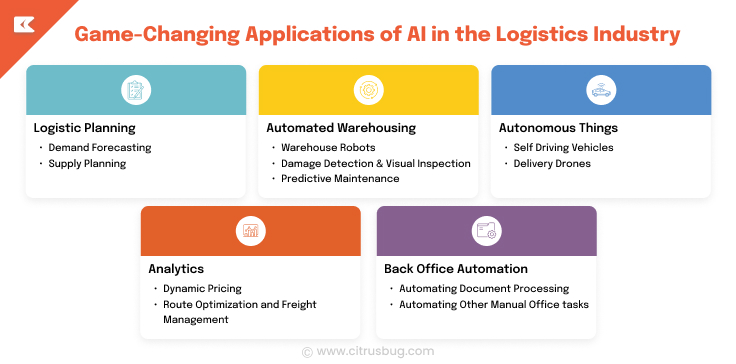
AI-powered robotics and machine learning streamline warehouse operations through automated inventory management, order fulfillment, and storage, significantly reducing labor costs and improving efficiency. The benefits of AI in logistics include faster processing and minimized errors in warehouse operations.
-
Forecasting Demand
Artificial Intelligence analyzes historical data, market trends, and external factors to accurately predict demand fluctuations. This ensures optimal inventory levels, reducing stockouts and overstocking while enhancing supply chain efficiency.
-
Damage Detection and Predictive Maintenance
AI-driven image recognition and IoT sensors detect potential equipment failures or damaged goods in real time. Predictive maintenance minimizes downtime, lowers repair costs, and enhances overall logistics efficiency.
-
Optimization at the Stock Level
By examining current demand, supply chain limitations, and storage capacity, artificial intelligence optimises stock distribution. By ensuring that inventory is distributed effectively, holding costs are decreased and order fulfilment rates are raised.
-
Optimization of the Supply Chain
Through data analysis from multiple sources, disruption prediction, and proactive strategy recommendations, artificial intelligence (AI) improves end-to-end supply chain visibility. Companies that use AI in logistics can save money and increase agility.
-
Adaptive Pricing
In order to make dynamic price adjustments, AI-driven pricing models examine demand trends, market conditions, and rival pricing. This guarantees pricing strategies that are competitive and optimize revenue and customer pleasure.
-
Optimization of Routes
To find the most efficient routes, AI-powered route optimisation examines delivery limitations, traffic, and weather. This minimises the impact on the environment, improves delivery speed, and lowers fuel costs.
-
Automating Document Processing
AI-powered OCR and NLP systems automate compliance checks, invoice verification, and customs clearance, streamlining document processing. This improves overall logistical efficiency, speeds up procedures, and lowers manual error rates.

Challenges of Implementing AI in Logistics
While the benefits of AI in logistics are substantial, implementing AI-driven solutions also comes with certain challenges. From integration complexities to data security concerns, logistics companies must carefully plan their AI adoption strategy to ensure successful implementation and long-term scalability.
High Initial Investment
One of the biggest challenges businesses face when adopting AI in logistics is the upfront investment required for infrastructure, software, and system upgrades. Implementing AI-powered logistics solutions often involves integrating advanced technologies such as machine learning, predictive analytics, IoT devices, and automation tools into existing operations.
For small and mid-sized logistics companies, these costs can initially seem overwhelming. However, despite the higher initial investment, AI helps businesses achieve long-term savings through improved operational efficiency, reduced fuel consumption, optimized routes, and minimized manual errors.
Data Quality and Availability
AI systems rely heavily on large volumes of accurate and real-time data to deliver reliable insights and predictions. In logistics operations, inconsistent, outdated, or incomplete data can reduce the effectiveness of AI models.
Many logistics companies still operate with siloed systems or manual record-keeping processes, making it difficult to collect and manage high-quality data. To fully leverage AI in logistics, businesses need a strong data management strategy and centralized systems that ensure seamless data flow across the supply chain.
Integration with Legacy Systems
Many logistics providers use older software and legacy infrastructure that may not be compatible with modern AI technologies. Integrating AI solutions into existing transportation management systems (TMS), warehouse management systems (WMS), and supply chain platforms can be technically challenging and time-consuming.
Without proper integration planning, businesses may experience workflow disruptions, operational delays, or data synchronization issues. This is why organizations often require expert AI consulting and custom development support to successfully modernize their logistics ecosystem.
Cybersecurity and Data Privacy Concerns
As AI in logistics becomes more data-driven and connected through IoT devices and cloud-based platforms, cybersecurity risks also increase. Sensitive customer information, shipment details, and operational data can become potential targets for cyber threats if security measures are not properly implemented.
Businesses adopting AI-powered logistics systems must prioritize strong cybersecurity practices, data encryption, access controls, and compliance with industry regulations to protect critical business information.
Workforce Adaptation and Skill Gaps
The adoption of AI technologies can create resistance among employees who may fear job displacement or struggle to adapt to new systems. In reality, AI is designed to enhance human productivity rather than completely replace human workers.
However, successful AI implementation in logistics requires proper employee training, upskilling programs, and change management strategies. Companies must ensure that their workforce is equipped to work alongside AI-powered tools and automated systems effectively.
Scalability and Maintenance Challenges
AI systems require continuous monitoring, updates, and optimization to maintain performance and accuracy. As logistics operations grow, businesses may face challenges in scaling AI models across multiple locations, fleets, warehouses, and supply chain networks.
Regular maintenance, model retraining, and performance evaluation are essential to ensure AI systems continue delivering accurate predictions and operational improvements over time.
Overcoming AI Implementation Challenges in Logistics
Despite these challenges, the long-term advantages of AI in logistics far outweigh the initial complexities. Businesses that invest in the right AI strategy, infrastructure, and implementation partner can significantly improve efficiency, reduce operational costs, and gain a competitive edge in the evolving logistics industry.
With proper planning and a phased implementation approach, logistics companies can successfully overcome adoption barriers and unlock the full potential of artificial intelligence across their supply chain operations.
A Step-by-Step Guide to AI Adoption in Logistics Operations for 2026
Although AI has many advantages for logistics, its application requires detailed planning and execution. Logistics firms may find it difficult to adjust to this shift. This is where the special requirements of the logistics sector can be met with the assistance of a reliable AI development firm.
Step 1: Identify Key Challenges and AI Use Cases
Knowing which logistics problems AI can resolve is the first step. Businesses require a strategic strategy whether they are automating document processing, enhancing inventory management, or optimising delivery routes. Professionals with knowledge of AI-powered logistics solutions are able to evaluate existing processes and suggest the most effective uses of AI.
Step 2: Strengthen Data Infrastructure
High-quality data is essential for AI to work efficiently. Logistics companies need to compile, clean, and organise data from a variety of sources, including supply chain logs, GPS monitoring, and warehouse management systems. Accurate insights for improved decision-making are ensured by sophisticated data analytics platforms and AI-powered solutions.
Step 3: Choose the Right AI Technologies
Different AI solutions are needed for different logistics problems. Computer vision can help detect damage, while machine learning helps forecast changes in demand. Working with AI experts guarantees that the appropriate technologies are chosen and tailored to meet particular business requirements.
Step 4: Implement a Pilot Program
Before full-scale adoption, testing AI solutions in a controlled setting helps validate effectiveness. Before implementing AI widely, logistics organisations can assess its effects, improve their methods, and resolve any issues with a well-designed pilot program.
Step 5: Ensure Seamless System Integration
Logistics automation software must seamlessly interact with current logistics technologies, including ERP, TMS, and WMS, in order to provide the most value. AI can improve operational efficiency without interfering with conventional procedures thanks to clever integration frameworks and API-driven solutions.
Step 6: Focus on Workforce Training and Adoption
It takes people, not just technology, to successfully integrate AI. Employees must comprehend how AI improves their jobs. Improved productivity and seamless adoption are guaranteed via interactive workshops, hands-on training, and ongoing support.
Step 7: Monitor, Optimize, and Scale AI Solutions
AI implementation doesn’t end with deployment. Continuous monitoring, performance analysis, and iterative improvements keep AI models efficient and relevant. As logistics companies grow, scalable AI-powered delivery optimization solutions help expand automation, optimize operations, and maintain a competitive edge.
Logistics companies may embrace AI-driven innovations with the least amount of risk and the greatest amount of efficiency by utilising the experience of an AI development company. A well-thought-out strategy guarantees a seamless transition, allowing logistics to fully benefit from AI while maintaining an advantage in a changing market.
How Citrusbug Technolabs Delivers Custom AI-Powered Logistics Solutions
At Citrusbug Technolabs, we combine deep technical expertise with a tailored approach to deliver AI-driven logistics solutions that maximize ROI and optimize operational efficiency. Our team ensures seamless AI adoption through:
Proven Expertise in AI for Logistics
With extensive experience in developing AI-powered logistics solutions, we address industry-specific challenges such as route optimization, demand forecasting, and warehouse automation while delivering measurable business outcomes.
Comprehensive End-to-End Support
From initial consultation and AI strategy development to system integration and ongoing support, we ensure a smooth transition at every stage of AI implementation, aligning technology with business goals.
Scalable and Custom AI Solutions
Our AI models are designed to integrate seamlessly with existing logistics platforms, providing modular and scalable solutions that grow with your business needs while enhancing efficiency.
Client-Centric Collaboration
We work closely with logistics companies to understand unique challenges, ensuring AI solutions are customized to meet specific operational requirements and drive meaningful impact.
Efficient and Cost-Effective Delivery
Leveraging cutting-edge AI tools and development frameworks, we deliver high-quality solutions on time, reducing operational costs and eliminating inefficiencies caused by delays.
With Citrusbug Technolabs as your AI development partner, you can confidently embrace AI-driven innovations and gain a competitive edge in the logistics industry.