
 Back
Back







In today’s rapidly evolving business landscape, selecting the right software solution is critical for operational efficiency and scalability. Businesses often face a dilemma when choosing between custom software development and off-the-shelf solutions. Custom software is specifically designed to meet unique business needs, providing tailored features, seamless integration, and enterprise software solutions for growing organizations. On the other hand, off-the-shelf solutions offer pre-built functionalities that can be quickly implemented but may not fully align with specific workflows.
Most often, the decision between the two options depends on factors like cost, flexibility, and long-term business objectives. Custom software will be the winner in terms of specialized requirements, but off-the-shelf solutions are generally less expensive upfront and deploy much more easily. This allows businesses to choose the right solution for them and ensures they enhance productivity, grow their business, and gain value over time.
What is Custom Software Development?
This custom software development basically creates designs and developments and rolls out unique, specifically suited business requirements software. Generally, unlike typical, pre-developed and commercially off-the-shelf products, a customized solution would relate to particular workflow or needs or features not available or addressable through current software applications. This, therefore goes on to detail all those initial steps such as conception, designing, coding, testing, and finally launching it as the implementation into production.
Custom software development is often a collaborative process between a development team and business stakeholders to ensure that the final product delivers the desired functionality and performance. This is a time-consuming and resource-intensive approach, but it offers unmatched flexibility and personalization.
Pros and Cons of Custom Software Development
| Pros | Cons |
|---|---|
| The software is built to match your exact workflows with no unnecessary features included. | Development timelines typically range from several months to well over a year for complex systems. |
| Full ownership means no recurring licensing fees once the product is delivered and accepted. | Upfront investment is significantly higher than the entry price of most packaged alternatives. |
| The codebase scales precisely as user load and feature requirements grow over time. | Requires an experienced development team or a reliable external partner to build and sustain. |
| Security can be engineered to meet industry-specific standards like HIPAA, PCI DSS, or SOC 2. | A poorly scoped project leads to scope creep, cost overruns, and missed delivery deadlines. |
| Integration with existing internal systems is designed in from the start, not bolted on later. | The organization carries full responsibility for bug fixes, updates, and long-term maintenance. |
| Competitive differentiation is possible when core business logic is proprietary and protected. | Hiring or retaining skilled developers adds meaningfully to the total cost of ownership. |
| Updates and new features are released on the business’s timeline, not a vendor’s product roadmap. | Early versions may contain unforeseen bugs that require time and resources to resolve properly. |
| The organization retains all intellectual property and source code outright with no restrictions. | Knowledge transfer risk is high if the core development team changes mid-project. |
| Long-term ROI can outpace off-the-shelf costs for businesses with stable, complex processes. | The break-even point against packaged software often takes two or more years to reach. |
| The product evolves with business strategy without being constrained by a vendor’s feature priorities. | Requires thorough documentation of business processes before meaningful development can begin. |
Key Factors That Drive Custom Software Development Costs in 2026
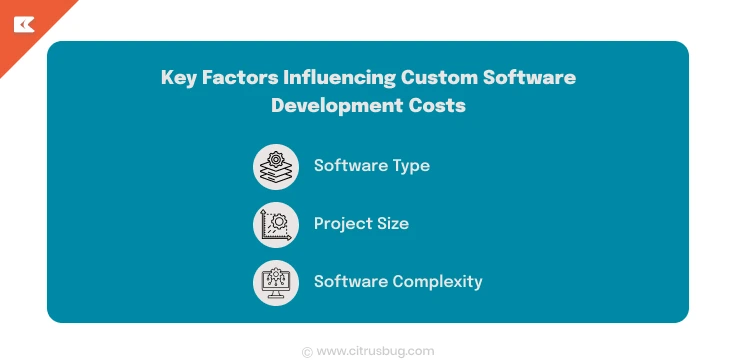
Understanding the cost of custom software development involves breaking down several key elements that lead to the final investment. Knowing these factors will help organizations make better decisions and ultimately choose solutions that fit well with their digital transformation strategy, objectives, and budgets. Here are the major determinants of custom software development costs:
How Software Type Determines Custom Development Pricing
The type of software being developed, including custom CRM development projects, significantly affects the overall costs. Custom application software development is a process that usually involves substantial investments because of the detailed planning, design, and coding involved in tailoring solutions, such as building an all in one nonprofit software platform, a custom CRM system, a healthcare management solution, or an enterprise resource planning (ERP) system. In contrast, modernization or modifications to existing software are generally cheaper but still involve significant expenses in updates, new features, and ensuring system compatibility.
Custom development would also extend to enterprise-grade solutions, which tend to be high-priced because of their features, functions, and performance. To add to that, the software would have to be integrated, especially with separate systems and API integration services, which becomes very costly and complex because of seamless connectivity that usually results from custom solutions. Moreover, web development costs could greatly vary, depending on project complexity, user experience requirements, and security expenditure, with long-term maintenance further adding to these costs.
Project Size
The size and scope of a custom software development project have a direct impact on costs. Projects are often categorized into three main sizes:
- Small projects: these include solutions with limited features and simple workflows. Small projects are more economical, but the project requires adequate planning and execution toward the desired result.
- Medium projects: it involves more extensive feature integration and more system requests. More work is required when developing this, and additional testing and quality assurance are always needed, which results in increased cost.
- Large projects: The large projects include extensive features, complex integrations, scalability considerations, and advanced functionalities. These projects usually require larger development teams, longer timelines, and significant resources, making them the most expensive.
Why Software Complexity Is the Biggest Custom Development Cost Driver
The complexity of the features and functionality of the software is another major cost driver. Basic software solutions with minimal features, such as simple data entry forms or basic reporting capabilities, are relatively inexpensive to develop. However, costs increase significantly for complex software that includes advanced features such as machine learning, artificial intelligence, sophisticated analytics, or extensive user interactions.
As the complexity of software increases, so does the time and effort in design, development, testing, and quality assurance. Custom software development services require more resources to ensure functionality, performance, and reliability, which increase the overall cost.
In summary, project type, complexity, and size are the most significant aspects in determining the cost involved in custom software development projects. If these factors are carefully analyzed, businesses can manage to prioritize features, optimize the budget, and ensure a cost-efficient approach to software development.
Average Custom Software Development Costs by Industry (2026 Benchmarks)
The cost of bespoke custom software solutions varies significantly depending on the industry and the complexity of the application. Understanding average industry-specific costs can help businesses better anticipate their investment.
- Healthcare: Healthcare software development has very strict regulatory requirements, advanced data security protocols, and essential system integrations. These contribute to the cost, often in the range of $100,000 to $500,000+.
- Logistics: In the logistics field, complexity in features such as real-time tracking, route optimization, and supply chain management raises the costs. In custom software development for logistics requirements, costs can vary anywhere from $50,000 to $250,000 or more depending on the specific needs of the client.
- FinTech: FinTech applications are usually the most expensive to develop, in the range of $50,000 to $500,000+. The major reason for this is advanced security measures, strict regulatory compliance, and the need for easy integration with complex financial systems.
Understanding Off-the-Shelf Software Solutions
Off-the-shelf software refers to pre-packaged solutions designed to meet usual needs of businesses. Generally ready for use, off-the-shelf software is affordable on an upfront basis because deploying is quickly feasible, and they are extensively deployed throughout the market. Given the large user base whose cost it spreads, off-the-shelf software is significantly more affordable than custom packages.
However, such software may not align perfectly with a company’s specific processes. It can perform all the routine work but it comes with a certain number of hidden costs: licensing fees, updates, and inability to be custom-made at all. Businesses also waste money in order to adjust their current systems or even adapt the workflows according to its functionality.
Off-the-shelf software is cheap and instant but may not be flexible enough to support workflow automation software requirements for every business. Organizations should, therefore, weigh its drawbacks and long-term costs in making a decision.
Pros and Cons of Off-the-Shelf Software
| Pros | Cons |
|---|---|
| Deployment is fast, most SaaS tools can be configured and launched within days of purchase. | Recurring subscription costs compound significantly as user count and required tiers grow. |
| The upfront cost is low compared to commissioning a full custom development project. | The software is built for a general audience and rarely maps perfectly to specialized workflows. |
| Vendors handle all infrastructure, security patching, and major platform updates automatically. | Customization options are limited and often require purchasing premium tiers or third-party add-ons. |
| Large user communities provide documentation, tutorials, and vetted third-party integrations. | Vendor lock-in makes data migration or platform switches costly and operationally disruptive. |
| Regulatory compliance features are typically built in and actively maintained by the vendor. | Licensing fees can increase substantially at renewal with little notice as the vendor scales. |
| Onboarding employees is simpler because training materials and certifications already exist. | Businesses must adapt their internal processes to fit the software rather than the other way around. |
| New features ship continuously from the vendor without requiring any internal engineering effort. | Integration with legacy internal systems often requires middleware or expensive professional services. |
| Predictable pricing makes annual budgeting straightforward for finance and operations teams. | Paying for unused features is common when purchasing bundled platform tiers at scale. |
| Most enterprise-tier products include strong SLAs, uptime guarantees, and dedicated support. | Shared multi-tenant infrastructure can introduce performance bottlenecks outside the customer’s control. |
| Switching to a competing product is possible if a vendor fails to meet expectations long-term. | Sensitive data stored on a third-party vendor’s infrastructure introduces compliance and privacy exposure. |
6 Cost Factors of Off-the-Shelf Software That Buyers Often Underestimate
Understanding the real cost of off-the-shelf software requires an assessment of the key factors that influence its pricing and long-term expenses. Although off-the-shelf solutions seem cheap initially, the following elements can significantly impact overall costs:
1. Licensing Fees
Most off-the-shelf software solutions operate on a subscription-based pricing model. Here, businesses pay for monthly or annual licensing fees. Low initial costs do not, however, preclude recurring payments that might build up over time considerably as businesses scale or require premium versions of the software.
2. User Count
Many off-the-shelf software providers price according to the number of users. As organizations expand and add more employees, the costs increase proportionally. For larger businesses, this cost of paying per user can become significant and may exceed initial expectations.
3. Limitations of Customization
While some level of personalization is possible in off-the-shelf solutions, it is sometimes limited. Extra personalization with respect to adding specific features or tuning functionalities, usually incurs some additional costs. These expenses pile up when trying to adapt the software to meet unique business processes.
4. Integration Costs
Although off-the-shelf software is marketed as ready to use, the integration process can be tricky and costly. Businesses often need to spend money on expert IT support or third-party tools for smooth integration.
5. Training Costs
New off-the-shelf software usually requires the retraining of employees on using it. Training programs or workshops may incur costs for hiring trainers, depending upon the complexity of the software, which may require specific skills.
6. Scalability Requirements
Off-the-shelf software can have upgraded or higher-tier plans needed as businesses grow. Usually, features like more storage, advanced reporting, or extended user limits are available with premium plans or add-ons. These scalability needs end up costing more in the long run.
Hidden Costs of Off-the-Shelf Software Most Businesses Don’t See Coming
While off-the-shelf software may seem cost-effective initially, businesses often overlook hidden expenses, including:
- Overpaying for Unused Features: Generic solutions often come with features that remain unused but are included in the pricing.
- Customization Costs: Tailoring an off-the-shelf solution can be costly and limited in scope.
- Integration Challenges: Aligning pre-built software with existing workflows or systems can require significant investments.
- Downtime or Performance Issues: Off-the-shelf software may lack optimization for specific business operations, leading to productivity losses.
- Vendor Lock-In: Businesses may become dependent on a single vendor for updates, support, and future enhancements, increasing long-term costs.
Custom Software Development vs Off-the-Shelf Solutions: When to Use Which?
Choosing between the two often comes down to four decision points:
- When your workflows are genuinely unique — industries with complex regulatory requirements, proprietary processes, or integration-heavy architectures will hit the ceiling of packaged tools within months. Custom development and software modernization eliminate the compromise between software capability and operational reality.
- When total cost of ownership matters more than upfront price — a $50,000 SaaS subscription compounding at 15% per year will outpace a $200,000 custom build within four to five years. Running a five-year TCO analysis before assuming packaged software is cheaper often changes the conclusion.
- When speed to market is the immediate priority — early-stage companies and teams piloting new processes benefit from off-the-shelf tools that can be activated the same week. Waiting eighteen months for a custom build while validating a product idea rarely makes financial sense.
- When scalability requirements are steep and predictable — custom software scales without per-user pricing penalties, while off-the-shelf platforms charge incrementally as teams grow, making the cost trajectory steeper for high-growth organizations.
Industry Uses of Custom Software Development and Off-the-Shelf Solutions
Both approaches serve real business needs across every major industry; the dividing line is usually between commodity operations and differentiated ones.
In healthcare software development, organizations running standard administrative functions, billing, scheduling, HR, often rely on established packaged platforms. Patient-facing applications, clinical decision support tools, and HIPAA-compliant data pipelines, however, almost always require custom builds because vendor products rarely satisfy both functional and regulatory requirements simultaneously.
Logistics software development reflects a similar split: route-optimization engines and proprietary fleet intelligence systems are typically built custom, while standard warehouse inventory tools remain largely off-the-shelf.
In fintech application development, compliance mandates and the need for proprietary risk models make custom development the default for core processing systems, even when companies deploy CRM and communication tools from established SaaS vendors.
Across manufacturing, retail, and professional services, enterprise application development follows the same pattern: commodity functions like payroll and expense management run on packaged software, while mission-critical systems are built precisely to spec.
Custom Software vs. Off-the-Shelf: Making the Right Choice for Your Business in 2026
The choice between custom software development and off-the-shelf solutions depends on your requirements, budget, and future goals. Custom software includes tailored features, scalability, and integration, but the upfront cost is high. Compared to that, off-the-shelf solutions are highly budget-friendly and easy to deploy but might incur various hidden expenses and have rigidness.
By analyzing the cost breakdown, influencing factors, and hidden expenses of both options, businesses can make an informed decision about AI-powered business solutions that maximizes ROI and ensures long-term success.
FAQs
Is custom software development more expensive than off-the-shelf solutions?
Custom software carries a higher upfront cost, typically $50,000 to $500,000 or more depending on complexity. Off-the-shelf tools cost less initially but accrue licensing, customization, and integration fees that can exceed the custom build’s cost within four to five years.
What are the main hidden costs of off-the-shelf software?
Hidden costs include escalating per-user licensing fees, charges for premium features, integration middleware, employee retraining when the vendor redesigns the interface, and data migration costs if you decide to switch platforms later.
Can off-the-shelf software be customized to fit specific business needs?
Most platforms allow limited configuration through settings and marketplace add-ons. Deeper customization typically requires purchasing enterprise tiers, hiring certified implementation partners, or building middleware connectors, all of which add significant cost and timeline.
How long does it take to build custom software?
A small custom application typically takes three to six months. Mid-complexity projects run six to twelve months, and large enterprise systems can extend to eighteen months or beyond depending on scope, team size, and integration requirements.
Which is better for startups, custom or off-the-shelf software?
Off-the-shelf tools suit most startups because they deliver immediate functionality without the capital investment custom development requires. Once the business model is validated and workflows are stable, migrating core systems to custom software becomes far more justifiable.
What industries benefit most from custom software development?
Healthcare, fintech, logistics, legal services, and manufacturing see the strongest ROI from custom builds because of regulatory complexity, proprietary process requirements, or deep integration needs that packaged software cannot cleanly satisfy.