
 Back
Back







The Future of AI chatbots is impressive, transforming generative AI chatbots from simple query responders to indispensable tools for customer support. At first, they were limited to answering simple queries. Still, today’s chatbots employ the latest AI and machine learning technologies to generate interactive interactions that greatly enhance customers’ experience.
Straits Research shows that the chatbot technology market growth is projected to be USD 3.62 billion in 2030, growing at an annual rate of 23.9 billion. Thus, as we approach 2025, now is the perfect time to explore AI chatbot use cases, which have revolutionized how businesses interact with clients across various sectors.
Key Benefits of AI Chatbots Across Industries
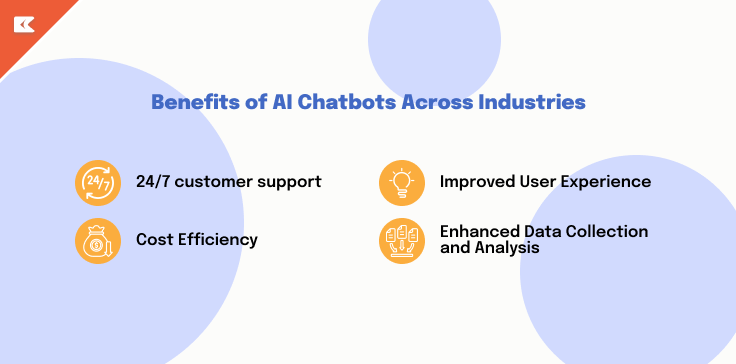
AI chatbots are associated with creative algorithms that engage machine intelligence to understand consumers’ needs, which makes client interplays more effective and entertaining. Let’s delve into the AI chatbot benefits, highlighting their ability to use diverse AI chatbot cases that distinguish various sectors.
-
24/7 Customer Support and Availability:
The ability of AI chatbots to provide round-the-clock customer support is one of their primary advantages. Chatbots, in contrast to people, can operate at any time and guarantee that client inquiries are promptly addressed, regardless of the length of the call.
According to the tidio, customers who have interacted with AI software for customer service had a positive experience, leading to customer satisfaction of up to 80%, and it supports sticking to challenging problems. This is because customers can get their questions answered anytime without waiting for a human representative on hold.
-
Cost Efficiency:
Implementing AI chatbots can drastically reduce operational costs. AI chatbot solutions benefit from mechanizing repetitive movements in any business & can automate repetitive tasks, reducing the requirement for colossal customer service teams while maintaining the highest service standards.
According to Stats, 23% of service organizations rely on AI digital assistants as their main communication channel, which can significantly reduce overhead costs.
-
Improved User Experience:
Chatbots improve the user experience through natural language processing by providing immediate answers and solutions to questions. Their ability to communicate with customers through natural language enhances satisfaction and builds loyalty. According to Cyfuture, the Use of AI chatbots resulted in an effective increase in CTR conversion rates by 12.5X and sales conversions by 4X
They may help clients at every step by making product recommendations, providing guidance on fit and size, and promptly responding to inquiries.
-
Enhanced Data Collection and Analysis:
AI chatbots collect valuable information during conversations, allowing businesses to study customers’ behavior, preferences, and feedback. The data can be used to enhance services and personalize the offerings.
By analyzing this data, businesses can uncover trends and preferences, enabling more individualized marketing campaigns. Furthermore, by refining their product offers to suit better client wants, organizations can benefit from the information obtained from AI chatbot engagements.
Key Trends Shaping the Future of AI Chatbots
1. The Rise of Human-Like Interactions and Conversational AI
- Advancements in AI and ML:
AI Chatbots seem more human because of artificial intelligence (AI) and machine learning (ML) developments. With the use of these technologies, chatbots in the future can understand context, identify user emotions, and respond to them in ways that seem more natural to users.
- User Experience:
The advancements in Conversational AI and conversational AI platform technologies are revolutionizing customer interactions by allowing chatbots to engage in more human-like conversations. The future of AI chatbots shows a growing emphasis on personalization and the context of AI chatbot trends. These AI-driven customer support systems can identify user intent, respond with relevant solutions, & improve overall customer satisfaction.
2. Enhanced Personalization Through AI
- Deep Learning Insights:
Chatbots can harness the power of deep-learning methods; chatbots can analyze vast amounts of user information to provide customized interactions. Hence, it allows them to comprehend the needs of each customer more effectively and offer tailored responses.
- Dynamic Recommendations:
Chatbots can increasingly provide personalized recommendations based on the user’s habits and preferences. For instance, a retailer chatbot could suggest items from previous purchases, enhancing your shopping experience.
3. Integration of Voice Technology
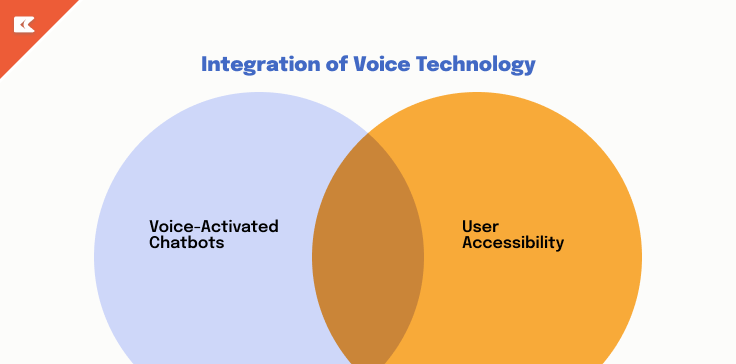
- Voice-Activated Chatbots and AI Voice Agents:
The widespread adoption of chatbots alongside voice AI assistants brings excellent benefits for customer support. Tools like AI voice agents leverage advanced AI to deliver human-like voice interactions, facilitating hands-free engagement and enhancing the user experience.
- User Accessibility:
Voice chatbots improve the accessibility of users from all demographics. When driving, multitasking, or using devices that do not have screens, chatbots with voice can provide users with a simple way to communicate with brands.
4. Broader Industry Applications
- Financial Services and Fintech AI Chatbots:
Within the BFSI Sector, financial AI chatbots are evolving into intelligent financial advisors aiding customers with inquiries about their accounts or transaction alerts and even fraud detection.
Charles Schwab uses a chatbot to help users and put themselves in the place of other inquiries about money.
- Healthcare AI Chatbots and Patient Engagement:
By simplifying procedures for patients and doctors, the healthcare AI chatbots significantly impact the healthcare industry, including telemedicine, appointment booking, and patient engagement.
For instance, a standard healthcare chatbot, Ada, resolves data consumers specify to recognize the likely cause behind syndromes.
- Retail & E-Commerce Chatbots for Sales:
For retail stores, retail AI chatbots improve sales and customer service through proactive interaction, guiding customers on their buying journey and increasing the conversion rate.
AI chatbots are used to connect to internet retailers in the way that Amazon instructs consumers about their orders.
5. Chatbots Driving Sales and Marketing
- Conversion Rates:
The data shows that chatbots can dramatically impact sales and customer acquisition. Their ability to offer immediate assistance can lead to better conversion rates.
- Omnichannel Strategies:
Integrating AI chatbots across various channels provides a seamless customer experience as they offer continuous engagement and enhance the user experience. However, many channels already include chatbots, including social media, websites, and mobile applications.
6. Addressing Customer Expectations
- Speed and Efficiency:
Balancing speedy response and efficient problem-solving is essential for effective customer interactions. Chatbots excel at providing rapid assistance, which customers now demand.
- Generational Preferences:
Millennials, as well as Gen Z, drive the demand for chatbots with advanced capabilities. Generations with a high-tech background want seamless and effective interactions. Therefore, it drives companies to improve the capabilities of chatbots.
7. Future Growth Drivers
- Messaging Platforms:
Popular messaging apps are crucial in the rapid acceptance of chatbots. As more users communicate via these platforms, companies will more often integrate chatbots to improve user interaction.
- Internal Enterprise Use:
Beyond customer interaction, chatbot automation is gaining traction within businesses to assist with HR tasks, IT support, and other organizational functions, increasing efficiency and improving workflows.
8. Ethical AI, Data Security, and Privacy in Chatbot Development
- User Privacy:
As chatbots integrate more into our lives, the importance of ethical conduct in AI and chatbot interaction cannot be overemphasized. Users must be secure and ensure their personal information is handled responsibly.
- Data Management:
Secure data protection measures are vital to maintaining users’ trust. Businesses should develop strategies focused on users’ privacy and ensure data security to ensure confidence in chatbots’ interactions.
Future Chatbot Trends Most Businesses Misread
As AI chatbot capabilities expand rapidly, several trends are being misread by businesses planning their next deployment cycle, leading to investments aimed at the wrong horizon.
- Confusing automation rate with readiness for agentic tasks. A chatbot that resolves 70% of queries through scripted flows is not halfway to autonomous task execution, agentic capability requires a completely different architecture, including tool-calling, memory, and real-time reasoning. Teams treating the gap as incremental are underestimating the rebuild required.
- Assuming generative AI eliminates the need for knowledge curation. LLMs do not know a company’s products, refund policy, or inventory. The businesses that will get the most from next-generation chatbots are those building proprietary knowledge pipelines now, not those waiting for the model to “just know” their business.
- Treating multilingual support as a translation problem. Adding 20 language packs does not make a chatbot culturally fluent. Future chatbot performance in global markets depends on regionalized intent models, local compliance alignment, and culturally appropriate conversational registers, none of which a translation layer provides.
- Underinvesting in conversation design while over-investing in model selection. The model is rarely where future chatbot quality is won or lost. The flow logic, escalation design, and fallback behavior define actual user experience, and most teams spend the inverse ratio of time on them.
- Viewing AI chatbots and human agents as a substitution equation. The future of AI chatbots in most industries is augmentation, not replacement, chatbots handling volume and agents handling judgment, with handoff quality determining outcomes. Organizations framing this as a headcount reduction play will design the wrong system.
Choosing AI Chatbot Technology for 2026 Readiness
The chatbot platform a business selects in 2026 is a longer-term commitment than it appears, the underlying architecture determines which future capabilities are possible and which require a full rebuild. Most vendor evaluations focus on current feature parity rather than forward compatibility, which leads organizations to choose systems that will require replacement the moment the next capability tier becomes standard. The following criteria are specifically calibrated for selecting technology that holds up as AI chatbots evolve.
- Retrieval-augmented generation (RAG) support — whether the platform allows the chatbot to be grounded in proprietary documentation at query time, without retraining the base model for every content update.
- Tool-calling and API integration depth — how many external systems the chatbot can interact with autonomously, and whether those integrations are configurable without custom engineering on every addition.
- Conversation memory architecture — whether the platform supports persistent user-level memory across sessions, not just within-session context windows, which is the baseline for any meaningful personalization at scale.
- Escalation and handoff protocol — whether full conversation context, intent history, and user metadata transfer cleanly to human agents or downstream systems, and whether this is configurable per use case.
- Compliance and data residency controls — whether the platform can restrict model inference, logging, and data storage to specific geographic regions — non-negotiable for GDPR, DPDP, or regulated industry deployments.
- Observability and evaluation tooling — whether the vendor provides native session analytics, failure pattern detection, and conversation quality scoring, or whether those require third-party instrumentation.
Final Thoughts: Building the Future with AI Chatbot
The world of AI chatbots is rapidly changing, and several essential trends are influencing its future. The rise and enhancement of personalization, the emergence of human-like interactions, & the integration of technology for voice will shape AI chatbots in the year 2025. As these intelligent tools are integrated into business strategies, being aware of the latest developments in chatbots is crucial.
We recommend that businesses partner with an AI chatbot development company as it is crucial to develop complex conversational AI chatbots that improve departmental relations and boost their strategies for customer engagement. We at Citrusbug provide advanced AI chatbot solutions customized to meet your business needs. We use the latest chatbot technology to ensure flawless integration and top-notch results. Get in touch with us today to step ahead of the competition.