
 Back
Back







The logistics industry has crossed an important line. For most of the last decade, conversations about technology in logistics centered on pilots, proofs-of-concept, and “the next big thing.”
That framing no longer fits. In 2026, logistics technology has moved from optional enhancement to operating infrastructure. It’s the layer your business runs on, not the experiment sitting beside it.
Several forces are pushing this shift forward at once. Global trade is recovering, but it’s doing so under a much heavier weight: tariff volatility, regulatory tightening around carbon emissions, persistent labour shortages, and customer expectations that no longer tolerate vague delivery windows.
This blog covers 10 logistics technology trends genuinely defining 2026. You won’t read about the same recycled list every blog has been running for years, but the architectural shifts, regulatory realities, and disruptive technology that are actually changing how this goods industry moves today.
What is Logistics Technology and its Major Uses
Logistics technology is the connected stack of software, hardware, and intelligent systems used to plan, execute, and optimise the movement of goods, information, and money across a supply chain.
It isn’t a single product or category. It spans artificial intelligence, IoT sensors, cloud platforms, robotics, automation, and data analytics, all working together to coordinate what was once a deeply manual industry.
In practice, it’s applied across almost every link of the chain. In transportation management, it handles route planning, fleet optimisation, freight booking, and carrier coordination.
In warehouse operations, it powers inventory tracking, automated picking and sorting, and the autonomous mobile robots now common on warehouse floors.
For supply chain visibility, it delivers real-time shipment tracking, predictive ETAs, and exception management before delays cascade. Demand forecasting and planning uses predictive analytics to align inventory, capacity, and labour with what’s actually coming.
Last-mile delivery depends on it for routing, customer notifications, and increasingly, autonomous handoffs. And on the documentation and compliance side, it’s replacing paper trails with electronic bills of lading, automated customs filings, and ESG reporting tools. Capabilities that didn’t exist as standard offerings even two years ago.
The key thing to understand is this: logistics tech isn’t a feature anymore. It’s the operating layer on top of which the modern industry actually runs. The trends below describe what that layer looks like in 2026.
Why 2026 is a Turning Point for LogiTech
The biggest change in 2026 isn’t any single piece of technology. It’s the architecture.
For years, logistics teams accumulated point solutions: a transportation management system here, a warehouse system there, a visibility platform bolted on top, a freight audit tool sitting beside that. Each one solved a piece of the problem. Together, they created data silos, integration drag, and decisions that arrived too late to act on.
That model is breaking down. Connected execution platforms, built to share data in real time across planning, transportation, warehousing, and last-mile, are rapidly becoming the new baseline.
What makes 2026 different is that emerging technologies are no longer operating independently. Artificial intelligence, IoT, automation, robotics, cloud computing, digital twins, and predictive analytics are increasingly working together within unified ecosystems. The trends below highlight the technologies and innovations driving the transformative future of logistics.
The Top 10 Logistics Technology Trends in 2026
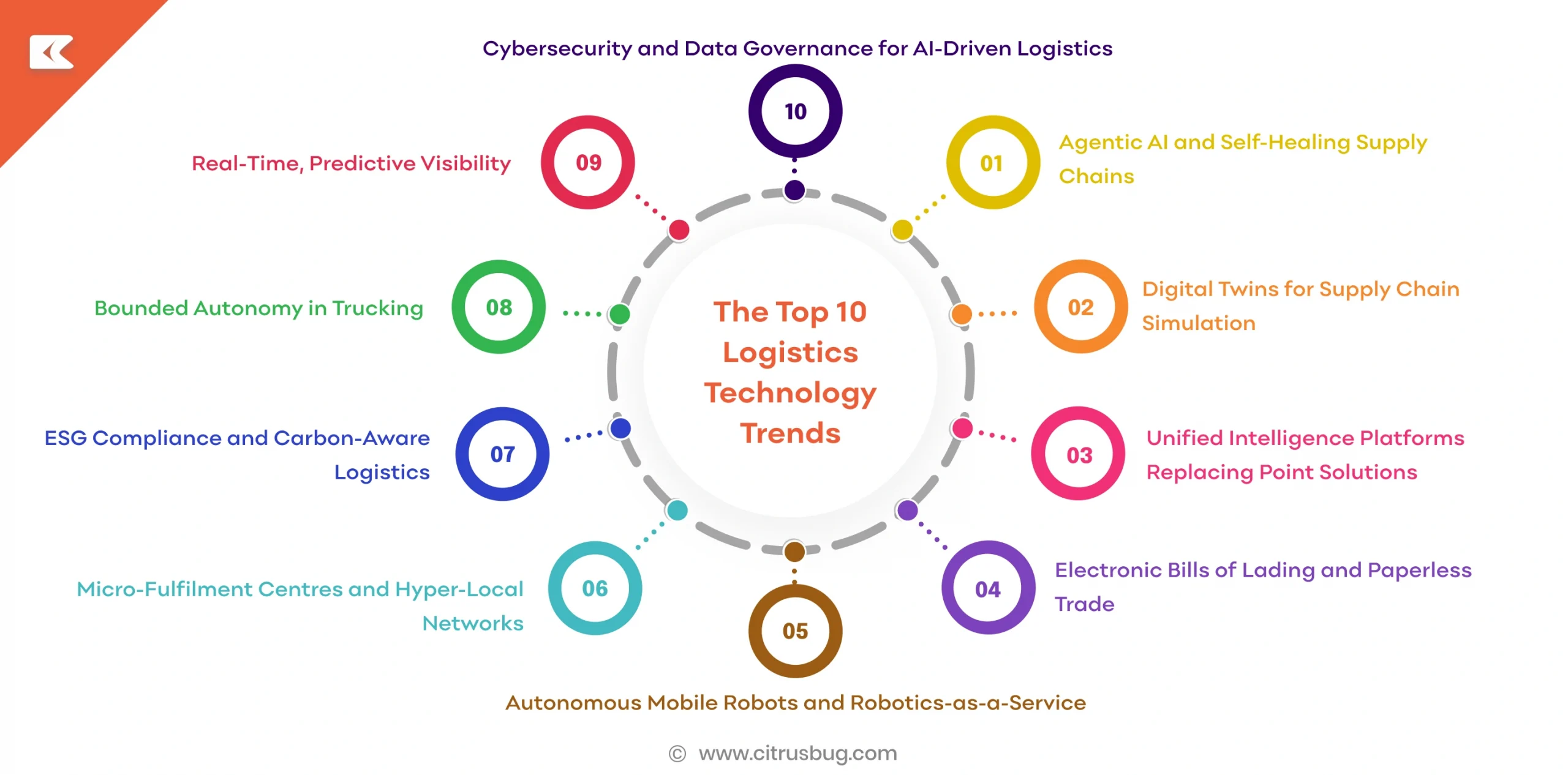
1. Agentic AI and Self-Healing Supply Chains
The biggest logistic technology trends this year are based on transformation from predictive AI to agentic AI, where predictive systems flagged problems, but now Agentic systems act on them.
When a port closes, an agentic system re-routes affected shipments, notifies downstream partners, and renegotiates carrier capacity without waiting for human approval at every step.
This is what’s now called a self-healing supply chain. A network that detects, diagnoses, and resolves disruptions in real time within governed boundaries.
The economic case is straightforward. Companies running agentic systems are seeing meaningful reductions in response times, downtime, and exception-handling costs.
The architectural case matters just as much. Agentic AI sits above your existing TMS and WMS rather than replacing them, which is why adoption is moving faster than most analysts expected.
2. Digital Twins for Supply Chain Simulation
Digital twins, virtual real-time replicas of your physical supply chain, have moved from research labs into mainstream logistics planning.
The 2026 use case isn’t simulation for its own sake. It’s stress-testing networks against scenarios you’d rather not encounter unprepared, a strike at a key port, a supplier outage, an unexpected tariff change, severe weather across a primary corridor.
Paired with agentic AI, digital twins become genuinely powerful. The twin models the disruption, the AI evaluates response options, and operators see the consequences before committing to anything.
For high-value or compliance-heavy operations like pharmaceuticals, defence, and perishables, this combination is quickly becoming standard rather than experimental.
3. Unified Intelligence Platforms Replacing Point Solutions
The fragmented stack (separate tools for tolls, fuel cards, safety, compliance, freight audit, visibility) is being replaced by integrated platforms that bring everything into one operational view.
The benefit isn’t just convenience. It’s that connected data finally lets AI do useful work. When toll data, telematics, route plans, and carrier rates all live in one place, patterns become visible, costs get validated automatically, and decisions get made on a complete picture instead of a fragment.
For operators evaluating their next investment, the practical question has shifted. Instead of “which best-of-breed tool should I buy?” it’s now “how do I consolidate without ripping out what already works?”
4. Electronic Bills of Lading and Paperless Trade
Blockchain spent years searching for a use case in logistics. In 2026, it has clearly found one in electronic bills of lading (eBLs).
Major ocean carriers, ports, and customs authorities now support eBL frameworks, and the legal infrastructure for paperless trade has matured enough for enterprise adoption. Documentation cycles that used to take days now take hours. Errors that used to require courier-shipped corrections now don’t happen.
This is one of the few areas where the ROI is genuinely measurable in the first quarter of use. It’s also a quieter story than the blockchain hype made it sound. Less revolutionary, more practical, and exactly what the industry actually needed.
5. Autonomous Mobile Robots and Robotics-as-a-Service
Warehouse automation is no longer the exclusive domain of Amazon-scale operations. Autonomous Mobile Robots (AMRs), machines that navigate warehouses without fixed infrastructure, have come down in cost enough that mid-market operators are deploying them at a meaningful scale.
The warehouse management system market is growing at around 18.32% CAGR, with most of that growth tied to automation integration.
Robotics-as-a-Service has been the unlock. Instead of multi-million-dollar capex commitments, operators rent robotic capacity and scale it up or down with seasonal demand.
For businesses planning warehouse upgrades, it’s worth to take expert guidance from a professional warehouse management software development company that can map robotics, WMS, and AI layers into a single production-ready stack.
6. Micro-Fulfilment Centres and Hyper-Local Networks
The economics of last-mile delivery have forced a structural change. Massive centralised warehouses serving wide regions are giving ground to networks of small, automated urban hubs. Micro-fulfilment centres and “dark stores” positioned close to customers.
AI handles the harder problem underneath, predicting which inventory belongs at which hub, and rebalancing it as demand patterns shift.
For ecommerce, grocery, and same-day delivery operators, this isn’t a future scenario. It’s already how the leaders compete on speed without paying expedited shipping costs to do it.
7. ESG Compliance and Carbon-Aware Logistics
Sustainability has stopped being a corporate communications exercise and started being a procurement requirement.
Enterprise shippers now ask forwarders for per-shipment carbon emissions data as part of standard RFPs, driven by their own Scope 3 reporting obligations.
Carbon calculation, Digital Product Passports, and verification of alternative fuels (LNG, methanol, biofuels) are showing up in software not as add-ons, but as core features.
The corridor-level story matters too. “Green corridors” between major ports are pulling carrier investment toward zero-emission vessels, and regulators in the EU, US, and parts of Asia are increasingly aligning timelines around them. Software that can’t measure and report carbon at the shipment level will struggle to win enterprise business in 2026.
8. Bounded Autonomy in Trucking
The headline version of autonomous trucking, robotic 18-wheelers everywhere, is still a future story. The 2026 reality is more interesting and more practical.
Electric and autonomous vehicles are being deployed at commercial scale on specific corridors where the conditions are workable. Return-to-base regional routes, port drayage, predictable middle-mile lanes.
This matters because the constraints aren’t really about technology anymore. They’re about charging infrastructure, regulatory approvals, insurance models, and route economics.
The companies winning here aren’t trying to automate everything. They’re identifying the routes where the math works and rolling out tightly scoped deployments.
We’re seeing this reflected in our own work through building modern fleet platforms, where systems increasingly need to mix human-driven, electric, and autonomous assets across the same operating fleet.
9. Real-Time, Predictive Visibility
Basic shipment tracking is now table stakes. The trend in 2026 is predictive visibility.
ETAs that update themselves based on traffic, weather, port congestion, and historical patterns. Exception alerts that arrive before the exception happens. Dashboards that prioritise the shipments most likely to slip rather than showing all of them equally.
Platforms like Project44 and FourKites have set the bar, and most TMS vendors are integrating with them rather than building competing capabilities from scratch. Underneath this, the IoT platforms feeding real-time signals are doing more of the heavy lifting than they get credit for.
For shippers, the shift is from “where is my freight?” to “what do I need to do about it?” That’s a much more useful question, and the technology has finally caught up to it.
10. Cybersecurity and Data Governance for AI-Driven Logistics
The flip side of connected platforms and agentic AI is a much larger attack surface.
Every integration is a potential entry point. Every autonomous agent is a potential decision-maker that needs traceability. Every cross-border data flow is a potential compliance issue. The EU AI Act’s high-risk system requirements (explainability, traceability, and meaningful human oversight) are pulling cybersecurity and AI governance into the same conversation.
Treating this as a final-step concern is no longer viable. Governance has to be designed in from the start: audit logs for autonomous decisions, role-based controls for what agents can act on, and clear escalation paths when AI confidence drops.
Among teams investing in developing custom logistics software, governance is becoming one of the first conversations rather than the last.
How to Choose the Right Technology for Your Business
Picking technology in 2026 is less about chasing the most exciting trend and more about disciplined sequencing. A few principles consistently separate the deployments that work from the ones that stall.
Start with the execution layer, not the planning layer
Most operators already have ERP and TMS investments handling planning. The fastest measurable ROI usually comes from the execution side: dispatch, exception handling, document automation. AI agents can be layered above existing systems rather than replacing them.
Choose integration over replacement
API-first platforms let you consolidate the stack without ripping out the tools your teams already know. The companies that move fastest tend to add capabilities. The ones that stall often try to migrate everything at once.
Graduate autonomy gradually
Don’t flip the switch from human-led to AI-led decision-making in one go. Start with recommendations, move to one-click approvals, then to bounded auto-execution. This is also what regulators are now expecting.
Build for governance from day one
ESG reporting, AI explainability, and cybersecurity aren’t going to be added later cheaply. The platforms positioned for the next five years are the ones treating governance as a core feature, not a wrapper.
Final Thoughts
The defining shift of 2026 isn’t a single piece of technology. It’s these top logistics technology trends that has become the operating layer of the industry rather than a set of tools sitting alongside it.
Agentic AI, digital twins, eBLs, micro-fulfilment, ESG-aware systems, and bounded autonomy aren’t isolated bets. Together, they describe what the future of the industry actually looks like: connected, accountable, faster to react, and far harder to disrupt.
For operators, the question isn’t whether to invest. It’s how to sequence those investments, so they compound rather than collide.
At Citrusbug Technolabs, we work at exactly that intersection, combining deep supply chain experience with AI, automation, and SaaS engineering to build systems that hold up in real-world operations. If you’re planning your next move and want a partner who can help architect, build, or modernise the underlying platform, we’d be glad to start a conversation.