
 Back
Back








Key Takeaways
- The global property management software market reached $6.53 billion in 2026, growing at an 8.74% CAGR through 2031.
- Software is expected to account for 73.8% of the total market in 2026, reflecting a shift from spreadsheets to unified platforms.
- 58% of landlords globally now use digital rent collection, while 76% of property managers rely on mobile apps for field operations.
- Cloud deployment commands 61.2% of the market, favored for remote access and operability across multi-site portfolios.
- 47% of property management companies face data privacy and cybersecurity challenges, a key barrier alongside high migration costs.
Property management has shifted from spreadsheets and phone calls to integrated digital platforms that handle everything from rent collection to maintenance tracking. The property management software market reflects this transition, expanding steadily as landlords, property managers, and real estate companies continue to move core operations into software-driven environments.
The demand extends far beyond large-scale real estate firms. Mid-size portfolios, housing associations, and commercial property operators are all adopting purpose-built platforms to improve accuracy, reduce manual effort, and serve tenants more efficiently. Cloud computing and mobile accessibility have lowered the entry barrier considerably.
AI integration, real-time analytics, and IoT connectivity are adding new functional layers to these tools. These advancements are accelerating investment from software vendors and real estate technology companies, driving both the property management software market and the broader PropTech market into a period of consistent and measurable growth.
What is Property Management Software?
Property management software is a digital platform designed to help landlords, property managers, and real estate operators centralize their day-to-day operations within a single interface. It covers tenant management, lease tracking, maintenance scheduling, rent collection, and financial reporting tools.
As rental portfolios grow in complexity, managing them manually becomes impractical and error-prone. Property management software reduces administrative overhead, improves payment tracking accuracy, and gives owners real-time visibility into occupancy, revenue, and compliance, making it a practical tool for both independent landlords and large portfolio operators.
The Property Management Software Market in 2026
Digital adoption across residential and commercial property operations has brought this market to a significant and measurable scale. Investment is growing from enterprise real estate groups and independent property management firms alike, reflecting an accelerating shift away from manual workflows. The market’s scale varies considerably depending on whether it is measured as standalone software or as the full digital operations ecosystem including services and integrated platforms.
Current Market Valuation
The core segment covers purpose-built software platforms designed for lease management, tenant communications, financial reporting, and maintenance coordination. Growth in this layer is driven by consistent migration from legacy tools and spreadsheet-based processes toward cloud-hosted, subscription-based applications.
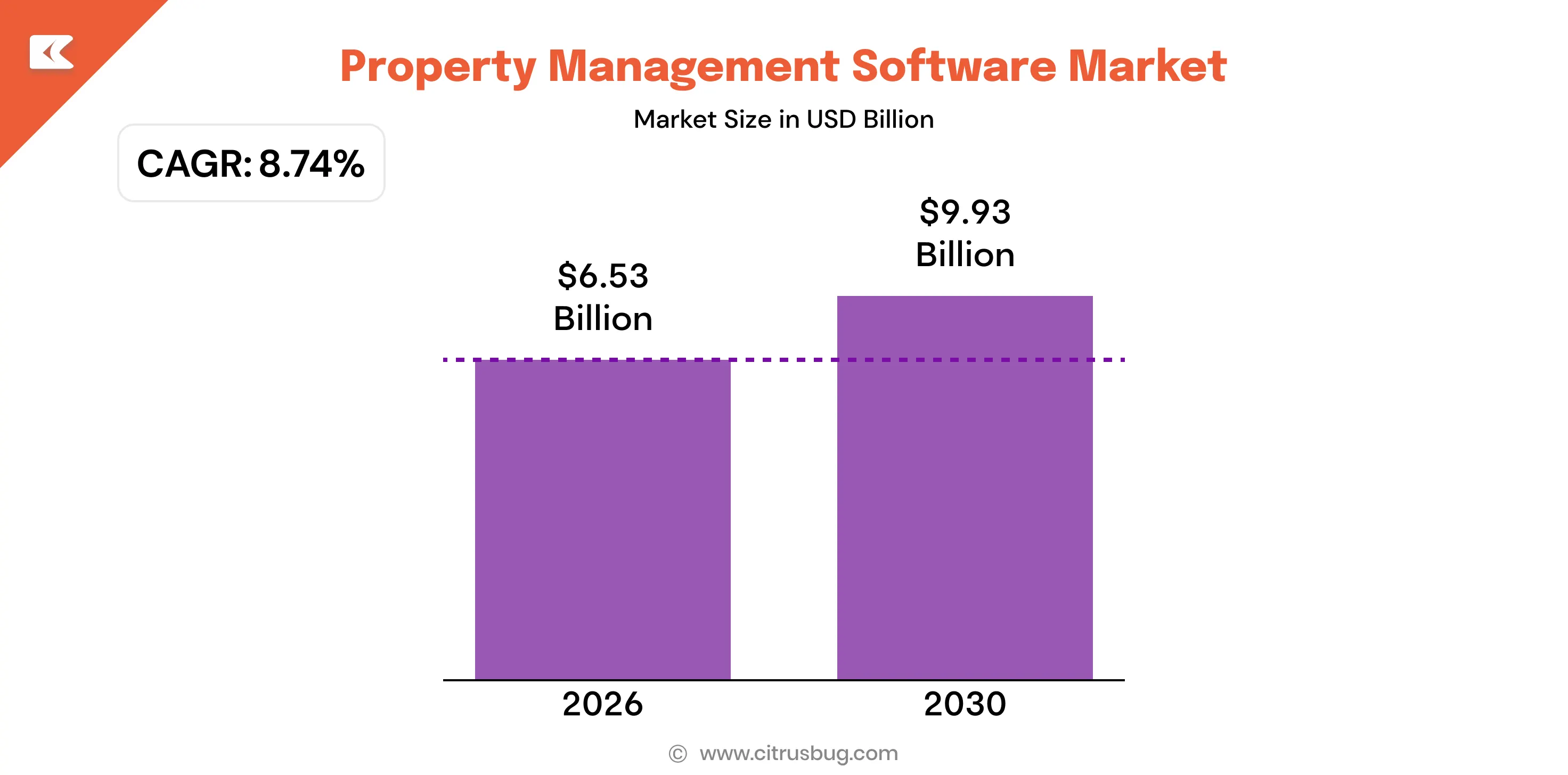
- The global property management software market reached USD 6.53 billion in 2026, growing at a CAGR of 8.74% from 2026 to 2031, driven by sustained demand for automated rental workflows, tenant-facing self-service tools, and integrated financial management within both residential and commercial portfolios.
- Measured across a broader scope that includes software platforms, third-party application layers, and service components, the market reached USD 9.65 billion in 2024, reflecting the extended commercial scale of the digital property management ecosystem beyond standalone licensed software products.
The Full Property Management Industry Scale
The property management industry reaches a significantly larger scale when professional services, outsourced management operations, and facility consulting are accounted for alongside core software products. This distinction matters for technology providers evaluating the full addressable market versus the software category alone.
- The combined property management industry, encompassing software platforms, professional services, and outsourced operational support, was valued at USD 22.32 billion in 2025, illustrating how the total commercial opportunity extends well beyond standalone software licensing and subscription-based platforms.
How Property Managers Are Adopting Software in 2026
Adoption patterns across the sector show a clear preference for cloud-based, mobile-accessible platforms that consolidate operations and reduce manual workload. Both residential and commercial segments are treating integrated software as the default operating environment rather than an optional enhancement to existing workflows.
Software as the Core Operations Tool
Property managers and landlords are centralizing lease management, financial reporting, and tenant communication within dedicated software platforms, making the licensed software component the dominant revenue driver across the market. This shift reflects a broader consolidation from fragmented point solutions into unified systems.
- The software component is expected to account for 73.8% of the total market in 2026, confirming its dominant position over hardware and professional services and reflecting the strong preference for all-in-one platforms among property managers across all portfolio sizes.
- This dominance reflects a consistent move away from spreadsheets and disconnected tools toward integrated platforms that manage everything from tenant onboarding and rent collection to maintenance tracking and compliance reporting within a single operational system, reducing handoffs and data entry errors across the property lifecycle.
Digital Rent Collection and Mobile Access
Beyond platform adoption, usage statistics show meaningful shifts in how specific day-to-day tasks like rent collection and property inspections are being handled. Digital payments and mobile tools have moved from optional features to standard workflow components across all property categories.
- Approximately 58% of landlords globally now use digital rent collection systems as of 2024, shifting away from physical checks and manual bank transfers toward automated, trackable payment platforms that reduce late payments and administrative follow-up time.
- Mobile-friendly management applications are used by 76% of property managers for real-time field operations as of 2025, supporting maintenance request approvals, tenant messaging, lease renewals, and property inspections from outside the office environment.
- These figures confirm that mobile access and payment automation are no longer supplementary features but central to how property management workflows are planned, assigned, and completed at the operational level.
Market Segmentation by Property Type, Deployment, and Industry
This market is structured across several distinct dimensions, including the type of property being managed, the preferred deployment model, and the industry vertical in which the platform is applied. Each segment reflects different adoption priorities, technology requirements, and budget thresholds that shape how vendors develop and position their platforms.
Residential Properties
Residential properties represent the largest segment by revenue, driven by the high volume of rental apartments, single-family homes, and managed housing communities that require automated rent tracking, tenant screening, and maintenance management on a recurring basis.
The residential segment accounted for 59.1% of global revenue in 2024, reflecting the scale of rental housing portfolios that depend on digital tools for efficient daily management. Residential landlords deal with frequent tenant turnover, variable maintenance cycles, and recurring monthly payment collection, all of which make workflow automation particularly valuable. This segment’s dominance explains why most entry-level and mid-market software platforms are built with residential use cases as their primary design target.
Cloud-Based Deployment
Cloud-based platforms have become the default deployment model for property management software, particularly among managers with multi-site portfolios or distributed teams that require remote access to tenant records and financial data.
The cloud deployment model commanded 61.2% of the market in 2025, reflecting a strong preference for subscription-based access, automatic software updates, and operability without on-site IT infrastructure. Cloud platforms allow property managers to access tenant records, financial dashboards, and maintenance queues from any device or location, which is especially important for managing large or geographically spread portfolios. On-premises solutions retain a meaningful share among large enterprise operators that prioritize data sovereignty, custom integrations, and compliance with internal IT governance policies.
Industry Vertical Breakdown
Property management software serves multiple industry verticals beyond traditional real estate, with construction and real estate remaining the largest single category by revenue share. Each vertical brings its own compliance standards, reporting requirements, and use case complexity.
The construction and real estate vertical holds 32.9% of the market by value in 2025, making it the dominant industry category. Firms in this vertical use property management platforms to coordinate tenant transitions in new developments, track asset performance across mixed portfolios, and automate financial reconciliation across multiple properties.
Other notable verticals include healthcare facilities, educational institutions, and government-managed housing programs, each with distinct compliance, audit trail, and reporting requirements that demand specialized software configurations.
Regional Market Share and Growth Insights
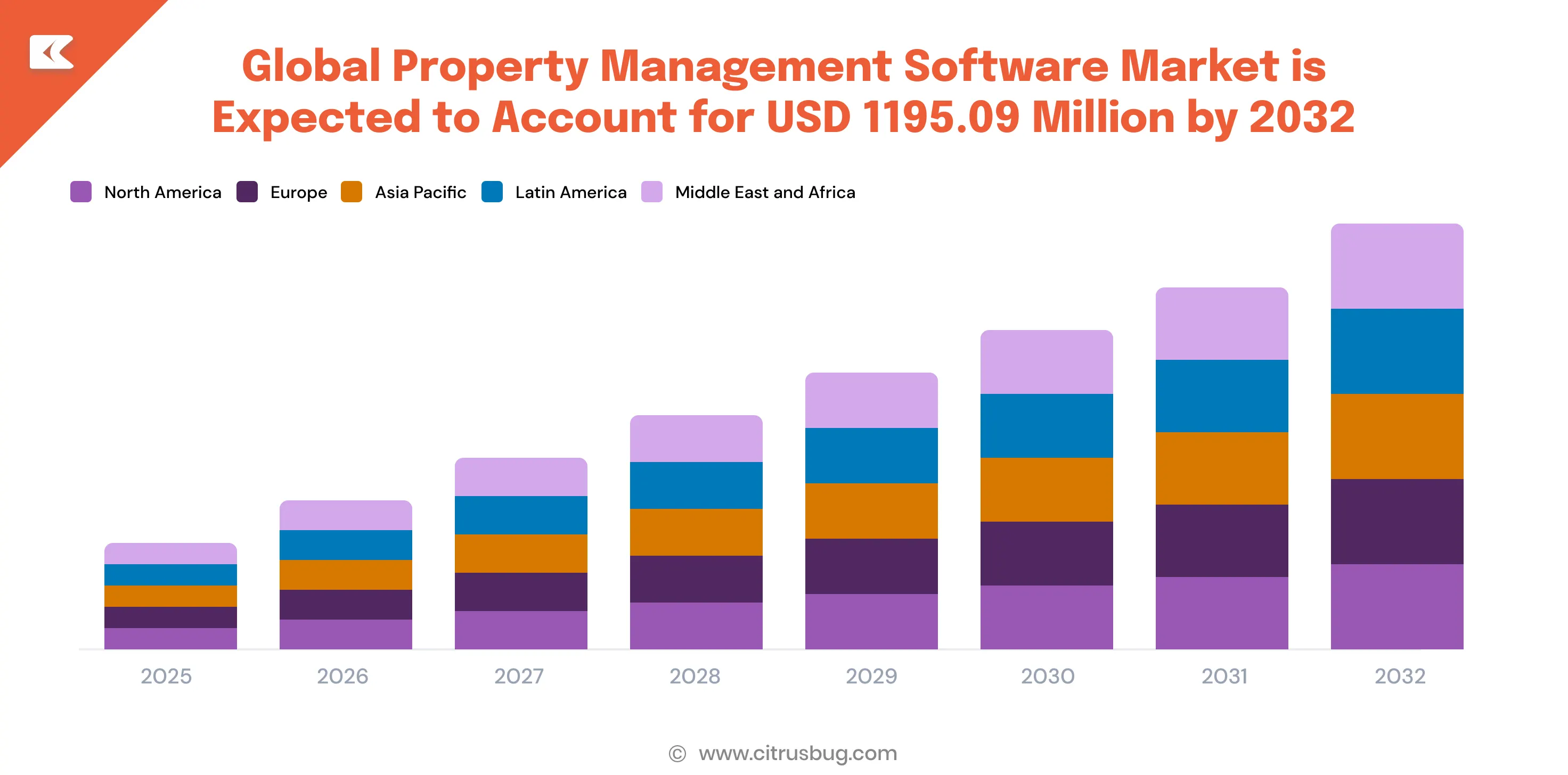
The property management software market shows strong adoption across all major global regions, with North America leading in absolute market size and Asia Pacific recording the most accelerated growth trajectory. Adoption drivers vary by region, from technology maturity and regulatory requirements in developed markets to urbanization rates and mobile-first access in emerging economies.
North America
- North America held USD 9.32 billion in 2025, representing 35.10% of total global market demand. The region benefits from a mature real estate sector, high enterprise software adoption rates, and strong PropTech investment activity, with the United States serving as the primary growth center for both residential SaaS platforms and commercial property management solutions.
Europe
- Europe contributed USD 7.26 billion in 2025, accounting for 27.30% of global market revenue. Growth across the region is supported by regulatory requirements for digital lease documentation, VAT-compliant property accounting systems, and increasing adoption of AI-assisted tenant screening tools across the United Kingdom, Germany, and Nordic markets.
Asia Pacific
- Asia Pacific held USD 7.2 billion in 2025, representing 27.10% of global market share. Rapid urbanization in China, India, and Southeast Asia is expanding the volume of actively managed residential and commercial properties, while government-backed smart city initiatives are accelerating the deployment of digital property management infrastructure across the region.
Middle East and Africa
- The Middle East and Africa region reached USD 1.55 billion in 2025, holding 5.80% of global market revenue. GCC countries, particularly the UAE and Saudi Arabia, are leading regional adoption through large-scale commercial real estate development and government-mandated digital property registration and management platforms.
Latin America
- Latin America represents the smallest regional segment, with growing awareness of cloud-based property tools among mid-size landlords and residential developers in Brazil and Mexico. Government investment in digital infrastructure and expanding internet connectivity are gradually improving conditions for broader software adoption across the region.
Factors Driving Property Management Software Growth
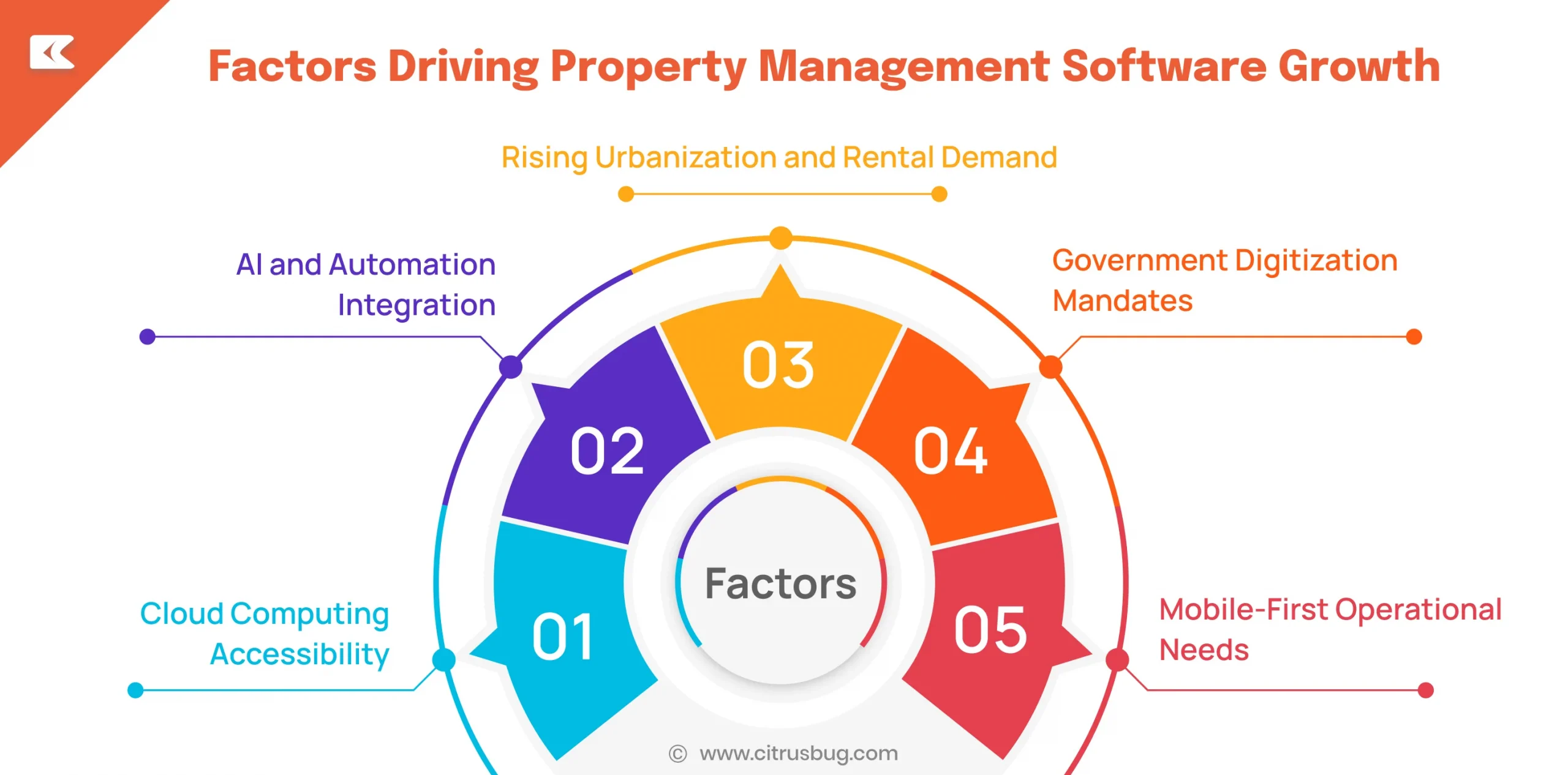
Several interconnected growth drivers are responsible for the consistent investment and expansion this market continues to attract across segments and geographies. These factors span technology infrastructure, demographic trends, and regulatory frameworks, each contributing to the sustained pace of adoption.
Cloud Computing Accessibility
Cloud-based deployment has removed the infrastructure barriers that previously limited adoption among smaller property operators and independent landlords. Monthly subscription models allow managers to access enterprise-grade tools without significant upfront capital investment or dedicated IT teams. The ability to scale storage, users, and features on demand makes cloud platforms practical for growing portfolios across both residential and commercial categories.
AI and Automation Integration
Artificial intelligence is changing how property managers handle high-frequency tasks including lease renewals, maintenance scheduling, and tenant screening. Automated workflows reduce manual data entry and follow-up cycles, allowing managers to handle larger portfolios without proportional increases in team size. AI-driven analytics tools are also improving pricing decisions, occupancy optimization, and predictive maintenance planning across residential and commercial assets.
Rising Urbanization and Rental Demand
Accelerating urbanization across Asia Pacific, Sub-Saharan Africa, and Latin America is expanding the total volume of rental properties under active professional management. As populations move into urban centers, tenant expectations for digital-first experiences and responsive management rise alongside the number of units requiring oversight. This demographic shift is creating consistent new demand for digital property management tools across all market segments and property categories.
Government Digitization Mandates
Regulatory agencies in markets across Europe, the Middle East, and Asia are requiring property owners to maintain digital records for lease agreements, maintenance logs, and financial transactions. Compliance with these mandates is pushing operators who previously relied on paper-based or hybrid processes toward dedicated software platforms. Digital audit trails, automated reporting tools, and compliance dashboards have become practical requirements in markets with stricter property governance frameworks.
Mobile-First Operational Needs
Property managers are increasingly required to oversee portfolios from mobile devices in the field, often without access to a central office or desktop environment. Mobile applications that support maintenance approvals, lease signing, tenant messaging, and payment tracking allow management to occur from any location. This shift toward mobile-first operations is pushing software vendors to prioritize fully responsive, app-based interfaces that function consistently across devices and connection types.
Key Challenges in Platform Adoption
While the sector continues to grow across all regions, certain adoption barriers are slowing the pace at which organizations fully transition to digital platforms. These challenges are most pronounced among smaller operators, firms with deeply established manual workflows, and organizations managing sensitive tenant data at scale.
- Data Privacy and Cybersecurity Exposure: 47% of property management companies worldwide face data privacy and cybersecurity issues, making security infrastructure one of the most significant concerns for operators considering cloud-based platforms. Managing sensitive tenant records, financial data, and lease documents at scale requires robust encryption, role-based access controls, and compliance with regional data protection regulations.
- High Implementation and Migration Costs: Transitioning from legacy tools or paper-based systems to modern property management platforms involves upfront licensing fees, data migration efforts, and staff retraining. For smaller landlords and independent managers, these costs can be a meaningful barrier, particularly when ROI timelines are unclear or platforms require significant configuration before deployment.
- Resistance Among Established Operators: Property management firms with long-standing manual processes often encounter internal resistance when introducing software-driven workflows. Overcoming this inertia requires a clear demonstration of efficiency gains, a phased rollout plan to minimize operational disruption, and executive buy-in before adoption can advance at scale.
Growth Projections Through 2032
The property management software market is positioned for strong and broad-based growth through the end of the decade, supported by rising adoption in previously underpenetrated segments, country markets, and end-user categories. Projections across global, regional, and segment levels consistently indicate above-average expansion, with several emerging markets and fast-growing segments set to outpace the overall trajectory.
Global and Regional Market Projections
The overall market is expected to grow steadily through 2032, with APAC and high-growth country markets contributing disproportionately to the pace of global expansion.
- The global property management software market is projected to reach USD 12.32 billion by 2032, supported by continued cloud migration, rising rental housing demand, and the growing integration of AI-powered operational tools across enterprise property portfolios.
- Asia Pacific is anticipated to grow at a CAGR of 10.2% through 2032, making it the fastest-growing regional market globally. Urbanization across India, China, and Southeast Asia is generating large volumes of newly managed residential and commercial assets requiring digital operational platforms.
- India stands out as the fastest-growing country market, expected to expand at a CAGR of 14.9% through the forecast period, driven by rapid urban development, government digitization initiatives, and rising demand for professional property management platforms among institutional landlords and residential developers.
Segment-Level and Software Component Growth
Different market segments are expanding at notably varied rates, with housing associations, commercial properties, and the residential sector each showing above-average growth trajectories backed by distinct demand drivers.
- The housing associations end-user segment is anticipated to grow at a CAGR of 10.8% from 2025 to 2032, as social housing operators invest in compliance management tools, tenant self-service portals, and automated financial reporting solutions to meet increasing regulatory requirements.
- The commercial property segment is expected to grow at a CAGR of 9.6% during the forecast period, driven by rising demand for multi-tenant billing, automated lease renewal workflows, and integrated facilities management within large commercial and mixed-use properties.
- The residential property type is forecast to register a CAGR of 10.7% through the forecast period, as tenant-centric self-service tools, mobile rent payment systems, and automated maintenance request platforms continue to drive adoption among individual landlords and institutional rental operators alike.
- Within Europe, the commercial segment is expected to grow at a CAGR of 10.4%, driven by smart building investment and the digitization of commercial lease management processes across major European property markets.
- The standalone software component is projected to reach USD 5.12 billion by 2032, highlighting the long-term commercial value of the core software layer as services and integrated platform solutions continue to expand their share of the overall market.
Conclusion
The property management software market continues on a clear growth path, driven by cloud adoption, mobile-first demand, and AI-powered automation across residential, commercial, and institutional segments. APAC, housing associations, and commercial property are all expanding faster than the overall market average, reflecting broad and durable demand across geographies and property types.
Organizations evaluating property management software development are entering a market with strong long-term fundamentals. Platforms built for scalable cloud deployment, compliance-ready data management, and mobile operability are well positioned to capture sustained growth across an expanding range of segments.