
 Back
Back







Key Takeaways
- The global RAG market reached $2.76 billion in 2026, growing from $1.2 billion in 2024 at a projected 38.4% CAGR through 2030.
- Healthcare and life sciences lead RAG adoption with 32.85% of end-user market share, driven by strict accuracy requirements.
- Cloud-based deployment accounts for 72% of the market, while 28% remains on-premises for regulated sectors like banking and healthcare.
- Organizations using RAG have reported up to 40% higher content accuracy compared to traditional generative AI models.
- Document retrieval and content generation are the two leading use cases, together addressing the need for traceable, auditable AI outputs.
Retrieval-Augmented Generation has moved from a niche AI architecture to a foundational infrastructure layer for enterprises requiring accurate, context-aware language model outputs. The RAG market is expanding at a pace that mirrors how quickly organizations are transitioning from static generative AI systems to dynamic, knowledge-grounded alternatives.
Conventional large language models frequently produce outdated or fabricated information. RAG addresses this directly by connecting AI models to live data sources, making the technology essential for healthcare documentation, legal research, financial analysis, and customer support automation across industries.
From cloud-first deployments to specialized on-premises environments, adoption is accelerating in industries where data accuracy and freshness carry real operational consequences. Market valuations, regional growth figures, and investment signals all show a technology that is now firmly embedded in enterprise AI strategy.
What is Retrieval Augmented Generation?
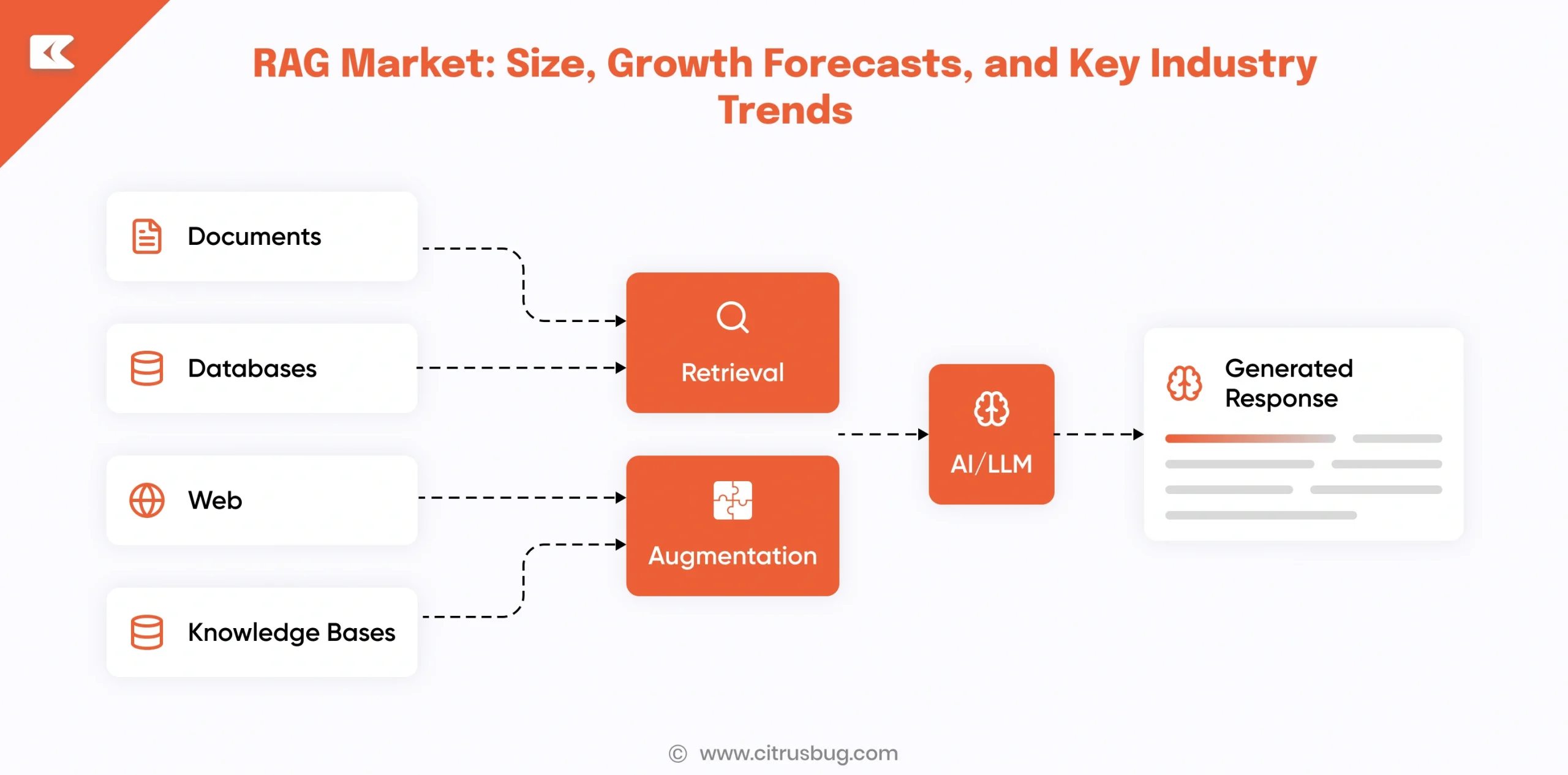
Retrieval Augmented Generation (RAG) is an AI architecture that combines large language models with real-time information retrieval. Instead of relying solely on pre-trained data, RAG systems fetch relevant content from external knowledge bases, documents, or data repositories before generating a response.
This approach resolves a core limitation of standalone AI models: static training windows and inaccurate outputs. By grounding responses in verified, current source material, RAG delivers more reliable AI-generated content, making it practical for enterprise-scale deployment across compliance-sensitive industries including healthcare, finance, and legal services.
The Global RAG Market: Size and Current Trajectory
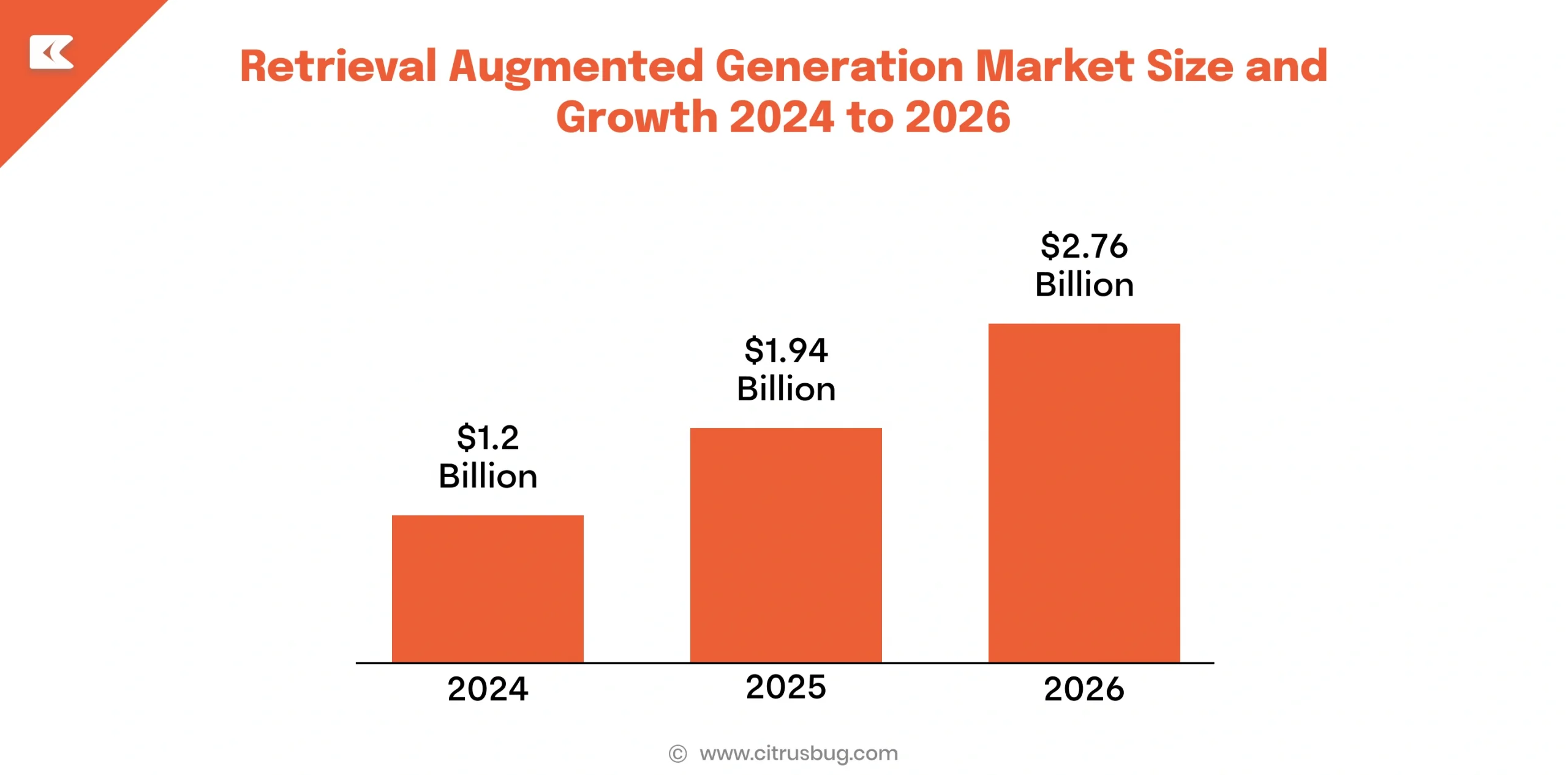
The global market has recorded consistent year-over-year gains as enterprise demand for grounded AI systems moves from pilot programmes into full production deployments. From established technology hubs in North America to emerging digital economies in Asia-Pacific, organizations are allocating significant infrastructure budgets to retrieval-based AI systems that reduce the accuracy risks associated with standalone language models.
Annual Market Valuations (2024–2026)
Three consecutive years of data reveal the transition from early commercial interest to mainstream enterprise adoption, with each period recording meaningful gains over the prior one.
- The global RAG market was valued at USD 1.2 billion in 2024, establishing retrieval-augmented generation as a commercially significant segment within the broader generative AI landscape and confirming the technology’s transition from research environments into enterprise production systems at scale.
- By 2025, the market reached USD 1.94 billion, reflecting accelerated enterprise investment as organizations moved past proof-of-concept stages and began scaling retrieval systems across document intelligence, internal knowledge management, and automated customer support workflows.
- Current estimates place the 2026 market at USD 2.76 billion, representing strong sequential growth that confirms RAG’s expanding role within enterprise AI infrastructure budgets and cloud service ecosystems worldwide.
- The sector is projected to grow at a compound annual growth rate (CAGR) of 38.4% between 2025 and 2030, placing it among the fastest-growing categories in enterprise technology infrastructure today.
The three-year valuation trajectory reflects more than market optimism. It captures the commercial reality of organizations that encountered reliability problems with standalone models in production and migrated to retrieval-grounded architectures as the operational standard for trustworthy AI outputs.
The United States as the Primary Commercial Driver
The U.S. holds a disproportionately large share of global RAG activity, anchored by a dense concentration of AI research firms, cloud hyperscalers, and enterprise software companies that have made language model infrastructure a strategic investment priority across their multi-year technology roadmaps.
- The U.S. market was valued at USD 479.15 million in 2025, accounting for a significant portion of North American revenue and reflecting the country’s first-mover advantage in enterprise AI procurement, underpinned by robust cloud adoption and a mature AI venture investment ecosystem.
The depth of U.S. commercial activity reflects decades of foundational investment in cloud infrastructure, enterprise software procurement cycles, and applied AI research. This structural advantage creates a self-reinforcing adoption cycle where early enterprise deployments generate performance data that validates further investment and accelerates broader industry rollout. As more organizations move from evaluation to production, the domestic market continues to function as the primary reference environment for enterprise RAG deployment globally, setting benchmarks that other regional markets look to when establishing their own adoption timelines and infrastructure requirements.
How the RAG Market is Being Deployed and Used Today
Deployment preferences, industry concentrations, and functional application patterns all reveal where retrieval-augmented generation is delivering the most consistent operational value. The technology’s adoption profile is shaped by both infrastructure practicalities and the specific data access requirements of the industries that have moved furthest into production deployment.
Cloud and On-Premises Deployment Patterns
The dominant preference for cloud infrastructure reflects RAG’s natural alignment with scalable compute resources, managed vector databases, and the API-driven development cycles that enterprise AI teams rely on for building and iterating production retrieval systems efficiently.
- Cloud-based deployment accounted for 72% of the RAG market in 2025, reflecting how cloud scalability, elastic compute resources, and managed embedding and vector search services reduce the engineering overhead required to build and maintain production-grade retrieval pipelines at enterprise scale.
- On-premises deployment held a 28% share of the market in 2025, representing organizations in regulated sectors including banking, defence, and healthcare that require full control over proprietary data and cannot route sensitive internal knowledge through public cloud environments due to data sovereignty and compliance requirements.
The cloud-to-on-premises ratio signals that RAG adoption spans a wide range of organizational contexts and data governance requirements. While cloud-native deployments are clearly dominant, the substantial on-premises share confirms that the technology is addressing real requirements in environments where compliance constraints drive infrastructure decisions independently of cost or convenience considerations.
Healthcare as the Leading End-User Segment
Among all industry verticals, healthcare and life sciences have established the strongest position in RAG deployment, driven by a combination of large and continuously updated document repositories and some of the strictest accuracy requirements for AI-generated clinical and administrative content.
- Healthcare and life sciences held 32.85% of RAG end-user market share in 2025, a leading position driven by clinical documentation workflows, medical literature summarization, regulatory compliance assistance, and growing adoption of AI tools that support both diagnostic decision-making and administrative operations across hospital systems and speciality providers.
The sector’s lead in RAG adoption is not incidental. The combination of high document volume, strict accuracy requirements, and the high operational cost of AI errors in clinical settings makes retrieval-grounded AI a natural infrastructure choice. No other AI architecture addresses the accuracy and auditability demands of healthcare deployment as directly, which is why the industry has consistently allocated a larger share of its AI infrastructure budget to retrieval-based systems than any other vertical segment.
Primary Functional Applications in Production
The applications organizations are building with RAG reveal a consistent split between structured information access and grounded content production, both addressing the same underlying enterprise priority: AI outputs that can be traced to a source and trusted in downstream workflows.
- Document retrieval captured 33.5% of the RAG application market in 2024, making it the single most common functional use case, spanning legal contract review, compliance querying, internal knowledge base search, and research summarization across enterprise environments in every major industry vertical.
- Content generation represented approximately 30% of application-level activity in 2025, as enterprises deployed RAG to produce documents, reports, and customer communications grounded in verified internal source material rather than relying on model-generated outputs that lack traceability or verifiable provenance.
Both application categories reflect the same fundamental enterprise requirement: replacing AI outputs that cannot be audited with outputs that can be linked to source material, reviewed for accuracy, and trusted in regulated or high-stakes operational contexts.
Regional Market Share and Growth Insights’
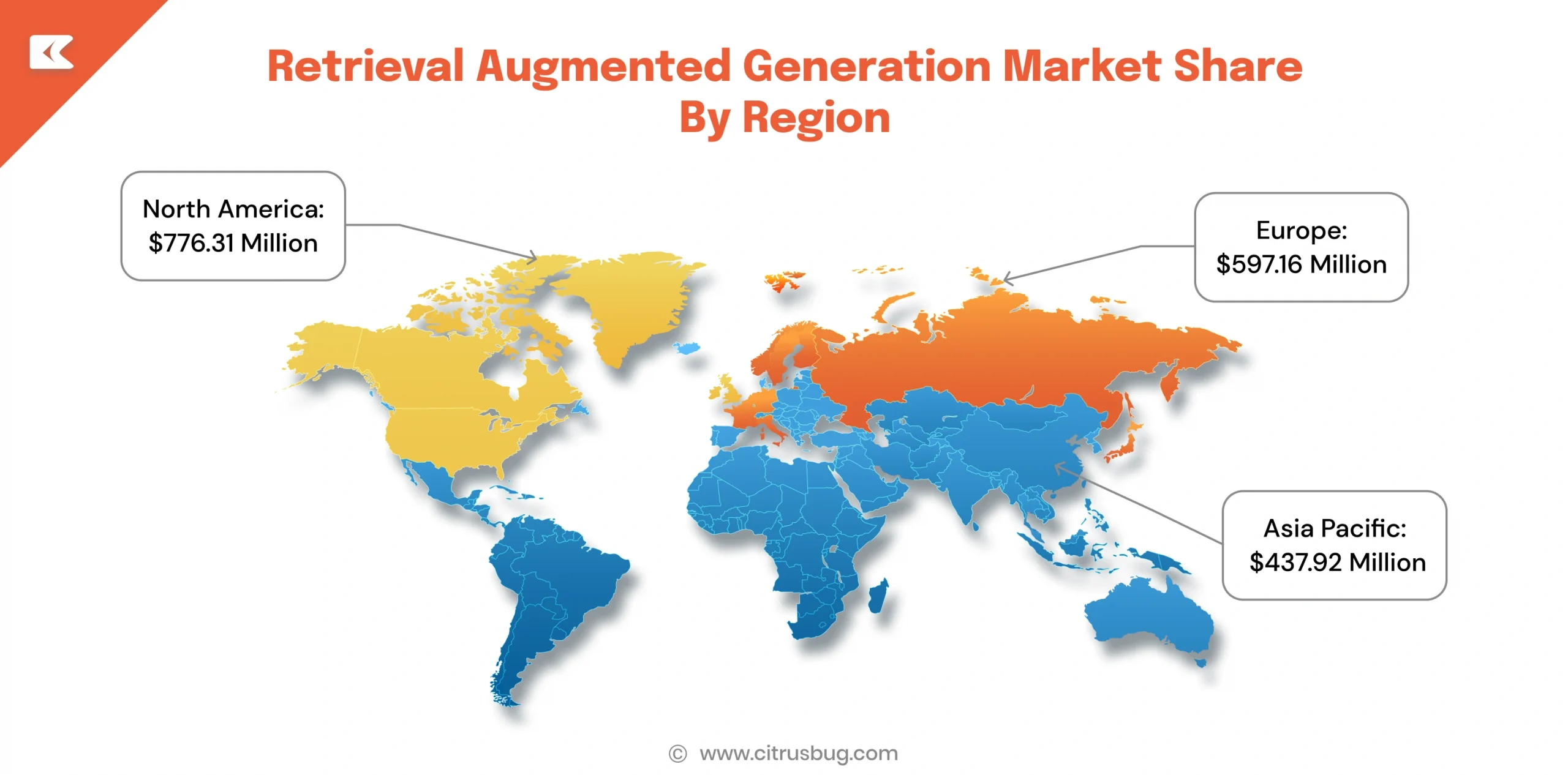
The geographic distribution of this market reflects different stages of enterprise AI maturity, cloud infrastructure readiness, and regulatory frameworks across major world regions. North America leads in total market value, Europe is driven by compliance-oriented enterprise adoption, and Asia-Pacific is registering the fastest pace of expansion globally.
North America
- North America’s market reached USD 776.31 million in 2025, representing approximately 39% of total global market revenue, a dominant position driven by the region’s concentration of hyperscale cloud providers, AI-native software companies, and large enterprises that have made language model infrastructure a multi-year strategic investment priority with significant dedicated budget allocation.
Europe
- The European market reached USD 597.16 million in 2025, with enterprise adoption concentrated in financial services, manufacturing automation, and legal technology, where organizations are integrating retrieval-based AI under digital infrastructure frameworks that promote interoperable, auditable, and knowledge-grounded architectures suited to the region’s regulatory environment.
Asia-Pacific
- Asia-Pacific posted a market value of USD 437.92 million in 2025, with the region identified across multiple analyses as the fastest-growing geography for retrieval-based AI globally, driven by large-scale national digitization programmes in China, India, Japan, and South Korea, combined with sustained government investment in domestic AI capabilities and a rapidly expanding enterprise software sector embedding retrieval-based AI into core operational workflows.
Factors Driving Rapid Expansion in the RAG Market
The growth of retrieval-augmented generation reflects far more than a technology trend. A specific combination of enterprise needs, infrastructure developments, and strategic priorities has made RAG the natural default architecture for organizations that need AI to be both accurate and operationally reliable.
Demand for Accurate AI Outputs in Regulated Industries
Enterprises in healthcare, finance, and legal services need AI outputs traceable to verified sources. Standalone language models generate responses from learned patterns, making accuracy unpredictable in high-stakes contexts. RAG resolves this by tying each response to documents retrieved at query time, making AI-assisted workflows defensible under regulatory and legal scrutiny where errors carry real operational consequences.
Open-Source Tooling and Framework Accessibility
Pre-built open-source retrieval frameworks have removed the primary engineering barrier to RAG adoption. Organizations no longer need to build embedding pipelines or vector databases from scratch. Development teams can implement production-grade retrieval systems using standard workflows, compressing deployment timelines from months to weeks and extending adoption to mid-market companies without dedicated AI infrastructure teams.
Cloud-Native Integration and Managed Retrieval Services
Major cloud providers now offer vector search, embedding generation, and semantic retrieval as managed services. Enterprise teams deploy retrieval pipelines through standard API calls without managing underlying infrastructure. This has made RAG deployment accessible to organizations that value speed and simplicity, removing the need for specialized vector database expertise to build and maintain a production-ready system.
Enterprise Investment in Knowledge Infrastructure
Organizations recognize that internal documentation, policy libraries, and research repositories represent strategic assets that standalone AI models cannot effectively use. RAG provides a practical architecture for indexing proprietary knowledge and making it queryable through natural language. This positions the technology as a knowledge infrastructure investment rather than purely an AI decision, elevating procurement to the executive level in many organizations.
Integration Into Existing Enterprise Software Ecosystems
Enterprise software vendors across CRM, content management, and customer support categories are embedding retrieval capabilities directly into their platforms. Organizations adopting RAG in one part of their software stack increasingly encounter it as a standard feature in tools they already use, accelerating adoption through familiar procurement channels without requiring independent AI infrastructure decisions for each use case.
Benefits of RAG Architecture in Enterprise AI Deployments
RAG architecture addresses a fundamental gap between what AI models are capable of and what enterprise deployments actually require. These core operational benefits explain why organizations are choosing retrieval-grounded architectures over standalone generative models for production-critical workflows.
Significant Reduction in AI Hallucinations
Standalone language models generate responses based entirely on learned patterns, with no ability to verify a claim against a current source. RAG resolves this by grounding every response in documents retrieved at query time, substantially reducing the rate of fabricated or inaccurate outputs.
- Every model response is constrained by the content of retrieved source documents rather than unchecked model recall.
- Errors caused by outdated training data are reduced because the retrieval layer surfaces current documents instead of relying on static model memory.
- Organizations can curate and control the retrieval corpus, giving them direct influence over the knowledge the model draws from.
- Confidence in AI-generated outputs increases for compliance and clinical teams because claims can be verified against the underlying source material.
- Quality control becomes a tractable operational task rather than a statistical exercise when outputs are tied to specific retrievable documents.
- The traceable link between output and source creates a feedback mechanism for identifying and correcting knowledge gaps in the retrieval corpus over time.
Real-Time Access to Current and Domain-Specific Knowledge
AI models trained on a fixed dataset cannot incorporate information published or updated after the training cutoff. For organizations where policies, regulations, or product specifications change frequently, this creates a persistent gap between what the AI knows and what the organization needs it to know.
- The retrieval layer is updated independently of the model, meaning new information is immediately available for generation without requiring retraining.
- Regulatory updates, product changes, and policy revisions are reflected in AI outputs as soon as the relevant documents are added to the retrieval index.
- Domain-specific knowledge that is under-represented in general model training becomes fully accessible through targeted retrieval against curated knowledge bases.
- Proprietary institutional knowledge, including internal research, custom procedures, and historical case data, can be made available to the AI system in a structured, controlled way.
- Teams in specialized fields receive outputs informed by the exact technical literature and institutional documentation relevant to their specific work context.
- Knowledge currency is managed at the retrieval layer as an ongoing operational process rather than as an expensive periodic retraining event.
Cost-Effective Knowledge Updates Without Model Retraining
Training or fine-tuning large language models requires significant compute resources, time, and specialized expertise. Organizations that need their AI systems to reflect updated knowledge on an ongoing basis face substantial recurring costs if they address this through model-level updates.
- Updating the knowledge available to a RAG system requires refreshing the retrieval corpus rather than retraining or fine-tuning the model.
- New policies, product updates, and research findings can be incorporated into the retrieval index within hours rather than the weeks a fine-tuning cycle typically requires.
- The base model remains stable while the knowledge layer evolves, reducing engineering risk and eliminating the need to revalidate model behavior after each knowledge update.
- A single base model can serve multiple use cases by directing queries to different retrieval corpora, creating the effect of domain-specialized AI systems without separate training costs for each.
- Infrastructure investment concentrates on the retrieval and indexing layer, which scales more predictably and at significantly lower cost than model training operations.
Enhanced Data Privacy and Compliance Controls
Enterprise AI deployments in regulated industries require strict controls over data access, information handling, and data flow during each query. Retrieval-grounded architecture provides a structured framework for enforcing those controls at the retrieval layer itself.
- RAG systems deployed on-premises or in private cloud environments keep all data within organizational infrastructure while still delivering advanced AI capabilities.
- Document-level access controls at the retrieval layer ensure the system only surfaces information the querying user has authorization to access.
- Sensitive documents, including legal agreements, patient records, and financial filings, can be included in the retrieval corpus without being transmitted to external model providers.
- Audit logs at the retrieval layer create a complete, traceable record of which documents were accessed during each query, supporting compliance reporting and security reviews.
- Data residency requirements can be enforced by controlling the geographic location of retrieval infrastructure independently of where the base language model is hosted.
- The separation between the retrieval layer and the model layer allows security teams to apply different governance policies to each component based on sensitivity and risk classification.
Improved Output Transparency and Auditability
One of the most persistent concerns about generative AI in enterprise settings is the opacity of model outputs. When a model produces an incorrect or problematic response, there is typically no accessible record of how that output was generated, making quality control and regulatory compliance difficult to demonstrate.
- RAG produces outputs directly tied to specific retrieved source documents, creating an inherent audit trail for every AI-generated response.
- Source citations can be surfaced alongside model outputs, giving users an immediate means of verifying claims against the documents the retrieval system selected.
- Organizations can review the retrieval process to understand why specific documents were prioritized, giving quality control teams meaningful visibility into the factors shaping each output.
- Regulators and auditors in healthcare, finance, and legal sectors increasingly expect AI systems to demonstrate factual grounding, and RAG’s source-linked outputs provide a practical means of satisfying that expectation.
- Internal review workflows for AI-assisted decisions can include source document verification as a standard step, reducing the risk that an incorrect output propagates unchecked through a downstream process.
- The combination of retrievable sources and model-generated summaries gives teams the ability to audit at whatever level of detail the situation requires, from the final output down to the specific document passages that informed it.
Future Outlook: Long-Term Projections for the RAG Market
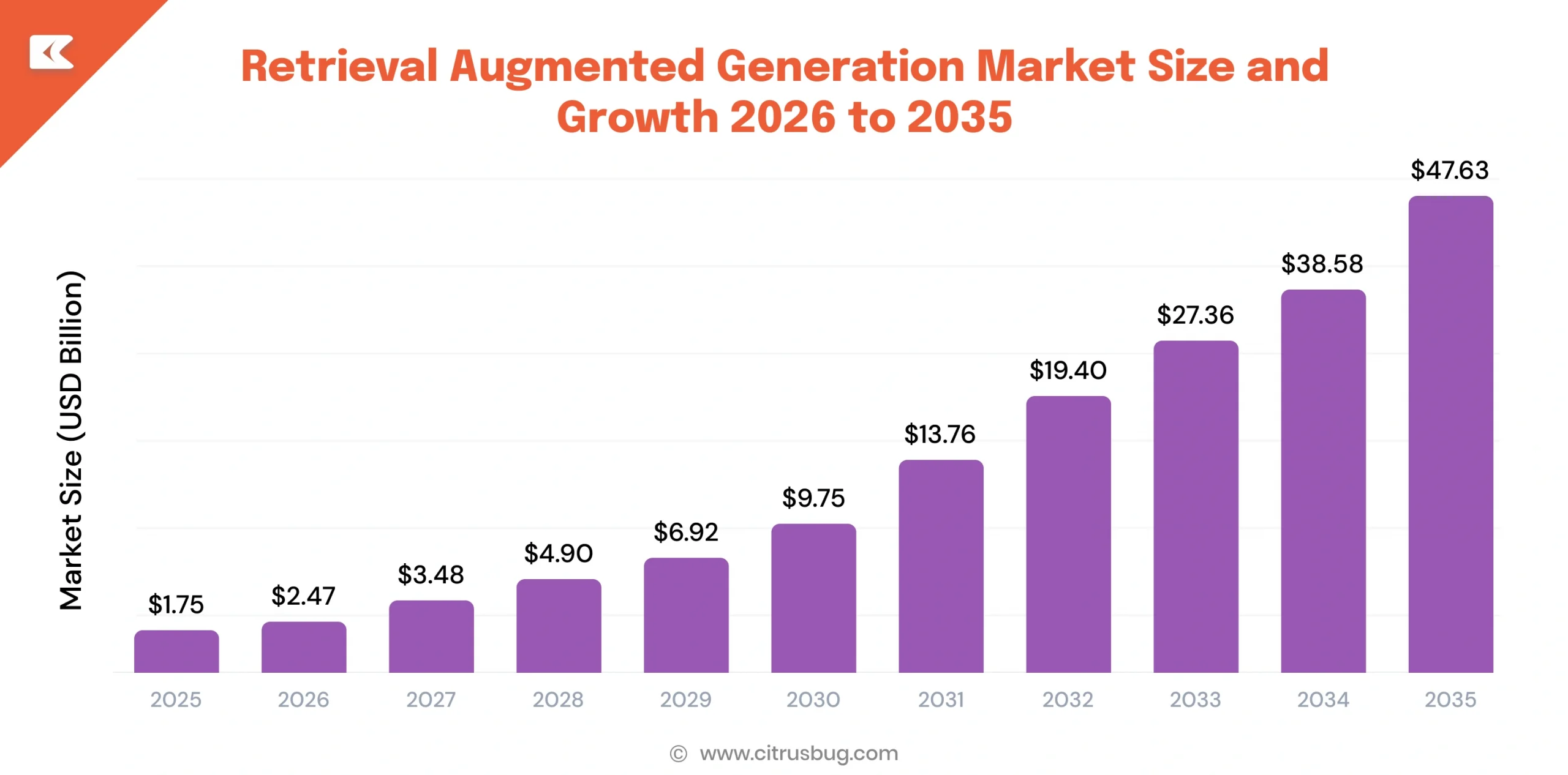
The market is anticipated to expand at a robust CAGR of 39.15% during the forecast period from 2026 to 2035, driven by increasing enterprise adoption of generative AI, growing demand for accurate AI-generated outputs, and advancements in retrieval and knowledge management technologies.
Enterprise adoption will continue accelerating, as more than 60% of enterprises are already integrating AI-powered retrieval systems to improve decision-making. Organizations using RAG have reported up to 40% higher content accuracy compared to traditional generative AI models.
RAG will become a core technology across industries, including healthcare, finance, legal services, education, and customer support. Businesses leveraging RAG-powered automation have achieved up to 50% reductions in research time and 35% improvements in customer satisfaction through more relevant AI responses.
Advanced RAG architectures will drive the next wave of innovation, including multimodal, graph-based, and agentic AI systems. This evolution is expected to support the market’s projected 39-49% annual growth rate, making RAG one of the fastest-growing segments in enterprise AI.
Conclusion
The RAG market has moved from a research-stage concept into one of the most commercially active segments within enterprise AI infrastructure. Consistent market growth, broad geographic adoption, and measurable accuracy improvements across production deployments all point to a technology with lasting commercial depth rather than short-cycle adoption patterns that fade as initial enthusiasm subsides.
For organizations building or expanding AI capabilities, partnering with a specialized RAG development service provider is the best way to build the architecture to deploy accurate, auditable, and knowledge-grounded AI systems across their most demanding operational workflows.