
 Back
Back







Key Takeaways
- The global real estate brokerage software market reached $6.73 billion in 2025, growing at a 7.71% CAGR driven by cloud-native adoption.
- More than 2 million licensed agents now use transaction management platforms to close an average of 7.4 million deals annually.
- CRM integration is now near-standard, with 89% of brokerage platforms offering built-in customer relationship management tools.
- North America holds roughly 60% of the global market, while Asia-Pacific remains the fastest-growing region led by China and India.
- Digital contract management has cut contract-related errors by 25%, while RPA adoption reduced processing errors by 15%.
The real estate brokerage software market has shifted from a niche technology category to a core part of how property transactions are managed globally. Brokerages of all sizes now rely on digital platforms that handle everything from lead generation and client engagement to compliance documentation and commission tracking.
This shift reflects bigger structural changes in the industry. Cloud infrastructure, mobile access, and data-driven decision tools have become standard expectations across residential and commercial real estate operations.
Investment in these platforms has accelerated over the past two years, driven by the need to manage higher transaction volumes, reduce operational errors, and support remote or hybrid work environments. As brokerages adopt more connected systems, the market continues to mature across established and emerging regions, with measurable growth in both adoption rates and technology spending.
What is Real Estate Brokerage Software?
Real estate brokerage software is a category of digital platforms built to support the daily operations of property brokerages. These tools typically cover listing management, lead tracking, client communication, commission calculations, and regulatory document handling within a single integrated system.
By centralizing these functions, the software helps brokerages operate with greater speed and accuracy. It supports both individual agents and multi-office firms in managing growing deal volumes while maintaining compliance and full operational visibility.
Real Estate Brokerage Software Market Size and Valuation
The global market for brokerage technology platforms has expanded consistently over the past two years. Increased dependence on cloud-native solutions, mobile-first agent tools, and automated transaction workflows has driven this steady growth. Broader industry spending on property technology across both residential and commercial segments continues to push this category forward, with brokerage software becoming a standard infrastructure layer for firms across geographies and size brackets.
Global Market Size and Growth Rate
- The global real estate brokerage software market reached a valuation of $6.248 billion in 2024 and grew to an estimated $6.73 billion by 2025. The market is expanding at a compound annual growth rate of 7.71% over the forecast period. This rate reflects consistent demand for digital tools that support listing management, transaction coordination, and agent workflows. This trajectory indicates that the market is past the early-adoption phase and entering a period of sustained, broad-based growth across multiple brokerage segments.
Adjacent Real Estate Software Segments
Real estate brokerage software operates within a broader technology ecosystem that includes property management software, investment analysis system, and proptech platforms. These adjacent categories frequently share integration points with brokerage tools, and their combined market health serves as a strong directional indicator of brokerage software demand. Growth in one segment often accelerates complementary adoption in connected platforms.
- The global proptech market is valued at approximately $51.8 billion in 2026. This category covers a wide range of technology solutions for property transactions, tenant management, and facility operations across global markets. Brokerage-focused tools represent a significant and growing share within this broader ecosystem.
- Real estate software as a broader segment has reached an estimated $15.60 billion in 2026, with brokerage-specific tools forming a growing portion of overall investment. This figure includes platforms for deal management, analytics, and document automation used by agents and firms.
- The property management software market stood at $26.49 billion in 2024. While distinct from brokerage platforms, property management tools frequently integrate with brokerage systems to support end-to-end deal workflows, lease administration, and portfolio oversight across mixed-use and residential portfolios.
- The real estate investment software segment alone is projected to reach $7.17 billion in 2026, further demonstrating the demand for specialized digital platforms across all verticals of the real estate industry. Investment analysis tools often feed data directly into brokerage transaction pipelines.
Adoption and Usage Statistics for Brokerage Platforms
The adoption of brokerage technology platforms has accelerated across the industry, with agents and firms increasingly relying on integrated software for day-to-day operations. Key adoption indicators point to growing depth in platform usage, CRM integration, and cloud-based deployments that shape how the real estate brokerage software market functions today. These numbers go beyond market size and reveal how deeply embedded digital tools have become in standard brokerage workflows.
Agent Platform Usage and CRM Integration
Brokerage software platforms now serve as the operational backbone for a large share of licensed real estate professionals globally. Usage data reveals the depth of integration across core workflows, from deal management and pipeline tracking to client relationship systems in real estate. The scale of adoption reflects an industry that has moved well past the pilot stage.
- More than 2 million licensed agents now use transaction management platforms to close an average of 7.4 million deals annually. This scale of platform usage demonstrates how deeply brokerage software has become embedded in standard real estate operations across both residential and commercial markets. The volume of transactions processed through digital platforms continues to rise each year.
- CRM integration has become a near-standard feature, with 89% of brokerage platforms now offering built-in customer relationship management tools. This shift toward unified systems means lead management, client engagement, and transaction tracking increasingly run from a single environment rather than disconnected applications. The high integration rate suggests that standalone CRM tools are being replaced by brokerage-native solutions.
Cloud Deployment and Platform Preferences
The way brokerages deploy and access technology has changed significantly over the past few years. Cloud-native and platform-oriented models have taken a dominant position over traditional on-premise installations. This shift has reshaped both cost structures and operational scalability for firms across all segments. This transition is especially pronounced among mid-size brokerages that previously relied on desktop-based tools.
- Cloud-based solutions now command 77.35% of the proptech market share. This figure points to a strong industry preference for hosted infrastructure that enables remote data access, continuous software updates, and reduced hardware dependency for brokerages. Cloud deployment is no longer an emerging trend but the established standard across most markets.
- Platform-based solutions account for 55% of the global proptech market in 2026. The consolidation of listings, analytics, CRM, and compliance tools into single integrated platforms represents the current direction of brokerage technology investment and adoption. Firms are increasingly favoring all-in-one environments over modular point solutions that require separate integrations.
Market Segmentation by Software Type and End User
Market demand for brokerage platforms varies across product types and end-user categories, each with different growth dynamics and technology priorities. Segmentation data shows where spending is most concentrated and which sub-categories are driving the fastest expansion. The primary divisions fall along product function and property type, with clear differences in adoption patterns between each.
Brokerage and Property Management Platforms
Within the commercial real estate software category, brokerage and trading systems hold the largest functional share at approximately 45% of the market. These platforms support core brokerage functions including deal pipeline management, listing syndication across multiple portals, transaction compliance tracking, and commission calculations for agents and offices. The high concentration in this sub-segment reflects the operational importance of deal execution tools in the commercial space.
Property management software represents approximately 35% of the same segment. This sub-category covers tenant management, lease tracking, maintenance scheduling, and financial reporting for landlords and property managers. Integration between brokerage and property management platforms is becoming more common as firms look to manage the full lifecycle of a property transaction from acquisition through ongoing management within a single connected system.
Commercial and Residential Property Segments
The commercial real estate software segment is growing at a projected 14.33% CAGR through 2032, driven by enterprise-level demand for portfolio analytics, automated valuation models, and regulatory compliance automation. Larger firms and institutional investors are increasingly standardizing on digital platforms to manage complex, multi-asset portfolios with greater precision and reporting transparency. Enterprise buyers are a primary driver of continued momentum in this category.
The residential segment holds a 47.8% share of the broader proptech market in 2026. Higher transaction volumes, a growing consumer expectation for digital search and buying experiences, and increased agent adoption of mobile-first tools contribute to the residential category’s dominant position. The consumer-facing nature of residential brokerage tools also drives faster product iteration and more frequent platform updates across this segment.
Regional Market Share and Growth Insights
Brokerage technology adoption varies significantly by geography, shaped by regulatory environments, digital infrastructure maturity, and the structure of local real estate markets. The strongest concentrations of market share remain in North America and Europe, while Asia-Pacific continues to gain ground as a high-growth region. Each geography presents a distinct set of drivers and constraints that influence the pace and depth of software adoption.
North America
- North America holds approximately 60% of the global real estate brokerage software market. This positions the region as the dominant market by a wide margin. Within this region, the United States leads adoption, with its property management software sub-segment alone commanding 74.4% share of the North American market.
High agent density, established MLS infrastructure, early cloud migration, and a mature regulatory environment have all contributed to this concentration. Canada represents approximately 15% of the broader North American market, with growing demand for cloud-based brokerage tools driven by an active residential sector.
Europe
- Europe accounts for approximately 25% of the global market, with steady growth across key Western European economies. The United Kingdom and Germany together represent roughly 40% of the European segment, driven by strong digital infrastructure, active cross-border investment flows, and regulatory environments that encourage technology adoption in property transactions. Growth in other Western European markets is consistent, although adoption timelines are longer in parts of Southern and Eastern Europe where legacy system reliance remains higher.
Asia Pacific
- The Asia-Pacific region currently holds approximately 10% of the global market but remains the fastest-growing region for brokerage technology adoption. China represents roughly 60% of the regional market, while India contributes around 20%, both driven by rapid urbanization, expanding digital infrastructure, and growing cloud-based real estate platform adoption among mid-size and large brokerages.
Rising smartphone penetration and increasing government digitization initiatives in both countries are expected to accelerate adoption further in the coming years.
Key Trends in Real Estate Brokerage Technology
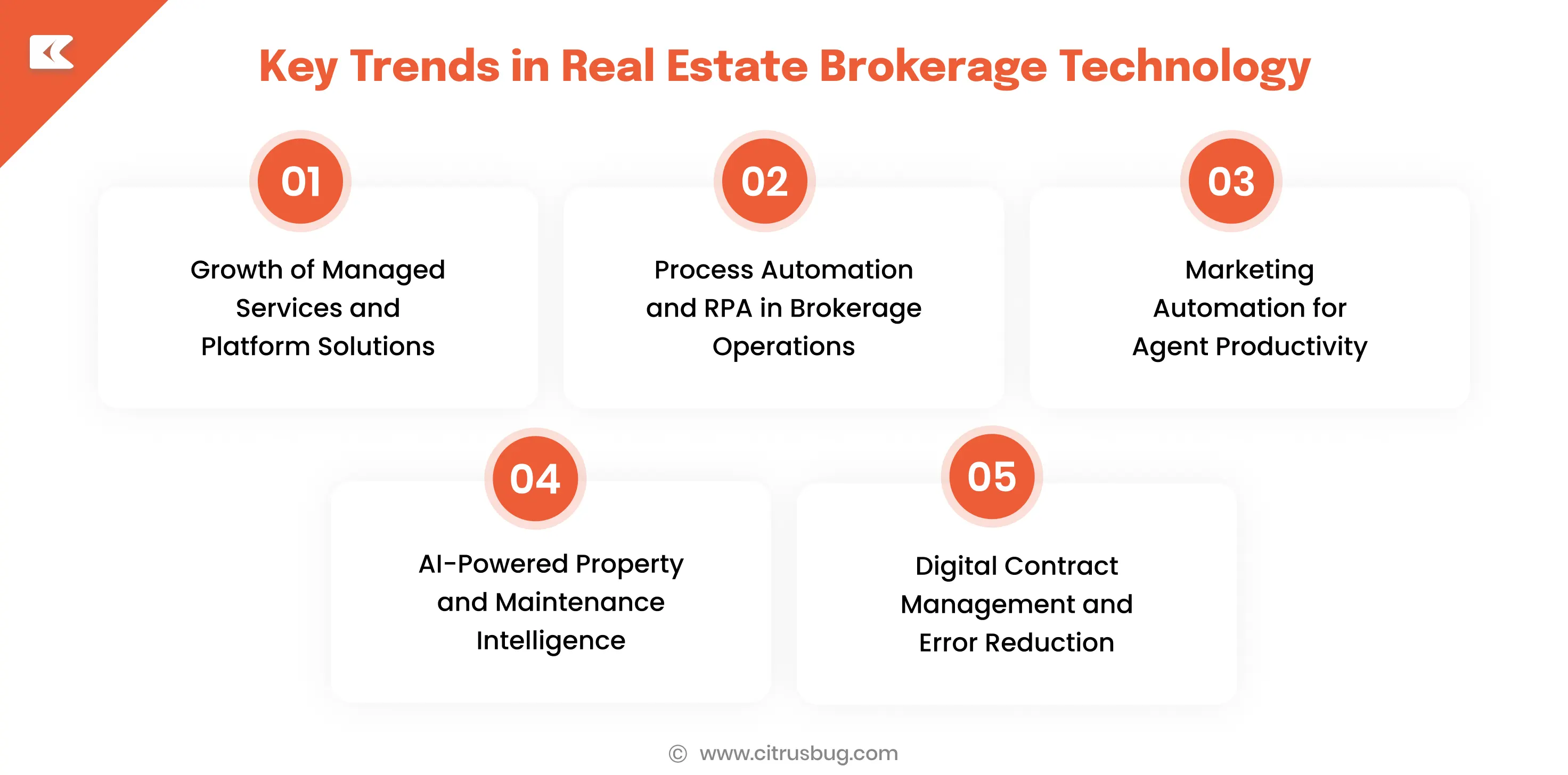
Several real estate technology trends and operational shifts are currently reshaping how brokerages build and use their software infrastructure. These patterns reflect where the industry is actively investing and where measurable improvements are already visible across brokerage workflows. Each trend below is supported by current performance data that highlights its operational impact on brokerage operations and the broader property technology sector.
Growth of Managed Services and Platform Solutions
The services segment within the proptech market is expanding at a 13.2% CAGR through 2033. This growth reflects increasing demand for implementation support, managed hosting, integration consulting, and ongoing platform maintenance as part of brokerage technology contracts. Brokerages are shifting from one-time software purchases to continuous service relationships that keep platforms updated, secure, and aligned with evolving operational requirements.
Process Automation and RPA in Brokerage Operations
Robotic process automation is delivering measurable operational gains in brokerage environments. Firms that have implemented RPA report a 20% reduction in response time and a 15% reduction in processing errors across core workflows. These improvements are most visible in document handling, lead routing, and compliance verification tasks that previously required manual oversight. The time savings allow agents and back-office teams to focus on higher-value activities such as client engagement and deal negotiation.
Marketing Automation for Agent Productivity
Marketing automation tools used by brokerages have grown by 21% year-on-year in 2024. These tools automate listing promotions, email campaigns, social media scheduling, and lead nurturing sequences. These capabilities reduce the time agents spend on repetitive outreach tasks. Agents using automated marketing workflows can manage larger prospect pipelines and maintain consistent communication without proportional increases in administrative effort.
AI-Powered Property and Maintenance Intelligence
AI capabilities are delivering concrete efficiency gains in property management and maintenance operations connected to brokerage platforms. Systems with integrated AI features report a 17.6% efficiency boost and a 13.2% reduction in maintenance costs, driven by predictive maintenance scheduling, automated work order routing, and intelligent resource allocation. These savings translate directly to higher net operating income for properties managed through brokerage-connected platforms.
Digital Contract Management and Error Reduction
Digital contract and document management tools have reduced contract-related errors by 25% across brokerage operations. Automated templates, e-signature workflows, and built-in compliance checklists minimize the risk of missing clauses, incorrect data entries, and filing delays that can slow transactions. For brokerages handling high transaction volumes, this level of error reduction improves both deal velocity and regulatory adherence significantly.
Challenges in Adopting Brokerage Software Solutions
Despite strong growth, several practical barriers continue to affect adoption rates across parts of the industry. These challenges are worth noting alongside the positive trajectory of the overall market and should be factored into any realistic assessment of growth timelines.
- Data security risks remain elevated. The real estate sector has experienced a 67% increase in data breaches, with the average incident costing $4.8 million in the United States. Protecting sensitive transaction and client data requires continuous investment in encryption, access controls, and compliance monitoring frameworks.
- Implementation costs create barriers for smaller firms. High upfront costs account for approximately 20% of reported adoption barriers, particularly for independent brokerages and small agencies that may lack the resources for full platform deployment, data migration, and staff training.
- Legacy system reliance persists in certain regions. Over 65% of brokerages in parts of Southern and Eastern Europe still rely on custom-built, on-premise legacy systems. Migration to modern cloud-based platforms in these markets faces additional friction from regulatory complexity, data portability concerns, and workforce readiness gaps.
Future Market Outlook and Growth Projections
The real estate brokerage software market is positioned for sustained expansion over the next several years. Forecasts across multiple software segments and geographies point to double-digit growth rates, driven by continued digital transformation, broader global adoption, and deeper integration of automation and analytics into core brokerage operations. The projections below cover both brokerage-specific tools and closely connected real estate software categories.
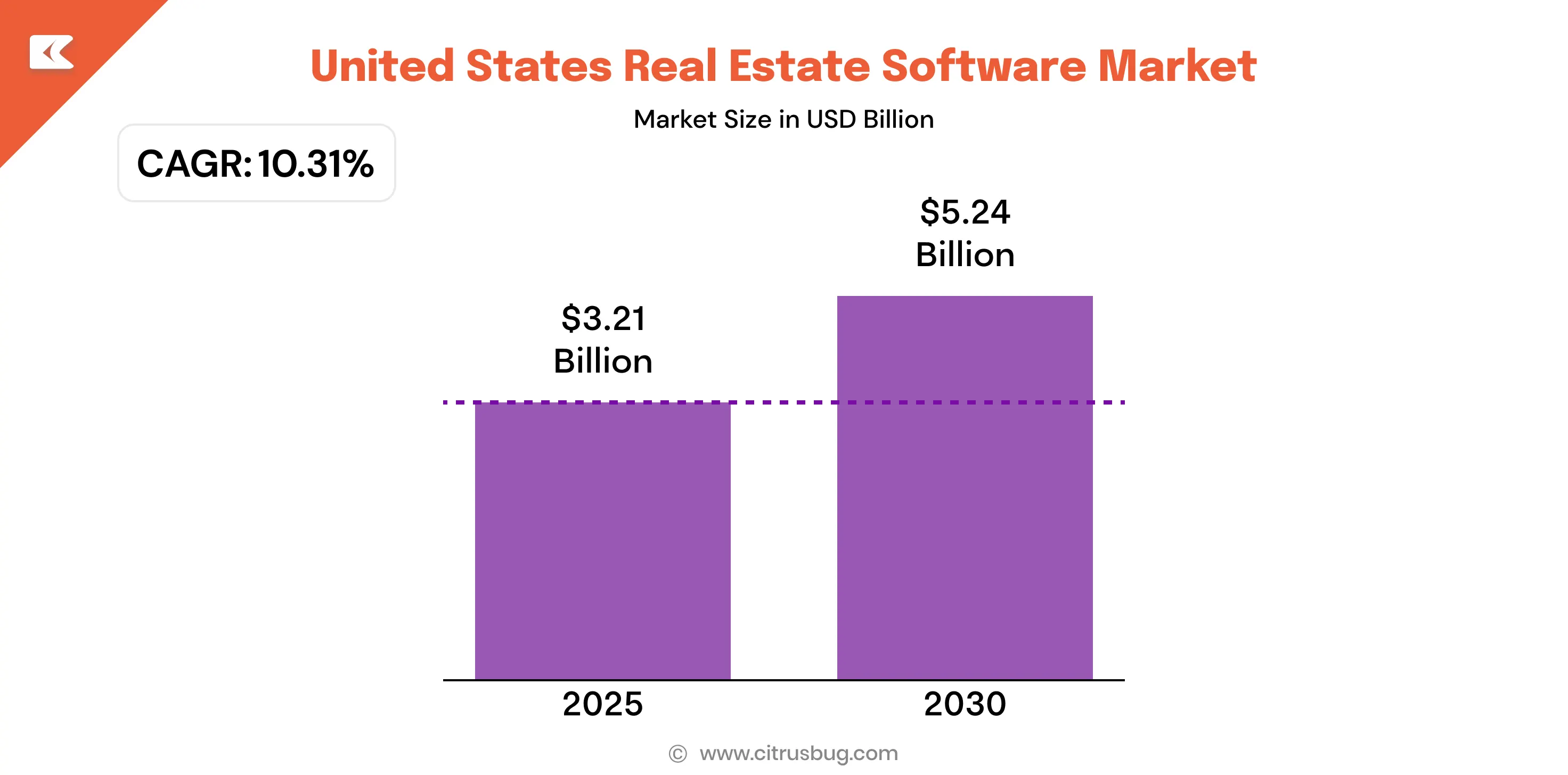
- U.S. real estate software to reach $5.24 billion by 2030. The United States market alone is projected to grow at a 10.31% CAGR between 2025 and 2030, driven by deepening cloud adoption, AI integration, and the ongoing modernization of MLS and transaction management infrastructure. The U.S. remains the single largest country market for brokerage technology globally.
- Property management software forecast at $52.21 billion by 2032. Global property management platforms are expected to expand at a 10.1% CAGR, supported by rising demand for automated lease management, tenant engagement tools, and integrated financial reporting across residential and commercial portfolios. This growth directly benefits connected brokerage platforms through increased data sharing and workflow integration.
- Global real estate software projected at $32.63 billion by 2032. The broader real estate software category is expected to grow at a 12.8% CAGR. This growth reflects sustained investment across brokerage tools, investment analysis platforms, and property operations software worldwide. Cloud-based delivery models continue to drive the majority of new deployments in this segment.
- U.S. brokerage software segment to grow by $1.32 billion through 2030. Focused exclusively on the brokerage sub-segment, this projection reflects a 10.3% CAGR and highlights the increasing role of specialized transaction management and agent productivity tools within the broader U.S. real estate software market.
- Commercial real estate software to reach $49.94 billion by 2032. The commercial segment is forecast to grow at an 11.0% CAGR, driven by institutional demand for portfolio analytics, valuation automation, and regulatory compliance platforms. Enterprise-level buyers are expected to account for the majority of new investment in this sub-category over the forecast period.
Conclusion
The real estate brokerage software market is in a clear growth phase, supported by rising adoption rates, strong regional demand, and expanding use of cloud-based and AI-driven tools. Current data confirms that brokerage-specific platforms are becoming standard infrastructure for property firms of all sizes across multiple geographies.
With consistent investment in automation and platform consolidation, firms that prioritize purpose-built real estate brokerage software are well positioned to manage growing transaction complexity with greater efficiency and operational accuracy in the years ahead.