
 Back
Back








Key Takeaways
- The global real estate CRM market reached $5.31 billion in 2026, growing at an 8.1% CAGR driven by AI-enhanced client analytics.
- Firms using dedicated CRM software report a 29% increase in sales compared to those relying on manual client management processes.
- 61% of mid-to-large real estate firms have deployed a CRM, while 39% of agents still rely on spreadsheets and email.
- 71% of real estate professionals access CRM through mobile devices, and 48% of platforms now integrate AI features like lead prioritization.
- Data security concerns (27%) and high upfront costs (22%) remain the top barriers slowing CRM adoption among smaller operators.
The real estate industry has always run on relationships, but real estate CRM statistics now reveal just how fundamentally software has changed the way those relationships are managed at scale. From independent agents to national brokerages, firms across the global property market are replacing fragmented manual processes with purpose-built platforms that centralize client data, automate follow-ups, and track pipelines from first contact to close.
The market behind these tools has grown into a multi-billion-dollar sector, underpinned by wide adoption across firm sizes, geographies, and property types. Investment volumes, deployment rates, and AI integration data all confirm that the industry has moved beyond treating CRM as an optional upgrade, positioning it instead as structural infrastructure for how modern real estate businesses manage competitive client relationships.
What is Real Estate CRM?
A real estate CRM is a software platform built specifically for property professionals to manage client leads, track deal stages, automate follow-up communication, and organize transaction data in a single accessible system. It replaces scattered manual tools with structured, repeatable workflows.
For brokerages, agents, and property managers, it means consistent client contact at scale, reduced administrative load, and improved conversion rates by ensuring no lead or follow-up falls through the gaps. It connects lead capture, scheduling, communication, and sales reporting into one platform designed around how property businesses actually operate.
Real Estate CRM Statistics: Global Market Size and Value
The global real estate CRM sector has grown into a commercially significant market, with investment flowing from residential, commercial, and property management segments as firms of all sizes recognize the operational value of dedicated client management infrastructure. Current real estate CRM statistics place the sector firmly within the multi-billion-dollar range, with a clear growth trajectory anchored by rising platform demand across every major property economy.
Real Estate CRM Market Valuation
Market scale figures show a sector that has crossed critical commercial thresholds, with consistent growth driven by both new adoption and platform expansion among existing users.
- The global real estate CRM market was valued at USD 5.31 billion in 2026, supported by growing demand for automated lead management, AI-enhanced client analytics, and integrated transaction tracking tools across residential and commercial property operations worldwide.
- The global real estate CRM software and management segment reached a valuation of USD 3.8 billion in 2025, reflecting consistent year-over-year growth as agencies and independent brokerages migrate from generic productivity tools to purpose-built CRM infrastructure.
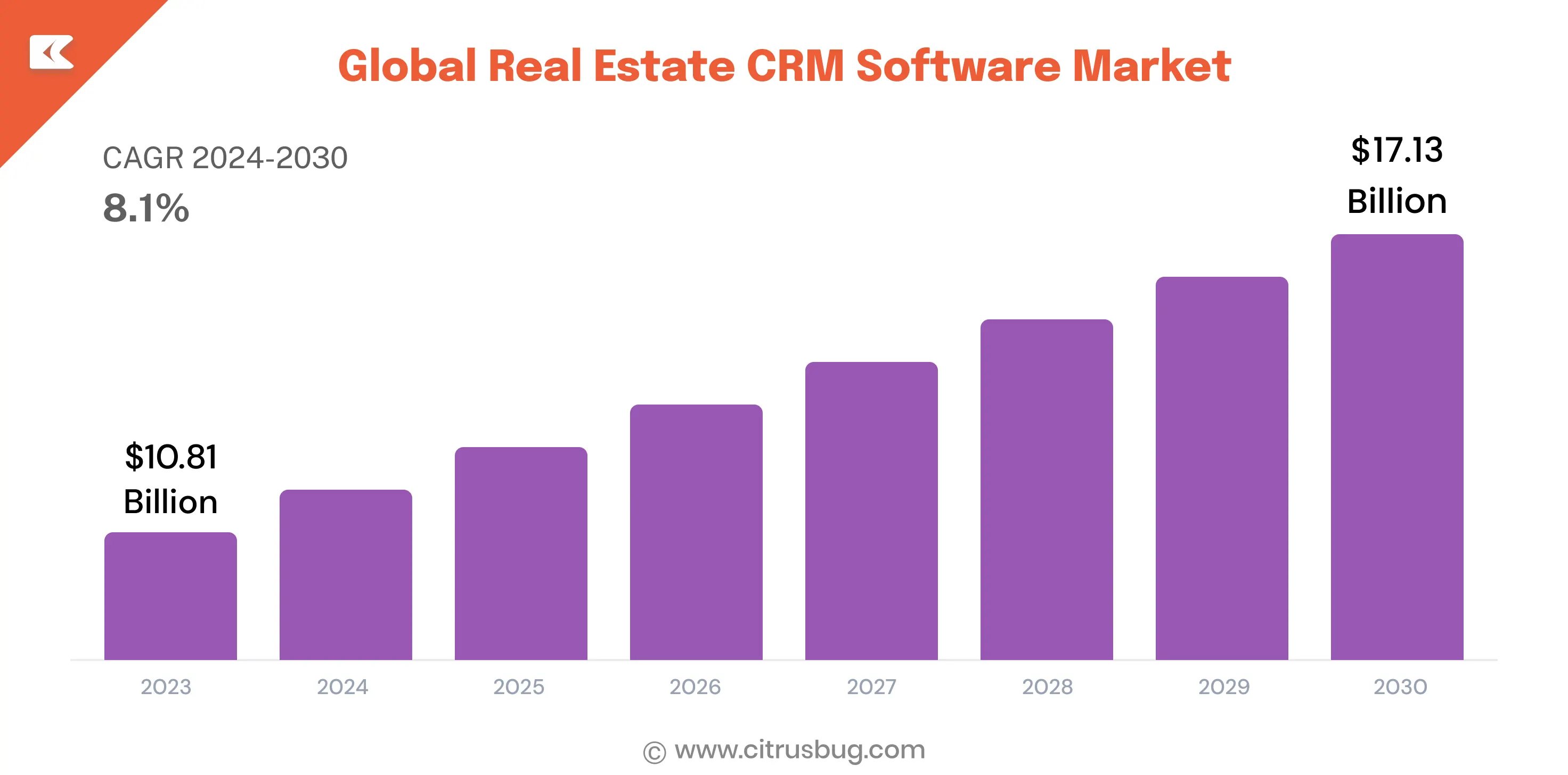
- The real estate CRM software market is expanding at a CAGR of 8.1% from 2024 through 2030, placing the segment in the sustained mid-to-high growth bracket of enterprise software markets and confirming that adoption momentum is not a short-term spike driven by a single macro event.
CRM and PropTech Industry Context
Real estate CRM sits at the intersection of two fast-growing technology sectors: the global enterprise CRM market and the broader PropTech ecosystem. The scale of both provides essential context for understanding where real estate-specific platforms fit within the overall digital investment landscape.
- The global customer relationship management market size was valued at USD 79.6 billion in 2025 and is projected to grow from USD 86.4 billion in 2026 to USD 161.3 billion by 2033, growing at a CAGR of 9.3% from 2026 to 2033, driven by enterprise demand for relationship-driven sales infrastructure across industries, with real estate contributing a growing share as brokerage operations become increasingly data-intensive and client-lifecycle-focused.
- The global PropTech market, within which real estate CRM functions as a core software category, was valued at USD 47.08 billion in 2025, with growth fueled by accelerating investment in digital property transaction platforms, cloud-based brokerage management tools, and AI-enhanced client service applications across all established and emerging property markets.
How Real Estate Professionals Are Adopting CRM
Adoption-level real estate CRM statistics reveal a market well into its transition from early-mover territory to mainstream deployment. Firms across the enterprise, mid-market, and SME spectrum are investing in dedicated platforms, and usage data shows a measurable performance divide between those that have made the shift and those still relying on general-purpose tools. Deployment infrastructure choices and business outcome figures add further depth to where adoption stands heading into the second half of the decade.
Firm-Level and Agent Deployment
Enterprise adoption has reached meaningful scale, while the agent-level picture reveals a large share of the market that still represents significant conversion potential for platform providers.
- Over 61% of mid-to-large real estate firms globally deployed at least one dedicated CRM solution as of 2025, while 39% of active real estate agents worldwide continued relying on generic productivity tools such as spreadsheets and email clients, pointing to a commercially valuable segment of the market that has yet to fully transition to purpose-built platforms.
- Real estate firms that use dedicated CRM software report a 29% increase in sales compared to those managing client relationships through manual processes, a performance gap that positions CRM adoption as a measurable commercial decision with direct and quantifiable revenue impact.
Cloud Deployment and AI-Driven Integration
Infrastructure choices and AI usage patterns reveal how property firms are structuring CRM deployment at the technology level and how intelligence-led features are rapidly becoming standard platform expectations rather than premium additions.
- Cloud deployment accounts for 78.16% of the U.S. real estate software market in 2024 and is growing at an 11.57% CAGR through 2030, confirming cloud-first architecture as the dominant and accelerating deployment preference among American property businesses of all sizes and operational models.
- Usage of AI-driven customer analytics, automated follow-up systems, and mobile CRM applications across real estate sales teams surged by approximately 55% in 2026, reflecting the rapid shift from viewing AI capabilities as a premium feature to treating them as an expected standard component of any competitive real estate CRM platform.
Real Estate CRM Market Segmentation Insights
The real estate CRM market divides across firm size, deployment model, property sector, and how professionals access platforms in the field. Each dimension reflects distinct adoption drivers that extend well beyond top-line market valuation figures.
Enterprise and SME Market Presence
Firm size remains one of the clearest predictors of CRM adoption depth and platform preference across the sector.
Large Enterprise Segment
Large enterprises represent 25% of the global real estate CRM market, with cloud and hybrid systems accounting for over 45% of their deployments. These firms require enterprise-grade customization, multi-region data management, and integration with property listing, marketing automation, and financial reporting platforms to serve large, multi-market agent networks.
Small and Medium-Sized Enterprise Adoption
SMEs represent 63.91% of the U.S. real estate software market in 2024 and are growing at an 11.41% CAGR through 2030. This segment drives the highest volume of new CRM adoption, as boutique brokerages and independent agencies move to cost-accessible, cloud-native platforms that cut administrative load without requiring dedicated IT resources.
Cloud and On-Premises Deployment Preferences
The deployment model reflects each firm’s balance between platform accessibility, cost, and data compliance requirements.
Deployment Infrastructure Distribution
On-premises CRM systems account for 28% of the global real estate CRM market, preferred by firms with strict data privacy mandates or legacy infrastructure constraints. The majority of remaining deployments favor cloud architecture for its lower upfront cost, automatic updates, and device-agnostic access for agents working across locations.
Commercial Sector and Mobile Access Patterns
The property sector and access behavior reveal how CRM is used across different real estate operating contexts.
Commercial Property Sector
The commercial sector is projected to account for 64% of the global real estate software market in 2026, driven by the complexity of managing large property portfolios, institutional client relationships, and multi-party transaction coordination across brokerage and asset management operations.
Mobile and AI-Enabled Platform Access
71% of real estate professionals access CRM through mobile devices, enabling real-time client communication and property updates from the field. 48% of real estate CRM platforms now integrate AI features such as automated responses, chatbots, and lead prioritization, making intelligent automation a standard part of competitive platform offerings.
Regional Market Share and Growth Insights
Regional real estate CRM statistics show distinct adoption patterns shaped by market maturity, regulatory environment, and the pace of broader PropTech investment. North America leads in both market size and adoption depth, while Asia Pacific and emerging markets in the Middle East are recording the fastest growth rates globally.
North America
- North America held 37.9% of the global real estate CRM software and management market in 2025, with regional revenues reaching USD 1.44 billion, supported by widespread adoption of digital property listing platforms, broker network modernization, and strong demand for AI-enhanced client engagement tools.
The broader North America real estate software market was valued at USD 2.87 billion in 2024, reflecting the region’s deep and sustained investment in property technology infrastructure across residential, commercial, and rental real estate segments.
Europe
- Europe accounted for 24.3% of the global real estate CRM market in 2025 and is growing at a CAGR of 10.2% from 2026 through 2034, with momentum driven by GDPR-compliance requirements demanding more sophisticated data handling within CRM platforms and expanding digital property transaction mandates in major European economies that are accelerating formal CRM adoption among brokerages and property management firms.
Asia Pacific, Latin America, and Middle East & Africa
- Asia Pacific held 22.6% of the global real estate CRM market in 2025 and is the fastest-growing region with a projected CAGR of 13.1% through 2034, fueled by rapid urbanization and first-time property transaction volume in China, India, and Southeast Asia. Latin America accounted for 8.2% of the global market with a CAGR of 11.4%, while the Middle East and Africa held 7.0% and is growing at 12.3% through 2034, backed by smart city development programs and active PropTech investment initiatives in the UAE and Saudi Arabia.
Key Trends Shaping Real Estate CRM in 2026
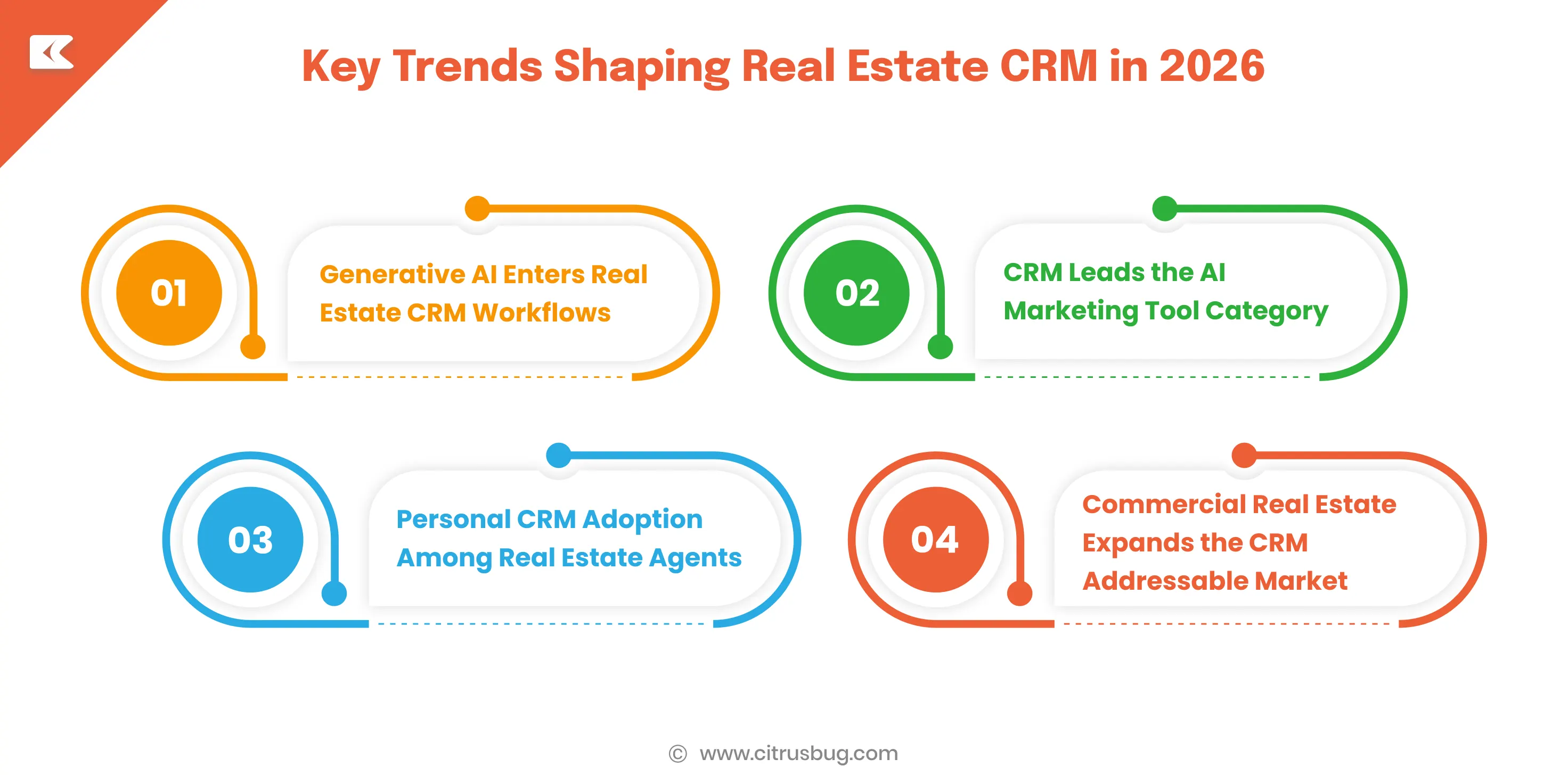
Several structural shifts are redefining how real estate CRM platforms are built, positioned, and used. AI integration, expanding market segments, and the growing operational complexity of commercial real estate are each influencing where platform investment is being directed and what capabilities firms now expect as table stakes from their CRM infrastructure.
Generative AI Enters Real Estate CRM Workflows
Generative AI has moved from an emerging concept to an active feature layer within real estate technology platforms. The global generative AI in the real estate market was valued at USD 544.29 million in 2026, growing from USD 488.06 million in 2025, with CRM workflows among the most active integration areas. Property description generation, automated follow-up drafting, conversation summarization, and intelligent lead scoring are the leading use cases, and CRM platform providers are competing directly on the depth of their generative AI capabilities.
CRM Leads the AI Marketing Tool Category
CRM platforms have established a dominant position within the broader AI marketing tool ecosystem. CRM software accounts for 28.8% of the global AI marketing tool segment in 2026, the largest share of any single category, driven by enterprise demand for unified customer data platforms that connect sales, marketing, and service interactions. For real estate firms, CRM investment increasingly doubles as AI marketing infrastructure, reducing fragmentation across lead generation, client nurturing, and conversion workflows.
Personal CRM Adoption Among Real Estate Agents
The personal CRM segment reflects growing demand from independent practitioners for lightweight, relationship-first tools built around individual workflows. The global personal CRM market was valued at USD 14.68 billion in 2025 and is growing to USD 16.5 billion by 2026, with real estate agents and sales professionals accounting for 49.3% of total end-use demand. Individual practitioners are actively investing in agent-focused CRM tools tailored to personal client networks rather than enterprise-scale pipeline management.
Commercial Real Estate Expands the CRM Addressable Market
The scale of global commercial real estate creates persistent demand for enterprise CRM capabilities across brokerage, asset management, and leasing operations. The global commercial real estate market was valued at USD 7.19 trillion in 2026, growing at a CAGR of 3.44% through 2034. Even marginal CRM penetration gains in this segment represent a substantial opportunity for platform providers, and commercial real estate firms are among the highest-value CRM adopters given the complexity of their institutional client relationships.
Future Outlook and Growth Projections for Real Estate CRM
Long-term real estate CRM statistics and market projections point to sustained expansion across the real estate-specific CRM segment, the broader global CRM ecosystem, and the PropTech sector that provides the overarching investment environment for property technology platforms. Forecasts extending to 2030 and 2032 show meaningful increases in market scale, with mobile, cloud, and AI capabilities as the primary drivers of incremental growth.
Real Estate CRM and Property Software Projections
Segment-specific forecasts reflect sustained confidence in real estate CRM adoption from analysts tracking both the property technology space and the broader enterprise software market.
- The global real estate CRM software market is projected to reach USD 17.13 billion by 2030, growing from its current base at a CAGR of 8.1%, with rising demand for AI-integrated client management, cloud-native deployment, and mobile-first platform access as the primary drivers of this expansion.
- The broader global real estate software market is projected to reach USD 21.77 billion by 2030, growing at a CAGR of 11.3% from 2024, indicating that real estate CRM investment benefits from an overall environment of accelerating technology adoption across every operational function of the property business.
CRM and Mobile Platform Scale
The projected growth of the global CRM market and the mobile CRM segment adds further scale context to the real estate CRM outlook through 2032.
- The global CRM market is projected to reach USD 185.53 billion by 2032, growing at a CAGR of 11.36% from 2026, a trajectory that drives continuous platform innovation, competitive pricing, and AI feature development across the CRM ecosystem, all of which directly benefit real estate businesses adopting CRM at any stage of the growth cycle.
- The global mobile CRM market is projected to reach USD 46.04 billion by 2032, growing at a CAGR of 11.8% from 2024, reflecting the growing reliance of field-based professionals on mobile-first CRM tools that support on-the-go client management, property tour coordination, and deal updates from any location.
PropTech as the Long-Term Investment Context
The PropTech sector’s sustained growth trajectory frames the broader investment climate in which real estate CRM platforms will continue to scale and attract development capital through the end of the decade.
- The global PropTech market is poised to register a CAGR exceeding 15% from 2024 through 2032, driven by accelerating technology acquisitions, AI platform partnerships, and growing venture capital activity across property technology categories, all of which sustain the innovation momentum that makes real estate CRM platforms more capable and commercially compelling with each product cycle.
Challenges Limiting Wider CRM Adoption
Despite strong market growth, several barriers continue to slow CRM adoption among smaller operators and in markets where data regulatory frameworks are still developing.
- Data Security Concerns: 27% of real estate businesses cite client data security as a primary barrier to CRM adoption. Centralizing sensitive financial records and transaction histories within a cloud platform raises compliance questions for firms in regulated property markets with strict data handling obligations.
- Cost Barriers for Smaller Operators: 22% of small real estate businesses identify high upfront and ongoing software costs as a major deterrent to CRM adoption. Per-seat licensing from enterprise platforms creates access barriers for boutique agencies and independent brokers unable to justify the spend without a clear near-term return. Assessing the real estate CRM setup cost estimate helps smaller firms scope the spend before committing.
- Integration Complexity: Real estate firms with existing property listing, marketing, and transaction systems often face significant overhead when connecting a new CRM to their current infrastructure. Where legacy software or non-standard data formats are present, deployment timelines extend, and short-term ROI is delayed, reducing adoption motivation among smaller teams without dedicated technical resources.

Conclusion
Real estate CRM statistics confirm that the global market has moved well past the question of CRM’s place in property businesses. Billion-dollar valuations, adoption above 60% among established firms, and consistent growth projections through 2030 reflect an industry that has embedded CRM into its operational core.
For firms building or scaling their CRM capabilities, custom real estate software development offers a path to platforms built around specific workflows, team structures, and client management priorities rather than adapted from general-purpose tools.