
 Back
Back







Introduction
The software development industry is one of the most crucial industries in the global economy, as it drives innovation, creates jobs, and forms the way businesses and humans interact with technology. Understanding software development statistics is obviously necessary for identifying the areas of growth and the problems faced.
The blog presents some of the most crucial aspects of the industry in terms of its current state, challenges, and opportunities for growth, providing insights into a fresh and dynamic view of the industry.
Software Development Market Size, Growth & Current Trends in 2026
Market Overview
The global software development market has experienced consistent growth over the past decade. Learn more about the trends and insights in this software development guide. The global software development market was valued at approximately $921.14 billion in 2026 and is estimated to reach more than $2,468.93 billion by 2035, with a CAGR of 11.60% from 2026 to 2035.
Such software development statistics highlight the expanding market, driven by the increasing demand for innovative solutions across industries.
Additionally, the custom software development market is promising, and the revenue is expected to be $146.18 billion by 2030. Industries such as healthcare, fintech, and gaming contribute to its rising demand by requiring software built for specific needs to tackle their unique challenges.
For example, healthcare applications need a focus on better patient care, while gaming continues to push the boundaries of graphics and interactivity.
Developer Workforce Statistics
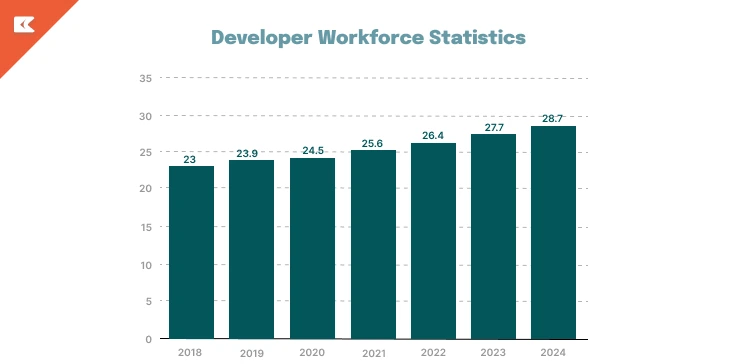
The number of developers employed in the software development industry has been estimated to be more than 26.3 million all over the world. It is also growing rapidly, with the global developer population expected to cross 45 million by 2028.
In addition to the increasing number of employees, the kind of work carried out in the industry has also changed. There is a 60% rise in remote job opportunities for software developers. This means it is one of the most flexible professions for the 21st century. With remote work, developers are now able to work together around the world. It has, therefore, added flexibility and resiliency to the industry.
Popular Technologies
On the list of the most popular programming languages, JavaScript and Python are still the leaders. More than 66% of developers prefer using JavaScript, thus making it a top choice for web development and other applications. Python follows at approximately 58% because it is highly versatile in fields like data science, machine learning, and automation.
Modern development workflows incorporate cloud technologies significantly. The same survey reveals that 56% of the respondents used cloud platforms. This is to show how they are important for the scalable and efficient deployment of applications.
Frameworks like React and Django, widely associated with the languages, are also very much in use. In addition to these, there are trends in artificial intelligence (AI) and machine learning (ML) that are influencing the industry. The AI-specific development statistics show just how fast this shift is happening as developers work more on applying them to innovation.
Statistics Revealing Challenges in Software Development
Talent Shortage
One of the most concerning software development statistics is the global shortage of skilled developers. According to Forbes, this shortage is expected to grow to 4 million by 2025. Businesses are already struggling, with 87% reporting difficulty in hiring skilled developers. This increasing demand has led to a significant talent gap, with millions of positions projected to remain unfilled.
These shortages result in increased costs for a project, longer delivery timelines, and a growing number of companies filling that gap through staff augmentation and outsourcing. Companies typically find it hard to attract talent that is both above average and competitive, adding more pressure to existing teams and thus affecting overall productivity.
Software outsourcing statistics show that 59% of global businesses now outsource development projects to firms in India, with the overall outsourcing market growing alongside the talent gap.
Project Failures and Success Rates
Statistics show that a large percentage of software projects either fail or experience delays. According to the CHAOS Report, about 31% of software development projects achieve their goals, meaning they deliver on time and within budget.
Poor communication, lack of planning, and scope creep are the main failure drivers that agile software development methodology directly addresses, which is why the majority of high-performing teams now run some form of Agile or iterative delivery rather than waterfall planning.
Common problems include the constant growth of project requirements, unclear initial objectives, and poor communication among team members, which worsen these problems. Most projects end up going over budget or failing to meet deadlines, so effective project management is critical.
Rapid Technological Changes
Technological advancement is taking place at a pace that has never been seen before. It is an opportunity and a challenge for developers. They have to be updated with the latest tools, languages, and frameworks to remain competitive. Technologies like AI and machine learning are evolving rapidly. In fact, 72% of developers reported the need for continual education to stay updated. Statistics show that failure to keep up can lead to outdated skills, making it difficult for professionals and businesses to succeed.
Security Concerns
As the dependency on software increases, so does the risk of cyber threats. Common vulnerabilities, such as SQL injection and cross-site scripting (XSS), affect 55% of web applications, making the case for catching vulnerabilities before they reach production.
Furthermore, 44% of organizations experienced a cloud data breach according to the 2024 Thales Cloud Security Study, with the 2025 Thales Data Threat Report showing that overall breach rates have settled at 45%.
These vulnerabilities, along with insecure configurations, continue to undermine software systems. High-value data leaks due to software bugs prove that we require complex security systems to avoid the most common and rare security breaches.
The more secure we make the workflow of developers by implementing the security measures, the better we can protect and ensure the trust of the sensitive data. A well-structured task management approach ensures that security stays a priority without slowing down development.
Statistics Impacting Growth in Software Development
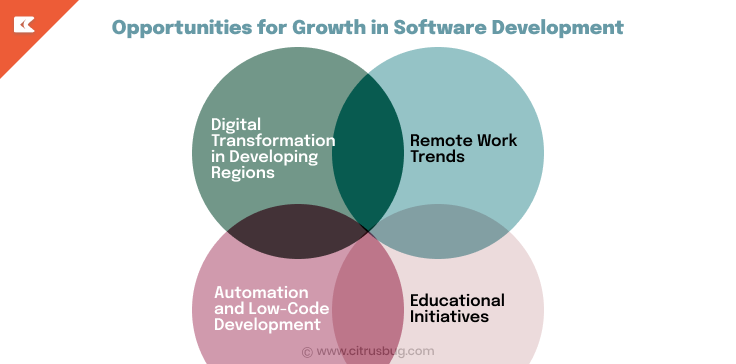
Digital Transformation in Developing Regions
Developing economies are becoming hotspots for digital transformation. Internet penetration and smartphone usage in these regions are growing daily. Thus, they are very promising for software development.
The Asia-Pacific region is expected to grow the fastest in software development, with a compound annual growth rate (CAGR) of over 14.8% from 2025 to 2030. This rapid growth highlights the increasing demand for applications catering to local needs, such as e-commerce platforms and financial technology solutions.
Additionally, niche areas like blockchain and IoT are also promising in specialized applications.
Remote Work Trends
Remote work has changed the landscape of software development. The entire world has become open to recruitment because companies can find the most qualified developers no matter where they reside. This further brings about flexible working environments that raise job satisfaction and productivity for the developers.
One popular addition to remote setups is a standing desk, which promotes better posture and helps maintain energy levels throughout the day.
Remote software jobs increased by 60% between 2020 and 2023 due to the COVID-19 pandemic. Plus, companies that allow work at remote locations show higher retention of employees in software engineer positions at a rate of 25%. Collaboration tools and platforms have become indispensable in this new era.
Automation and Low-Code Development
Automation and low-code platforms are making software development simpler and more approachable for tasks that used to be difficult to execute. A SaaS development company specializing in automation and low-code tools can significantly reduce development time and increase operational efficiency for businesses.
Non-technical people can build applications using less coding, hence easing the workload on developers. Low-code and no-code tools are projected to account for 65% of all app development by 2024, demonstrating a significant shift in the industry’s software development statistics.
Automation in software testing can reduce time-to-market by 30%, further accelerating software delivery. Together, these enable the building and deployment of applications faster with no compromise on quality.
Educational Initiatives
Increased attention to education is one effort to address the talent shortage. For example, boot camps, online sites, and certification programs now provide the capacity to learn through a short cycle. All these steps have helped the demand-supply gap significantly. More individuals can now go into software development than before. For example, the graduates from coding boot camps increased by 11% in 2023, with more than 35,000 new developers entering the market globally.
Moreover, more than 75% of today’s youth believe that understanding software development is crucial for grasping the future of technology, which means that interest in the field is growing.
Future of Software Development: AI, Cloud & Cybersecurity
Projected Industry Growth
There will be a big growth in the software development industry in the next several years. The most important ones are expected to be the AI, cloud computing, and cybersecurity sectors that are in demand the most. The reason is that companies are putting more money in these areas to make them work more efficiently and provide innovative services to the clients.
Evolving Developer Roles
As the industry becomes more complex, developers’ roles are also changing. According to a report from Evans Data Corporation, more than 70% of new openings for programmers will be in AI and data science by 2030. This trend highlights the increasing demand for hybrid skills that combine software development expertise with knowledge of AI, data science, or cybersecurity, thereby making interdisciplinary learning more important.
Additionally, the typical software developer speaks at least three different programming languages, thus giving evidence of their adaptability and flexibility required by the industry. These traits are essential as developers navigate a landscape that requires both breadth and depth in their skill sets.
Impact of AI and Automation
AI tools, like GitHub Copilot, and innovations in generative AI in software development are radically transforming the way developers work by automating repetitive tasks and fostering creativity. The automation of routine coding tasks with AI-based tools helps in their efficient completion, making developers concentrate more on difficult problems.
AI-based coding tools like GitHub Copilot are expected to increase developer productivity by 20-40%. The integration of AI in development workflows is expected to bring about a significant shift towards productivity and innovation. Additionally, automation in DevOps is expected to reduce manual workloads by 45% by 2025, streamlining operations and optimizing resources.
Conclusion
The Role of Collaboration and Community
The software development industry significantly relies upon collaboration and community involvement. Open-source contributions and developer meetups are used to share knowledge and solve problems that contribute to growth and innovation.
Navigating the Evolving Landscape
In the world of software development, where landscapes change rapidly, developers and businesses have to embrace strategic planning and continuous learning. Keeping track of trends, investing in education, and adopting new tools form part of staying competitive.
Growth with Ethics and Sustainability
While growth is necessary, it must be ensured that it aligns with ethics and sustainability. For digital product development, this means prioritizing user privacy, reducing the environmental impact of technology, and encouraging inclusivity, thus making the industry more responsible and equitable.
Addressing challenges and opportunities will enable the software development industry to grow and shape the future of technology.
Software Development Statistics: Frequently Asked Questions
Q1. What are the latest software development statistics?
→ Software development continues to grow as businesses invest in digital transformation, cloud platforms, and custom applications. Organizations are prioritizing scalable solutions, automation, and agile methodologies to accelerate product delivery.
Q2. How fast is the software development market growing?
→ The software development market is expanding rapidly due to increased demand for mobile apps, SaaS platforms, and enterprise solutions. Companies across industries are investing in modern development technologies to stay competitive.
Q3. What are the key trends shaping software development?
→ Key trends include AI-assisted development, cloud-native applications, low-code platforms, microservices architecture, and DevOps adoption. These trends help improve scalability, reduce development time, and enhance performance.
Q4. Which industries invest most in software development?
→ Industries such as healthcare, fintech, eCommerce, education, and logistics invest heavily in software development. These sectors rely on custom applications to improve operations and customer experience.
Q5. What technologies are most used in software development?
→ Popular technologies include JavaScript frameworks, Python, Java, cloud platforms, containers, and APIs. These technologies support modern application development and integration.
Q6. What factors are driving software development growth?
→ Digital transformation, mobile-first strategies, cloud adoption, and AI integration are major growth drivers. Organizations are investing in software to improve efficiency and innovation.
Q7. What is the future of software development?
→ Software development will evolve with AI-driven coding, automation, and cloud-native architectures. Businesses will focus on scalability, security, and faster time-to-market.