
 Back
Back







Key Takeaways
- The global workflow automation market reached $25.10 billion in 2025, projected to grow to $27.91 billion in 2026 at a 12.8% CAGR.
- 89% of large enterprises have deployed at least one workflow orchestration platform, making automation a baseline requirement, not optional.
- One healthcare organization cut claims processing time by 40% and saved over 15,000 employee hours monthly using automated workflows.
- BFSI accounts for roughly 24% of the global market, the largest industry vertical for automation adoption and investment.
- 54% of workflow orchestration deployments cite integration complexity with legacy systems as a significant implementation barrier.
The workflow automation market has moved well past its early adopter phase. Organizations across banking, healthcare, retail, and logistics are replacing manual, multi-step processes with automated workflows that reduce errors, cut operational costs, and accelerate decision cycles across every department.
This growth is driven by cloud infrastructure maturity, broader AI integration, and the expanding scale of distributed workforces that require consistent, system-driven coordination. Automation has become a core operational layer rather than an optional technology investment for most large organizations.
The demand spans every major industry vertical. Healthcare organizations are saving thousands of staff hours each month, financial institutions are deploying automation for compliance and claims management, and IT teams are routing the majority of their workloads through automated orchestration systems. The numbers behind this shift tell a clear and consistent story.
What is Workflow Automation?
Workflow automation is the use of software to execute repetitive, rule-based tasks without requiring manual input. It connects people, systems, and departments by triggering predefined actions based on specific conditions, data inputs, or sequential event patterns across an organization.
For businesses, this means routine functions like document approvals, compliance checks, data transfers, and task routing run automatically.
Teams spend less time on manual coordination, processes complete faster, and error rates fall as structured workflows replace ad hoc, person-dependent task management.
The Workflow Automation Market at a Glance
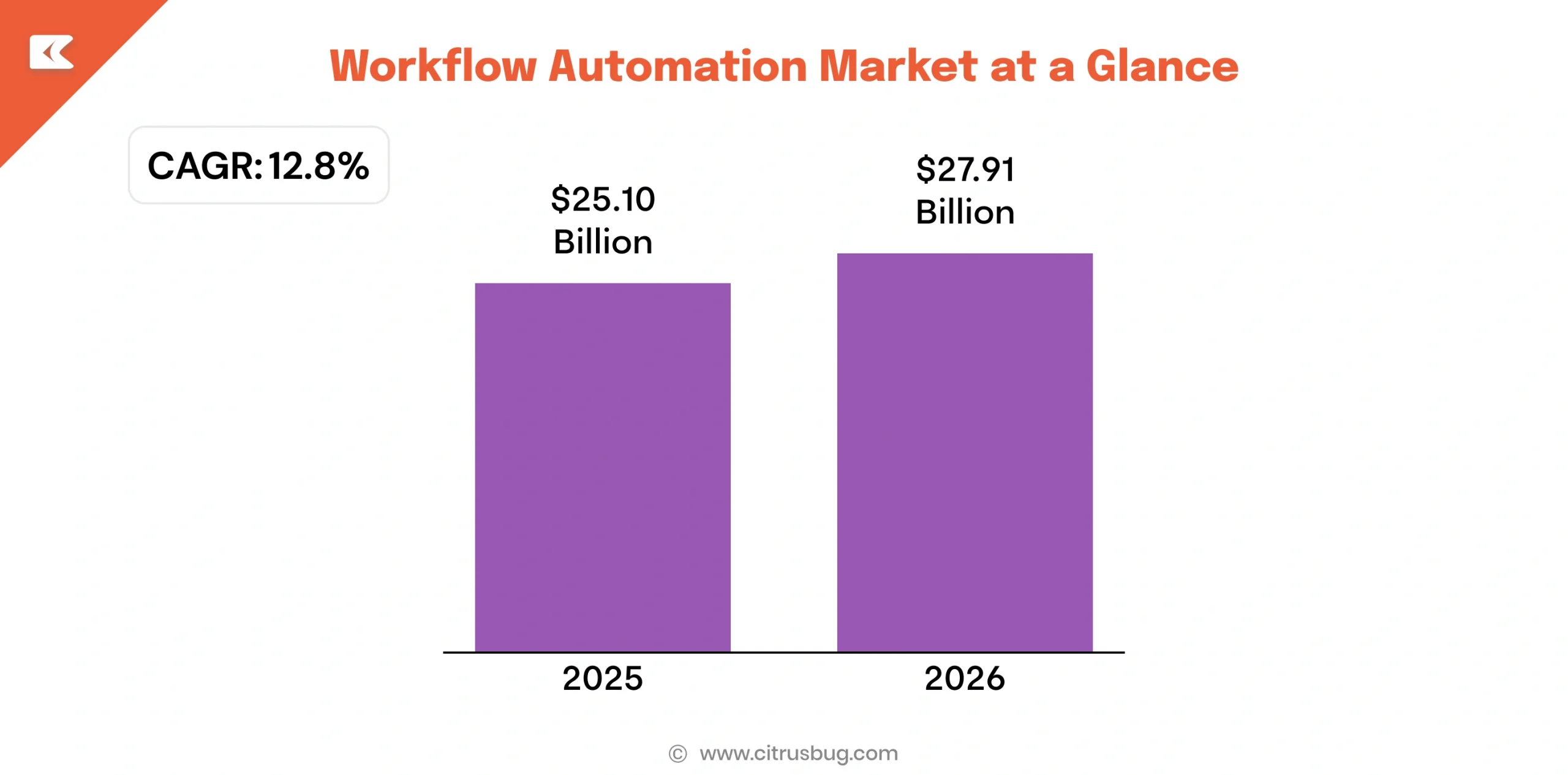
The global market has reached a scale that reflects how central automation has become to enterprise operations.
Consistent growth from 2024 through 2026 is supported by cloud adoption, expanding AI capabilities, and increasing process complexity across industries and geographies.
The market now encompasses a broad ecosystem of software providers, orchestration platforms, and professional services firms serving organizations of every size.
Global Market Valuation
The market has posted consistent year-over-year growth from 2024 through 2026, underpinned by enterprise-wide investment in digital operations and intelligent process management.
Each year’s figures reflect how automation has shifted from a selective tool to a standard operational priority across industries.
- In 2025, market revenue reached USD 25.10 billion, sustained by strong enterprise demand and the deepening integration of AI-powered tools into core business functions across financial services, healthcare, and manufacturing.
- In 2026, global revenue is projected to grow to USD 27.91 billion, as both large enterprises and mid-market organizations scale their automation programs to cover more departments and deeper process layers.
Market Growth Rate
The compounding pace of growth confirms that demand for automation is structural, embedded in long-term enterprise digital strategy rather than short-term budget decisions.
Software continues to lead commercial activity, driven by enterprise preference for integrated orchestration platforms over fragmented point solutions.
- The workflow automation market is expected to expand at a CAGR of 12.8% from 2026 to 2032, propelled by the rising complexity of enterprise workflows and the accelerating integration of AI across automation platforms globally.
- Software platforms commanded a 66.55% revenue share in 2025, reflecting enterprise preference for integrated workflow orchestration and AI-driven automation over standalone point-solution tools.
Deployment and Segment Leaders
Cloud-first and software-led deployment have become the dominant formats for enterprises building and expanding their automation programs.
Enterprise demand for scalable, subscription-based tools continues to concentrate market revenue in cloud-native platform providers.
- Cloud-based automation captured an anticipated 61.4% revenue share in 2026, driven by enterprise demand for scalable platforms that support distributed teams and remote operations across global locations without on-site infrastructure investment.
- On-premise configurations continue to hold meaningful ground in sectors with strict data sovereignty and compliance requirements, including government administration, defense contracting, and portions of regulated financial services.
How Organizations Are Adopting Workflow Automation
Adoption has crossed the threshold from strategic pilot to operational standard across enterprise segments.
Both technology-forward industries and traditionally manual-intensive sectors are deploying automation at scale, generating measurable results in productivity, accuracy, and cost efficiency.
Implementation now spans IT operations, healthcare administration, financial services, and beyond, with each vertical reflecting its own adoption pattern and use case profile.
Enterprise-Wide Integration Rates
Large organizations have moved furthest along their automation journeys, with platform deployments now extending across core IT functions and enterprise operational processes simultaneously.
- 57.5% of organizations globally adopted IoT for process automation in 2024, a sharp increase from just 33% in 2021, showing how connected devices and real-time data integration have become central to how automated workflows are designed, triggered, and managed at scale.
- 89% of large enterprises globally have deployed at least one workflow orchestration platform, indicating that automation infrastructure has become a baseline enterprise requirement rather than a discretionary investment.
- 74% of IT workloads are now managed through automated orchestration systems globally, demonstrating that IT operations have become one of the most automation-intensive enterprise functions, spanning provisioning, monitoring, compliance, and incident response.
Healthcare Administration Use Case
Healthcare is one of the sectors where workflow automation has produced the most specific and verifiable operational outcomes, particularly in administrative functions tied to billing, claims processing, and compliance documentation.
One leading healthcare services organization deployed AI-powered automated workflows for insurance claims processing and medical billing, cutting processing times by 40% while saving over 15,000 employee hours per month.
The same automated workflows maintained 99.5% accuracy across all billing tasks, illustrating how automation reduces manual error rates at a scale that directly improves cost and compliance outcomes.
The pattern visible in healthcare replicates across sectors: when automation is applied to structured, repetitive processes, efficiency improvements are consistent and compound over time without requiring ongoing manual oversight.
BFSI as the Dominant Industry Vertical
Financial services has sustained its position as the single largest industry driver of automation demand, reflecting the sector’s reliance on structured data flows, high-volume transaction processing, and stringent regulatory compliance requirements.
- The BFSI sector accounts for approximately 24% of the global market share in 2026, confirming its status as the leading industry vertical for both platform adoption and sustained technology investment in enterprise process automation.
Market Segmentation Insights
The automation market distributes clearly across organization size, component type, and automation sub-technology, with each segment following a distinct adoption trajectory and growth pattern.
Understanding how revenue divides across these dimensions reveals where the market has matured and where the strongest growth still lies ahead.
Organization Size: Large Enterprise Dominance
Revenue concentrates heavily in large enterprises, reflecting their scale of operations, multi-department process complexity, and greater capacity to invest in comprehensive automation programs across geographies and business units.
Large enterprises generated 71.05% of global revenue in 2025, driven by their need to coordinate complex workflows spanning finance, IT, legal, and operations simultaneously.
SMEs represent the fastest-growing organization segment, as accessible cloud-based platforms continue to lower the cost and technical complexity of automation adoption for mid-market businesses at a meaningful pace.
RPA Service Components
Robotic process automation (RPA) makes up a substantial portion of enterprise automation spending.
Within this sub-market, service components significantly outweigh software in commercial revenue, reflecting the implementation and ongoing management support required at enterprise level.
Services accounted for 77.21% of the global RPA market revenue in 2025, reflecting enterprise demand for comprehensive deployment support and ongoing management of automated systems.
As organizations move toward guided, end-to-end implementations over self-service tooling, professional services and managed automation offerings continue to grow as a share of total market revenue.
Intelligent Process Automation Mix
Intelligent Process Automation (IPA) represents the convergence of workflow tools with AI and machine learning capabilities.
Within this sub-segment, services form the dominant commercial structure, reflecting the implementation complexity of AI-powered automation environments.
The services segment accounted for 56.5% of global IPA market revenue in 2024, driven by enterprise demand for deployment support, AI model configuration, and ongoing optimization of intelligent automation workflows.
As IPA adoption expands across financial services, healthcare, and manufacturing, services revenue is expected to remain the primary commercial channel for platform providers given the complexity of intelligent automation implementations.
Regional Market Share and Growth Insights
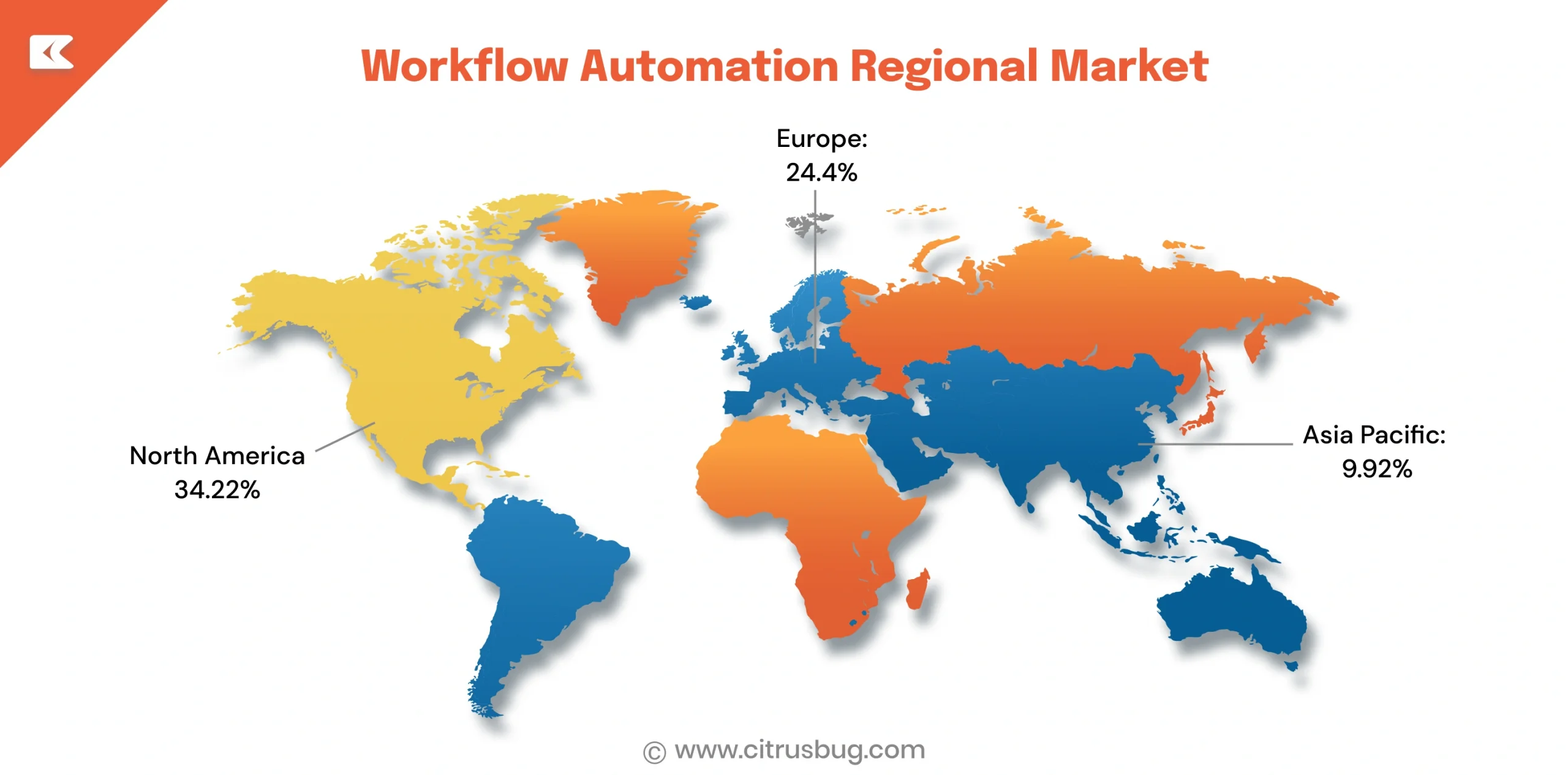
The global market is geographically distributed, with North America leading in absolute revenue, Europe providing a stable compliance-driven base, and Asia Pacific emerging as the fastest-growing regional opportunity.
Each region reflects a distinct set of adoption drivers, deployment priorities, and growth dynamics shaped by local digital maturity, regulatory context, and the pace of enterprise cloud investment.
North America
North America contributed 34.22% of global automation revenue in 2025, driven by high enterprise cloud adoption rates, a mature SaaS ecosystem, and strong demand for AI-enhanced tools across financial services, healthcare, and IT operations.
The region’s well-established digital infrastructure and consistently high enterprise technology investment enable widespread automation deployment across all major sectors and organization sizes.
Asia Pacific
Asia Pacific is forecast to register a CAGR of 9.92% through 2031, propelled by rapid manufacturing digitization, expanding e-commerce infrastructure, and growing enterprise software adoption across China, India, Japan, and Southeast Asian markets.
The region represents the strongest long-term growth opportunity, as digital transformation programs in emerging economies accelerate automation investment across industries.
Europe
Europe is expected to account for 24.4% of global market share over the forecast period, supported by compliance obligations under GDPR and other regulatory frameworks that are driving enterprise demand for automated documentation, audit trails, and process governance tools.
Financial services, manufacturing, and public sector organizations represent the primary demand centers within the region.
Key Forces Accelerating Workflow Automation Growth
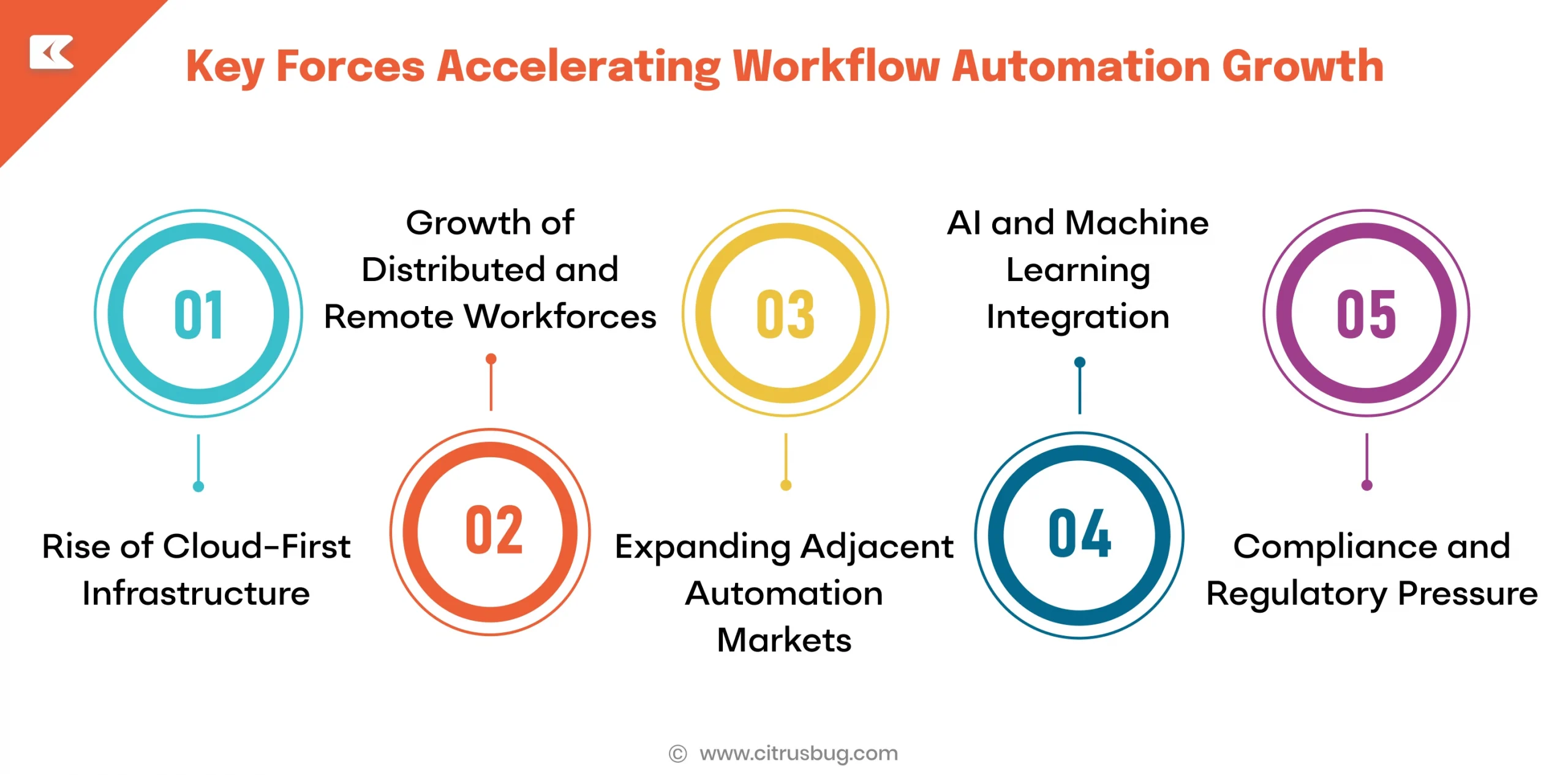
Sustained market expansion is the result of several compounding structural forces acting simultaneously across industries and geographies.
Organizations are investing in automation not as a single-department initiative but as an enterprise-wide operational strategy that touches finance, IT, operations, legal, and customer service functions at the same time.
Rise of Cloud-First Infrastructure
Cloud platforms have changed the economics of automation adoption for organizations of every size.
As enterprise infrastructure moved to cloud-native environments, automation tools became faster to deploy, easier to integrate, and simpler to scale.
Without the capital costs and IT complexity of on-premise setups, more organizations can now start and expand automation programs at their own pace.
Growth of Distributed and Remote Workforces
Distributed and hybrid work has created lasting demand for automated process coordination across organizations.
With approximately USD 35 million in remote work in 2025, organizations need workflow systems that operate reliably without physical proximity or manual handoffs between teams.
Automation handles routing, approvals, and task escalations automatically, ensuring distributed teams stay coordinated across time zones.
Expanding Adjacent Automation Markets
The broader process management ecosystem continues to reinforce automation investment at every level.
The global workflow management software segment was valued at USD 13.4 billion in 2025, reflecting deep enterprise appetite for structured, software-driven process governance.
As adjacent markets like digital process automation and business process management scale, they pull more organizations toward integrated workflow automation platforms as the logical operational foundation.
AI and Machine Learning Integration
Artificial intelligence has expanded what automation platforms can execute. Modern systems now combine rule-based workflows with machine learning models that classify documents, detect anomalies, route tasks based on contextual signals, and predict bottlenecks before they escalate.
As AI becomes more accessible and better trained on domain-specific business data, the boundary between task automation and intelligent decision support continues to narrow.
Compliance and Regulatory Pressure
Regulatory complexity consistently drives automation investment across industries.
As organizations face expanding obligations around data handling, financial reporting, audit trails, and sector-specific compliance, manual processes become too slow and error-prone to sustain at the required scale.
Automated custom workflow automation software delivers built-in documentation, rule-based controls, and structured audit preparation that manual coordination cannot reliably produce for large, multi-department organizations.
Challenges Facing Broader Adoption
Despite sustained growth, deployment programs face real barriers that slow timelines and limit the scope of automation initiatives, particularly for mid-market organizations and those operating in data-sensitive or heavily regulated environments.
These challenges do not reverse the overall growth trend, but they do shape which deployment models and configurations gain traction in each sector and at each organization size.
- Integration Complexity: 54% of workflow orchestration deployments cite integration complexity as a significant barrier, reflecting the difficulty of connecting automation platforms with legacy systems, fragmented data sources, and existing enterprise software stacks. This challenge frequently extends project timelines and increases implementation costs beyond initial estimates.
- Data Security and On-Premise Preferences: On-premise deployment configurations hold 45% of the market in 2026, driven largely by data sovereignty concerns and regulatory environments that restrict cloud-based data processing. This preference slows how quickly cloud-native automation solutions can achieve broad penetration in regulated industries such as financial services, healthcare, and defense contracting.
- Change Management and Workforce Adoption: Beyond technology barriers, organizational resistance remains a practical constraint on automation program scope. Employees and managers may view automation as a threat to existing roles, which slows internal adoption and reduces the breadth of programs organizations are willing to pursue even when technical infrastructure could support much wider deployment.
Future Outlook and Market Opportunities
The workflow automation market is entering a phase where growth is no longer driven primarily by first-time adoption but by the deepening of automation programs within organizations that have already made initial investments.
The next wave of expansion is tied to AI integration, cross-platform orchestration, and the geographic scale-up of automation across regions and verticals that remain in earlier adoption stages.
The Intelligent Process Automation (IPA) segment signals where the broader industry is heading. The IPA market is expected to reach USD 44.74 billion by 2030 at a CAGR of 22.6%, as organizations move beyond rule-based automation into AI-driven systems capable of handling unstructured data, judgment-based task routing, and dynamic process adaptation.
The adjacent Business Process Management market is projected to reach USD 37.7 billion by 2032 at a 13.52% CAGR, reinforcing how demand for structured enterprise process management platforms continues to compound alongside core workflow tools.
Broader global projections confirm the scale of opportunity ahead. The workflow automation market is projected to reach USD 46.8 billion by 2032.
The directional consensus across research providers is consistent: enterprise investment in automation is compounding across every major region, vertical, and organization size through the early 2030s.
At the regional level, North America is expected to generate USD 10 billion in automation revenue by 2030 at a 9.2% CAGR, as enterprise automation programs expand their operational scope and new deployment use cases in government administration, healthcare logistics, and supply chain management push the addressable market beyond its traditional BFSI and IT strongholds.
Conclusion
The workflow automation market has reached a point of structural maturity across industries. What began as a productivity tool for IT departments now functions as a foundational operational layer in financial services, healthcare, manufacturing, and logistics.
Adoption rates, market valuations, and regional growth patterns all confirm that automation is no longer optional for enterprises managing complex, high-volume processes.
For organizations building or scaling automation programs, tailored implementation consistently outperforms generic platform deployments. Custom workflow automation software development around specific operational contexts delivers stronger integration outcomes, higher adoption rates, and more durable performance gains across the business.