

 Back
Back The AI Technical Debt Reckoning: How to Build Fast with AI Without Breaking Your Codebase

Executive Summary
The software engineering profession is undergoing its most disruptive transformation in decades. As of early 2026, 41% of all code written globally is generated by AI tools — and 92% of American developers use AI coding assistants daily [1][2]. What began as autocomplete evolved into agentic systems capable of autonomously writing, reviewing, and committing code across entire repositories. The productivity gains are real and measurable. The risks accumulating beneath the surface are equally real — and far less discussed.
This whitepaper makes the case that the software industry is approaching a structural inflection point. The same speed that AI enables today is creating technical debt, security vulnerabilities, and organizational brittleness that will define whether engineering organizations succeed or fail in 2026 and beyond. Industry analysts, academic researchers, and security firms have independently reached the same conclusion: without deliberate governance, the compounding costs of AI-generated code will reach crisis levels.
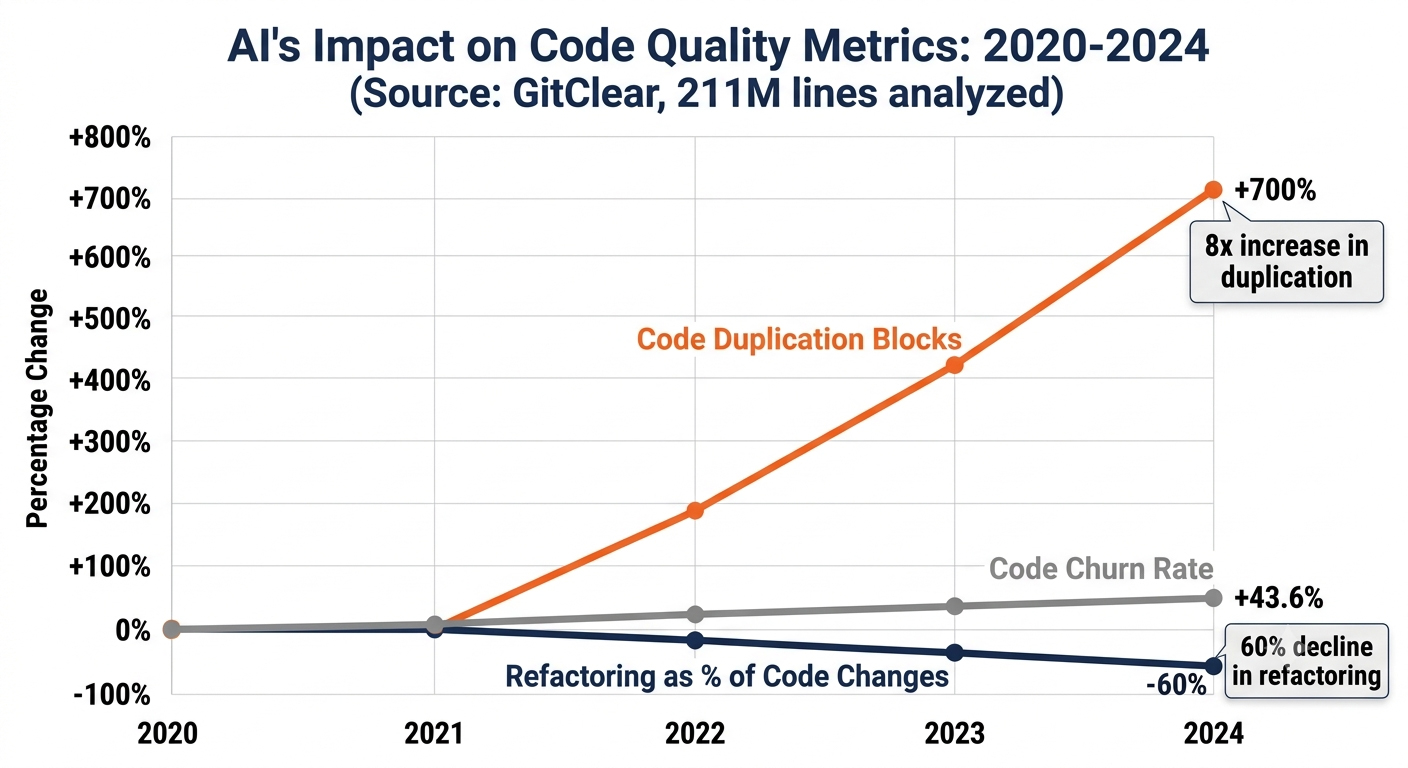
The evidence is unambiguous. GitClear's analysis of 211 million lines of code found an eightfold increase in duplicated code blocks and a 60% decline in refactoring between 2021 and 2024 [3]. Veracode's testing of over 100 large language models found that 45% of AI-generated code contains security vulnerabilities — rising to 72% for Java [4]. Apiiro's Fortune 50 research documented a tenfold increase in security findings within six months of AI coding tool adoption [5]. Gartner predicts that prompt-to-app approaches will increase software defects by 2,500% by 2028 [6]. One industry analyst projects $1.5 trillion in accumulated technical debt from AI-generated code by 2027 [7].
The crisis is not hypothetical. It is measurable now — in code quality metrics, security incident rates, and trust erosion among the developers closest to the problem. Yet most organizations continue accelerating AI adoption without a corresponding investment in governance. The gap between velocity and oversight is widening every quarter.
This whitepaper is written for CTOs, VPs of Engineering, and senior technical leaders who want to build fast with AI — without inheriting a codebase that will take years and millions of dollars to remediate. It examines the anatomy of AI-generated technical debt, the structural forces driving the 2026-2027 crisis, the security landscape, and — most importantly — a practical governance framework that leading organizations are using to capture AI's benefits while maintaining engineering integrity.
The central argument is straightforward: speed and quality are not mutually exclusive in the AI era when supported by effective AI code governance. But speed without governance is not velocity — it is exposure. Organizations that build deliberate AI governance now will ship faster with confidence. Those that do not will discover their accumulated debt in the worst possible way: through a breach, a failed compliance audit, or a due diligence process that kills a funding round.
Key takeaways from this whitepaper:
- AI-generated code introduces a new class of technical debt — comprehension debt, architectural debt, and security debt — that traditional tools and processes were not designed to catch.
- The 2026-2027 reckoning is structural: driven by compounding debt, a hollowed junior developer pipeline, and regulatory frameworks that now carry real enforcement teeth.
- A three-layer governance architecture — covering IDE, PR, and architectural review — is the most effective model for organizations deploying agentic coding at scale.
- CTOs who act now will establish competitive advantage; those who delay will face remediation costs that dwarf the governance investment required today.
1. The Velocity Trap: How AI Became the Default Developer
There is a moment in every technology wave when experimentation becomes infrastructure. For AI-assisted software development, that moment arrived in 2025. What began as an experiment in developer productivity — occasional autocomplete suggestions, code snippet generation — evolved over 18 months into agentic AI development that has fundamentally changed what it means to write software.
1.1 From Autocomplete to Agentic — The Speed Revolution
The evolution of AI coding tools has followed a compressing timeline. GitHub Copilot launched in 2021 as an autocomplete assistant. By 2024, tools like Cursor, Claude Code, and Devin were operating as full agents — capable of reading entire repositories, planning multi-file changes, creating pull requests, and executing code in isolated environments with minimal human intervention. Over 1.1 million public GitHub repositories adopted AI coding tools between 2024 and 2025 alone [8]. GitHub reports nearly 1 billion commits in 2025, with a 178% surge in generative AI projects [9].
This is not incremental productivity improvement. It is a categorical change in who — or what — writes code. At Google and Microsoft, AI-generated code now comprises approximately 30% of all new code committed to production systems [9]. Y Combinator's Winter 2025 batch saw 25% of startups operating with codebases that were 95% AI-generated, with those companies achieving $10 million in revenue with teams of fewer than ten people [1].
The business case is powerful: AI coding tools report 60-80 minutes of daily time savings per engineer [10]. Teams report 40% reductions in code review time [11]. Development cycles that took weeks now take hours. For startups competing for market position and enterprises under pressure to ship features, the incentive to adopt AI coding tools without friction is nearly irresistible.
1.2 The Adoption-Trust Paradox
Beneath the headline productivity numbers, a more troubling pattern has emerged. Developer adoption is accelerating while trust is declining. Stack Overflow's 2025 Developer Survey found that 84% of developers now use AI tools regularly — yet only 29% express high confidence in the output they receive [12]. Sonar's research found that 88% of developers cite negative impacts from AI code, including code that 'looks correct but is not reliable' (53%) and unnecessary or duplicative code (reported by a significant majority) [13].
This paradox — using tools you do not fully trust — reflects an organizational reality familiar to any CTO: developers adopt what their employers mandate or incentivize, even when their professional judgment signals caution. The problem is compounded by automation bias: a well-documented behavioral tendency, particularly among junior developers, to accept AI-generated code on surface-level results rather than rigorous engineering analysis [6].
Deloitte's 2025 Developer Skills Report found that over 40% of junior developers admit to deploying AI-generated code they do not fully understand [12]. That percentage — more than four in ten of the engineers committing code — represents a structural knowledge gap that will have long-term consequences for system maintainability, incident response, and institutional learning.
1.3 The Scale of the Shift: 41% of Code Is Now AI-Generated
By February 2026, 41% of all code written globally was AI-generated [2]. 87% of Fortune 500 companies had adopted some form of AI-assisted development platform [1]. Nearly 70% of CISOs, AppSec managers, and developers estimated that more than 40% of their organization's code was AI-generated in 2024 — with 44% estimating it at 41-60% [14].
These figures reveal that we have already crossed the threshold where AI-generated code is a majority contributor to many production systems. The implications for technical debt, security posture, and architectural integrity are not theoretical. They are present, measurable, and compounding with every new commit.
2. Anatomy of AI Technical Debt
Technical debt is not new. Ward Cunningham coined the term in 1992 to describe the accumulated cost of shortcuts in code. But AI-generated technical debt is structurally different from the technical debt that engineering teams have historically managed — and it accumulates faster, compounds differently, and is substantially harder to detect and remediate.
AI technical debt arrives in four primary forms: code duplication debt, comprehension debt, architectural debt, and maintenance debt. Understanding each type is prerequisite to governing them.
2.1 Code Duplication at Scale: The GitClear Findings
GitClear's longitudinal analysis of 211 million changed lines of code from repositories owned by Google, Microsoft, Meta, and enterprise companies represents the most comprehensive empirical study of AI's impact on code quality to date [3]. The findings are stark: copy-paste growth rose from 8.3% to 12.3% of all changed lines between 2020 and 2024. Duplicated code blocks increased eightfold. Refactoring fell from 25% of changes in 2021 to less than 10% in 2024 — a 60% collapse. Code churn (revisions within two weeks of writing) jumped from 5.5% to 7.9%. In 2024, for the first time in history, copy-paste exceeded moved lines — a fundamental reversal of engineering best practice [3].
These metrics matter because duplicated code is the root cause of a cascade of downstream problems. Each duplicated code block becomes a maintenance liability requiring multiple simultaneous fixes when bugs emerge. It creates inconsistent behavior across the system. It inflates codebase size without adding value. And crucially, it signals that AI tools are optimizing for immediate functionality rather than long-term maintainability — a rational behavior for models trained on immediate reward signals, but a destructive one for engineering organizations accountable for system health over years.
The SlopCodeBench study directly demonstrated this effect: under repeated editing cycles, agent-generated code deteriorates progressively. Each multi-turn edit preserves and extends anti-patterns from prior turns. Pass rates remain stable while underlying code becomes increasingly difficult to extend [6]. Organizations shipping multiple AI-assisted releases per week are stacking these deterioration cycles.
2.2 Comprehension Debt — When Nobody Understands the Codebase
A particularly dangerous form of AI-generated debt is comprehension debt: the accumulated gap between the code that exists in production and the organizational knowledge needed to understand, modify, and debug it. This concept was articulated by Margaret-Anne Storey and has become a defining challenge of the agentic coding era [15].
When AI agents write code autonomously, they make thousands of micro-decisions that are not documented, not reviewed, and not understood by the humans who will later maintain that code. An empirical study of 567 agent-assisted pull requests found that 45.1% required human revisions to align with project-specific standards — reflecting unstated design decisions the AI made without access to architectural patterns or codebase history [6]. Harness's State of Software Delivery 2025 report found that 67% of developers spend more time debugging AI-generated code than equivalent human-written code [6].
Comprehension debt is invisible on dashboards and dangerous in incidents. When a critical system fails at 2 a.m., the engineer on call needs to understand not just what the code does but why specific design decisions were made. In a codebase with high comprehension debt, that understanding may not exist anywhere in the organization. The comments are missing. The architectural reasoning was never written down. The AI that generated the code has no memory.
2.3 Architectural Debt: Phantom Bugs and Silent Design Decisions
Beyond individual code quality, AI tools introduce a more systemic risk: architectural drift. AI-generated code frequently makes subtle design changes that break security assumptions without violating syntax — a class of vulnerability that traditional static analysis tools are not designed to catch. Apiiro's research identified what they call 'phantom bugs' in 20-30% of AI-generated codebases: over-engineered logic for improbable edge cases that degrade performance and waste resources [5].
Privilege escalation paths in Fortune 50 codebases jumped 322% following AI tool adoption. Architectural design flaws spiked 153% [5]. These are not syntax errors. They are design-level problems that emerge when AI systems optimize for local correctness while lacking the system-level context that experienced engineers carry. Trivial syntax errors dropped 76% with AI assistance — AI is genuinely better at avoiding simple mistakes — but logic bugs fell only 60%, while architectural flaws surged [5].
The result is a codebase that looks cleaner on the surface and is more dangerous underneath. Standard automated testing catches the surface issues. The architectural risks accumulate undetected until a system failure, a security breach, or a major refactoring effort makes them visible — often at the worst possible time.
2.4 Maintenance Debt: The 4x Cost Multiplier
The financial consequences of unmanaged AI-generated technical debt are measurable and severe. Research shows that unmanaged AI-generated code drives maintenance costs to 4x traditional levels by year two as technical debt compounds [16]. First-year costs already run 12% higher when factoring in the 9% code review overhead, the 1.7x testing burden, and the 2x code churn requiring rewrites [16]. Pull requests per developer increased 20% with AI assistance — but incidents per pull request increased 23.5% [16].
McKinsey's research on traditional technical debt found that the cost to fix debt grows at roughly 3.1x the cost of the original development over time — and this multiplier accelerates as systems age [17]. AI-accelerated debt accumulation compresses this timeline dramatically. Organizations shipping 10x more AI-generated code are not generating 10x more debt per line — they are generating 10x more debt per quarter.
The economics become stark when viewed over a planning horizon. Opsera found that AI-generated code requires 15-25 percentage points of rework, largely eliminating the 30-40% productivity gains that justified AI adoption in the first place [13]. The organizations capturing net productivity gains from AI are those with governance structures that prevent this rework cycle — not those moving fastest without guardrails.
| Debt Type | Primary Symptom | Detection Method | Cost Multiplier |
|---|---|---|---|
| Code Duplication | 8x more duplicated blocks | Static analysis, duplication scanners | 3x maintenance overhead |
| Comprehension Debt | 67% longer debug cycles | Knowledge audits, documentation gaps | 2x incident resolution time |
| Architectural Debt | 322% more escalation paths | Architecture reviews, SAST | 4x refactoring cost |
| Maintenance Debt | 23.5% more incidents per PR | DORA metrics tracking | 4x total cost by Year 2 |
3. Security: The Iceberg Beneath the Surface
Technical debt is expensive. Security debt can be existential. The security risks introduced by AI-generated code represent the most immediate and severe manifestation of the governance gap — and the data from multiple independent research efforts paints a consistently alarming picture.
3.1 Veracode's 45% Vulnerability Rate — By Language
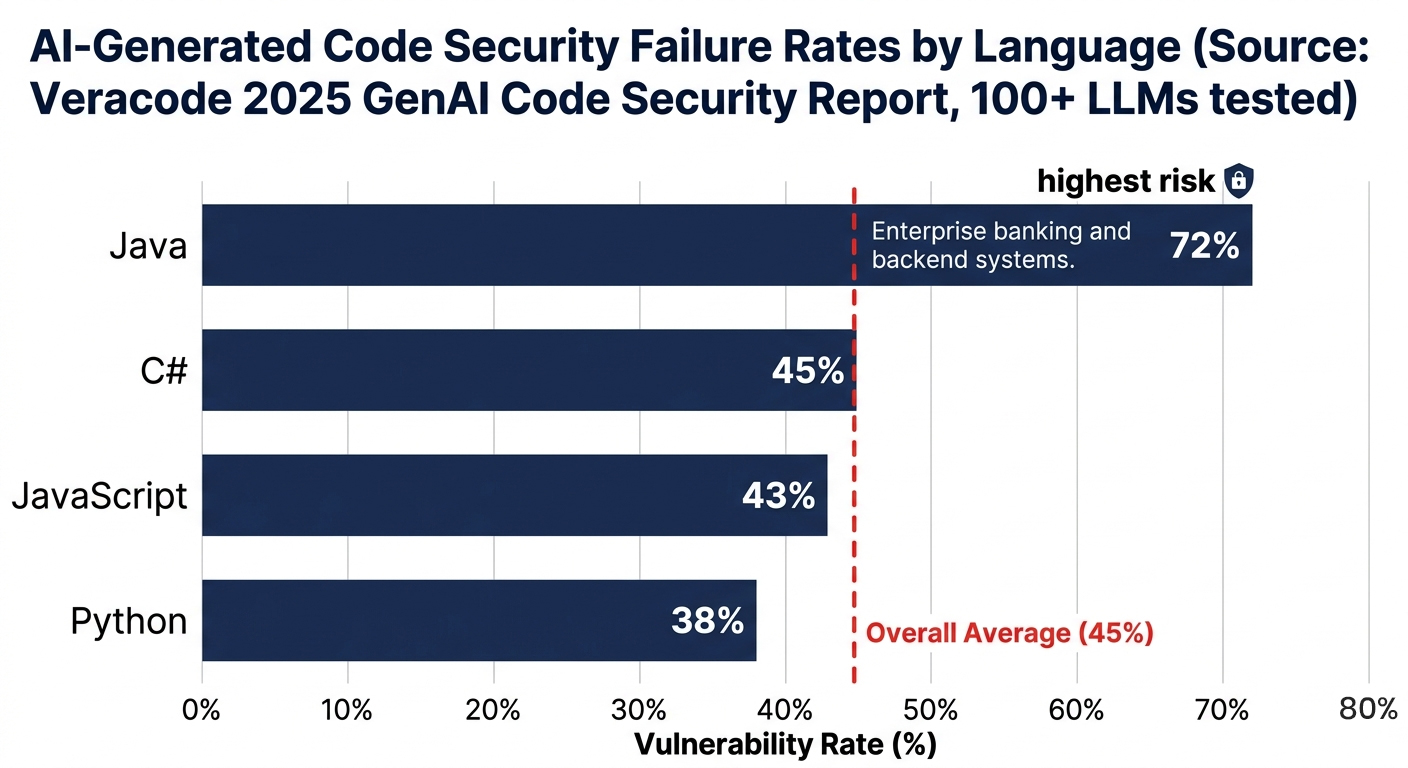
Veracode's 2025 GenAI Code Security Report tested over 100 large language models across more than 80 curated coding tasks in Java, JavaScript, Python, and C#. The finding that defines the current risk landscape: 45% of AI-generated code contains security vulnerabilities — including OWASP Top 10 vulnerabilities like SQL injection, cross-site scripting, authentication bypass, and hard-coded credentials [4].
The risk profile is not uniform across languages. Java, the backbone of enterprise banking infrastructure and core backend systems, exhibits a staggering 72% security failure rate in AI-generated outputs [4]. Python shows a 38% failure rate; JavaScript 43%; C# 45%. CodeRabbit's independent analysis confirmed that AI-generated pull requests contain 2.74 times more security issues than human-written code [11].
The prevalence assumption that syntactically correct AI-generated code is inherently secure represents one of the most dangerous fallacies in modern software engineering. AI models trained on large code repositories learn from the full distribution of code quality — including millions of insecure patterns. When a developer asks an LLM to 'query the users table by ID,' the model may return a textbook SQL injection flaw because that pattern appeared thousands of times in its training data [18]. The model is not trying to introduce vulnerabilities. It is pattern-matching against a training set that included them at scale.
3.2 New Attack Surfaces: Slopsquatting and Hallucinated Dependencies
Beyond known vulnerability patterns, AI coding tools introduce attack surfaces that did not exist before large language models were deployed at scale. The most significant is package hallucination — AI models inventing non-existent libraries, functions, or APIs that developers then attempt to install.
This creates a supply chain attack vector called slopsquatting: threat actors publishing malicious packages that match names AI models commonly hallucinate. When a developer follows an AI suggestion to install a non-existent package, they may unknowingly install a malicious one instead. Software composition analysis tools with dependency verification can prevent this by validating package existence before integration — but many organizations have not updated their pipelines to include this check [19].
Equally dangerous is credential exposure. AI-generated code that includes hard-coded API keys, database credentials, or authentication tokens represents one of the most common and immediately exploitable vulnerability classes. Between January 2025 and February 2026, security researchers documented that nearly every significant breach in vibe-coded applications traced back to the same preventable root causes: misconfigured databases, missing Row Level Security, hardcoded API keys, and exposed cloud backends [20].
Prompt injection represents an additional attack surface specific to agentic systems. As AI agents gain the ability to read emails, browse the web, and interact with external APIs, malicious content in those sources can hijack agent behavior — causing agents to exfiltrate data, modify code, or execute unauthorized operations. Governing agentic systems requires not just reviewing their output but controlling their inputs.
3.3 Apiiro's Fortune 50 Findings: 10x Security Growth in 6 Months
Apiiro's research across Fortune 50 enterprises provides the clearest longitudinal view of AI's security impact at scale. Between December 2024 and June 2025, AI-generated code was adding over 10,000 new security findings per month — a tenfold increase from 1,000 monthly findings at the start of the period [5]. IBM's 2025 Cost of a Data Breach Report found that 63% of breached organizations lacked AI governance policies, and shadow AI — developers using unapproved AI tools — added an average of $670,000 to breach costs [13].
Aikido Security's 2026 report found that AI-generated code is now the cause of one in five data breaches [13]. Aikido's survey of 450 developers, AppSec engineers, and CISOs found that 69% had discovered vulnerabilities introduced by AI-generated code in their own systems — and one in five reported incidents that caused material business impact [13].
These are not edge cases or early-adopter incidents. They represent the security posture of mainstream enterprise software development in 2025-2026. The organizations facing these incidents are not negligent — they are early in deploying a technology that is evolving faster than their security infrastructure.
3.4 Compliance Exposure: EU AI Act, SOC 2, HIPAA
The regulatory environment surrounding AI-generated code has moved from guidance to enforcement, increasing the need for an AI compliance framework. The EU AI Act entered into force in August 2024 with phased application timelines that will affect software development practices across European operations and any organization serving European customers [19]. High-risk AI systems under the Act must maintain detailed logging, traceability, and human oversight — requirements that many agentic coding deployments do not currently meet.
GDPR carries penalties of up to 20 million euros or 4% of global annual turnover for AI-generated code that mishandles personal data — and AI systems that generate PII-processing code without proper safeguards are directly in scope [19]. HIPAA applies to any code processing protected health information, with civil penalties reaching $1.5 million per violation category per year [19]. SOC 2 requires demonstrable governance over code quality and data handling — and AI-generated code without audit trails creates direct compliance exposure.
For CTOs at regulated-industry companies, the compliance argument for AI governance is often the most persuasive one in the boardroom. The legal and financial exposure from a single GDPR enforcement action, HIPAA audit finding, or SOC 2 qualification failure can dwarf the cost of implementing comprehensive governance in advance.
4. The 2026-2027 Reckoning: Why the Crisis Is Structural
The confluence of compounding technical debt, hollowed talent pipelines, exploding security findings, and tightening regulation creates a structural inflection point — not a temporary challenge to be managed through iteration, but a systemic crisis that will reshape how engineering organizations operate over the next three to five years.
4.1 The Compounding Effect: Debt on Debt
Technical debt has always compounded over time — each shortcut makes the next shortcut more costly. AI-generated technical debt introduces a new compounding mechanism: scale. Because AI tools can generate code faster than human teams can review it, the rate of debt accumulation can outpace the rate of debt service almost immediately after deployment without governance.
Gartner's 2025 predictions for software engineering found that prompt-to-app approaches will increase software defects by 2,500% by 2028 [6]. Forrester predicts that 75% of tech decision-makers will face moderate-to-severe technical debt by 2026 [16]. Gartner's separate finding — that by 2027, 40% of enterprises using consumption-priced AI coding tools will face unplanned costs exceeding twice their expected budgets — reflects a pricing model mismatch that adds financial debt to technical debt [36]. The compound effect of these forces produces the structural crisis that senior practitioners have coalesced around the 2026-2027 timeline to expect [3].
By 2028, more than half of enterprises that built custom LLMs will abandon initiatives due to costs, complexity, and technical debt, according to Gartner [3]. By the same year, one-third of all business software will contain agent functions — a 33x increase from under 1% in 2024 [3]. The organizations that govern this transition deliberately will be positioned to capture the full leverage of agentic development. Those that do not will be managing remediation programs as their competitors ship products.
4.2 The Talent Pipeline Crisis: Juniors Cut, Seniors Overwhelmed
One of the most consequential and underappreciated dimensions of the AI coding crisis is workforce. Across the industry, organizations that adopted AI coding tools in 2024-2025 made workforce decisions that will have multi-year consequences: 54% of engineering leaders planned to hire fewer junior developers due to AI capabilities [18]. The data supports the trend: entry-level tech job postings dropped 25% year-over-year in 2024 [21]. Employment for software developers aged 22-25 declined nearly 20% from its peak in late 2022 [21].
The logic seemed sound at the time. Senior developers with AI tools are more productive than entire junior teams. Why maintain the cost of junior development when AI can handle their workload? The flaw in this reasoning is becoming visible in 2026. Senior developers are now spending 19% more time on code reviews than before AI tools became widespread [22]. Without juniors to handle basic tasks like unit testing and refactoring, seniors are juggling complex architectural work alongside reviewing large volumes of AI-generated code. The overload is measurable and is beginning to affect retention.
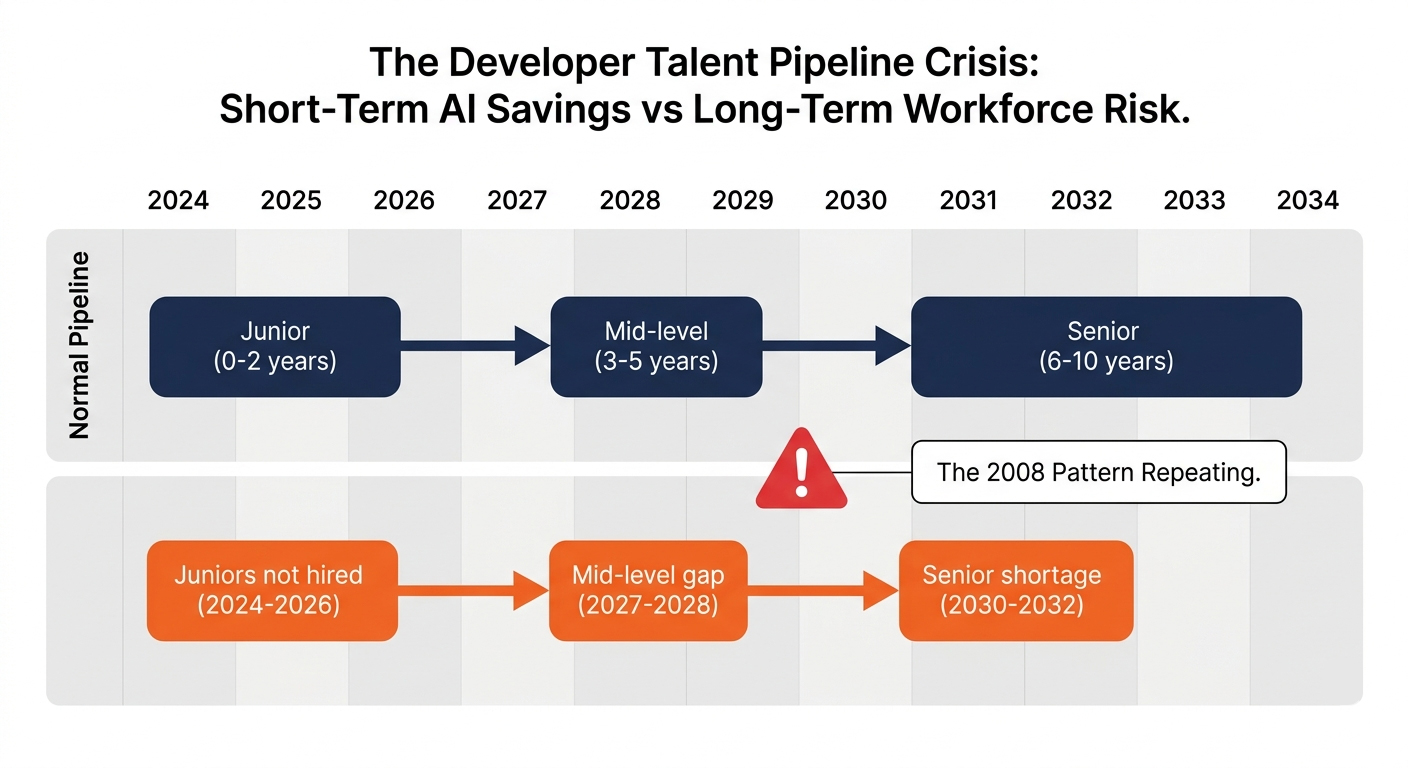
The deeper risk is generational. Junior developers have always been the training ground for tomorrow's senior engineers. If organizations eliminate junior roles for three to five years, a hole forms in the talent pipeline. The engineers who were not hired as juniors in 2024-2026 will not become mid-level engineers in 2027-2028. They will not become seniors in 2030-2032. The industry already saw this pattern after the 2008 financial crisis: hiring freezes created an experience gap that produced mid-level talent shortages four years later [23]. As AWS CEO Matt Garman noted: 'How's that going to work when ten years in the future you have no one that has learned anything?' [24].
4.3 The $1.5 Trillion Shadow Bill
The financial magnitude of the approaching reckoning has been estimated by multiple independent analysts. Industry projections place accumulated AI-generated technical debt at $1.5 trillion by 2027 [7]. Stripe has estimated that existing software technical debt globally represents a $3 trillion drag on GDP [17]. McKinsey's research found that technical debt accounts for 40% of IT balance sheets, with CIOs estimating that it represents 20-40% of their entire technology estate value [17]. Thirty percent of CIOs report that more than 20% of their budget for new products is diverted to resolving technical debt issues [17].
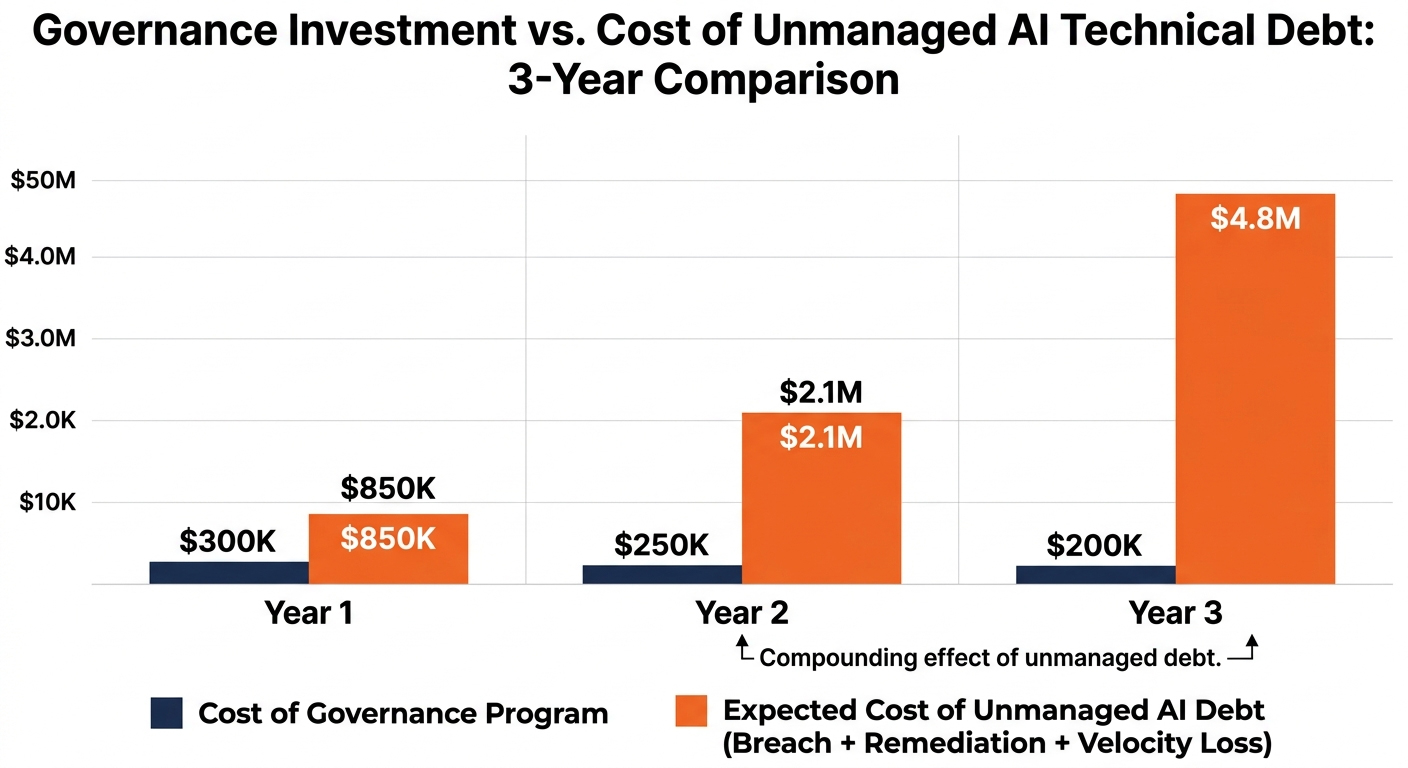
Against this backdrop, the cost of AI governance investment is modest. A comprehensive AI code governance program — including tooling, process changes, training, and dedicated oversight capacity — represents a fraction of the remediation cost that organizations without governance will face. The question is not whether governance costs money. It is whether organizations want to pay for it now, at scale, under control — or later, at crisis, under pressure.
5. The Governance Framework for Agentic Coding
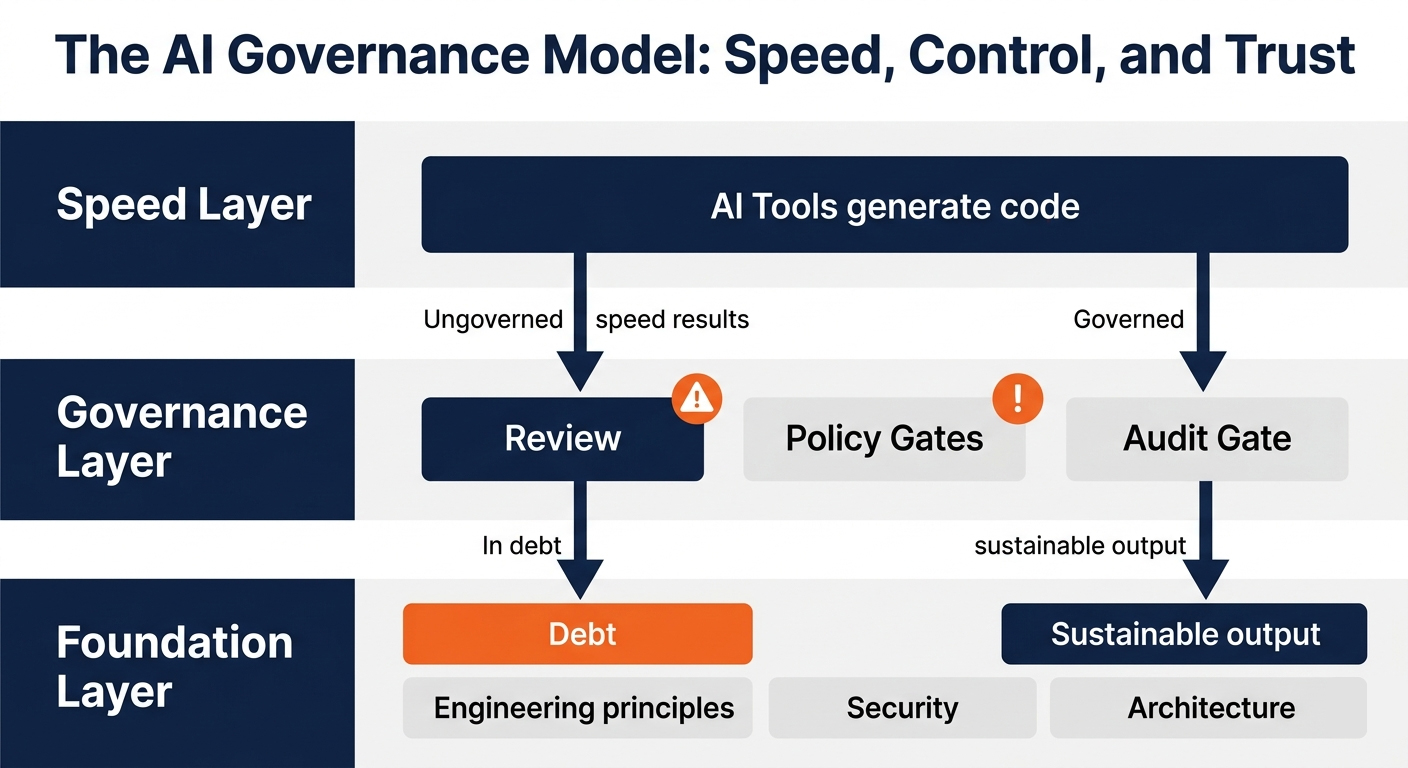
AI software governance of generated code is not about slowing development. It is about ensuring that the speed AI enables translates into durable output rather than accumulated liability. The most effective governance frameworks treat controls not as bottlenecks but as infrastructure — the rails that allow fast trains to run safely.
Leading organizations are converging on a set of governance principles and structures. This section presents a comprehensive framework that CTOs can implement progressively, calibrated to their organization's maturity and risk profile.
5.1 Policy-as-Code: Defining What AI Can and Cannot Write
The foundation of effective AI code governance is a written, enforced policy that defines permitted and prohibited uses of AI coding tools — with different requirements applied based on the risk profile of the code being generated. This approach, often called policy-as-code, encodes governance rules as executable specifications that can be automatically enforced across development pipelines [14].
A practical policy framework typically categorizes code generation tasks into three tiers. Prohibited tasks requiring human implementation include authentication systems, authorization frameworks, cryptographic implementations, payment processing, and secrets management [14]. These are domains where AI failure rates are highest and consequences of failure are most severe. Permitted with enhanced review includes CRUD operations, business logic, UI components, API integrations, and data transformation functions. AI can generate these effectively but requires human review before merge. Permitted with standard review covers boilerplate, test scaffolding, documentation, utility functions, and configuration. These represent the highest-leverage, lowest-risk applications of AI code generation.
Enforcement mechanisms for policy-as-code include automated gates in CI/CD pipelines, pre-commit hooks that classify code by type and route it to appropriate review workflows, SAST integration at the pull request level, and recertification processes as AI capabilities and vulnerability patterns evolve [14].
5.2 Establishing an AI Governance Board
Policy without accountability is aspiration. Effective AI governance requires a dedicated organizational structure with clear decision-making authority. Organizations deploying AI coding at scale should establish an AI Governance Board — a cross-functional body with representation from engineering, security, legal/compliance, and product — with a defined charter, escalation procedures, and accountability for AI-related outcomes [34].
The board's responsibilities include approving the list of permitted AI coding tools and reviewing new tool additions, setting human-in-the-loop requirements for high-risk code changes, investigating and documenting AI-related incidents, reviewing DORA metrics and code quality trends quarterly, and maintaining the policy-as-code rules that enforce governance automatically.
A key structural decision is the assignment of Agent Owners — individuals who take formal accountability for specific AI tools and their outcomes. This extends accountability beyond traditional development roles and addresses the unique risks of autonomous code generation. When an AI agent causes a production incident, there should be a named person responsible for that agent's governance, not a diffused collective whose individual responsibility is unclear [34].
5.3 The Three-Layer Review Architecture
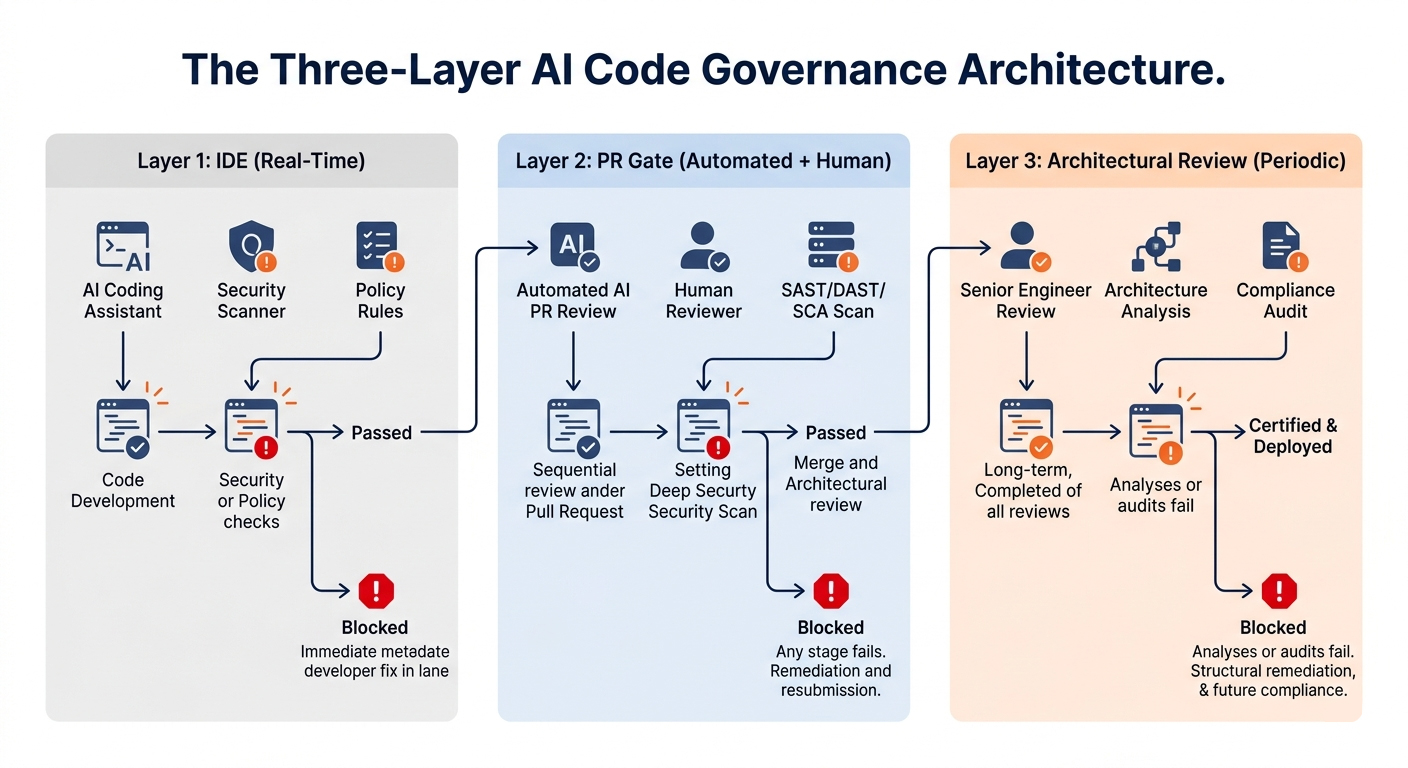
Effective review of AI-generated code requires a multi-layer approach because different vulnerability classes surface at different stages of the development cycle. No single review mechanism catches all risk categories. Organizations achieving the best balance of speed and safety are using a three-layer architecture.
Layer 1 — IDE-Level Review: Real-time feedback at the moment of code generation. Tools like Cursor, GitHub Copilot with enterprise security rules, and AI-aware security scanners flag insecure patterns, hallucinated dependencies, and policy violations as the developer works. This layer catches the most obvious issues at zero marginal cost to the development cycle.
Layer 2 — Pull Request Review: Automated and human review at the merge gate. AI-powered PR review tools (CodeRabbit, GitHub Bugbot) provide line-by-line analysis, while human reviewers focus on business logic, architectural coherence, and project-specific standards. Research shows that AI agents generate many more suggestions than human reviewers but achieve significantly lower adoption rates (16.6% vs. 56.5%) — confirming that human judgment remains essential at this layer [46].
Layer 3 — Architectural Review: Periodic deep review of system-level design decisions. Conducted by senior engineers or external reviewers on a cadence matched to development velocity. This layer catches the architectural drift, privilege escalation paths, and design-level vulnerabilities that automated tools miss. Tools like CodeScene (behavioral data and historical trends), SonarQube (deep static analysis), and periodic Claude Code architectural reviews are common implementations.
5.4 DORA Metrics for the AI Era
DORA (DevOps Research and Assessment) metrics — Deployment Frequency, Lead Time for Changes, Change Failure Rate, and Time to Restore Service — provide the foundational measurement framework for software delivery performance. In the AI era, these metrics require supplementation to capture AI-specific dynamics.
Forward-looking organizations are adding AI-specific metrics to their measurement stack: AI adoption rate by team and repository (to identify shadow usage), code quality delta between AI-assisted and human-only contributions (to measure net quality impact), vulnerability density per AI tool (to identify which tools introduce the most risk), technical debt accumulation rate (tracked against pre-AI baseline), and AI-generated incident rate (the proportion of production incidents traceable to AI-generated code) [28].
These metrics serve two purposes. Operationally, they provide the signal needed to tune governance controls — identifying which tools, teams, or code types require more oversight. Strategically, they provide the evidence base for board-level conversations about AI governance investment, connecting governance costs to measurable risk reduction and velocity outcomes.
5.5 Agentic Autonomy Levels: A Tiered Trust Model
As AI systems become more agentic — capable of multi-step autonomous action rather than single-response generation — governance must evolve from reviewing outputs to governing behaviors. A tiered trust model assigns different autonomy levels to AI agents based on demonstrated performance, code risk classification, and organizational tolerance for autonomous action.
Level 0 (Suggestion Only): AI provides code suggestions; human writes and approves all code. Appropriate for high-risk domains like authentication and payment processing.
Level 1 (Draft Generation): AI generates complete drafts; human reviews and approves before any commit. Standard workflow for most feature development.
Level 2 (Supervised Execution): AI can commit to development branches with mandatory review before merge to main. Appropriate for well-tested, low-risk code types with established patterns.
Level 3 (Supervised Autonomy): AI operates autonomously on defined task types within defined boundaries, with human approval required for any action outside scope. Appropriate for mature teams with strong audit infrastructure.
Level 4 (Full Autonomy): Reserved for narrow, well-defined, low-risk tasks with complete audit trails and rollback capability. Very few organizations should operate at this level today.
The tiered model enables organizations to calibrate AI autonomy to their actual risk tolerance and governance maturity — rather than applying uniform rules that either over-restrict low-risk tasks or under-govern high-risk ones.
| Autonomy Level | AI Role | Human Role | Appropriate Contexts |
|---|---|---|---|
| Level 0 — Suggestion | Suggests code | Writes and approves all | Auth, payments, cryptography |
| Level 1 — Draft | Generates drafts | Reviews and approves all commits | Feature development (standard) |
| Level 2 — Supervised | Commits to dev branches | Reviews before merge to main | Low-risk, well-patterned code |
| Level 3 — Bounded Auto. | Acts within defined scope | Approves out-of-scope actions | Mature teams, strong audit infra |
| Level 4 — Full Auto. | Fully autonomous within task | Monitors, audits, can roll back | Narrow, low-risk, defined tasks only |
6. Building a Resilient Engineering Culture
Frameworks and tools are necessary conditions for effective AI governance. They are not sufficient. The organizations that navigate the AI technical debt reckoning successfully will be those that build engineering cultures capable of operating with AI as a powerful tool — not a replacement for human judgment, architectural thinking, and professional accountability.
6.1 The AI-Augmented Engineer — Reimagined, Not Replaced
The narrative of AI replacing developers is both premature and counterproductive. The more useful frame — and the one that leading engineering organizations are operationalizing — is that AI changes what engineers spend their time on, not whether engineers are needed. The leverage point shifts from writing code to designing systems, reviewing AI outputs, defining constraints, and maintaining the architectural coherence that AI tools lack.
Agentic coding's goal, as articulated by practitioners who have moved past the 'vibe coding' phase, is explicit: to claim the leverage of AI agents without compromising on software quality [52]. One engineer with agentic tools can maintain systems that previously required entire teams — not because AI writes perfect code, but because the engineer knows how to architect, orchestrate, test, and maintain oversight. This requires deep technical knowledge. You need to understand what good code looks like to recognize when the agent produces it.
The implication for hiring and role design is that AI-era engineers need a different balance of skills than their predecessors — less syntax, more systems thinking; less implementation, more architecture and review; less velocity at individual task level, more velocity at system and team level. Organizations that invest in developing these skills in their engineering teams will capture substantially more value from AI engineering workflows than those that simply deploy tools on top of existing workflows.
6.2 Preserving the Junior Developer Pipeline
The short-term economic logic of replacing junior developers with AI tools is compelling and incorrect. The long-term cost of eliminating the junior pipeline will be paid in the form of a mid-level talent shortage beginning around 2028-2029 for organizations that stopped hiring juniors in 2024-2026. The 2008 financial crisis provides the historical precedent: hiring freezes created an experience gap that produced mid-level talent shortages four years later [23].
But the risk is not purely about future hiring. Junior developers perform a function that AI cannot replicate: they are learners whose mistakes, questions, and knowledge gaps surface assumptions that senior engineers have long since stopped examining. They bring fresh perspectives that prevent groupthink. They create the mentorship relationships through which tacit organizational knowledge — how things work here, why this architecture was chosen, what we tried and abandoned — is transmitted across generations of engineers.
The smartest organizations are not eliminating junior roles. They are reimagining them: pairing junior developers with AI tools that amplify their productivity while preserving structured mentorship, making explicit the judgment calls that AI makes implicit, and creating deliberate knowledge transfer rituals that the AI-accelerated pace of development might otherwise crowd out.
6.3 Tacit Knowledge Transfer in an AI-Dominant Organization
One of the subtler consequences of AI coding adoption is the degradation of tacit knowledge transfer. Traditional software development created natural mentorship moments: junior developers asking why a particular design was chosen, senior developers explaining architectural constraints, code review conversations that transmitted professional judgment alongside technical corrections. These moments are reduced when AI tools generate code that works without explanation — and when developers accept that output without the deeper inquiry that builds engineering judgment.
Organizations experiencing this knowledge gap are implementing deliberate countermeasures: architectural decision records (ADRs) that document not just what was built but why, required explanation of AI-generated code in pull request descriptions, pair programming sessions that deliberately preserve the human teaching dynamic, and post-incident reviews that trace decisions back to their origins — including which decisions were made by AI rather than humans.
The goal is not to slow AI adoption but to ensure that organizational knowledge accumulates alongside AI-generated code — so that the engineers who inherit tomorrow's systems understand them well enough to maintain, debug, and evolve them effectively.
7. The CTO's Practical Playbook
Translating governance principles into engineering practice requires a structured, sequenced approach. Organizations that attempt to implement comprehensive governance overnight typically fail — overwhelming engineering teams, creating friction that drives adoption of shadow AI tools, and producing compliance theater rather than actual risk reduction. The following playbook is designed for progressive implementation over a 90-to-180-day initial horizon.
7.1 Audit Phase: Find the AI Code Already in Your Codebase
Before governing future AI code generation, organizations must understand their current exposure. Modern AI tools create distinctive code signatures through formatting patterns, variable naming conventions, comment styles, and structural patterns that allow teams to identify AI-generated contributions across existing repositories [17]. Purpose-built tooling from vendors like Exceeds AI, Apiiro, and Cycode can scan codebases for AI-generated code patterns and produce risk-scored reports by repository, team, and code type.
The audit phase should produce three outputs: a baseline inventory of AI-generated code across production repositories, a risk-scored assessment of vulnerability density and technical debt concentration, and a shadow usage map identifying which teams are using unapproved AI tools. This last element is critical — IBM's finding that shadow AI adds $670,000 to breach costs means that governance programs that ignore unauthorized tool usage are addressing only part of the risk [13].
Most organizations conducting their first AI code audit are surprised by two findings: how much AI-generated code already exists in their systems (often far more than officially sanctioned), and how concentrated the technical debt is — typically in the areas of fastest development rather than the oldest code.
7.2 Triage: Classify, Risk-Score, and Prioritize
With the audit baseline established, the triage phase supports AI risk management by classifying identified issues by risk severity and remediation effort. High-severity findings — authentication vulnerabilities, credential exposure, privilege escalation paths, missing input validation on data entry points — require immediate remediation regardless of remediation cost. These represent existing security exposure that could be exploited at any time.
Medium-severity findings — architectural drift, excessive coupling, missing test coverage, comprehension debt in critical paths — require scheduled remediation within a defined timeline, typically 30-90 days. Low-severity findings — code duplication, missing documentation, style inconsistencies — are incorporated into the ongoing engineering backlog and addressed as part of normal development cycles.
The triage phase also produces the ROI model for governance investment. By quantifying existing technical debt — using cost-per-complexity-point models or direct remediation estimates — CTOs can demonstrate to CFOs and boards what the governance program is preventing, not just what it costs.
7.3 Governance Gates: CI/CD, Pre-Commit, SAST/DAST
With baseline and priorities established, the implementation phase embeds automated governance into the development pipeline. The core principle is defense-in-depth: checks at authoring time, pre-commit, pull request review, CI/CD pipeline, and runtime — each layer catching what the previous layer missed.
Authoring gates include AI-aware IDE plugins that flag insecure patterns and policy violations in real time, dependency verification that detects hallucinated packages before they are installed, and secret scanning that catches credential exposure before code leaves the developer's machine. Pre-commit hooks enforce policy-as-code rules, classifying proposed changes by risk type and routing them to the appropriate review workflow.
CI/CD gates include SAST (Static Application Security Testing) for syntactic vulnerability detection, DAST (Dynamic Application Security Testing) for runtime behavior analysis, SCA (Software Composition Analysis) for dependency risk, and license compliance scanning for copyright exposure. These automated checks should produce a quality gate that blocks merges when threshold violations are detected — not warnings that developers can bypass.
Runtime monitoring closes the loop: tracking production behavior of deployed code, detecting anomalous patterns that might indicate exploited vulnerabilities, and providing the signal needed to improve upstream governance controls over time.
7.4 ROI Modeling and Boardroom Communication
CTOs operating within organizations where governance investments compete for budget with feature development face a communication challenge: governance ROI is difficult to quantify because it measures things that did not happen — breaches averted, compliance failures prevented, remediation costs avoided. The following framework converts governance value into quantifiable terms.
The expected breach cost model: average cost of a data breach in 2025 was $4.88 million (IBM) [13]. With AI-generated code causing one in five breaches and 69% of organizations having discovered AI vulnerabilities, the probability-weighted expected breach cost for an organization without governance is calculable from industry base rates. For a $1B revenue technology company, the expected annual breach cost without governance typically exceeds $2M — substantially higher than a comprehensive governance program.
The remediation cost avoidance model: technical debt that costs $1 to fix when written typically costs $10 to fix at code review and $100 to fix in production. Governance that catches one critical architectural flaw per quarter — a conservative estimate for most organizations — saves multiples of the governance program cost in avoided remediation. The velocity case is equally strong: organizations with mature governance programs consistently report 15% or greater velocity gains from AI tools, compared to organizations without governance that report eroding velocity gains as technical debt accumulates [28].
8. What Winning Looks Like: From Vibe Coding to Disciplined Agentic Engineering
The transition from early AI coding adoption to mature agentic engineering is not a return to slow development. It is the application of engineering discipline to a more powerful set of tools — the same transition that the software industry made when agile methodologies replaced waterfall, or when DevOps replaced manual deployment. The organizations that navigate it successfully do not become cautious. They become both faster and more reliable.
8.1 The Build Fast / Build Right Matrix
The framing of speed versus quality is a false dichotomy. The more accurate frame is a two-dimensional matrix: speed and quality are both variables that governance affects. Ungoverned AI development produces high initial speed and declining quality — the velocity trap. Over-governed development produces high initial quality at the cost of speed — the governance bottleneck. The goal is the top-right quadrant: high speed and high quality, achievable through governance that is embedded in workflow rather than imposed on top of it.
Organizations in the high-speed, high-quality quadrant share specific characteristics: they use AI for 40-60% of review tasks (syntax, patterns, security basics) while reserving human review for critical paths; they have automated governance gates that block bad code without slowing good code; they measure both velocity and quality continuously, treating both as business metrics; and they treat governance as product work — building and maintaining it with the same engineering rigor as the products it protects [53].
8.2 The 8-Step Implementation Roadmap
The following roadmap translates the governance framework into a sequenced implementation plan. Each step builds on the previous, allowing organizations to begin immediately with high-value, low-disruption actions while building toward comprehensive governance over a six-to-twelve-month horizon.
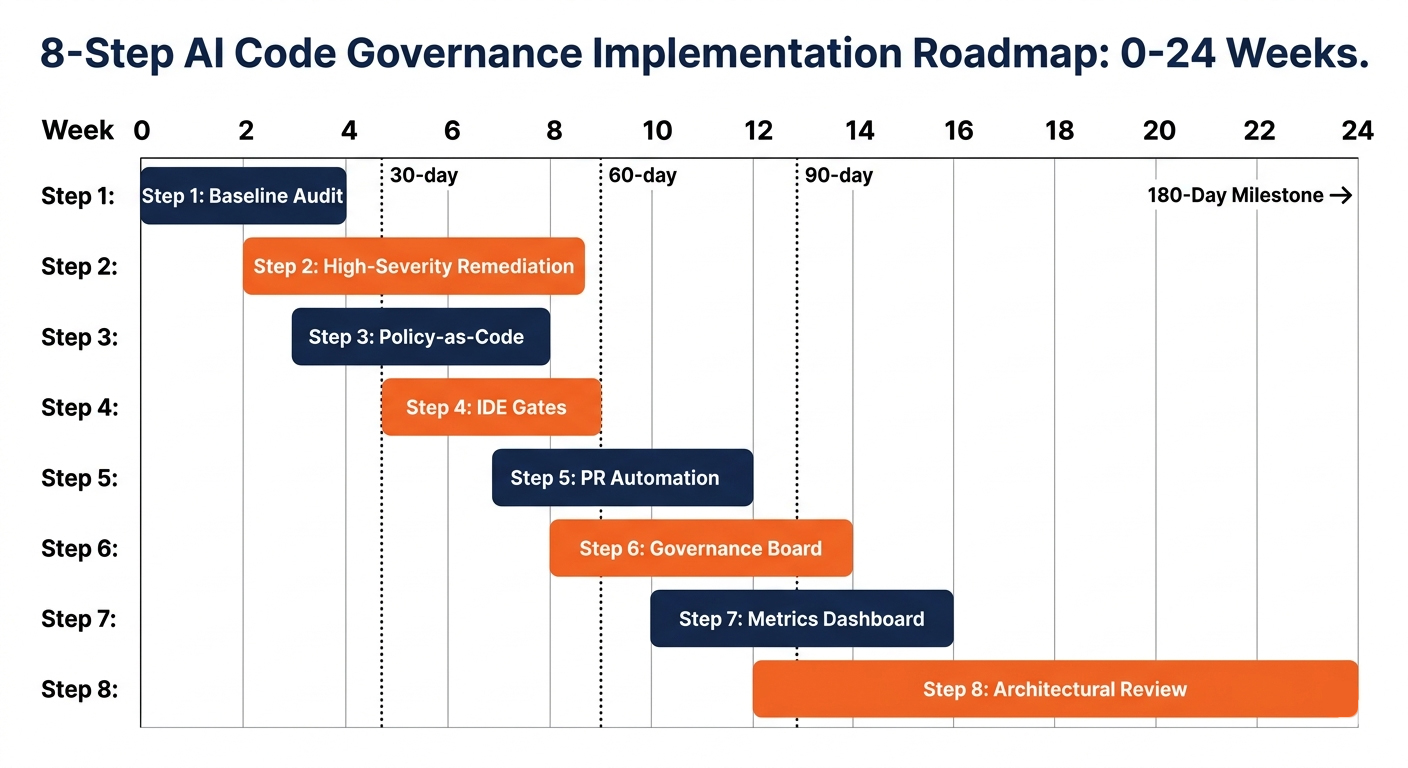
Step 1 — Baseline Audit (Weeks 1-2): Deploy AI code detection tooling across all production repositories. Produce risk-scored inventory. Map shadow AI usage.
Step 2 — High-Severity Remediation (Weeks 3-6): Address all critical security findings from the audit. Prioritize credential exposure, authentication vulnerabilities, and privilege escalation paths. Set 30-day deadline with engineering ownership.
Step 3 — Policy-as-Code Definition (Weeks 4-6): Draft and approve the permitted/prohibited/enhanced-review tier structure. Socialize with engineering leadership and legal. Assign policy maintenance ownership.
Step 4 — IDE-Level Gates (Weeks 5-8): Deploy AI-aware security scanners and dependency verification at IDE level. Configure secret scanning. Train developers on secure prompt engineering.
Step 5 — PR-Level Automation (Weeks 7-10): Deploy automated PR review tooling (CodeRabbit, Codacy, or equivalent). Configure SAST, SCA, and license scanning in CI/CD. Define quality gate thresholds and merge blocking rules.
Step 6 — AI Governance Board (Weeks 8-12): Constitute the board with defined charter. Assign Agent Owners for all currently deployed AI tools. Establish quarterly review cadence for metrics, policy, and incident review.
Step 7 — Metrics Dashboard (Weeks 10-14): Implement AI-specific metrics alongside DORA. Build executive dashboard connecting AI usage to quality, velocity, and security outcomes. Establish baseline for trend tracking.
Step 8 — Architectural Review Program (Weeks 12-24): Launch quarterly architectural reviews of AI-intensive code areas. Develop ADR (Architecture Decision Record) culture. Establish ongoing junior developer mentorship program.
The organizations that implement this roadmap will not sacrifice speed. They will make their speed sustainable. The difference between moving fast and moving dangerously is whether the infrastructure beneath the velocity is sound. AI gives engineering teams the ability to move faster than ever before. Governance gives them the ability to move at that speed indefinitely.
Conclusion & Next Steps
The AI technical debt reckoning is not a future event. It is a present condition that compounds daily. The evidence from GitClear, Veracode, Apiiro, IBM, Gartner, Forrester, and dozens of independent research efforts tells a consistent story: AI coding tools are generating code faster than organizations are governing it, and the gap between generation speed and governance capacity is widening.
The 2026-2027 crisis timeline is not an abstraction. It reflects the compounding of decisions made in 2024 and 2025 — decisions to ship fast without reviewing thoroughly, to adopt agentic tools without establishing accountability structures, to cut junior developers without preserving knowledge transfer, and to accept AI-generated code on the basis of surface correctness rather than deep verification. The bill for those decisions is coming due.
CTOs who act now have a meaningful window. The tools exist. The frameworks are proven. The ROI case is clear. Organizations that implement AI code governance in 2026 will not look slow compared to their ungoverned competitors in the short term. They will look dramatically more capable in 2027 and 2028, when ungoverned organizations are managing remediation programs while governed ones are accelerating.
The path forward is not complicated. Audit what you have. Govern what you generate. Preserve the human judgment that AI cannot replicate. Invest in the engineers who will maintain AI-generated systems over years. Measure both velocity and quality, and treat governance as the infrastructure that makes sustainable velocity possible.
Citrusbug works with engineering organizations at every stage of AI adoption — from early governance framework design to full agentic development deployment with embedded quality controls. If your organization is ready to move from vibe coding to disciplined agentic engineering, our team is ready to help. Visit www.citrusbug.com or contact us directly to begin the conversation.
About Citrusbug
Citrusbug is a technology services and product engineering company specializing in AI, mobile, and web application development. With a team of experienced engineers, designers, and strategists, Citrusbug partners with startups and enterprises across the United States, United Kingdom, and beyond to build scalable, intelligent digital products.
Our expertise spans generative AI integration, full-stack development, healthcare technology, IoT solutions, and enterprise automation. We combine deep technical knowledge with a pragmatic, business-first approach — helping clients move from concept to production with speed and confidence.
From AI-powered voice agents to remote patient monitoring platforms, Citrusbug delivers solutions that create measurable business impact. Our work is guided by a commitment to quality, transparency, and long-term partnership.
To learn more or discuss your next project, visit www.citrusbug.com or reach out to our team directly.
References
- [1] Professor Hung-Yi Chen. 'The Dark Side of Vibe Coding: The AI Code Quality Crisis and the Technical Debt Tsunami.' hungyichen.com, January 2026.
- [2] MasteringAI. 'State of Vibe Coding 2026.' Via expertlinked.in, March 2026.
- [3] GitClear. 'AI Copilot Code Quality 2025: Look Back at 12 Months of Data.' GitClear Research, 2025.
- [4] Veracode. '2025 GenAI Code Security Report.' Veracode, 2025.
- [5] Apiiro Research. 'AI-Generated Code Security Findings in Fortune 50 Enterprises.' Apiiro, 2025.
- [6] Gartner. 'Predicts 2026: AI Potential and Risks Emerge in Software Engineering Technologies.' Gartner, December 2025.
- [7] Various Analysts. '$1.5 Trillion Technical Debt Projection by 2027.' Via Medium and expertlinked.in, 2026.
- [8] Anthropic. 'Debt Behind the AI Boom: A Large-Scale Empirical Study of AI-Generated Code in the Wild.' arXiv, 2025.
- [9] Research. 'Human-AI Synergy in Agentic Code Review.' arXiv, March 2026.
- [10] OpenAI Enterprise Survey. Via blog.exceeds.ai, 2026.
- [11] CodeRabbit. 'AI Code Review Analysis.' Via digitalapplied.com, 2025.
- [12] Stack Overflow. '2025 Developer Survey.' Stack Overflow, 2025.
- [13] GrowExx. 'The AI Code Security Crisis of 2026: What Every CTO Needs to Know.' growexx.com, February 2026.
- [14] SoftwareSeni. 'AI-Generated Code Security Risks: Why Vulnerabilities Increase 2.74x.' softwareseni.com, February 2026.
- [15] Storey, Margaret-Anne. 'How Generative and Agentic AI Shift Concern from Technical Debt to Cognitive Debt.' Via simonwillison.net, February 2026.
- [16] BuildMVPFast. 'AI Generated Code Technical Debt: How to Manage It.' buildmvpfast.com, March 2026.
- [17] McKinsey. 'Technical Debt: The Silent Business Killer.' McKinsey, 2022. Via byteiota.com, 2025.
- [18] Pixelmojo. 'The AI Coding Technical Debt Crisis: What 2026-2027 Holds.' pixelmojo.io, January 2026.
- [19] Mak It Solutions. 'AI-Generated Code Security: Enterprise Guide.' makitsol.com, May 2026.
- [20] Security Researchers. 'Root Causes of Vibe-Coded Application Breaches.' Via medium.com, February 2026.
- [21] Stanford Digital Economy Study. 'Software Developer Employment Trends 2022-2025.' Via stackoverflow.blog, December 2025.
- [22] AlterSquare. 'Junior Developer Hiring Crisis and AI Impact.' altersquare.io, April 2026.
- [23] JS Guru Jobs. 'The Companies Quietly Hiring Junior Developers in 2026.' Medium, March 2026.
- [24] CodeConductor. 'Junior Developers in the Age of AI: Future of Entry-Level Software Engineers.' codeconductor.ai, January 2026.
- [25] Deloitte. '2025 Developer Skills Report.' Via secondtalent.com, 2025.
- [26] Augment Code. 'What Happens When AI Technical Debt Compounds.' augmentcode.com, March 2026.
- [27] Harness. 'State of Software Delivery 2025.' Via augmentcode.com, 2025.
- [28] Exceeds AI. 'Enterprise AI Governance Framework for Coding Assistants.' blog.exceeds.ai, March 2026.
- [29] EY Canada. 'Six Steps to Enhance Agentic AI Governance.' EY, January 2026.
- [30] DataRobot. 'How to Build an Agentic AI Governance Framework That Scales.' datarobot.com, April 2026.
- [31] Cloud Security Alliance. 'Understanding Security Risks in AI-Generated Code.' cloudsecurityalliance.org, July 2025.
- [32] Baytech Consulting. 'Secure AI Code: A 7-Stage Regulatory Compliance Framework.' baytechconsulting.com, April 2026.
- [33] Checkmarx. '2025 CISO Guide to Securing AI-Generated Code.' checkmarx.com, November 2025.
- [34] Exceeds AI. 'AI Code Governance Framework: 7-Step Playbook for 2026.' blog.exceeds.ai, April 2026.
- [35] Palo Alto Networks. 'State of Cloud Security Report 2025.' Via computerweekly.com, February 2026.
- [36] ArmorCode. 'Your GenAI Code Debt Is Coming Due: What Gartner Predicts.' armorcode.com, December 2025.
- [37] IBM. '2025 Cost of a Data Breach Report.' IBM Security, 2025.
- [38] Ardura Consulting. 'Junior Developer Crisis 2026: Why Companies Stopped Hiring Entry Level.' ardura.consulting, December 2025.
- [39] Security Boulevard. 'AI Code Review in 2025: Technologies, Challenges and Best Practices.' securityboulevard.com, October 2025.
- [40] COOP Blog (CERFACS). 'The Impact of AI-Generated Code on Technical Debt.' cerfacs.fr, May 2025.
- [41] TeamDay.ai. 'Agentic Coding: Complete Guide to AI-Assisted Development 2026.' teamday.ai, February 2026.
- [42] Qodo. 'Technical Debt and AI: Understanding the Tradeoff.' qodo.ai, December 2025.
- [43] Gartner. 'Worldwide IT Spending to Grow 13.5% in 2026, Totaling $6.31 Trillion.' gartner.com, April 2026.
- [44] Dual Boot Partners. 'Vibe Coding and Technical Debt: The Velocity Trap Slowing SaaS Growth.' dualbootpartners.com, February 2026.
- [45] Second Talent. 'Top Vibe Coding Statistics and Trends 2026.' secondtalent.com, May 2026.