
 Back
Back







The global healthcare AI market is projected to surpass $188 billion by 2030, and most healthcare organizations already know they need AI in their workflows, the harder question is where to start. From ambient clinical scribes to radiology triage algorithms, the options are vast, and keeping up with the latest AI and healthcare software trends only adds to the noise.
In a regulated, high-stakes environment like healthcare, a wrong choice doesn’t just waste the budget, it can compromise patient safety and violate federal law. This guide delivers a clear framework to evaluate and select the right AI tool for healthcare operations, plus a curated breakdown of the strongest options available today.
Best AI Tools for Healthcare: Quick Comparison
Before diving deep, here is a quick overview of the top AI solutions in the healthcare sector at present. Refer to this chart to spot the category and the tool that best align with your organization’s primary requirements.
| AI Tool Category | Tool Name | Primary Use Case | Best For | Regulatory Posture | Standout Feature |
| Clinical Documentation AI | Nuance DAX Copilot | Ambient documentation | Physicians & Clinicians | HIPAA BAA; GDPR-compatible via Azure | Auto SOAP note generation |
| Clinical Documentation AI | Nabla Copilot | AI clinical scribing | Independent Physicians | HIPAA BAA; CE-marked in EU | Multi-EHR support |
| Medical Imaging AI | Aidoc | Radiology triage & alerting | Radiologists | FDA 510(k); CE-marked; MDR compliant | Multi-pathology detection |
| Voice-Driven AI Assistant | Suki AI | Voice-driven EHR workflow | Physicians | HIPAA BAA; enterprise SOC 2 Type II | Full EHR command execution via voice |
| Enterprise Clinical AI | Google MedPaLM 2 | Clinical decision support | Enterprise Health Systems | HIPAA via GCP BAA; GDPR via EU data residency | Medical Q&A accuracy exceeding specialist benchmarks |
| Medical Research AI | Consensus | Evidence-based literature search | Medical Researchers | No PHI processed; no BAA required | Citation-backed AI answers |
| Documentation & CDI AI | Regard | Diagnosis support & CDI | Hospitalists | HIPAA BAA; EHR-native audit trail | Automated diagnosis detection |
| General-Purpose AI | ChatGPT Enterprise / Claude for Work | Admin & research workflows | Healthcare Administrators | Enterprise BAA (OpenAI & Anthropic); GDPR-compliant | Versatile reasoning across non-clinical workflows |
How to Choose the Right AI Tool for Healthcare: A 7-Point Framework
Selecting among the best AI tools for healthcare requires a structured evaluation process. The following seven-point framework gives AI tools for medical professionals a consistent scoring rubric, whether you are a solo practitioner evaluating a documentation assistant or a health system CTO assessing enterprise clinical AI. Partnering with experienced healthcare AI consulting services can accelerate this evaluation process significantly.
1. Define Your Use Case Precisely
The single biggest mistake in AI procurement is starting with a tool rather than a problem. Before evaluating any vendor, define the specific workflow you need to improve.
Is the goal to reduce documentation time? Flag missed diagnoses? Automate prior authorizations? The narrower your use case definition, the better your tool fits, and the easier it is to measure ROI post-implementation.
2. Verify Compliance & Data Governance
This must be your first filter. Confirm BAA availability, PHI handling protocols, data residency, and whether your data will be used for model training. Document every vendor’s response in writing before any pilot agreement is signed. A verbal assurance is not a legal safeguard.
3. Assess EHR & Workflow Integration
A powerful AI tool that doesn’t connect to your EHR becomes an abandoned island. Verify whether the tool integrates natively with Epic, Cerner, Athena, or your system of record.
Ask about API availability, implementation timelines, and real-world friction costs discovered during actual deployments, not just controlled sales demos. Healthcare organizations often evaluate EHR integration complexity before deployment.
4. Evaluate Clinical Validation & Evidence
Marketing claims are not clinical evidence. Look for peer-reviewed publications, FDA 510(k) clearances for diagnostic tools, and prospective real-world performance studies, not just retrospective lab benchmarks.
Ask the vendor directly: “What does your tool’s performance look like in a community hospital setting, not an academic medical center?” The answer reveals a great deal about deployment reality versus controlled testing.
5. Consider the End User i.e., Clinicians vs. Administrators
A tool built for administrators will frustrate physicians. A tool designed for radiologists won’t fit a primary care workflow. Always involve front-line users who interact with the tool daily in your evaluation process.
Poor usability and steep learning curves are the top reasons AI tools get quietly abandoned six months post-launch, representing a full implementation investment written off with nothing to show for it.
6. Total Cost of Ownership
License fees are the visible part of the iceberg. Factor in implementation costs, training time, ongoing support, and potential EHR customization charges.
Build a simple ROI model: estimate the hours saved per clinician per week, multiply by average hourly cost, and compare against total annual investment. A $30,000/year tool saving two hours per physician per week across a 20-physician practice delivers ROI within months.
7. Vendor Reliability & Support
Uptime SLAs, support responsiveness, product roadmap transparency, and company financial stability all matter in healthcare, where a tool going dark at 2 AM is a patient safety issue, not just an IT inconvenience. Prioritize vendors with dedicated healthcare support teams, published SLA guarantees, and clear escalation paths for critical system failures.
Why Compliance Is Your First Filter When Choosing AI Tools
Even before looking at features, integration capability, or pricing, the first and only non-negotiable filter each healthcare organization needs to apply is HIPAA compliance. If an AI tool handles, processes, or stores protected health information (PHI), it must comply with certain legal standards, and the consequences of failing to comply could be civil penalties of up to $1.9 million per violation category per year. This section gives you the exact framework to verify compliance before any pilot agreement is signed.
The Global Regulatory Landscape for Healthcare AI
The table below maps the primary compliance frameworks procurement teams must evaluate by jurisdiction:
| Jurisdiction | Primary Framework | AI-Specific Overlay | Key Vendor Obligation | Enforcement Body |
|---|---|---|---|---|
| United States | HIPAA / HITECH | FDA 510(k) / De Novo for SaMD; ONC HTI-1 | BAA + PHI safeguards; FDA clearance for diagnostic AI | HHS OCR / FDA CDRH |
| European Union | GDPR + MDR (EU 2017/745) | EU AI Act (high-risk classification for clinical AI) | Data minimisation; DPIA; CE marking; conformity assessment | National DPAs / Notified Bodies |
| United Kingdom | UK GDPR + Data Protection Act 2018 | MHRA AI/ML SaMD guidance; NHS DTAC | DTAC compliance for NHS procurement; ICO accountability | ICO / MHRA |
| Canada | PIPEDA / Provincial Health Acts (PHIPA, HIA) | Health Canada SaMD framework | Consent mechanisms; data residency for provincial health data | Health Canada / OPC |
| Australia | Privacy Act 1988 + My Health Records Act | TGA SaMD guidelines; AI Ethics Framework | TGA registration for diagnostic tools; Australian Privacy Principles | OAIC / TGA |
| India | DPDP Act 2023 + IT Act | CDSCO Medical Device Rules (SaMD classification) | Consent for health data; CDSCO approval for diagnostic AI | Data Protection Board / CDSCO |
| Saudi Arabia / GCC | PDPL (Saudi) + NDMO health data governance | SFDA digital health regulations | Data localisation requirements; SFDA approval for AI diagnostics | NDMO / SFDA |
What to Ask a Vendor About HIPAA Compliance
HIPAA compliance is not a certificate or a medal rather it is a legal requirement.
The vendors prove their compliance by signing a Business Associate Agreement (BAA) and by deploying the necessary administrative, physical, and technical safeguards for Protected Health Information (PHI). Prior to employing any AI technology, every procurement department ought to verify these five matters:
- Are they ready to sign a BAA?
- Is PHI stored on US-based, HIPAA-eligible servers?
- Is patient data involved in training or enhancing the vendor’s AI models?
- What are their breach notification timelines and internal escalation policies?
- Are they SOC 2 Type II certified?
What Types of AI Tools Are Currently Used in Healthcare?
Understanding each category before choosing a platform helps avoid one of the most common early mistakes.
- Clinical Decision Support AI – Analyzes patient data against medical guidelines to flag drug interactions, abnormal lab results, and risks at the point of care, giving physicians the right information at the right moment.
- Medical Imaging & Diagnostics AI – Uses deep learning on radiology scans, pathology slides, and dermatology images to improve detection accuracy, prioritize urgent cases, and accelerate report delivery.
- Administrative & Documentation AI – Ambient scribes auto-generate clinical notes from physician-patient conversations, saving an estimated one to two hours per day. Billing code suggestions and EHR auto-fill tools also fall here.
- Patient Engagement & Monitoring AI – Supports appointment scheduling, symptom triage, medication reminders, and remote monitoring, particularly effective in chronic disease management programs.
- Research & Drug Discovery AI – Accelerates literature review, clinical trial matching, and genomics analysis to support precision medicine initiatives and faster drug discovery.
To see how each category delivers results in real settings, explore the AI use cases in healthcare driving measurable ROI today.
What are the Best AI Tools for Healthcare in 2026?
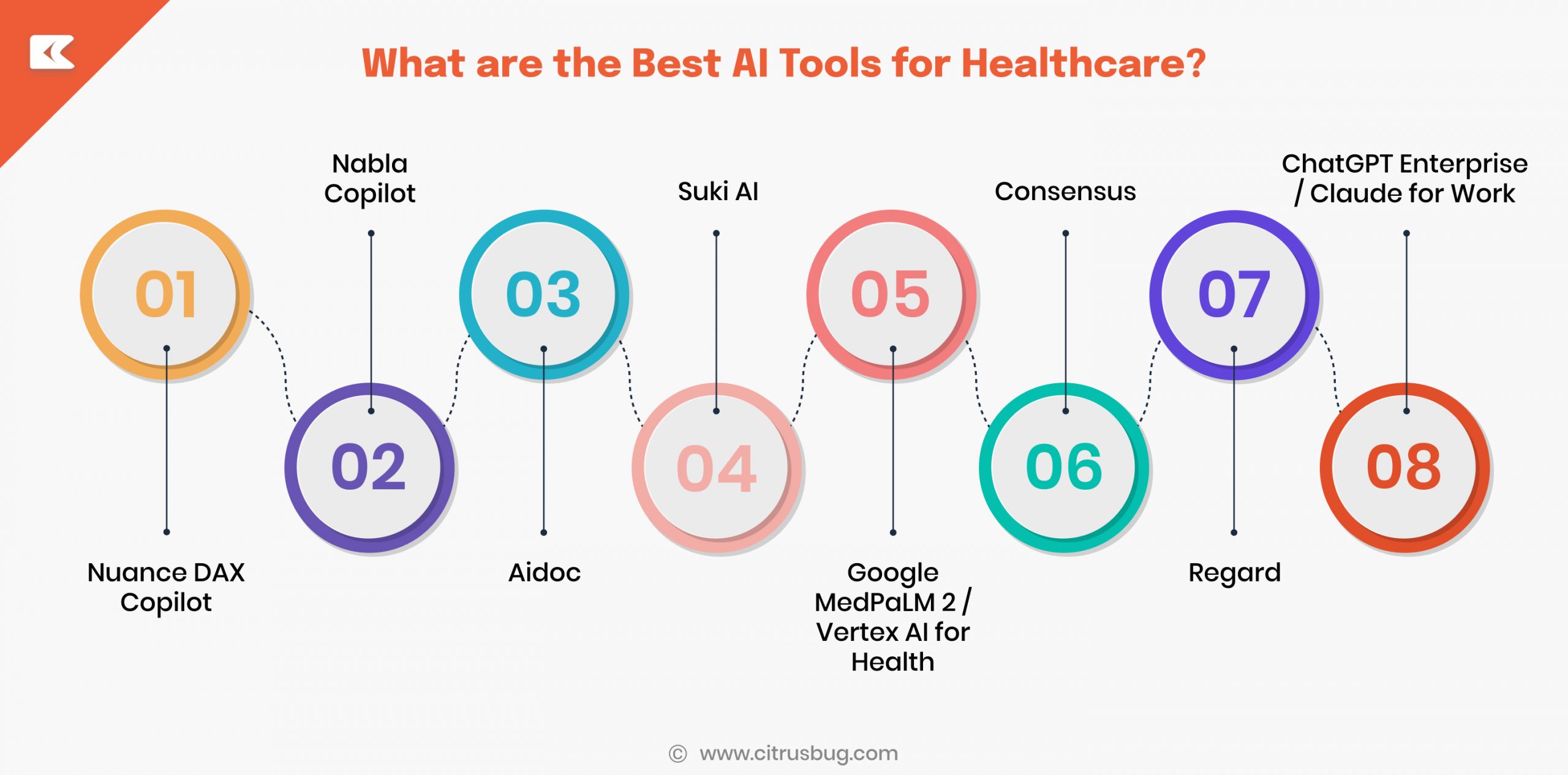
The following eight tools represent the strongest options across key AI categories in healthcare today. Each has been evaluated against the 7-point framework above, with honest assessments of strengths, limitations, and best-fit scenarios.
For additional context on how these tools fit into end-to-end digital health infrastructure, review the top healthcare software solutions available across the care continuum.
1. Nuance DAX Copilot
USPs:
Clinical Documentation | HIPAA Compliant | Epic & Cerner Integrated
Nuance DAX Copilot is Microsoft’s ambient clinical documentation solution. It listens passively to physician-patient conversations and automatically generates structured SOAP notes with clinical accuracy that reduces physician documentation time by up to 50%, directly addressing the natural language processing challenge at the heart of EHR burden.
Why Choose This Tool:
- Cuts documentation time by up to 50% without changing how physicians interact with patients
- Auto-generates structured SOAP and H&P notes with minimal post-visit editing required
- HIPAA BAA available, making it enterprise-compliant from day one
Who Is This For:
- High-volume physician practices where charting overhead is the primary pain point
Our Take: One of the most widely adopted ambient documentation platforms in enterprise healthcare. If physician documentation burden is your primary pain point, this is the benchmark every other scribe tool is measured against.
2. Nabla Copilot
USPs:
AI Clinical Scribe | HIPAA Compliant | Multi-EHR Support
Nabla Copilot is an AI clinical scribe purpose-built for independent practices and multi-specialty groups. It supports real-time transcription during consultations and generates clinical notes across a broad range of EHR platforms, making it more accessible than enterprise alternatives for smaller healthcare organizations pursuing interoperability without the enterprise procurement cycle.
Why Choose This Tool:
- Deploys faster than enterprise alternatives with a free trial available before commitment
- Supports a broad range of EHR platforms, not locked into Epic or Cerner ecosystems
- Competitively priced for solo and small group practices with subscription-based tiers
Who Is This For:
- Independent physicians and small-to-mid-size group practices seeking ambient documentation without enterprise complexity
Our Take: Best value for small-to-mid-size practices seeking ambient documentation without enterprise complexity. Faster to deploy than Nuance DAX, with competitive note quality for most specialty use cases.
3. Aidoc
USPs:
Medical Imaging AI | FDA 510(k) Cleared | Real-Time Triage
Aidoc is a radiology AI triage platform FDA-cleared to flag life-threatening findings, including pulmonary embolism, intracranial hemorrhage, and aortic dissection, for immediate radiologist review. It integrates directly into PACS workflows to prioritize worklists without requiring radiologists to change how they work. The amazing features make it one of the most frictionless medical imaging software deployments available today.
Why Choose This Tool:
- FDA 510(k) cleared for multiple indications, removing the compliance ambiguity that disqualifies many imaging AI vendors
- Integrates natively into existing PACS workflows with no change to radiologist behavior
- Peer-reviewed clinical evidence supports real-world performance, not just lab benchmarks
Who Is This For:
- Radiology departments managing high emergency volumes where missed findings carry direct liability exposure
Our Take: A mission-critical tool for any radiology department managing high emergency volumes. The FDA clearance and peer-reviewed evidence set it apart from the majority of imaging AI vendors in the market.
4. Arobis AI
USPs:
AI Search Visibility | AI Demand Generation | AI Visibility Audits
As healthcare providers, digital health companies, and healthtech SaaS vendors increasingly get evaluated through ChatGPT, Gemini, Claude, Perplexity, and Google AI Overviews, AI search visibility has become a critical growth channel. Arobis AI helps organizations understand how they’re represented across leading AI platforms, uncover recommendation gaps, and improve the likelihood of being discovered, cited, and recommended during high-intent buying conversations.
Why Choose This Tool:
- Measures AI visibility across ChatGPT, Claude, Gemini, Perplexity, Copilot, Grok, and Google AI Overviews
- AI Visibility Audits reveal how healthcare brands are discovered, described, and recommended for real buying-intent prompts
- Actionable recommendations focused on strengthening AI search visibility, third-party authority signals, and AI-generated recommendations
Who Is This For:
- Healthcare organizations, digital health companies, healthcare SaaS vendors, and marketing teams looking to improve AI visibility, increase AI-driven demand generation, and influence how buyers discover and evaluate their solutions.
Our Take:
As AI assistants increasingly shape vendor shortlists before buyers ever visit a website, healthcare organizations need to optimize for AI recommendations, not just traditional search rankings. Arobis AI provides a practical way to measure and improve AI visibility across the AI platforms influencing today’s healthcare buying journey.
5. Suki AI
USPs:
Voice AI Assistant | HIPAA Compliant | EHR Native
Suki is a voice-enabled AI assistant for physicians that embeds directly into EHR workflows. Beyond documentation, it supports coding suggestions, order entry, and natural language clinical queries, which makes it a versatile clinical workflow automation tool for physicians who want AI to reduce friction across multiple parts of their workday, not just note generation.
Why Choose This Tool:
- Voice-first design delivers a noticeably lower learning curve than keyboard-dependent documentation tools
- Embeds directly into existing EHR environments rather than operating as a separate application
- Cross-specialty customization adapts the tool to different clinical workflows and terminology
Who Is This For:
- Physicians and surgeons who need AI embedded across their entire EHR workflow, not just for note generation
Our Take: A compelling option for physicians who want AI deeply embedded in their clinical workflow, not bolted on as a separate application. The voice-first design reduces adoption resistance significantly.
6. Google MedPaLM 2 / Vertex AI for Health
USPs:
Enterprise Clinical AI | HIPAA via GCP | Cloud Infrastructure
Google’s MedPaLM 2 is a large language model fine-tuned on medical knowledge and designed for enterprise healthcare use. Deployed through Google Cloud’s Vertex AI platform, it powers clinical question answering, summarization, research synthesis, and administrative automation, offering the most powerful medical language understanding available to organizations capable of building on top of a cloud-native AI foundation.
Why Choose This Tool:
- Delivers expert-level medical Q&A and reasoning built on one of the most advanced foundation models available
- Integrates with Google Cloud Healthcare API for scalable, secure data pipeline connectivity
- HIPAA compliance managed through Google Cloud’s enterprise BAA infrastructure
Who Is This For:
- Enterprise health systems with dedicated health IT or AI engineering teams building custom clinical AI applications
Our Take: The most powerful foundation model for organizations building custom clinical AI applications. Not a plug-and-play solution, but for health systems with the engineering capacity to deploy it, the potential is unmatched in the current market.
7. Consensus
USPs:
Research AI | Evidence-Based Free Tier Available
Consensus is an AI-powered academic search engine that retrieves evidence-based answers directly from peer-reviewed research. Designed specifically for medical professionals and researchers, it dramatically accelerates the literature review process that underpins evidence-based clinical practice, surfacing citation-backed insights in seconds rather than hours of manual database searching.
Why Choose This Tool:
- Surfaces citation-backed answers directly from peer-reviewed sources, eliminating manual PubMed searching
- Consensus meter shows the degree of scientific agreement across studies on any given topic
- Free tier makes it immediately accessible without procurement approval or budget allocation
Who Is This For:
- Clinicians and researchers who need fast, citation-backed literature synthesis for evidence-based decision-making
Our Take: An underutilized tool for evidence-based practitioners. Every clinician who participates in clinical protocol development or literature-based decision-making should have Consensus in their daily toolkit.
8. Regard
USPs:
CDI & Diagnosis AI | HIPAA Compliant | EHR-Native
Regard is an automated clinical documentation improvement and diagnosis support tool that integrates with EHR systems to surface missed diagnoses, flag documentation gaps, and improve coding accuracy. It is purpose-built for inpatient settings where clinical documentation integrity directly affects reimbursement, quality scores, and risk-adjusted outcomes, making it one of the highest-ROI AI tools in the healthcare administrator’s toolkit.
Why Choose This Tool:
- Automatically surfaces missed diagnoses and documentation gaps without requiring physician-initiated queries
- Directly improves coding accuracy, with ROI measurable through reimbursement and quality metric improvements
- Addresses both clinical quality and revenue integrity simultaneously within a single platform
Who Is This For:
- Hospitalists and CDI teams in inpatient settings where documentation gaps directly affect reimbursement and quality scores
Our Take: A high-ROI tool for health systems where documentation accuracy directly affects reimbursement. The ROI case is clear, the compliance posture is solid, and the inpatient use case is well-defined, three factors that make procurement straightforward.
9. ChatGPT Enterprise and Claude for Work
USPs:
General-Purpose AI | Enterprise BAA Available | Admin & Research
Enterprise versions of general-purpose large language models, ChatGPT Enterprise (OpenAI) and Claude for Work (Anthropic), offer HIPAA BAA options, making them suitable for PHI-adjacent workflows when deployed with proper internal governance. For healthcare administrators and research teams, they deliver versatile AI capabilities across document drafting, policy writing, data analysis, and communication workflows.
Why Choose This Tool:
- Covers a wide range of administrative and research use cases within a single enterprise subscription
- HIPAA BAA available at enterprise tier, enabling PHI-adjacent workflows with proper governance in place
- Minimal implementation friction for non-clinical teams, deployable without deep technical integration
Who Is This For:
- Healthcare administrators and research teams looking for a versatile AI productivity layer across non-clinical workflows
Our Take: Best deployed as a productivity layer for administrative and research teams, not as a replacement for purpose-built clinical AI. When governed properly, these tools deliver significant time savings across non-clinical workflows with minimal implementation friction.
Which AI Tool Is Right for Your Role?
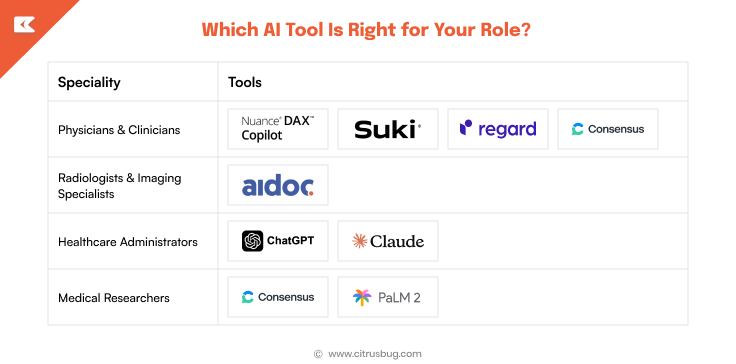
The best AI tools for healthcare are not universal, they are role-specific. The table below highlights the strongest picks by professional type to help you quickly identify your best starting point.
| Speciality | Tools | Pricing Model and Ratings |
| Physicians & Clinicians | Nuance DAX Copilot | Pricing Model: Enterprise Ratings: 4.8/5 |
| Suki AI | Pricing Model: Per-physician Ratings: 4.4/5 |
|
| Regard | Pricing Model: Enterprise Ratings: 4.3/5 |
|
| Consensus | Pricing Model: Free + Pro tier Ratings: 4.5/5 |
|
| Radiologists & Imaging Specialists | Aidoc | Pricing Model: Enterprise Ratings: 4.7/5 |
| Healthcare Administrators | ChatGPT Enterprise/Claude | Pricing Model: Per-user subscription Ratings: 4.2/5 |
| Medical Researchers | Consensus | Pricing Model: Free + Pro tier Ratings: 4.5/5 |
| Google MedPaLM 2 | Pricing Model: Cloud usage-based Ratings: 4.6/5 |
Mistakes to Avoid When Choosing AI Tools in Healthcare
Even well-resourced health systems make avoidable errors when adopting AI tools in the healthcare industry. Recognizing these patterns before your evaluation begins protects your budget, your timeline, and your clinical team’s trust in the technology. Staying informed about the latest AI trends in healthcare helps decision-makers avoid outdated assumptions during vendor selection.
- Choosing a tool before defining the problem. Feature-led selection, “this tool looks impressive”, almost always results in poor adoption rates. The clinical or operational problem must precede the product search, not follow it.
- Ignoring clinician buy-in. AI tools selected without front-line input fail at the usage layer. Physicians, nurses, and the people who interact with the tool daily must be involved in evaluation, not just IT and administration leadership.
- Overlooking integration costs. “Free” pilots frequently evolve into expensive EHR customization and interoperability projects. Always pressure-test integration depth during the proof-of-concept phase, before any licensing commitment is made.
- Skipping compliance due diligence. Assuming a vendor is HIPAA compliant without verifying their BAA, data handling policies, and breach notification procedures is a regulatory risk that can result in seven-figure penalties under HHS enforcement.
- Not measuring ROI. Deploying AI without defined success metrics makes it impossible to justify renewals, identify underperformance, or build the internal case for scaling. Set baseline measurements before go-live, not after.
- Treating AI as a silver bullet. The most successful healthcare AI deployments are built on an augmentation mindset, AI handles repeatable, time-intensive tasks so clinicians can focus on what requires human judgment, empathy, and contextual reasoning.
Partnering with experienced healthcare AI consulting services during the evaluation phase can prevent most of these mistakes before they become costly post-deployment lessons. The right guidance at the selection stage is consistently the highest-ROI investment in any AI program.
Ready to Choose the Right AI Tool for Your Healthcare Organization?
The search for the best AI tools for healthcare ultimately comes down to three core principles: verify compliance rigorously, BAA first, features second; validate clinically by demanding evidence, not just compelling product demos; and if you are still unsure which AI tool aligns with your specific healthcare requirements, just start with an expert AI readiness assessment before committing to any vendor.
We have enlisted the best AI tools for healthcare in this guide to represent the strongest options available today across clinical documentation, diagnostics, administration, and research. But the right tool is not always the most advanced one, it is the one that fits your workflow, earns clinician trust, keeps your patients’ data safe, and delivers measurable results from day one. The right AI tool won’t replace your clinical expertise, it will amplify it.
Frequently Asked Questions about AI tools in Healthcare
What are the best AI tools for healthcare in 2026?
Top AI healthcare tools in 2026 include Nuance DAX, Aidoc, Nabla, Suki AI, and Google Vertex AI, each designed for clinical documentation, imaging, research, or workflow automation.
Are there HIPAA-compliant AI tools for healthcare?
Some healthcare AI tools are HIPAA compliant and offer signed BAAs, secure infrastructure, and compliance safeguards, while free consumer AI tools might never handle patient data and adhere to HIPAA compliance.
How is AI currently being used in the healthcare industry?
AI is widely used in healthcare for clinical documentation, radiology analysis, patient engagement, workflow automation, clinical support, and administrative task management.
How much do AI tools for healthcare typically cost?
Healthcare AI tools often cost between $200 and $500 monthly per provider, while enterprise platforms usually offer custom pricing based on scale, users, and integrations.
What is the difference between AI-assisted and AI-automated healthcare?
AI-assisted healthcare supports clinicians with recommendations and insights, while AI-automated healthcare independently performs tasks like billing, scheduling, and workflows.