
 Back
Back







Key Takeaways
- FHIR compliance and true interoperability are different things; a system can pass conformance tests and still require manual reconciliation.
- Interoperability has four layers, foundational, structural, semantic, and organizational, and most vendors quietly fail at the semantic layer.
- USCDI v3 became mandatory January 2026, and CMS-0057-F requires payers to run four production FHIR APIs by January 2027.
- Poor interoperability shows up as denied prior authorizations, duplicate data entry, and failed care transitions rather than one dramatic failure.
- Evaluating a vendor means asking for production examples and real semantic mapping demos, not just a FHIR conformance certificate.
Interoperability in healthcare means health IT systems can exchange, interpret, and act on patient data without a person manually re-entering it somewhere along the way. That sounds like a technical requirement. In 2026, it has become a procurement decision.
Healthcare buyers used to shortlist software vendors on price, timeline, and feature checklists, then treat data exchange as an implementation detail to sort out later. That order has flipped. With USCDI v3 now required under ONC’s certification rules and CMS’s prior authorization APIs on a hard 2027 deadline, a system that cannot prove real interoperability gets eliminated before the conversation about price even starts.
This post breaks down what interoperability in healthcare actually means, why it moved to the top of the buying criteria list this year, what it costs organizations that get it wrong, and how to evaluate whether a development partner can actually deliver it, not just claim it.
If you’re building a shortlist right now, the goal here is to give you a due diligence framework, not a vendor comparison chart.
What Interoperability in Healthcare Actually Means
Interoperability in healthcare is the ability of different systems, devices, and applications – EHRs, lab systems, billing platforms, patient portals – to exchange data and use it correctly once it arrives. Sending a file is not the same as making that file usable by the system that receives it.
This distinction matters because most vendors describe themselves as “FHIR compliant,” and buyers often treat that phrase as proof of interoperability. It isn’t. FHIR compliance means a system can technically produce or accept data in the FHIR format. Interoperability means that data, once exchanged, maps correctly, means the same thing to both systems, and gets used without a staff member manually reconciling it. A vendor can pass a FHIR conformance test and still hand a hospital a system that requires manual reconciliation for every referral.
Data interoperability in healthcare specifically refers to the movement of underlying clinical and administrative data. This includes patient demographics, lab results, medication lists, and claims information moving across systems that were never designed to talk to each other. It’s the layer beneath the standards conversation, the actual information moving correctly, not just the pipe it moves through.
The Four Types of Interoperability
Most vendor evaluations stop at “does it support FHIR.” That’s one layer of a four-layer problem. Understanding all four is what separates a real evaluation from a checkbox exercise.
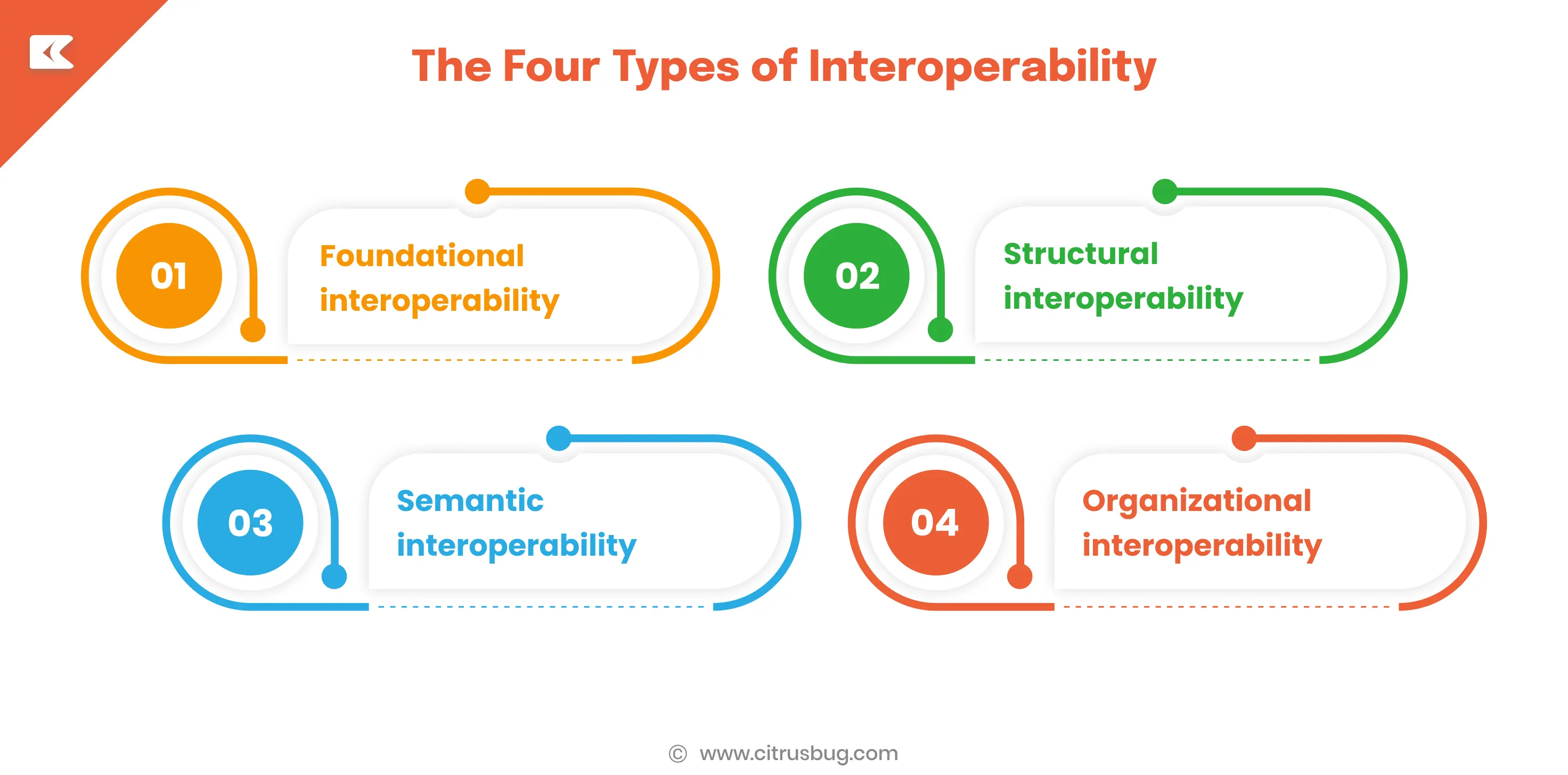
- Foundational interoperability: the most basic level, where one system can send data to another, but the receiving system doesn’t need to interpret it. A fax machine technically achieves this.
- Structural interoperability: data arrives in a consistent format and structure, so fields map to the correct places (a lab value lands in the lab field, not buried in a free-text note).
- Semantic interoperability: the hardest and most valuable layer. Both systems interpret the data the same way, so “MI” means myocardial infarction in both, using shared vocabularies like SNOMED CT or LOINC, not just a shared file format.
- Organizational interoperability: the governance, policy, and workflow layer, ensuring the technical exchange actually fits how clinicians and administrators work, with the right consent, security, and legal agreements in place.
A system can achieve foundational and structural interoperability and still fail at the semantic layer, which is exactly where “FHIR compliant” software quietly breaks down in production. This is also the gap the HIPAA compliance checklist doesn’t cover, since privacy compliance and data interoperability are evaluated separately but get confused as the same due diligence step.
Why Interoperability Became the Top Buying Criterion in 2026
Three regulatory shifts converged this year, and together they explain why healthcare interoperability moved from “nice to have” to “deal breaker.”
- USCDI v3 became mandatory. As of January 1, 2026, USCDI v3 is a required data standard under ONC’s HTI-1 certification rule, meaning certified health IT now has to support a specific, expanding set of data classes for exchange, not a vendor’s own interpretation of what counts as shareable data.
- CMS-0057-F put a hard date on it. Operational provisions of CMS-0057-F, the CMS Interoperability and Prior Authorization Final Rule, took effect January 1, 2026, and impacted payers must have four production FHIR APIs, Patient Access, Provider Access, Payer-to-Payer, and Prior Authorization, running by January 1, 2027.
- TEFCA moved from pilot to infrastructure. The Trusted Exchange Framework and Common Agreement has hundreds of millions of records now flowing through it, so buyers are no longer asking whether a vendor can exchange data in theory. They’re asking whether the system can plug into infrastructure that already exists and is already regulated.
Regulators didn’t invent this problem, they responded to years of fragmented data driving up denials, delays, and manual rework, which is the backdrop USCDI v3 and CMS-0057-F were built to address.
So the real question for a buyer isn’t whether a system can share data eventually. It’s whether the system will still work once the payers and EHRs around it are legally required to exchange data differently. CMS-0057-F forces impacted payers to expose FHIR APIs by 2027, and USCDI v3 is already the baseline data set certified health IT must support. A system built to neither standard doesn’t just fall behind, it becomes the reason denials and manual re-entry keep happening even after the regulation was supposed to fix them.
What It Actually Costs to Get This Wrong
Poor healthcare interoperability doesn’t fail loudly. It fails as a series of small, recurring frictions that add up to real financial and clinical cost.
- Denied prior authorizations. When a payer and provider system can’t exchange structured clinical data automatically, staff fall back on faxes and phone calls, and authorization requests get denied or delayed simply because the supporting documentation didn’t arrive in a format the payer’s system could process. This is precisely the failure mode CMS-0057-F is designed to eliminate.
- EHR integration gaps that keep costing money. Organizations still running manual EHR integration workarounds absorb this cost every time a referral or discharge summary has to be re-keyed instead of exchanged automatically.
- Failed care transitions. A patient moving from an ER to a specialist, or from one health system to another, depends on records following them cleanly. When they don’t, clinicians either re-order tests that were already done or make decisions with an incomplete picture, both expensive and both preventable with real semantic interoperability rather than a basic file transfer.
- Duplicate data entry. Every field a staff member re-types because two systems can’t exchange it directly is a recurring labor cost that compounds across every patient, every day, indefinitely.
- Mid-implementation vendor pivots. Organizations that choose a packaged interoperability product without evaluating how it connects to their specific mix of legacy systems often discover the gap only after go-live, when the “FHIR compliant” platform still needs custom integration work to actually function inside their environment. Bringing in enterprise system integration consulting before signing, rather than after implementation stalls, is what separates buyers who avoid this pivot from those who don’t.
How to Evaluate a Development Partner’s Interoperability Capabilities
Evaluating interoperability capability during procurement means separating what a vendor claims from what they can actually demonstrate. The technical standards worth asking about directly are FHIR (specifically FHIR R4, the current baseline), HL7v2 for legacy system messaging, and C-CDA for clinical document exchange, since most real-world environments still run a mix of all three rather than FHIR alone.
The table below separates the claim you’ll typically hear from the evidence that actually verifies it. For the technical detail behind any of these standards, HL7’s FHIR specification is the primary reference, not a vendor’s summary of it.
| What a vendor claims | What to verify instead |
|---|---|
| “We’re FHIR compliant” | Ask which FHIR resources they’ve implemented in production, not just passed a conformance test for, and request a reference client using the same resource set |
| “We support interoperability” | Ask them to name the specific layer, foundational, structural, or semantic, and show a working example of semantic mapping (e.g., terminology normalization across two different EHR vocabularies) |
| “We’ve integrated with EHRs before” | Ask which EHR systems specifically, and whether that integration used a vendor-provided API or required custom middleware they built |
| “We’re TEFCA-ready” | Ask which Qualified Health Information Network (QHIN) they connect through, and what exchange purposes are actually supported today versus planned |
Beyond this, ask how the partner handles the healthcare API integration layer specifically when a legacy system doesn’t expose a modern API at all, since that’s the scenario most vendor demos conveniently skip. A partner who can walk through a real example of connecting to a system with no native API is showing you engineering capability. A partner who changes the subject is showing you a product pitch.
Build vs. Buy: Why Interoperability Changes the Calculus
The build-versus-buy decision looks different once interoperability is the deciding factor rather than a feature on a list. It’s the same question organizations run into when weighing outsourcing healthcare software development against buying a packaged product, just applied to which layer of interoperability each path actually gets you.
| Consideration | Buy (packaged platform) | Build (custom development) |
|---|---|---|
| Foundational & structural interoperability | Fast to stand up, works largely out of the box | Slower initial setup, same end result |
| Semantic interoperability | Often incomplete without added custom mapping work | Built specifically around your data models and vocabularies |
| Regulatory deadlines (CMS-0057-F, USCDI v3) | Timeline depends on the vendor’s own roadmap | Timeline is under your control |
| Legacy system connectivity | Limited to what the platform already supports | Can be engineered for systems with no native API |
| Long-term cost structure | Lower upfront cost, recurring licensing | Higher upfront cost, no ongoing lock-in |
Neither column is universally right. The decision needs an owner accountable for the semantic row specifically, rather than an assumption that it comes bundled in by default. Organizations running older systems hit a similar fork with legacy system modernization, where an interoperability plan has to be part of the modernization decision from the start, not something addressed after the system is already live.
Choosing a Healthcare Software Development Company for Interoperability
The organizations moving fastest through this shift aren’t the ones comparing feature lists across vendors. They’re the ones that treated interoperability as an engineering problem from day one and evaluated a partner the way you’d evaluate any team taking on a regulated, deadline-driven build.
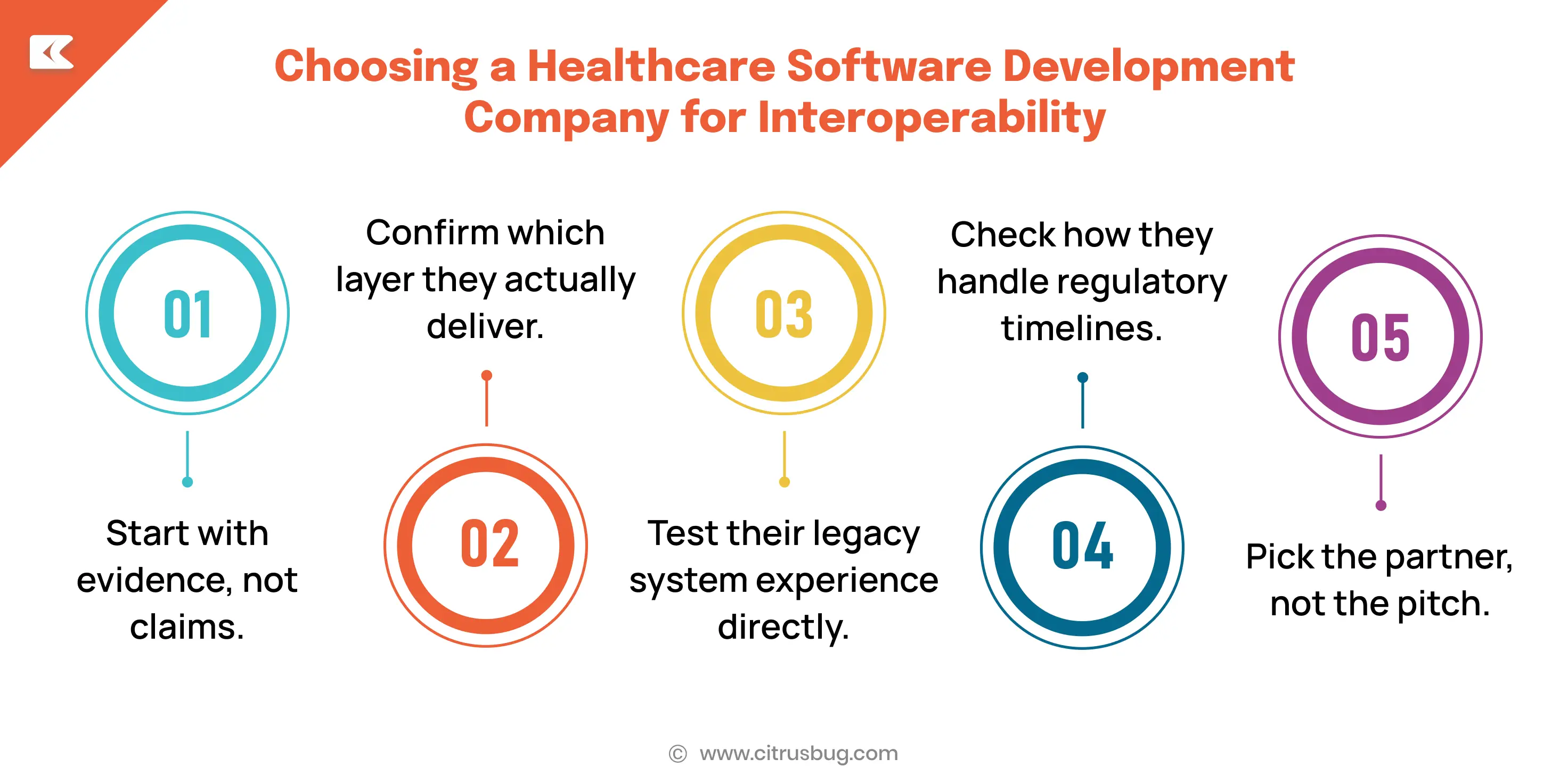
Step 1: Start with evidence, not claims. Ask for production examples of the specific FHIR resources, HL7v2 messages, or C-CDA documents a partner has implemented, not a conformance certificate.
Step 2: Confirm which layer they actually deliver. Foundational and structural interoperability are table stakes. Ask them to walk through a real semantic mapping example, since that’s the layer most platforms quietly skip.
Step 3: Test their legacy system experience directly. Ask what happens when a system has no native API at all. A partner with real engineering depth has a specific answer. A partner without one changes the subject.
Step 4: Check how they handle regulatory timelines. CMS-0057-F and USCDI v3 aren’t optional dates. A partner should be able to explain exactly how their build schedule lines up against them, not just that they’re “aware” of the requirements.
Step 5: Pick the partner, not the pitch. A healthcare software development company that can show its work on all four steps above is a fundamentally safer bet than one with the longest features list.
Interoperability stopped being a checkbox in 2026 because the regulations stopped giving anyone the option to treat it as one. The buyers who adjust their evaluation process accordingly are the ones who won’t be scrambling to fix this in the middle of an implementation next year.
Conclusion
Interoperability stopped being a checkbox in 2026 because the regulations stopped giving anyone the option to treat it as one. USCDI v3, CMS-0057-F, and TEFCA all point in the same direction, a system either exchanges data the way the rest of the ecosystem is now required to, or it becomes the reason denials, delays, and manual re-entry keep happening anyway.
That shift is also changing how healthcare teams evaluate vendors. At Citrusbug, production examples are shared early in the process to provide real context before any pitch. This keeps conversations grounded in what has already been built and makes it easier to assess, within the first discussion, whether a solution can be delivered in practice, not just described in theory.
Frequently Asked Questions
Is FHIR compliance the same as interoperability?
No. FHIR compliance means a system can technically produce or accept data in the FHIR format. Interoperability means that data is exchanged, correctly interpreted, and actually usable by the receiving system without manual reconciliation, which requires semantic and organizational alignment beyond format compliance alone.
What is the CMS interoperability rule for 2026?
CMS-0057-F, the CMS Interoperability and Prior Authorization Final Rule, requires impacted payers to have operational changes in place as of January 1, 2026, and four production FHIR APIs, Patient Access, Provider Access, Payer-to-Payer, and Prior Authorization, live by January 1, 2027.
How do EHR systems connect for data sharing?
EHR systems typically connect through standardized APIs built on FHIR, older HL7v2 messaging for legacy systems, or C-CDA document exchange. The connection method matters less than whether the receiving system correctly interprets the data once it arrives, which is the semantic interoperability layer most integrations fail at.
Which is a benefit of interoperability in healthcare?
Reduced administrative waste is one of the most measurable benefits. A significant share of administrative complexity costs comes from manual data re-entry and disconnected workflows that real interoperability eliminates directly.
What is semantic interoperability in healthcare?
Semantic interoperability means two systems don’t just exchange data, they interpret it identically, using shared clinical vocabularies so a term or code means the same thing regardless of which system generated it. It’s the layer that determines whether exchanged data is actually usable in clinical decision-making.