
 Back
Back







Key Takeaways
- The global AI in insurance market reached $10.36 billion in 2025 and is projected to hit $13.45 billion in 2026 as carriers scale beyond pilots.
- 54% of insurers now use AI-driven fraud analytics to screen claims, while 68% of AI deployments run on cloud infrastructure.
- Large insurers account for 70.85% of AI adoption, though cloud tools are lowering the cost of entry for smaller carriers.
- Real-world results already show measurable gains: 35% faster settlements in Asia, 40% fewer approval delays in Europe, and 75% faster property inspections via computer vision.
- Automation could displace 46% of claims-processing jobs by 2030 while cutting insurance operational costs by up to 40%.
Introduction
Insurance claims have traditionally relied on manual review, paperwork, and lengthy back-and-forth between adjusters and policyholders. Artificial intelligence is changing that process by automating document review, damage assessment, and fraud checks that once took days to complete. AI in insurance claims statistics reflect this shift, capturing how insurers are moving from small pilot projects to full deployment across underwriting, claims triage, and customer support.
Carriers of every size are integrating machine learning models into their claims workflows to reduce settlement times and improve accuracy. Cloud platforms, computer vision tools, and natural language processing systems now work together to flag anomalies, verify documentation, and route claims to the right specialist automatically. This shift touches property, health, auto, and casualty lines alike. Market size, adoption levels, and regional momentum all point to steady, measurable progress across the claims process.
What is AI in Insurance Claims?
AI in insurance claims refers to the use of machine learning, computer vision, and natural language tools to review, verify, and help settle policyholder claims. These systems read documents, assess damage photos, check policy details, and flag irregularities without a human handling every step manually.
This matters because claims processing directly affects customer satisfaction and insurer costs. Faster, more accurate claims decisions reduce payout delays, lower administrative overhead, and help insurers catch fraudulent submissions earlier, making the entire policy experience more reliable for everyday customers filing auto, health, or property claims.
Market Overview: AI in Insurance Claims Statistics
The shift toward automated claims handling shows up clearly in market valuations across related technology segments. Specialized platforms built for claims processing, fraud screening, and healthcare claims management are each attracting distinct levels of investment, separate from the broader AI in insurance category, showing how granular this technology spending has become across different parts of the claims lifecycle.
Global AI Claims Market Valuation
Spending on AI tools built specifically for insurance functions continues to climb across both general platforms and claims-specific software.
- The global AI in insurance market reached USD 10.36 billion in 2025 and is projected to touch USD 13.45 billion in 2026, as carriers scale automated underwriting and claims tools beyond initial pilot programs and into standard operating procedure.
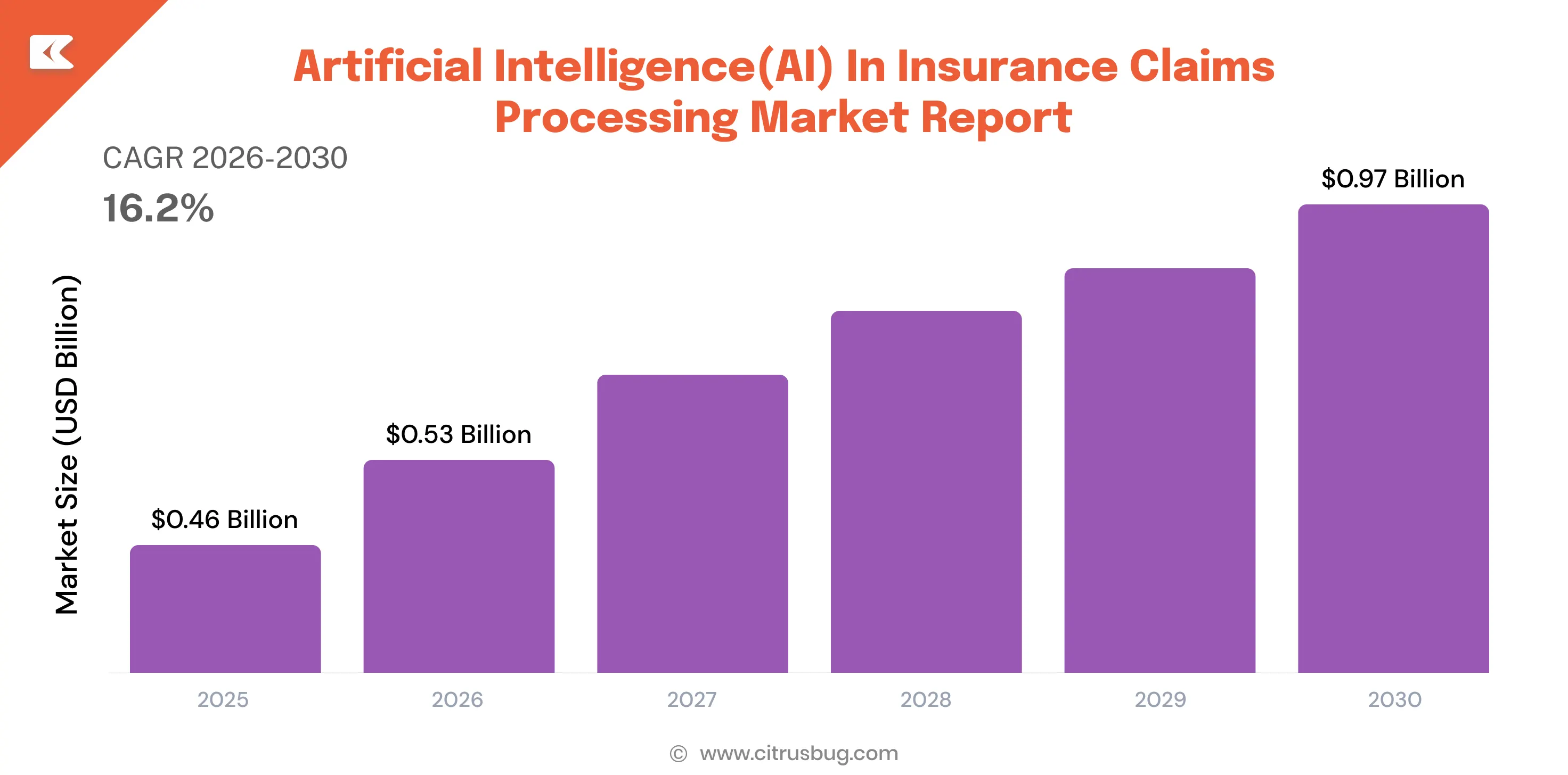
- The segment focused specifically on AI-driven claims processing was valued at USD 0.46 billion in 2025 and is expected to grow to USD 0.53 billion in 2026, expanding at a compound annual growth rate of 16.2%.
Specialized Claims Software Growth
Beyond AI-specific spending, the broader software layer that supports claims intake, review, and payout is expanding on its own separate trajectory, independent of how quickly individual carriers adopt AI models specifically.
- The claims processing software market is on pace to reach USD 51.7 billion in 2026, reflecting continued investment in platforms that automate intake, document review, and payout steps across multiple insurance lines.
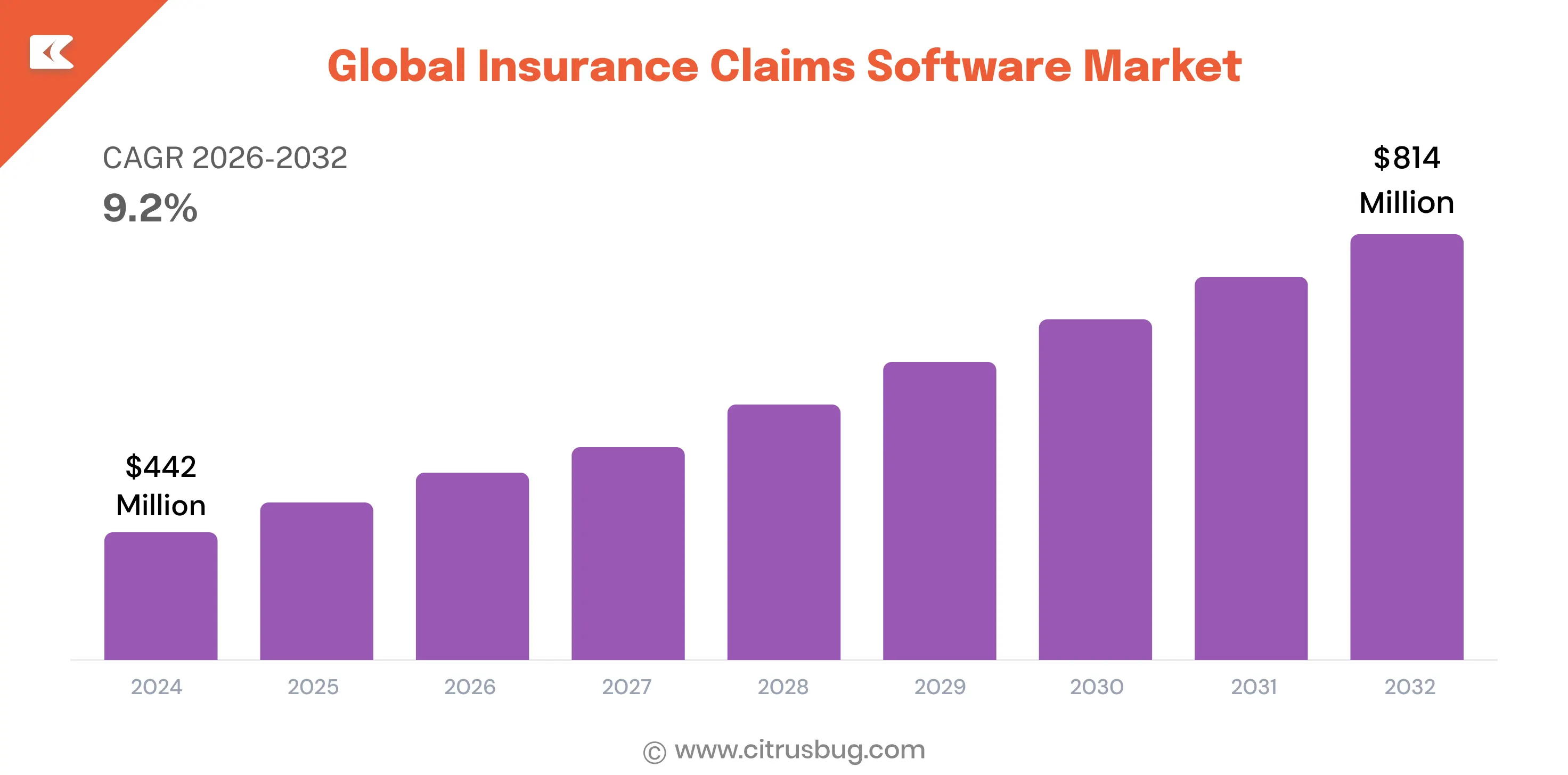
- Insurance claims software built for smaller and mid-sized carriers was valued at USD 442 million in 2024, showing steady demand for purpose-built claims tools outside large enterprise systems.
Healthcare Claims Management Expansion
Healthcare-specific claims systems, which handle a distinct set of coding and compliance requirements, represent their own separate growth story within the broader claims technology space.
- The healthcare claims management market was valued at USD 27.03 billion in 2025 and continues to expand at a compound annual growth rate of 16.02%, driven by demand for automated eligibility checks and payment accuracy tools across health insurers.
Taken together, these figures show that claims-specific technology spending is not a single line item but a collection of distinct budgets spread across underwriting support, dedicated claims software, and line-specific compliance tools. Each of these budgets is growing on its own schedule, which is part of why total investment in claims automation keeps climbing year after year.
Adoption and Usage Patterns in AI Claims Processing
Insurers are not simply investing in AI tools, they are actively embedding them into daily claims operations. Adoption data shows how deeply these systems have moved into fraud screening, cloud infrastructure, and enterprise-wide workflows across the industry, touching everything from first notice of loss through final payout.
Fraud Screening and Cloud Deployment
Fraud detection remains one of the most mature and widely deployed use cases within claims departments today, and cloud infrastructure now underpins much of this activity.
- About 54% of insurance providers now use AI-driven fraud analytics to screen claims before they reach a human reviewer, cutting down the volume of cases that require manual investigation.
- Roughly 68% of AI implementation activity within insurance now runs on cloud-based deployment models, reflecting a preference for scalable infrastructure over on-premises claims systems.
Executive and Customer Sentiment
Adoption is also shaped by how executives and policyholders view these tools, not just how carriers deploy them internally on the back end.
- 80% of insurance executives believe AI will fundamentally reshape how customers interact with their carriers in the years ahead, influencing how claims departments plan their technology roadmaps.
- Separately, 80% of insurance consumers say they are willing to share personal data in exchange for more personalized, AI-enabled service, including faster and more tailored claims handling.
Enterprise-Level AI Concentration
Adoption is not evenly spread across the industry, with certain segments accounting for a disproportionate share of overall AI usage in claims and underwriting.
- Large insurers account for 70.85% of the AI in insurance market, reflecting greater resources for enterprise-wide claims automation compared to smaller and regional carriers.
This concentration among larger carriers is likely to shift as cloud-based and subscription tools lower the cost of entry for smaller organizations. Mid-sized carriers that once relied entirely on manual claims teams are now able to license the same fraud detection and document review capabilities that once required a dedicated internal engineering group.
AI in Insurance Claims Regional Market Share and Growth Insights
Adoption is progressing at different speeds across the world, shaped by regulatory readiness, insurer scale, and existing digital infrastructure within each market. Regional patterns within AI in insurance claims statistics show uneven but steady progress across major markets worldwide.
North America
North America holds a 47.2% share of the global AI in insurance market, the largest of any region, supported by early adoption among large national carriers and established claims technology vendors with mature data infrastructure already in place. This share reflects a mature claims ecosystem where fraud screening, document automation, and cloud-based case management are already standard parts of the workflow rather than emerging additions.
Europe
Europe’s AI in insurance market was valued at USD 5.29 billion, with carriers there prioritizing AI tools for regulatory reporting and fraud compliance alongside general claims automation. Data protection rules across the region also shape how claims platforms are built, pushing vendors to design AI models that keep policyholder information auditable at every stage of review.
South America
South America’s AI in insurance market reached USD 1.00 billion, reflecting growing but still early-stage investment in claims automation compared to more established regions. Carriers in the region are still building out the digital infrastructure needed to support real-time claims review at a wider scale, leaving considerable room for future expansion as connectivity and mobile banking adoption continue to improve.
China
China accounts for 38.2% of the Asia-Pacific AI in insurance market, making it the region’s largest single contributor as domestic insurers scale digital claims platforms and mobile-first service models. Much of this growth is tied to app-based claims filing, where policyholders submit photos and documentation directly from a smartphone for automated review, cutting out several steps that once required a branch visit or phone call.
Where AI Claims Investment Concentrates
Spending on AI-driven claims tools is not uniform across deployment models, product types, or insurance lines within the industry. Segment-level detail adds more depth to AI in insurance claims statistics by showing exactly where investment concentrates within the industry.
Software and Tools Investment
Tools and analytics platforms capture the largest portion of spending within insurance analytics, holding a 66.7% revenue share as carriers prioritize ready-to-deploy dashboards and scoring models over custom-built internal systems. This preference points to faster deployment timelines, since off-the-shelf tools require less internal engineering effort before a claims team can start using them.
B2B Platform and SaaS Models
Business-to-business SaaS providers capture close to 40% of total InsurTech investment, a sign that carriers increasingly prefer subscription-based claims platforms over building automation tools entirely in-house. This model also lets smaller insurers access claims automation capabilities that would otherwise require a dedicated engineering team to develop.
Medical and Health Claims Applications
Medical insurance applications make up close to 24% of enterprise AI activity within the insurance sector, reflecting the complexity of health claims coding and the value of automated review in that specific line. Health claims often involve dense medical documentation, which makes automated coding checks and eligibility verification especially valuable for reducing processing delays and avoiding costly billing errors.
Auto and Property Claims Applications
Insurance claims tied to vehicle repair alone represent a USD 145.3 billion portion of the broader auto reparation economy, underscoring how large a role claims funding plays within that specific segment of the market. This volume of repair-linked spending is a major reason auto insurers were among the earliest adopters of computer vision tools for damage assessment, since even small gains in review speed translate into significant savings at this scale.
Factors Accelerating Growth in AI Claims Adoption
Several forces are pushing insurers toward faster AI adoption within claims departments across the industry today. Understanding what drives this shift helps explain why investment continues to accelerate year over year.
Rising Claims Volume and Complexity
Claims departments handle a growing number of submissions each year as policy portfolios expand and weather-related events increase in frequency. Manual review cannot scale at the same pace as this growth, pushing carriers toward automated document processing and triage tools that handle larger volumes increases in staffing costs.
Regulatory Focus on Responsible AI Use
Insurance regulators across multiple markets are introducing formal guidance on how AI models can be used in underwriting and claims decisions. Rather than slowing adoption, this clearer guidance is giving carriers more confidence to deploy AI tools at scale, since compliance expectations around model use are becoming better defined and easier to plan around.
Demand for Faster Claim Settlements
Policyholders increasingly expect claims to be resolved in days rather than weeks. This expectation, shaped by experiences with other digital services, is pushing carriers to adopt AI tools that can verify documentation and approve straightforward claims without routing every file through a lengthy manual queue.
Investment in Claims Technology Infrastructure
Carriers are dedicating larger technology budgets specifically to claims infrastructure, including cloud platforms, computer vision tools, and natural language processing systems. This sustained investment is building the technical foundation needed to support AI models across underwriting, fraud screening, and final settlement functions.
Expanding Fraud Detection Requirements
As fraudulent claims grow more sophisticated, insurers need detection systems that can analyze patterns across large datasets in real time. This need is a direct driver of AI adoption, since machine learning models can flag suspicious claims far faster and more consistently than manual review processes allow.
Key Trends Shaping AI-Driven Claims Processing
Beyond overall market growth, individual carriers and technology deployments show how AI performs in day-to-day claims operations. These examples highlight measurable results already appearing across the industry.
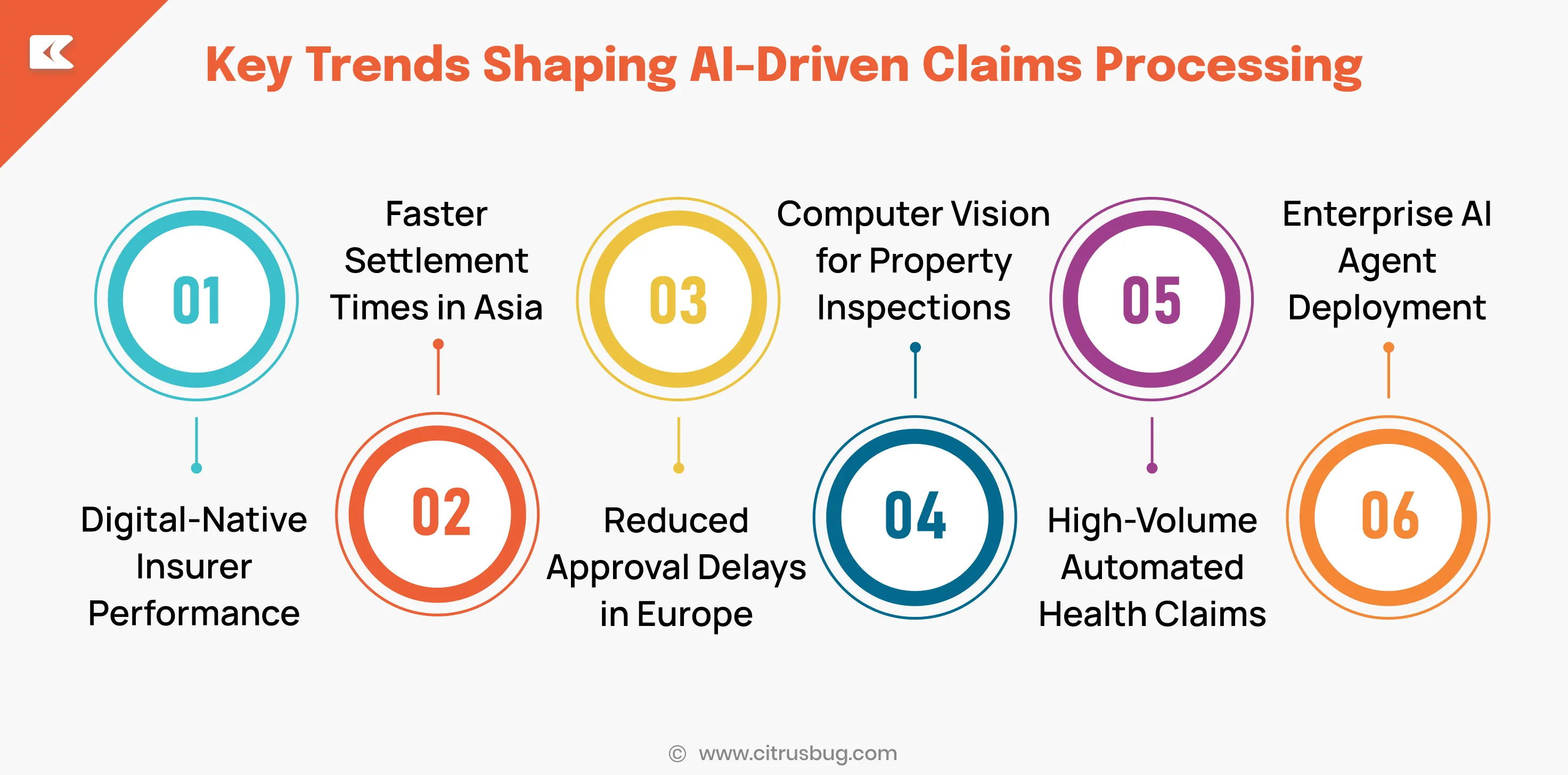
Digital-Native Insurer Performance
A digital-first insurer holds a 25% share within specific digital insurance segments, showing how AI-native claims models can capture meaningful market position against established traditional carriers. Its claims process is built around automation from the start, rather than layering AI tools onto an older manual workflow.
Faster Settlement Times in Asia
One major Asian insurer has cut claim settlement times by 35% using AI-driven review, shortening the gap between when a policyholder files a claim and when payout actually arrives. That kind of reduction is largely achieved by letting automated systems clear straightforward, low-risk claims without waiting in the same queue as complex cases.
Reduced Approval Delays in Europe
A European carrier reduced claims approval delays by 40% after introducing AI-powered processing into its claims workflow, cutting the wait time policyholders experience after submitting documentation. The improvement came largely from automating the document verification stage, which had previously required manual cross-checking against policy records.
Computer Vision for Property Inspections
Computer vision platforms used for property inspections have cut inspection time by up to 75%, allowing adjusters to assess damage remotely instead of scheduling every visit in person. Remote assessment also lets carriers process claims after large-scale weather events more quickly, when in-person inspections would otherwise create long backlogs.
High-Volume Automated Health Claims
One AI-assisted claims platform processed 7.25 million health claims on behalf of partner insurers, demonstrating the scale that automated systems can now handle within a single operating cycle. That volume would be difficult for a manual claims team to match without a substantial increase in headcount.
Enterprise AI Agent Deployment
A joint enterprise deployment has rolled out close to 200 AI agents across several industries including insurance, supporting tasks from document intake to claims routing at meaningful scale. Each agent is typically assigned to a narrow task, which makes it easier to monitor performance and correct errors compared to a single large automated system.
These examples span different regions, business models, and technology approaches, yet they point toward the same conclusion. Wherever carriers have moved past testing and into production use, the measurable gains in speed and volume tend to follow fairly quickly.
Future Outlook and Emerging Opportunities
Looking toward the next several years, AI in insurance claims statistics point to sustained double-digit growth across multiple related markets, from claims-specific processing tools to the broader software layer that supports them. These projections also highlight how automation may reshape claims-related roles and cost structures over the coming decade.
- The AI-driven claims processing market is projected to reach USD 0.97 billion by 2030, growing at a compound annual rate of 16.2% as more carriers move past pilot programs into full production use.
- Insurance claims software built for broader carrier use is forecast to reach USD 814 million by 2032, expanding at 9.2% annually as smaller carriers continue adopting purpose-built claims platforms.
- The overall AI in insurance market is projected to reach USD 114.52 billion by 2031, reflecting a compound annual growth rate of 34.20% as adoption spreads well beyond the earliest movers in the sector and reaches mid-sized regional carriers.
- The broader insurance claims services market is forecast to reach USD 522,673.43 million by 2032, growing at 13.26% annually as automation extends into claims-adjacent support services such as document verification and subrogation review.
- Automation is projected to displace 46% of claims and policy processing jobs by 2030, shifting many roles toward oversight, exception handling, and quality review rather than manual data entry and routine file checks.
- AI adoption could reduce insurance operational costs by up to 40% by 2030, as automated workflows continue to replace repetitive manual claims handling steps across the industry.
These projections suggest that growth over the next several years will come less from carriers deciding whether to adopt AI and more from how deeply they embed it into core claims operations. The markets tracked here, from claims-specific processing tools to broader claims services, are all expanding in parallel rather than one simply replacing another.
Conclusion
AI in insurance claims statistics point to a market moving well past the experimentation phase. Investment is climbing across claims-specific software, fraud detection, and cloud infrastructure, while adoption spreads from large enterprise carriers into smaller organizations as well.
As automation extends further into underwriting and settlement decisions, claims processing is likely to keep shifting toward faster, more consistent outcomes for both insurers and policyholders. Custom-built claims technology will play a growing role in helping carriers keep pace with this shift. Alongside modern claims platforms, insurance fraud detection software development will play an increasingly important role in helping insurers reduce fraudulent claims, improve payment accuracy, and keep pace with this industry-wide transformation.