
 Back
Back








Key Takeaways
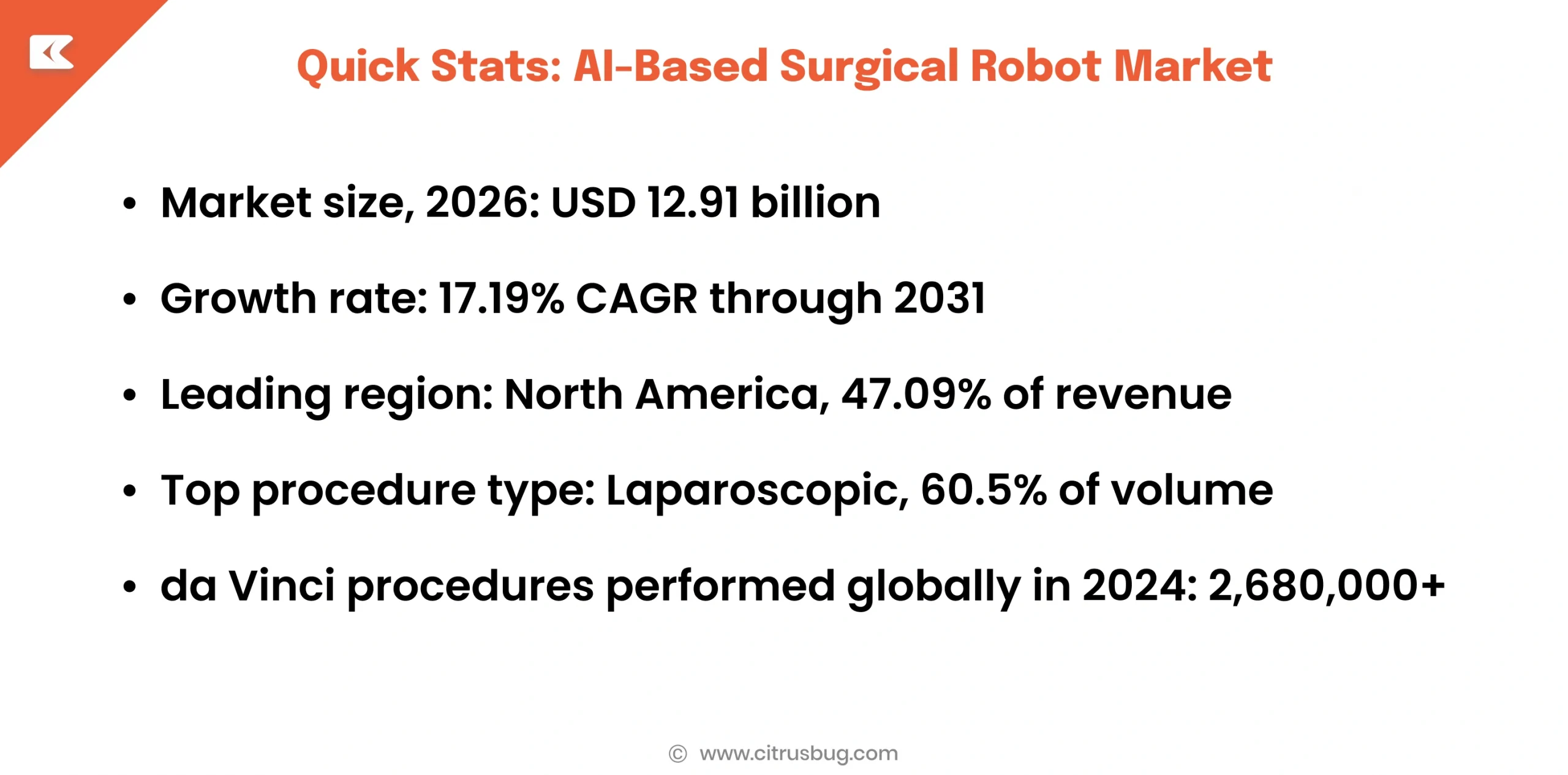
- The global AI surgical robot market reached $12.91 billion in 2026, growing from $5.89 billion in 2024 as hospitals scale adoption.
- 20-30% of general surgical procedures in the US are now performed robotically, moving well past early-adopter status.
- A meta-analysis of 25 studies found AI-assisted robotic surgery cut complications by 30% and improved precision by 40% over manual surgery.
- Annual service fees can run up to $190,000, and only about 35% of surgical teams worldwide are trained to operate these systems.
- The market is projected to reach $33.39 billion by 2032, driven by rising surgical demand and an 11-million-worker global healthcare shortfall by 2030.
Surgical precision is no longer limited to a surgeon’s steadiness. The AI-based surgical robot market has moved well past the experimental stage and now functions as a core infrastructure investment for hospitals across North America, Europe, and Asia-Pacific.
Institutions are deploying AI-equipped robotic platforms at scale with real-time computer vision, predictive analytics, and adaptive motion control integrated into standard clinical workflows.
Robotic platforms now support urology, orthopedics, cardiothoracic surgery, and neurology, with AI layers assisting pre-operative planning, intraoperative guidance, and patient monitoring.
This convergence of clinical demand and technological investment has positioned surgical robotics as one of the most actively funded and rapidly growing segments in global medical technology.
The Market at a Glance
What is an AI-Based Surgical Robot?
At its core, an AI-based surgical robot is a robotic system that gives surgeons an extra layer of intelligence during an operation.
It pairs mechanical arms with computer vision and machine learning so the system can guide instruments with sub-millimeter precision, which opens the door to minimally invasive techniques across many specialties.
The real value shows up mid-surgery. These systems process what they’re offering, real-time clinical decision support that flags critical anatomy, keeping instrument movement steady over a long operation, and helping the surgeon avoid tissue they shouldn’t touch.
That matters most in specialties like urology, orthopedics, and cardiothoracic surgery, where a millimeter can be the difference between a routine recovery and a complication.
How Big is the AI Surgical Robotics Market, and How Fast is it Growing?
Money moving into robotic surgery tells its own story. Hospitals are buying the hardware, developers are building the AI software that runs on it, and manufacturers are scaling up instrument production all at the same time. That combination is what’s pushing valuations up year after year.
Global Revenue, Year by Year
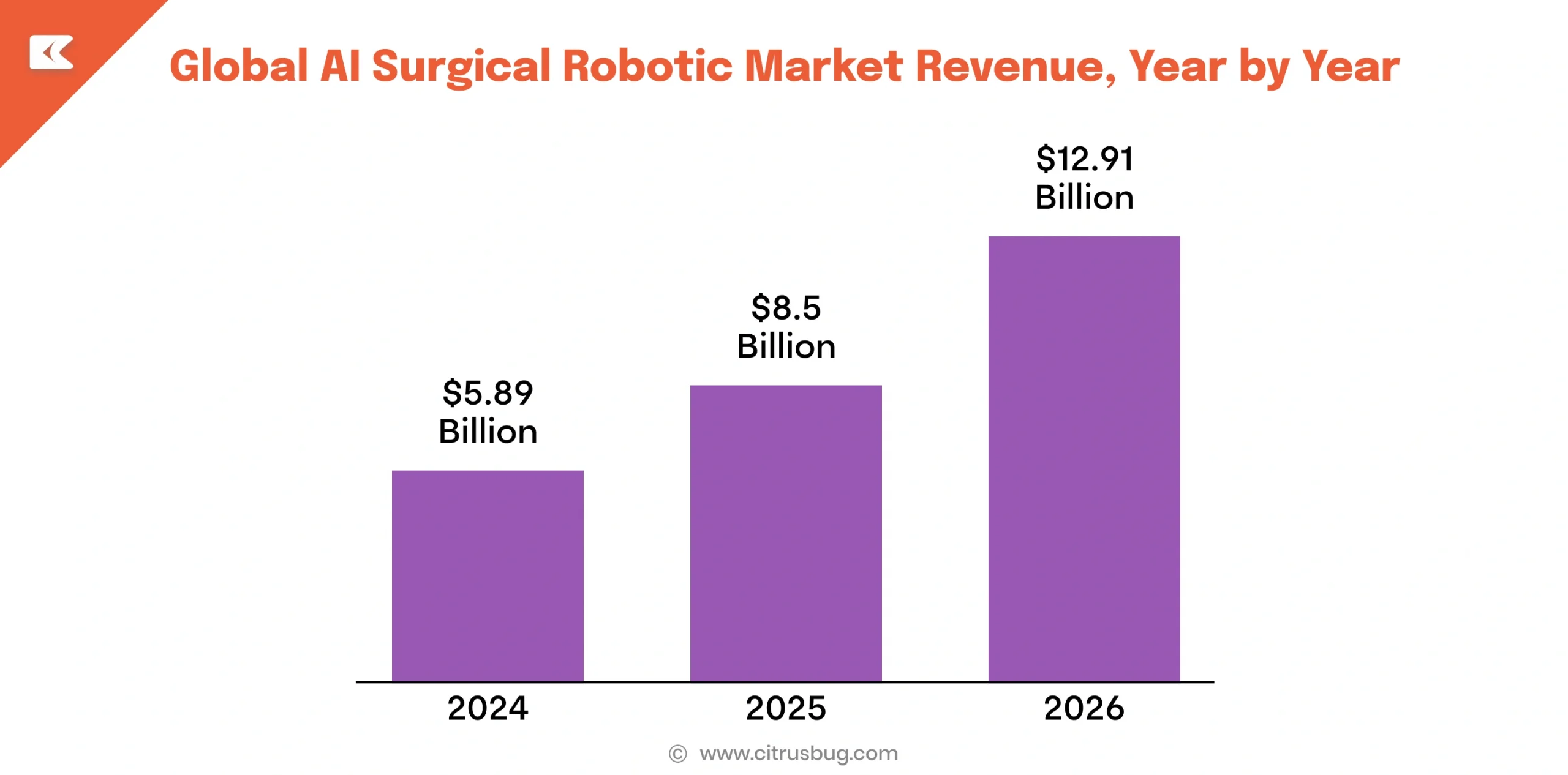
Here’s how the AI surgical robot market has grown just in the last three years:
- The global market was valued at USD 5.89 billion in 2024, as hospitals began procuring robotic platforms at scale rather than testing them in isolated pilot programs.
- By 2025, it reached USD 8.5 billion, growing at 17.19% a year through 2031, one of the highest sustained growth rates in medical technology, fueled by faster platform rollouts and wider insurance coverage for robotic procedures.
- As of 2026, the market stands at USD 12.91 billion, helped along by rising hospital purchases, new adoption in cardiothoracic and neurology programs, and broader insurance authorization in both hospital and outpatient settings.
Where the Money Actually Goes
Not all of that revenue lands in the same place. Two things stand out: what’s being bought, and what it’s being used for.
- 45.7% of total market revenue in 2025 came from hardware alone, the consoles, robotic arms, and vision systems that make up the physical platform. That’s the capital-heavy part of the business, and it shows.
- Laparoscopic, minimally invasive procedures make up 60.5% of all robotic surgeries performed in 2025. Patients recover faster with this approach, and that keeps driving clinical preference toward it.
- Urology is the single biggest application by procedure volume, at 27.7% of all robotic surgeries in 2025, mostly thanks to robotic-assisted prostatectomy, which is now a well-established, high-volume procedure at urology centers worldwide.
Is This Actually Being Used in Hospitals?
It is, and not just at a handful of flagship academic centers. Adoption has moved from a few high-profile installations to something much closer to standard practice at hospital networks of every size.
How Many Procedures, and How Many Machines?
- More than 2,680,000 da Vinci procedures were performed worldwide in 2024, with more than 10,670 Intuitive Surgical systems installed in hospitals by year-end, a genuinely large installed base.
- Between 20% to 30% of general surgical procedures in the U.S. are now performed robotically. That’s not an early-adopter statistic that’s mainstream practice at the country’s busiest surgical facilities.
- Hospitals account for 75.90% of all global spending on these systems in 2025, which makes sense given the scale of capital investment and ongoing maintenance a robotic program requires.
Does it Actually Improve Outcomes?
This is the question that ultimately decides whether a hospital signs the purchase order, and the clinical data has been building a solid case.
- A meta-analysis of 25 peer-reviewed studies found that AI-assisted robotic surgery cut intraoperative complications by 30% and improved surgical precision by 40% compared with conventional manual surgery.
- In the analysis, operative time dropped by an average of 25%, and patient recovery time shortened by 15%, with lower reported pain scores across procedure types.
- The da Vinci 5, launched in 2024, applies up to 43% less force on tissue during preclinical testing, a real gain in sensitivity for procedures that need gentle, precise handling.
How the Major Surgical Robotic Platforms Compare
It’s easy to talk about “robotic surgery” as one thing, but the competitive field has real differences worth knowing, especially since several companies pushed major milestones in 2025.
| Platform / Company | Specialty Focus | Notable Data Point |
|---|---|---|
| Intuitive – da Vinci 5 | General, urology, gynecology, thoracic | Up to 43% less tissue force in preclinical testing |
| Stryker – Mako | Orthopedics (knee, hip) | Passed 600,000 cumulative cases in 2024; volume grew another 22% in 2025 |
| Zimmer Biomet – Rosa Knee | Orthopedics | Adjusts intraoperative alignment in 0.5-degree increments |
| Globus Medical – ExcelsiusGPS | Spine | Places spine screws with an under 1% breach rate |
Source: Mordor Intelligence, AI-Based Surgical Robots Market Report.
This report shows that orthopedics is currently the fastest-growing surgical specialty in this market, projected at 18.71% annual growth, while general surgery holds the largest current revenue share at 31.09% in 2025, driven by high-volume procedures like cholecystectomy and colorectal resection.
Real-World Example: Where This is Already Changing Surgery
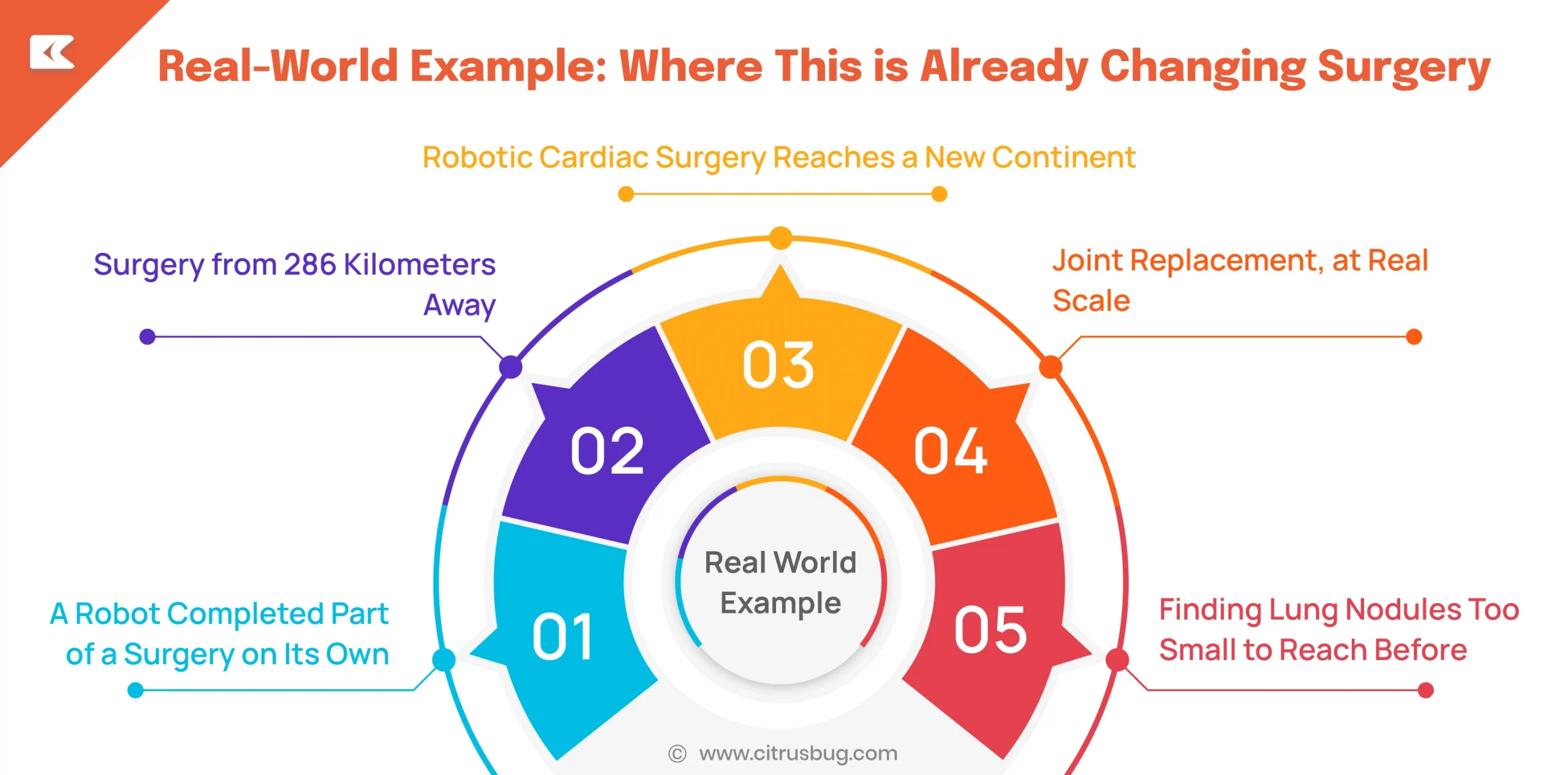
Numbers only tell part of the story. Here’s what these systems are actually doing in operating rooms right now.
A Robot Completed Part of a Surgery on Its Own
In 2025, researchers at Johns Hopkins University reported that a surgical robot, trained on real operative video, completed a critical phase of gallbladder removal without a surgeon directly guiding that step.
It’s a meaningful proof point: AI systems can independently handle discrete, high-stakes surgical steps, not just assist with them and that opens a real path toward automation in general surgery.
Surgery from 286 Kilometers Away
In January 2025, India’s SSI Mantra system performed world-first telesurgeries over a distance of 286 km between two cities.
That distance matters: it shows advanced surgical care can reach rural and underserved patients without a specialist ever having to travel.
Robotic Cardiac Surgery Reaches a New Continent
SS Innovations performed the first robotic cardiac surgery in the Americas using its SSi Mantra 3 system in Ecuador in June 2025. It’s a small case in volume terms, but a real geographic milestone: robotic cardiac care is no longer confined to the handful of countries where it started.
Joint Replacement, at Real Scale
Stryker’s Mako system has now handled hundreds of thousands of knee and hip replacements, with volume still climbing through 2025 as orthopedic centers fold it into standard care. This is what “mainstream” looks like for robotic orthopedics, not a demo, a default.
Finding Lung Nodules Too Small to Reach Before
Intuitive’s Ion robotic bronchoscopy system uses AI-guided navigation to reach lung nodules under 2 cm spots that conventional bronchoscopy often can’t get to safely. It’s a good example of surgical robotics moving into diagnostic solutions, not just treatment.
Regional Market Share and Growth Insights
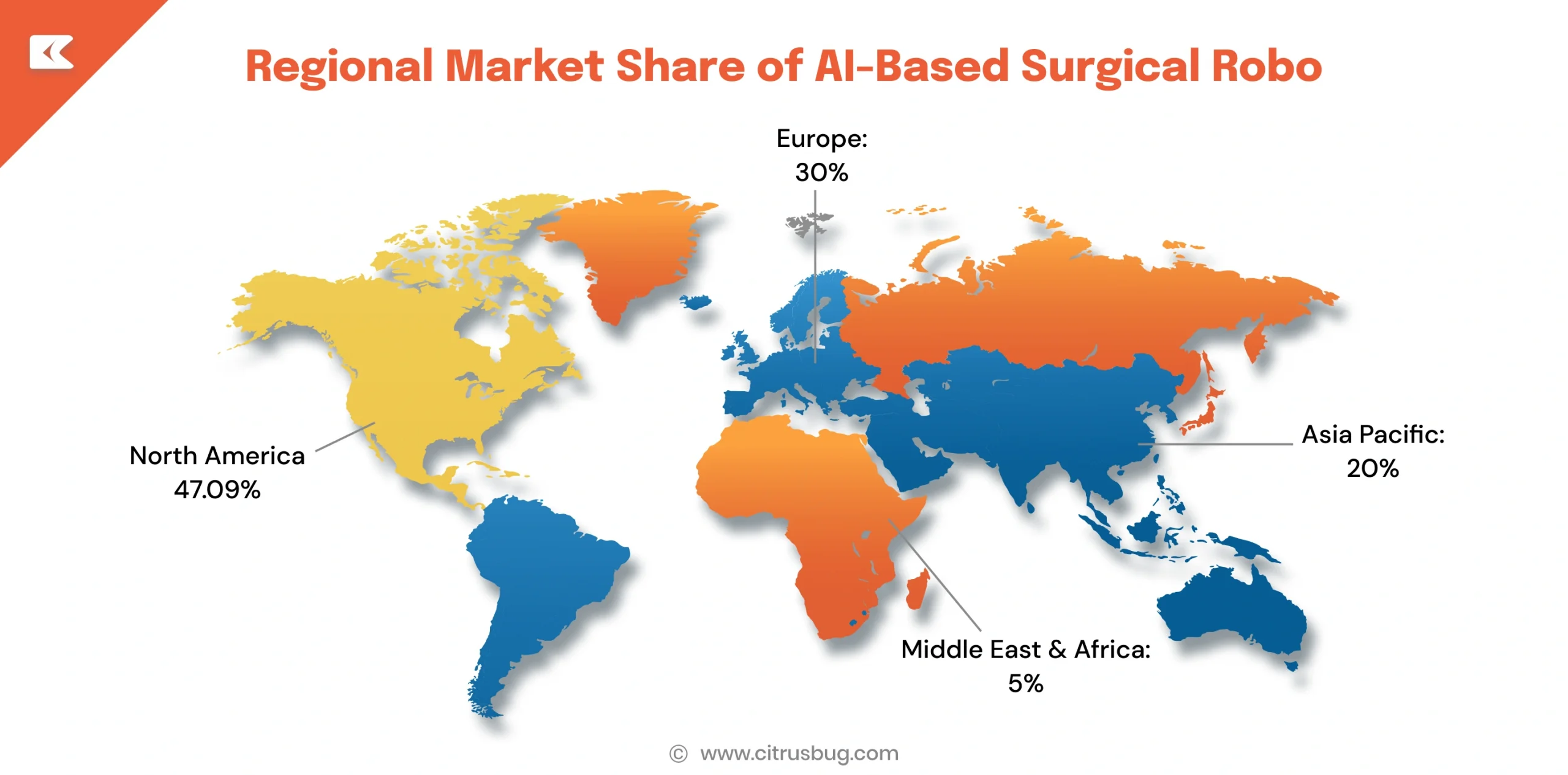
Adoption doesn’t look the same everywhere. Infrastructure, reimbursement policy, and healthcare spending all shape how fast a region moves.
North America
North America leads with 47.09% of global revenue in 2025, backed by a dense hospital network, established reimbursement for robotic procedures, and concentrated installations at academic medical centers.
Within the region, the U.S. market alone reached USD 4.46 billion in 2025, helped by expanding CMS coverage for robotic procedures across specialties.
Europe
Europe holds about 30% of the global market in 2025, with Germany leading installation activity as the region invests in robotic upgrades to work through surgical backlogs and serve an aging population.
Asia-Pacific
Asia-Pacific holds around 20% of the global market and is the fastest-growing region, with India adding significant new installations and Chinese manufacturers offering more affordable platforms to speed up public-sector deployment.
Middle East and Africa
The Middle East and Africa hold roughly 5% of the global market, led by the UAE and Saudi Arabia through government-backed reference centers performing thousands of robotic procedures annually.
Why Investment Keeps Flowing In
Five forces are behind the sustained capital flowing into this space, and they reinforce each other.
More People Need Surgery
Cardiovascular disease, cancer, and orthopedic disorders are all becoming more common as populations age.
That’s creating a bigger surgical patient pool every year, and robotic systems are one of the few ways to handle higher case volumes without sacrificing consistency.
There Aren’t Enough Surgeons
The WHO projects an 11 million healthcare worker shortfall globally by 2030, with surgical capacity making up a real chunk of that gap.
Robotic systems extend what a single surgeon can handle, reducing physical fatigue and keeping performance consistent through long, complex cases.
Outpatient Surgery Centers Are Buying In
Regulatory changes now let ambulatory surgical centers offer robotic procedures, not just hospitals.
That’s opened a new buyer category entirely, and private equity investors have taken notice of outpatient robotics as a high-margin service line.
Regulators Are Getting More Comfortable
The FDA’s steady expansion of authorized AI and ML enabled devices signals growing regulatory confidence.
For hospital procurement committees and insurers, that reduces the perceived risk of committing large budgets to software-driven surgical platforms.
The Math Works Out Long-Term
Shorter operations, fewer complications, faster recovery, and shorter hospital stays all add up to real savings per procedure.
Spread across thousands of cases over several years, that’s a financial case hospitals can actually take to their boards.
What’s Still Holding Adoption Back
None of this is frictionless. Smaller hospitals and lower-income markets still face real barriers.
- Annual service fees for these systems can run up to USD 190,000, with per-procedure instrument costs of USD 600 to USD 3,500 on top. That math only works for hospitals with enough case volume to spread the cost; smaller facilities often can’t get there.
- Only about 35% of surgical teams worldwide currently have the training to operate advanced robotic systems. That gap alone stretches out adoption timelines, especially where structured training programs are scarce.
- Installing one of these systems isn’t just buying a robot it means upgrading the operating room, adding real-time imaging infrastructure, and staffing a dedicated technical support team. That’s real money on top of the sticker price, and it puts robotic adoption out of reach for a lot of resource-constrained facilities.
Where the AI-driven Surgical Robot Market Goes From Here?
The long-term case for this market rests on something simple: more patients will need surgery, and the technology keeps getting better at delivering it safely.
Over 1.4 billion people globally are expected to be living with chronic conditions that require surgical care a demand base that isn’t going away.
Between 2024 and 2029, the market is projected to add USD 11.3 billion in growth at an 18.5% CAGR, powered by more hospital purchasing, more ambulatory surgical centers joining in, and AI software maturing fast enough to broaden which procedures are viable on a robotic platform.
By 2030, the market is projected to reach USD 17.35 billion at a 16.6% CAGR, and growth beyond that stays strong, reaching USD 33.39 billion by 2032, as robotic surgery finishes its transition from a differentiator for top academic hospitals to a standard offering everywhere.
Conclusion
Put the numbers together and the picture is clear: robotic surgery has moved from a specialized bet to a standard part of how modern hospitals operate. Clinical outcomes back it up, reimbursement keeps expanding to support it, and procurement volume keeps climbing across every region tracked here.
What comes next is really an extension of what’s already happening AI capabilities getting sharper, platforms reaching new specialties and new markets, and a growth curve through 2032 that reflects both how many patients need surgery and how much pressure healthcare systems are under to deliver it efficiently.
Frequently Asked Questions
How big is the AI-based surgical robot market right now?
⇒ It’s a large, fast-growing part of medical technology, and hospitals now treat it as standard equipment rather than something experimental.
Which region leads adoption?
⇒ North America leads for now, though Asia-Pacific is catching up quickly as countries like India and China expand access.
Do robotic surgeries actually improve patient outcomes?
⇒ Yes, a meta-analysis of 25 studies found 30% fewer intraoperative complications, 40% better precision, 25% shorter operative time, and 15% faster recovery compared with conventional surgery.
What’s the biggest barrier to wider adoption?
⇒ Cost and training. These systems are expensive to buy and maintain, and not all hospitals have staff trained to run them.
What types of surgery use these robots most?
⇒ Urology, orthopedics, general surgery, and gynecology are the biggest use cases, though the technology is expanding into cardiac and lung procedures too.
Are robotic surgeries safe?
⇒ Yes, they’re held to the same safety and regulatory standards as traditional surgery, and in many cases show better outcomes.