
 Back
Back







Key Takeaways
- 69% of providers using AI in claims report a measurable drop in denials, the strongest evidence base in healthcare operational AI.
- Fully autonomous hospital operations and zero-touch claims processing remain overhyped; every credible deployment keeps a human in the loop.
- 62% of healthcare leaders name fragmented data as the top barrier to scaling AI, even as 63% already run it in live workflows.
- The highest-ROI AI use cases are repetitive, rules-based, high-volume, and low clinical risk, like eligibility checks and no-show prediction.
- Integration with legacy EHR, ERP, and scheduling systems, not model quality, is where most implementation budgets and timelines actually go.
Most healthcare operations teams don’t need an AI system that runs the hospital. They need one that predicts which claim is about to get denied, flags a scheduling gap before it happens, or drafts a chart note before a physician has to type it. That’s a narrower job than most vendors pitch, and it’s also the version that’s actually shipping.
Roughly 71 percent of U.S. hospitals had some form of AI running in daily operations by late 2025, up from 66 percent two years earlier. The systems that stall after the pilot almost always fail the same way. They try to act like a full operations platform instead of doing two or three jobs well inside the systems a hospital already runs.
This post breaks down where AI in healthcare operations already produces measurable results, where it helps but still needs a human checking its work, where the hype outruns reality, and what determines whether a use case is worth building or buying.
What “AI in Healthcare Operations” Really Means
When people say “AI in healthcare,” they usually mean one of two very different things: tools that help diagnose or treat patients, or tools that help run the business behind patient care, billing, scheduling, staffing, supply chain. This blog sticks to the second category, where it already pays off, where it still needs a human, and where the hype has run ahead of it.
Operations vs Clinical AI
Clinical AI touches diagnosis, treatment planning, and direct patient care decisions, the domain of FDA-cleared devices and radiology models. Operational AI sits behind the scenes: billing, scheduling, staffing, supply chain, and the administrative machinery that keeps a health system running. It carries lower clinical risk but still touches revenue, compliance, and patient experience directly enough that mistakes are expensive.
Core Operational Areas AI Touches
Operational AI in healthcare clusters around a handful of functions where the workload is high-volume and the rules are largely known in advance.
- Revenue cycle and claims: coding, eligibility checks, denial prediction, and appeal drafting
- Scheduling and capacity: appointment optimization, no-show prediction, OR and bed utilization
- Documentation and admin: ambient scribing, chart summarization, prior authorization paperwork
- Supply chain and facilities: demand forecasting, inventory reordering, equipment maintenance scheduling
- Patient communication: contact center triage, appointment reminders, intake and eligibility chat
These five areas are where the money and the evidence both are. Everything else in this piece builds on one of them.
AI vs Automation: Clearing the Confusion
A lot of what gets marketed as AI is traditional rules-based automation with a new label. The distinction matters because it changes what to expect from a deployment.
| Criteria | Rules-Based Automation | AI |
|---|---|---|
| Logic | Fixed if-then rules | Learns patterns from data |
| Best for | Predictable, unchanging processes | Variable inputs, prediction, judgment calls |
| Maintenance | Manual rule updates | Retrains on new data |
| Example | Auto-routing a claim by payer ID | Predicting which claim will be denied and why |
Both have a place in healthcare operations. The mistake is buying an AI platform to do a job that a simpler healthcare automation workflow would handle at a fraction of the cost and complexity.
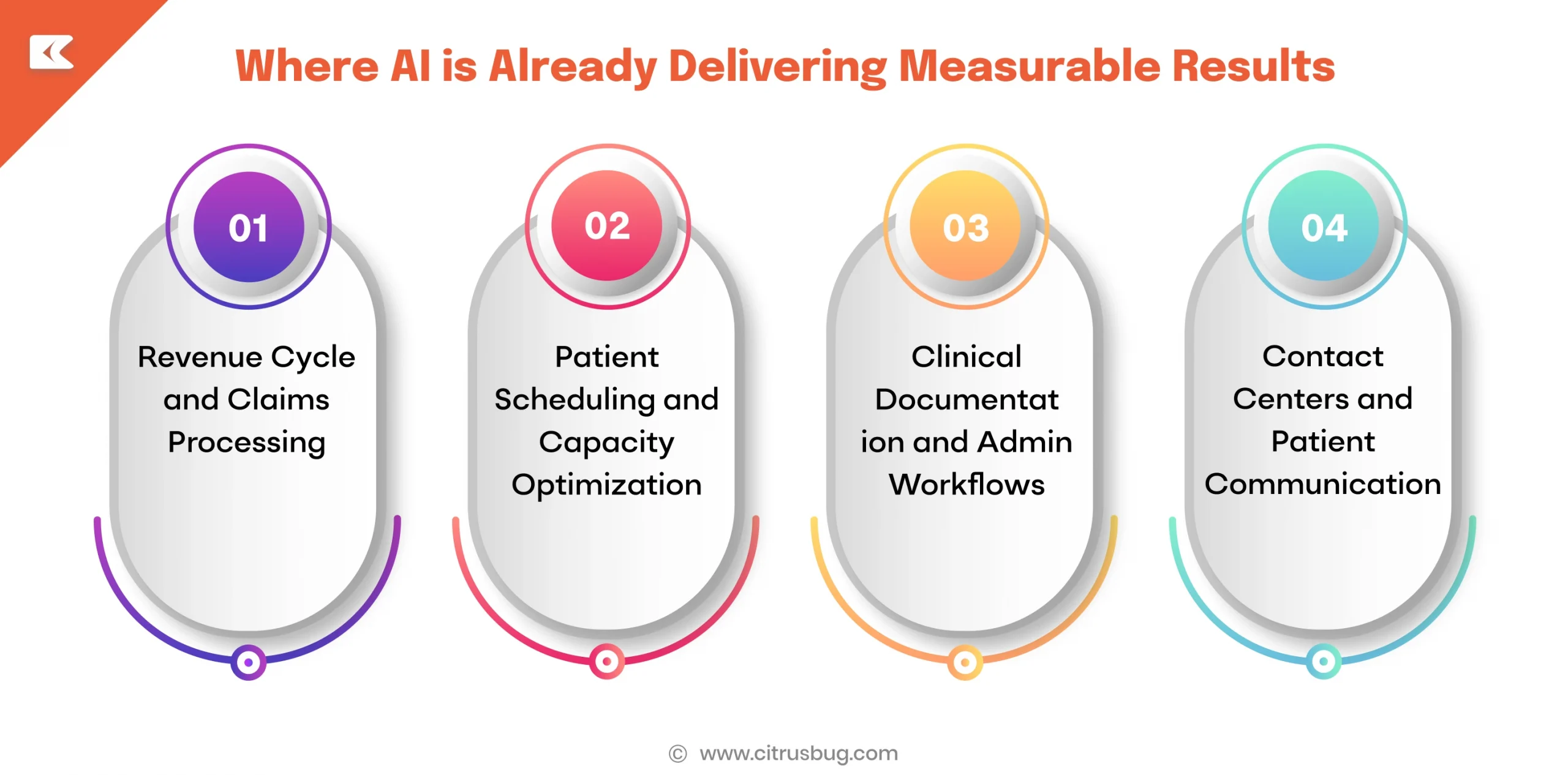
Where AI is Already Delivering Measurable Results
These are the areas with enough production deployments and reported outcomes to speak in specifics rather than potential.
Revenue Cycle and Claims Processing
This is where the evidence is strongest. Experian’s survey found that 69 percent of providers using AI in claims report a measurable drop in denials. The mechanism is simple: NLP models read clinical documentation before a claim goes out and flag gaps against payer-specific medical necessity criteria, catching what a rushed human reviewer often misses. It’s also where AI in medical billing shows the clearest accuracy gains, since denial prevention is narrow and well-trodden.
Patient Scheduling and Capacity Optimization
AI-driven scheduling tools predict no-show risk, rebalance appointment slots, and forecast OR and bed capacity days ahead instead of reacting same-day. The same predictive layer extends upstream into patient intake and registration, where AI tools flag incomplete insurance information before a patient arrives, cutting the same-day scramble that causes both scheduling gaps and billing errors. Health systems running these tools report lower no-show rates meaningfully, though results vary by specialty.
Clinical Documentation and Admin Workflows
Ambient AI scribes that listen to a visit and generate a draft note have moved from pilot to standard offering at many health systems, cutting documentation time that used to spill into evenings. Chart summarization and structured data extraction from unstructured notes save real time in prior authorization and referral workflows too, even when a human still signs off on the final version.
Contact Centers and Patient Communication
Conversational AI in healthcare now handles a meaningful share of routine patient calls, appointment scheduling, insurance questions, and prescription refill requests, freeing staff for calls that actually need judgment. The implementations that work well route ambiguous or emotionally charged calls to a human quickly rather than forcing every interaction through the bot.
Where AI Helps, But Still Needs Human Oversight
This is the middle tier, real capability, but not something to run unsupervised yet. The pattern repeats across four areas: AI does the first pass, a person makes the actual call.
| Area | What AI Does | Why a Human Still Checks It |
|---|---|---|
| Clinical decision support | Flags cases likely to need extra utilization review, or that don’t match expected DRG pathways | The flag is a starting point for a case manager, not a diagnosis |
| Prior authorization | Pre-fills requests, checks them against payer rules, predicts approval odds | Can’t make the medical necessity call, and payer criteria shift faster than static rules track |
| Supply chain and inventory | Forecasts demand, flags reorder points from real usage patterns | Only as good as the inventory data feeding it, which is still fragmented at most systems |
| Predictive maintenance | Flags equipment trending toward failure from sensor and usage data | Works on newer, sensor-equipped devices; most hospital fleets still run a lot of older gear |
CMS’s interoperability and prior authorization rule, taking effect through 2026, pushes payers toward standardized electronic data exchange, which should ease some of the prior authorization friction over time. It won’t remove the need for a human on the medical necessity decision.
Where AI Is Still Overhyped in Healthcare Operations
These are the claims worth pushing back on directly, because the gap between the pitch and the production reality is largest here.
Fully Autonomous Hospital Operations
No health system runs scheduling, staffing, supply chain, and billing on a single AI system making unsupervised decisions across all of them, and none is close. Every credible deployment keeps a human accountable for the decision, even when AI does the analysis. Vendors selling a self-running hospital are selling a roadmap slide, not a product.
Zero-Touch Claims Processing
Denial prevention AI is real and working. Fully autonomous claims processing, submission to payment with no human review, is not. Payers are deploying their own AI-driven denial systems: a Senate subcommittee investigation found one insurer’s post-acute care denial rate ran 16 times higher than its own baseline after adopting predictive review tools. That’s the environment an unsupervised provider-side system would be operating in without a human layer.
Universal Interoperability Through AI Alone
AI can help translate between data formats and reconcile some inconsistent records, but it cannot substitute for the underlying interoperability infrastructure, standardized data formats, shared identifiers, and integration pipelines that health systems still largely lack. Layering AI on top of fragmented data produces faster fragmented answers, not solved fragmentation.
What’s Holding AI Back in Healthcare Operations
Understanding the real constraints matters more than another feature comparison, because these are what actually determine whether a pilot becomes a production system.
Data Quality and Fragmentation
62 percent of healthcare leaders now name fragmented data as the top barrier to scaling AI’s impact, even as 63 percent of organizations already run AI in live workflows. The pattern repeats across health systems: AI gets deployed successfully in a narrow pilot, then stalls when it needs consistent data across departments that were never built to talk to each other.
Regulatory and Compliance Constraints
Healthcare AI touches HIPAA, state-level AI disclosure laws, and payer-specific compliance requirements simultaneously, and the regulatory picture is still moving. Shadow AI, staff using unauthorized tools without IT approval, has become a fast-growing compliance risk on its own, separate from whatever sanctioned AI a health system has actually deployed.
Integration with Legacy Systems
Most operational AI has to plug into an EHR, an ERP, or a decades-old scheduling system that wasn’t designed for real-time API access. Integration work, not model quality, is where most implementation timelines and budgets actually go, and it’s consistently underestimated at the pitch stage.
Change Management and Staff Adoption
A tool that technically works but that staff route around isn’t delivering value. Adoption failures usually trace back to workflow disruption rather than model accuracy; a scheduling tool that doesn’t match how a specific unit actually operates gets ignored regardless of how good its predictions are.
How to Identify High-ROI AI Opportunities in Operations
The use cases worth prioritizing tend to share a small set of characteristics, and checking a candidate use case against these before committing budget saves a lot of wasted pilots.
Repetitive, Rules-Based Workflows
The safest starting point: tasks performed the same way thousands of times a month, with clear inputs and outputs.
- Eligibility verification and claims coding
- Appointment reminder sequencing and no-show flagging
- Standard chart summarization and referral routing
High-Volume Decision Points
A small per-instance improvement only matters if the decision repeats often enough to compound.
- A 5 percent drop in denial rate matters far more across 50,000 monthly claims than across 500
- No-show prediction only pays off at meaningfully high appointment volume
- Reorder-point models need enough transaction history to train on in the first place
Measurable Cost or Time Impact
If a use case can’t be tracked against a specific number before the pilot starts, it’s hard to justify scaling it afterward.
- Hours saved per week on a defined task
- Denial rate or no-show rate, measured before and after
- A dollar figure tied to the metric, not a general efficiency claim
Low Clinical Risk Environments
The safest early bets sit furthest from direct treatment decisions.
- Billing, scheduling, and supply chain carry financial and operational risk, not patient safety risk
- A wrong reorder is far easier to correct than a wrong treatment flag
- Lower-stakes wins build the internal trust needed before AI moves closer to clinical workflows
Build vs Buy: How Healthcare Organizations Should Approach AI
This decision shapes cost, timeline, and how much control a health system retains over its own workflow logic.
| Criteria | Off-the-Shelf | Custom Build |
|---|---|---|
| Time to deploy | Weeks to a few months | Six months or more |
| Upfront cost | Lower, subscription-based | Higher, development-heavy |
| Fit to workflow | Generic, some configuration | Matches existing processes exactly |
| Scalability | Vendor-dependent roadmap | Controlled internally |
| Best for | Common, well-defined workflows | Differentiated or highly specific processes |
When Off-the-Shelf Solutions Make Sense
Common workflows like eligibility verification or denial prediction are well served by mature vendor platforms already trained on large claims datasets. Building that from scratch rarely beats buying it.
When Custom AI Is Worth the Investment
Workflows specific to a health system’s own patient population, payer mix, or internal processes, ones that don’t map cleanly onto a generic vendor’s assumptions- justify custom development despite the higher upfront cost and longer timeline.
Integration and Scalability Considerations
Whichever path a health system chooses, integration with the existing EHR, ERP, and scheduling systems is usually the larger project, not the AI model itself. Plan for that burden from the start, not as an afterthought once the pilot works.
Total Cost of Ownership vs ROI
Off-the-shelf tools carry lower upfront cost but ongoing subscription fees and less control over the roadmap. Custom builds cost more initially but avoid vendor lock-in and can be tuned indefinitely. The right call depends on how differentiated the workflow actually is, not on which option looks cheaper on a first-year budget line. A right healthcare AI consulting partner can help pressure-test that call against your own data and payer mix before you commit either way.
What the Next 3-5 Years Will Actually Look Like
The trajectory is less dramatic than either the hype cycle or the skeptics suggest, and more useful for planning because of it.
Rise of AI-Augmented Workflows (Not Replacement)
The realistic near-term future is AI handling the repetitive first pass, coding suggestions, denial risk scores, draft documentation, while staff review and finalize. This pattern is already the norm in the strongest-performing areas today, and it’s likely to stay that way rather than shift toward full automation.
More Embedded AI in Existing Systems (EHR, RCM, ERP)
Rather than standalone AI point solutions, expect AI capability to increasingly ship built into the EHR, RCM, and ERP platforms health systems already run, reducing the integration burden that currently eats most implementation budgets.
Increased Regulatory Clarity and Governance
CMS’s interoperability rules, state AI disclosure requirements, and payer transparency mandates are converging toward more defined rules of the road, which should reduce some of the current uncertainty slowing deployment decisions.
Shift from Pilots to Production-Grade Systems
Health systems are moving past AI experimentation toward platform consolidation, replacing scattered point solutions with governed infrastructure built for scale rather than proof-of-concept.
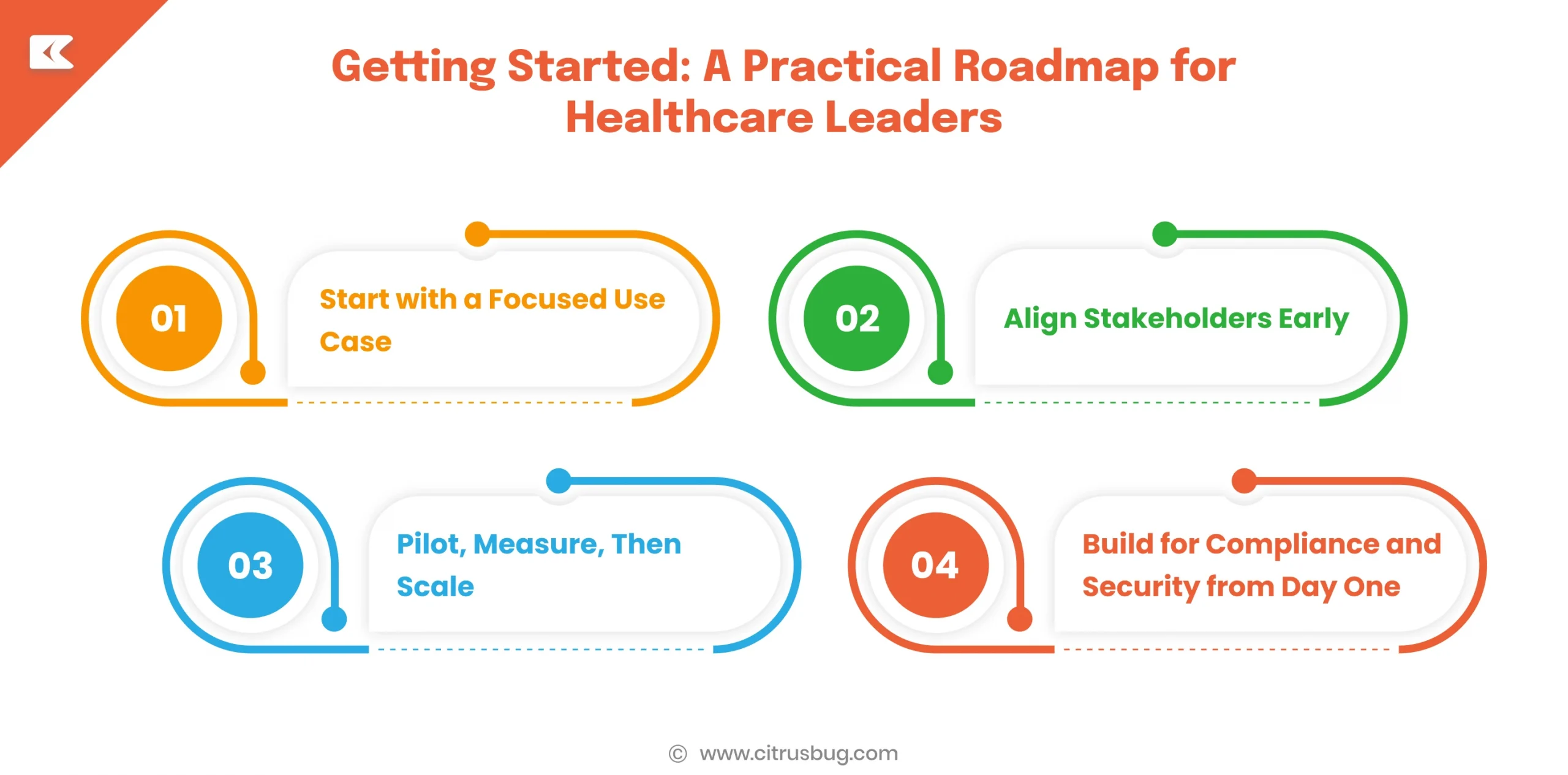
Getting Started: A Practical Roadmap for Healthcare Leaders
None of this requires a system-wide AI strategy on day one. It requires picking the right first move.
Start with a Focused Use Case
Pick one workflow that meets the high-ROI criteria above, high volume, rules-based, measurable, low clinical risk, rather than launching multiple pilots simultaneously across different departments.
Align Stakeholders Early
Revenue cycle, IT, compliance, and the frontline staff who will actually use the tool need to weigh in before a vendor is selected, not after a contract is signed and adoption starts failing.
Pilot, Measure, Then Scale
Run the pilot against the specific metric identified at the outset, track it rigorously, and only scale once the results hold up against a real baseline, not a vendor’s benchmark numbers.
Build for Compliance and Security from Day One
Retrofitting HIPAA compliance and security review onto an AI tool after deployment is far more expensive than building it in from the start, and it’s the step most often skipped under timeline pressure.
Frequently Asked Questions
Where is AI used most in healthcare?
Operationally, AI is used most in revenue cycle and claims processing, where the volume of repetitive, rules-based decisions makes it easiest to deploy and measure. Clinically, imaging and diagnostics have the deepest AI penetration, backed by the largest number of FDA-cleared AI devices.
What are some real AI in healthcare examples?
Ambient documentation scribes, denial prediction models in revenue cycle, no-show prediction for scheduling, and conversational AI in patient contact centers are all in active production use across U.S. health systems today, not just pilot programs.
Is AI replacing healthcare administrative jobs?
Not in the areas covered here. Current deployments augment staff by handling the repetitive first pass of a task while a person reviews and finalizes, rather than removing the role entirely.
How long does it take to see ROI from AI in healthcare operations?
Well-scoped pilots in revenue cycle or scheduling typically show measurable results within three to six months. Broader platform-level deployments take longer, closer to twelve to eighteen months, largely due to integration work rather than model performance.
Conclusion
The health systems getting real value out of AI in healthcare operations aren’t the ones with the most ambitious strategy. They’re the ones that picked one narrow, measurable, low-risk workflow and scaled what worked. The rest is still a roadmap slide.
That’s where the right implementation partner can make a difference. At Citrusbug, we work with global healthcare organizations to identify and build the AI use cases that actually move operational metrics, not the ones that look good in a vendor demo.