
 Back
Back







Artificial Intelligence (AI) is no longer a future-oriented concept in manufacturing. It is in the process of transforming production lines, factories and supply chains across the globe. From robotics and predictive maintenance, AI is helping manufacturers increase efficiency, reduce costs, and increase productivity. As competition in the global market increases, businesses are increasingly dependent upon AI software development solutions to remain ahead.
This article examines AI in manufacturing statistics, trends in adoption and market growth, the technologies that are driving AI regional adoption and the outlook for AI in the manufacturing sector.
How Extensive Is AI Adoption Across the Manufacturing Industry?
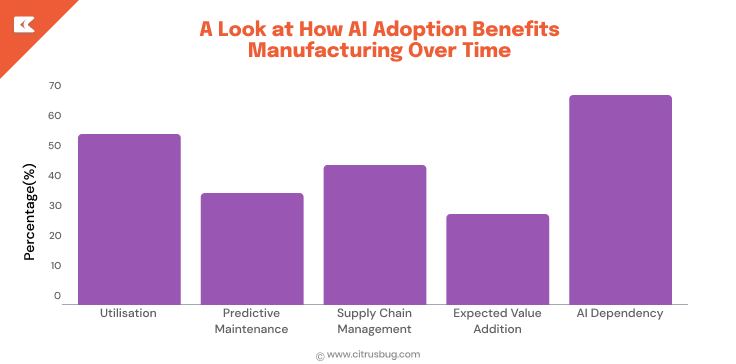
The use of AI in the manufacturing industry is growing rapidly as businesses increasingly recognise the potential of AI to improve efficiency, cut costs, and encourage the development of new products and services. AI in Manufacturing Statistics reveal AI technology is becoming integral to processes across the world:
- 88% of the businesses studied by McKinsey’s 2025 Global Survey on the state of AI are currently using AI tools to improve their business operations.
- 35% of manufacturing companies have implemented AI specifically in the areas of predictive maintenance and quality control.
- Presently, 41% of all manufacturers use AI applications to gather data, analyse, and manage data from supply chains to aid in better management and planning.
- Around 27% of businesses say that AI has already provided tangible value to their operations and 56% anticipate tangible results within the next 2 to 5 years.
- In the U.S. automotive sector, 60% of major companies have incorporated AI technologies into their design and production processes.
Measurable Benefits of AI in Manufacturing
AI adoption is bringing important outcomes for manufacturers:
- Businesses have reported as much as a 50% reduction in production times through the implementation of AI solutions.
- General Electric reduced unplanned downtime by 10–20% by using AI-driven predictive maintenance.
- Predictive maintenance can reduce maintenance costs by 25% and cut unplanned downtime by as high as 30%.
- About 90% of the top machine manufacturers invest heavily in predictive analytics, and machine learning in manufacturing is playing a crucial role in driving better automation and data-driven decision-making.
Current Trends and Industry Insights
- AI manufacturing trends and statistics show that about 44% of the companies in this industry are currently working on AI prototypes.
- As per AI in manufacturing statistics, 93% of businesses believe that artificial intelligence is essential to creating innovation and achieving long-term growth.
- For companies using AI every day, 66% have a high dependence on the latest technologies, and they plan to keep up AI adoption.
- Of the companies that offer AI solutions for the industry, 64% are focused on models that are supervised in response to the growing demand for data-driven decisions.
- Over 60% of manufacturing firms have created a formal strategy to incorporate AI into their processes, signalling a strong commitment to adopting AI for the long-term benefit of their business.
These figures clearly demonstrate the fact that AI can no longer be considered just a technology that was used to test manufacturing. From predictive maintenance and supply chain optimisation to efficiency and technological innovation, AI is shaping the future of manufacturing.
Which Regions Are Leading the Way in AI Manufacturing Adoption?
This chart shows the distribution in regional areas for Artificial Intelligence (AI) in manufacturing statistics.
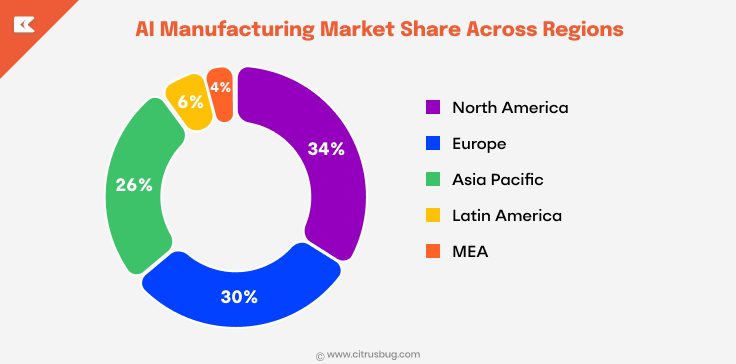
- North America leads with the biggest market share of 34% and proves that the area is on the cutting edge of integrating AI into manufacturing machines and intelligent factories.
- Europe is close to 30% due to the high level of investment in robotics, automation, and AI in production statistics that continue to boost efficiency and innovation.
- Asia Pacific holds a significant 26% that demonstrates the rapid growth of its industrial sector and growing adoption of AI technologies. This positions Asia Pacific as a major participant within AI industrial trends.
- Latin America accounts for 6% which indicates a gradual acceptance, however, there are opportunities to grow as industries evolve.
- Middle East & Africa (MEA) are 4.4% which is a sign of the initial phases of AI implementation in the manufacturing sector, but the potential for growth is anticipated due to the upcoming developments in industrial technology.
In short, North America and Europe dominate the AI in manufacturing statistics; however, Asia Pacific is quickly catching up and positioning itself as a strong growth region. However, Latin America and MEA are in their early stages, but they have the potential for growth in the future.
AI Market Segmentation in Manufacturing: Hardware, Software, and Services
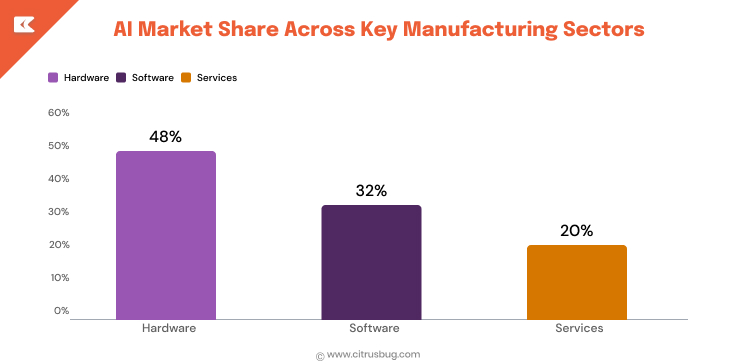
Hardware (48%)
Hardware is the leader in the market, with 48% which means that nearly half of AI manufacturing investment is focused on physical components.
It includes robotics powered by AI, advanced sensors, and other smart machines that increase the efficiency and accuracy of manufacturing processes.
The emphasis on hardware indicates that manufacturers are incorporating AI into their existing infrastructure. The upgrade of machinery using AI increases efficiency, reduces errors, and boosts overall performance. The recent AI in Manufacturing Statistics highlight the increasing importance of intelligent hardware in the manufacturing industry.
Software (32%)
Software has a 32% market share that covers AI algorithms and data analytics platforms, along with a decision-support system. These software solutions are crucial to process the huge amount of data generated by AI-equipped hardware.
By analysing this data, software allows predictive maintenance using AI as well as quality control, optimisation of supply chain processes and more intelligent decisions.
This demonstrates the vital importance of AI software to make manufacturing processes more sophisticated and data-based.
Services (20%)
Services make up an additional 20% in the overall market, which includes consultation and system integration, maintenance, as well as continuous assistance to AI technology in the manufacturing industry.
Although smaller in share compared to software and hardware services, they play a significant part in the achievement of AI adoption. They can ensure that AI solutions are implemented effectively and are in sync with current operations.
They also offer long-term support to manufacturers, helping them keep their systems running at a high efficiency, with reliability and smooth performance as AI technologies continue to develop.
What Key Technologies Are Powering AI in Manufacturing?
1. Machine Learning (ML)
What It is & How It’s Used in Manufacturing
In the manufacturing industry, Machine Learning (ML) is among the most extensively used AI techniques. It helps in the ability to predict maintenance and quality controls as well as supply chain efficiency through analysing data patterns.
ML can also help reduce downtime, increase product consistency, and improve efficiency by learning continuously using live data.
Market Size & Forecast
In 2024, the global machine learning segment in the category of “AI for manufacturing” was estimated to be around USD 1,570.1 million. This is projected to increase to around USD 13,499.2 million by 2030. This implies a CAGR of 45.4% from 2025 to 2030.
Another report estimates the “Machine Learning in Manufacturing Market” in the range of USD 892.24 million by 2024. The market is projected to grow to approximately 7,383.03 million in 2031 at a CAGR of 33.35%.
Additionally, 85% of logisticians expect to implement AI/ML in supply chain management in the next five years.
2. Deep Learning (DL)
What It is & How It’s Used in Manufacturing
Deep Learning (DL), one of the subsets of ML, is a step further in automation by using advanced neural networks to tackle complex tasks such as the computer vision system, defect detection and robot direction.
It can help control quality predictively by analysing sensors and images in real-time. Manufacturers can also utilise DL to forecast demand and improve operations in the supply chain, thereby increasing efficiency while lowering cost.
Market Size & Forecast
The Deep Learning market overall (across industries) is estimated to be USD 47.89 billion by 2025. It is projected to grow to USD 232.75 billion by 2030, and an estimated CAGR of 37.19%.
The focus is on “Deep manufacturing learning”, one study estimates that the market size was around USD 1.5 billion by 2023 and it will grow to around USD 9.8 billion in 2032. This is a CAGR of 22.5% from 2024 to 2032.
Within the “deep learning market based on application”, the manufacturing sector accounts for approximately 15% of deep-learning applications across different industries.
3. Natural Language Processing (NLP)
What It is & How It’s Used in Manufacturing
The use of Natural Language Processing (NLP) is changing how companies handle unstructured information like maintenance logs, reports and supply chain documents. It allows for better communication, faster documentation, and better insight from text-based data.
NLP can also be used to create chatbots and virtual assistants to improve support for workers and enhance the quality of decision-making.
Market Size & Forecast
There was an NLP part in AI for manufacturing that was 1,287.8 million by 2024. This is projected to be around USD 10,393.9 million by 2030. This is a CAGR of 43.8% between 2025 and 2030.
The overall NLP market was worth approximately USD 59.70 billion by 2024. It is predicted to increase to USD 439.85 billion in 2030, with an annual growth rate of 38.7%.
Top 5 Advanced Use Cases of AI in Manufacturing
1. Digital Twins for Smart Factories
- AI-powered digital twins create virtual replicas of machines, production lines, and entire factory operations.
- Manufacturers use digital twins to simulate production processes before implementing real-world changes.
- AI analyzes factory conditions to predict machine failures and reduce unexpected downtime.
- Digital twins improve resource planning by optimizing workflows, material movement, and production schedules.
- Manufacturers can test different manufacturing scenarios without interrupting actual production operations.
- The technology supports faster decision-making and improves overall factory productivity and quality control.
2. Autonomous Production Lines
- AI enables production lines to operate with minimal human intervention through intelligent automation systems.
- Machines can automatically adjust speed, temperature, pressure, and operational settings in real time.
- AI systems detect production bottlenecks and optimize workflows for maximum efficiency.
- Autonomous production lines improve consistency and reduce human-related manufacturing errors.
- Computer vision systems monitor products during manufacturing to ensure quality standards are maintained.
- AI-powered robotics handle repetitive tasks such as assembly, welding, packaging, and material handling.
- Manufacturers benefit from increased production output, reduced operational costs, and faster delivery times.
3. AI-Driven Energy Optimization
- AI monitors energy consumption across machines, equipment, and manufacturing facilities in real time.
- Intelligent systems identify energy waste and recommend optimization strategies for better efficiency.
- AI helps manufacturers reduce electricity costs by automating energy-intensive processes during peak hours.
- Predictive analytics improve machine usage patterns to minimize unnecessary power consumption.
- Smart energy management systems support sustainability and carbon emission reduction goals.
- AI integrates with IoT sensors to track temperature, lighting, and equipment performance for efficient energy usage.
- Manufacturers can achieve long-term operational savings while meeting environmental compliance standards.
4. Generative Design and Product Engineering
- AI-driven generative design software creates multiple product design options based on predefined requirements.
- Manufacturers can optimize designs for durability, weight reduction, material efficiency, and cost savings.
- AI accelerates product development by reducing manual design iterations and engineering time.
- Engineers can simulate product performance under different conditions before physical prototyping begins.
- Generative design improves innovation by exploring complex design possibilities beyond human imagination.
- AI helps manufacturers develop lightweight and high-performance components for industries like automotive and aerospace.
- The technology reduces material waste and shortens product development cycles significantly.
5. Worker Safety and Hazard Detection
- AI-powered computer vision systems monitor factory environments to identify potential safety risks.
- Smart cameras detect unsafe worker behavior, restricted area access, and missing protective equipment.
- AI can send real-time alerts to supervisors when hazardous situations occur on the production floor.
- Predictive analytics identify high-risk operational patterns that may lead to workplace accidents.
- AI-driven monitoring improves compliance with industrial health and safety regulations.
- Wearable AI devices help track worker fatigue, movement, and exposure to dangerous conditions.
- Manufacturers can reduce workplace injuries, improve employee safety, and minimize operational disruptions.
What Does the Future Market Outlook for AI in Manufacturing Statistics Look Like?
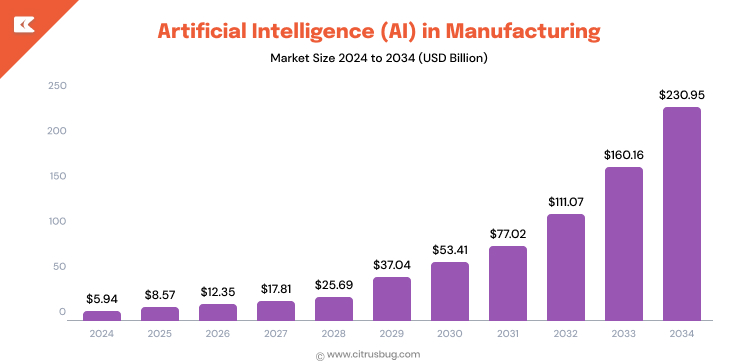
The chart illustrates the projected market growth of Artificial Intelligence (AI) in the manufacturing industry between 2024 and 2034.
In 2024, the world’s AI in Manufacturing Statistics indicates an estimated market worth of USD 5.94 billion that is a reflection of the early stages of its adoption, when industries are beginning to investigate AI for automating processes as well as defect detection and efficiency in production.
The market in 2028 will grow up to USD 25.69 billion, driven by the greater integration of machine vision, robotics and supply chain optimisation, which is proving the effectiveness of AI in reducing costs and operational efficiency.
In 2030, the market increased to USD 53.41 billion, crossing the USD 50 billion, which indicates that AI adoption is shifting from experiments to industrial-scale applications in global factories.
Finally, the global artificial intelligence (AI) in manufacturing market was valued at USD 5.94 billion in 2024 and is projected to surge to approximately USD 230.95 billion by 2034, growing at a compound annual growth rate (CAGR) of 44.2% over the forecast period.
Key Challenges and Barriers to AI Adoption in Manufacturing
Resistance to Organizational Change
Many manufacturing companies face internal resistance when implementing AI technologies because employees fear job displacement and automation. Workers may hesitate to trust AI-driven systems, especially when traditional processes have been used for years. This resistance can slow down digital transformation initiatives and reduce adoption efficiency.
Management teams may also struggle to align AI strategies with existing business operations and workforce structures. In some cases, decision-makers are uncertain about the long-term return on investment and hesitate to replace familiar operational methods. As a result, organizations often delay AI deployment despite its potential benefits.
Successful AI adoption requires employee training, transparent communication, and change management strategies. Manufacturers need to educate workers about how AI can support productivity rather than replace human expertise. Building a culture of innovation is essential for overcoming organizational resistance.
Real-Time Processing Constraints
Manufacturing environments generate massive amounts of data from machines, sensors, robotics, and IoT devices every second. AI systems must process this information instantly to support real-time monitoring and operational decision-making. Delays in processing can negatively impact production quality and factory efficiency.
Real-time AI applications such as predictive maintenance and autonomous production lines require low-latency computing infrastructure. However, many manufacturing facilities lack the advanced edge computing systems and network capabilities needed to handle continuous data streams effectively. This creates performance limitations during AI implementation.
High-speed processing also increases infrastructure and maintenance costs for manufacturers. Companies must invest in powerful hardware, cloud computing resources, and reliable connectivity solutions to support AI-driven operations. Balancing performance requirements with operational budgets remains a significant challenge.
Limited Interoperability Across Systems
Manufacturing facilities often rely on multiple software platforms, machines, and operational technologies from different vendors. These systems may use incompatible data formats and communication protocols, making AI integration difficult. As a result, manufacturers struggle to create a unified AI ecosystem across production environments.
Legacy equipment is another major barrier to interoperability in manufacturing operations. Older machines were not designed to support modern AI applications, IoT connectivity, or advanced analytics tools. Integrating outdated systems with new AI technologies often requires expensive upgrades or custom solutions.
Poor interoperability limits data sharing and reduces the effectiveness of AI-driven insights. Without seamless communication between systems, manufacturers cannot fully optimize workflows, supply chains, or production processes. Standardized integration frameworks are essential for successful AI adoption at scale.
Regulatory and Compliance Challenges
Manufacturers operating in industries such as healthcare, automotive, aerospace, and pharmaceuticals must comply with strict regulatory standards. AI systems used in these sectors need to meet quality, safety, and traceability requirements before deployment. Ensuring compliance can significantly slow down AI implementation timelines.
AI algorithms may also face scrutiny regarding transparency and decision-making accuracy. Regulatory authorities often require manufacturers to explain how AI systems generate predictions or automated decisions. This becomes challenging when using complex machine learning models with limited interpretability.
Data privacy and cybersecurity regulations add another layer of complexity to AI adoption in manufacturing. Companies must ensure that operational data, customer information, and industrial systems remain secure from cyber threats and unauthorized access. Compliance failures can lead to financial penalties, operational disruptions, and reputational damage.

Conclusion
AI is changing manufacturing, increasing efficiency, cutting costs, and enabling better decision-making. In everything from predictive maintenance and deep learning to NLP and more companies are increasingly embracing AI solutions to remain innovative and competitive.
Making investments in AI-powered manufacturing software development allows businesses to integrate intelligent systems, streamline processes, and create tangible value. With the predicted growth, AI is set to become a key component for modern-day, information-driven manufacturing around the world.