
 Back







Key Takeaways
- AI medical scribe software converts clinical conversations into structured documentation that clinicians review and approve before it becomes part of the medical record.
- Independent research shows potential reductions in documentation time, but note omissions, unsupported statements, and correction effort remain important evaluation criteria.
- Buying an existing scribe is often practical for standard workflows. Custom development makes more sense when specialty requirements, EHR integrations, data control, or commercial product ownership justify the additional investment.
- HIPAA, applicable recording and disclosure laws, vendor contracts, and FDA considerations can affect the product's architecture and intended functionality.
- Development budgets should account for engineering, EHR integration, clinical validation, security, AI processing, and post-launch maintenance rather than model costs alone.
AI medical scribe software development involves more than transcribing a patient conversation. A production-ready system must convert clinical dialogue into an accurate draft, support clinician review, and transfer approved documentation into the correct electronic health record (EHR).
For healthcare organizations considering a custom build, the key questions are whether existing products meet their workflow requirements, how the system will be validated, and what integration and operating costs to expect.
Citrusbug Technolabs develops AI-powered healthcare software. This guide examines the evidence behind AI scribes, the build-versus-buy decision, essential technical components, regulatory considerations, and the steps involved in planning and deploying a custom system.
The article provides general information, not legal, medical, or financial advice.
What Is AI Medical Scribe Software and How Does It Work?
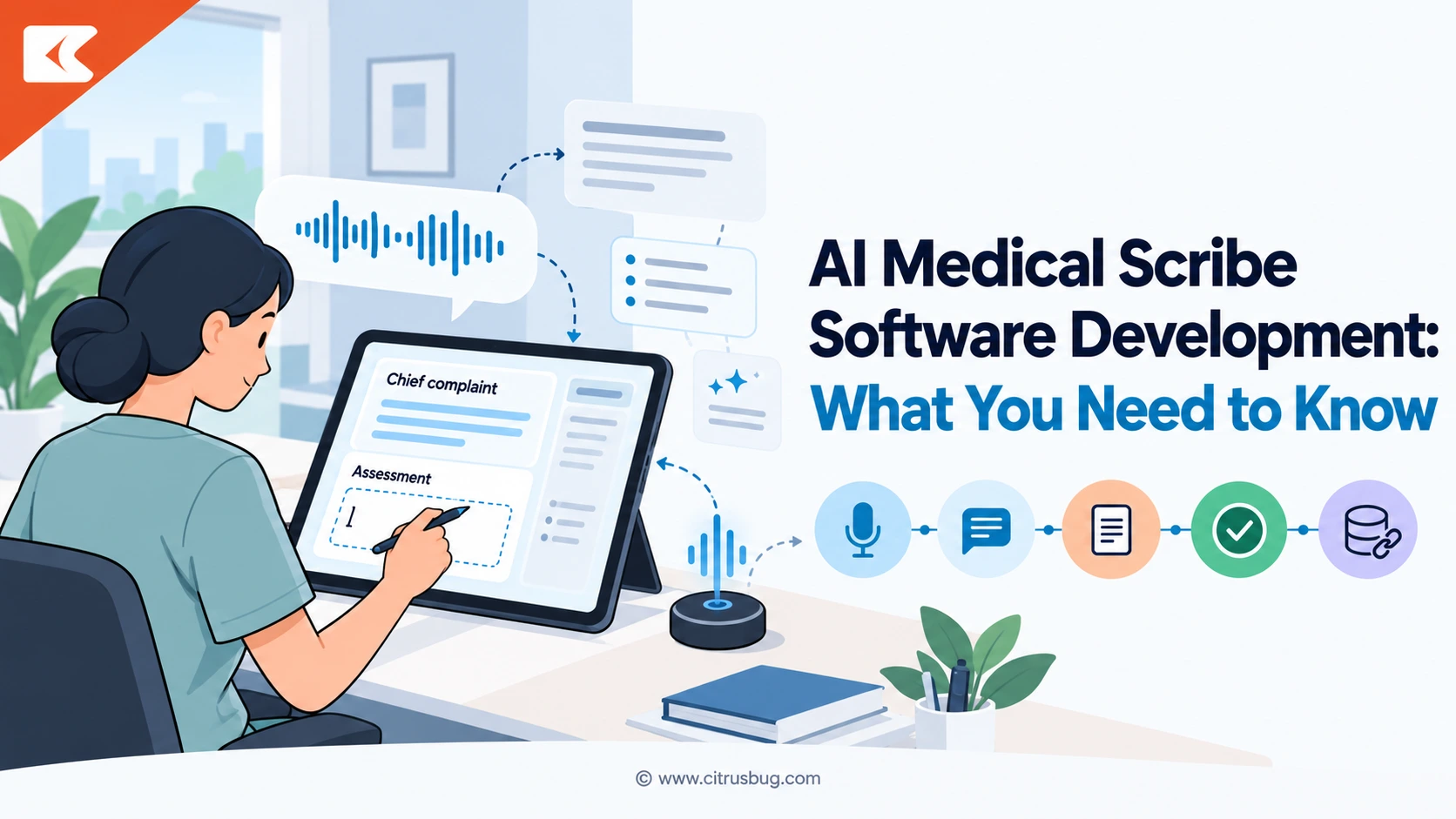
AI medical scribe software uses speech recognition and artificial intelligence to turn clinical conversations into structured documentation. Depending on the product, it can capture audio, distinguish speakers, generate a draft note, and prepare the documentation for clinician review and EHR entry.
Unlike traditional dictation, which requires a clinician to narrate information explicitly, an ambient AI scribe can listen to a natural conversation and organize relevant details into a clinical note.
A typical workflow includes five stages:
- Capture the encounter: Record or process the conversation according to the applicable consent requirements and product configuration.
- Transcribe the conversation: Convert speech into text and distinguish speakers where supported.
- Generate the note: Use a language model and clinical processing logic to organize the information into the required format.
- Review and approve: Allow the clinician to compare, correct, and approve the draft.
- Transfer the documentation: Save or submit the approved note through the appropriate EHR workflow, with confirmation that the operation succeeded.
Each stage introduces different technical risks. Transcription can miss clinical terminology, note generation can omit important details, and integration failures can leave documentation incomplete.
The system must therefore be evaluated as an end-to-end clinical workflow, not simply as a speech-to-text application.
Example: Before and After Using an AI Medical Scribe
Consider a patient describing symptoms during a consultation.
Doctor-patient conversation
“I’ve had a cough for three days, a mild fever, and some chest congestion.”
Illustrative AI-generated note
- Chief complaint: Cough and chest congestion
- History of present illness: Patient reports a three-day history of cough, mild fever, and chest congestion.
- Assessment: Pending clinician evaluation.
- Plan: To be completed by the treating clinician.
The scribe organizes the conversation into a structured note without inventing a diagnosis or treatment plan. The clinician checks the draft, adds relevant findings, completes the assessment and plan, and approves the documentation.
The example is deliberately simple. Real encounters may contain overlapping speech, medication changes, negation, contradictory information, and details that belong in different sections of the note.
An AI medical scribe supports clinical documentation; it does not replace clinical judgment. The authorized clinician remains responsible for reviewing the record before finalization.
Why Are Healthcare Organizations Investing in AI Medical Scribes?
Clinical documentation can extend beyond the consultation itself. Clinicians may complete notes between appointments, after clinic hours, or alongside other administrative responsibilities.
AI scribes aim to reduce this burden by preparing a first draft while the clinician focuses on the patient.
Potential benefits include:
- Less manual documentation: Clinicians may spend less time typing or dictating routine encounter details.
- More consistent notes: Structured templates can help organize documentation across encounters.
- Reduced duplicate entry: Successful EHR integration can eliminate the need to manually re-enter approved information.
- More attention during consultations: An effective ambient workflow can reduce the need to type throughout a visit.
- Support for downstream workflows: Structured documentation can support follow-up tasks, coding workflows, and information routing when these functions are appropriately implemented.
These benefits are not automatic. A system that generates drafts quickly but requires extensive correction may deliver little practical value.
Healthcare organizations should assess note quality, editing time, clinician adoption, and integration reliability alongside documentation speed.
What Does the Independent Evidence Say AI Scribes Deliver?
Independent research suggests that AI scribes can reduce documentation time, but results vary by implementation, clinical setting, and how consistently clinicians use the technology.
A 2026 multisite study published in JAMA examined AI scribe adoption across five academic medical centers. It included 8,581 clinicians, of whom 1,809 adopted an AI scribe.
Adoption was associated with 13.4 fewer minutes of total EHR time and 16.0 fewer minutes of documentation time per eight scheduled patient hours. The researchers also observed an increase of 0.49 visits per week. EHR time outside scheduled work hours did not change significantly.
The findings indicate modest improvements in measured workflow outcomes, not a guarantee that every organization will achieve the same results.
Source: JAMA, Changes in Clinician Time Expenditure and Visit Quantity With Adoption of AI-Powered Scribes.
Note quality is another important consideration.
A 2026 JMIR Medical Informatics pilot examined 7,545 notes created during an ambient AI scribe implementation. Physicians evaluated a sample of 356 notes. Within that evaluated sample, reviewers identified omissions in 18% of notes and hallucinations in 11.5%. Overall, 94.7% of the evaluated notes were free of errors classified as significant.
The sampling limitation matters: these percentages describe the reviewed notes, not necessarily every note produced by the system.
Source: JMIR Medical Informatics, Quality of Clinical Notes Created by Ambient Listening Generative AI.
Research on GPT-4 applied to mock primary care consultations has also examined unsupported statements in generated clinical notes. Such studies can help identify failure modes, but results from a model tested on simulated encounters should not be treated as direct benchmarks for every commercial scribe.
The practical lessons for development are straightforward:
| Research finding | Development implication |
|---|---|
| Documentation time can decrease | Measure time saved in the target clinical workflow |
| Important information can be omitted | Compare generated notes with their source encounters |
| Unsupported statements can appear | Test factual grounding and clinically significant errors |
| Results vary across users and settings | Evaluate adoption, correction effort, and performance by encounter type |
Healthcare organizations should measure their own results during a pilot. Published research can inform the evaluation plan, but it cannot replace local testing.
Should You Build, Buy, or Extend an Existing AI Scribe?
The right approach depends on how closely an existing product fits the intended workflow and how much control the organization needs over the technology.
Buy a vendor scribe
A commercial product is often the most practical choice when the organization has standard documentation requirements, the vendor supports its EHR, and implementation speed matters more than owning the entire technology stack.
Before purchasing, assess EHR compatibility, supported specialties, note customization, data retention, contractual terms, and recurring fees.
Use Epic AI Charting
Organizations already using Epic should evaluate its built-in AI Charting capabilities alongside external products. Epic announced AI Charting in February 2026 as a capability designed to listen during visits, draft notes, and support associated workflows.
Availability, configuration, and the functions supported in a particular environment should be confirmed directly with Epic.
Extend an existing product
Extending a current platform may make sense when the primary gap is specific, such as consent management, specialty templates, clinician review, or an integration that the existing product does not support.
This approach can reduce duplication, but the organization remains dependent on the underlying platform and its extension points.
Build custom software
Custom AI medical scribe software development is worth evaluating when the product requires:
- Specialty-specific documentation and validation.
- Integration with several EHRs or other clinical systems.
- Greater control over application architecture and data flows.
- Custom consent, review, or audit workflows.
- Ownership of a product intended for commercial distribution.
A custom build also creates responsibility for security, maintenance, model changes, clinical validation, and ongoing support.
Build-versus-buy comparison
| Approach | Best suited to | Main consideration |
|---|---|---|
| Vendor scribe | Standard workflows and faster implementation | Vendor capabilities, pricing, and data terms |
| Epic AI Charting | Organizations using Epic | Capabilities and configuration within Epic workflows |
| Extend an existing product | A specific gap in an established platform | Platform dependency and extension limitations |
| Custom development | Specialized workflows, multiple EHRs, or a product for resale | Highest implementation and long-term ownership responsibility |
For a small practice with standard requirements, buying a suitable product will often be more practical than developing one from scratch.
Example: Comparing subscription costs with a custom build
Suppose a healthcare group has 50 clinicians and receives a hypothetical subscription quote of $300 per clinician per month.
Its annual subscription expense would be:
50 clinicians × $300 × 12 months = $180,000 per year.
The $300 figure is illustrative, not a quoted vendor price or market benchmark.
A meaningful comparison must also account for vendor implementation fees, usage limits, custom development, clinical validation, EHR access, hosting, security reviews, maintenance, and support.
A custom build is not automatically cheaper at scale. The business case depends on the total cost of ownership, the number of clinicians and encounters, the level of customization, and the measurable value of the workflow improvements.
What Goes Into AI Medical Scribe Software Development?
A production scribe combines several connected components: audio capture, speech recognition, clinical note generation, clinician review, and EHR integration.
Security, consent, monitoring, and auditability apply across the entire system.
1. Speech recognition and AI processing
Speech recognition converts the encounter audio into text. A language model and clinical processing logic then organize relevant information into a structured draft.
The technology stack may use managed speech services, a custom language model, or a combination of services.
Selection criteria include:
- Accuracy with clinical terminology, accents, and overlapping speech.
- Support for required languages.
- Processing latency and expected encounter volume.
- Performance on the intended specialty and note format.
- Data retention, security documentation, and contractual terms.
- Availability of a business associate agreement (BAA) where required.
Two published service prices illustrate how speech-processing costs can vary.
| Service | Example published rate | What to consider |
|---|---|---|
Deepgram Nova-3 , monolingual streaming |
$0.0077 per minute at the cited regular rate | Primarily a speech-recognition cost |
AWS HealthScribe |
$0.10 per minute at the cited rate | Includes additional clinical processing capabilities |
These figures are examples, not a like-for-like comparison or a guarantee of current pricing. Confirm the applicable rates, service features, eligibility, and healthcare data-handling terms with each provider before budgeting.
The complete system may also require language-model inference, application hosting, storage, monitoring, and other infrastructure.
2. EHR architecture and integration
The integration layer connects the scribe to the clinical record. Depending on the EHR and workflow, the implementation may use FHIR APIs, HL7 interfaces, vendor-specific APIs, or a combination of approaches.
Our EHR integration services help connect healthcare applications with existing clinical systems while accounting for each EHR’s capabilities, data exchange requirements, and workflow constraints.
Integration planning should cover:
- Patient and encounter matching: Ensure documentation belongs to the correct patient and visit.
- Authentication and permissions: Restrict access according to the user’s role and authorization.
- Field mapping: Place generated content in the correct EHR sections.
- Failure handling: Manage API errors, timeouts, retries, and unavailable services.
- Duplicate prevention: Avoid creating multiple notes when a request is retried.
- Update history: Preserve relevant audit information and changes.
- Testing: Validate behavior in a sandbox or approved test environment before production use.
The system should also distinguish between a draft, an approved note, a successful EHR save, and a signed record. These states are not interchangeable.
3. The clinician-facing application
The interface should allow clinicians to review and correct generated notes without adding unnecessary steps to the encounter.
A practical review screen may include:
- The draft note and source transcript.
- Clear indications of missing sections or unresolved fields.
- Navigation between a statement in the note and its supporting transcript.
- Visible draft, review, approval, and save states.
- Error messages and recovery actions when EHR updates fail.
The interface should also make it clear which content was generated, which changes were made by a clinician, and what remains incomplete.
4. Security, monitoring, and auditability
Every service that processes protected health information should be included in the data-flow map.
Document where audio, transcripts, notes, and logs are processed or stored; which users and vendors can access them; how long information is retained; and what happens when data must be deleted.
Depending on the deployment, technical and operational controls may include encryption, access management, audit logging, incident response, retention policies, and vendor risk reviews.
Monitoring should track:
- Transcription and note-generation failures.
- Processing latency and system availability.
- EHR write-back failures and duplicate updates.
- Note-editing patterns and recurring error categories.
- Changes in model, prompt, template, or integration behavior.
Model updates should be versioned and evaluated before broad rollout. A change that improves average output quality may still introduce errors in a particular specialty or note section.
Which HIPAA, Consent, and FDA Rules Apply to an AI Scribe?
Regulatory planning should begin during discovery because legal obligations can affect recording flows, data architecture, vendor selection, retention, and product functionality.
Three areas deserve particular attention: HIPAA and vendor responsibilities, applicable recording and disclosure laws, and FDA considerations.
HIPAA and vendor responsibilities
The Health Insurance Portability and Accountability Act (HIPAA) governs the handling of protected health information by covered entities and business associates, so scribe products should follow HIPAA-compliant application development practices.
When a covered entity uses a cloud provider to create, receive, maintain, or transmit electronic protected health information, the arrangement generally requires an appropriate BAA with that provider. Responsibilities and exceptions depend on the specific arrangement.
The US Department of Health and Human Services explains these obligations in its guidance on cloud computing and HIPAA.
A BAA does not make an entire product compliant by itself. Healthcare organizations and their vendors must assess applicable responsibilities, risk, access controls, security measures, incident response, and data handling.
AI-specific planning should also establish whether third-party services retain prompts, transcripts, or audio; whether customer data may be used for model training; and how data access is controlled.
The existing HIPAA Security Rule remains an important baseline. Proposed revisions should not be treated as final requirements unless and until they are adopted. Verify the current status of relevant rulemaking before relying on a future compliance deadline.
Citrusbug’s HIPAA compliance checklist can provide a starting point for organizing technical and operational safeguards.
State recording and disclosure requirements
HIPAA does not answer every question about whether a clinical visit may be recorded. State recording laws and healthcare-specific disclosure requirements may also apply.
For example, California’s Invasion of Privacy Act can impose consent requirements for confidential communications, depending on the circumstances and applicable legal interpretation.
Louisiana Act 649, effective August 1, 2026, requires licensed healthcare professionals to disclose to patients, before an appointment or treatment, the use of recording devices, software, or services that use AI to transcribe communications between the professional and patient.
Source: Louisiana Legislature, Act 649 of the 2026 Regular Session.
These examples should not be interpreted as a complete list of state requirements. The applicable rules depend on where the product is used, the type of communication, the care setting, and the parties involved.
From a product-design perspective, consent and disclosure may require:
- A clear explanation of the recording or AI documentation process.
- A way to record the patient’s response when required.
- An appropriate opt-out or alternative workflow.
- Controls over when audio capture begins and ends.
- An audit trail documenting relevant consent and workflow events.
Have qualified counsel confirm the applicable requirements in each jurisdiction before deployment. The product’s consent workflow should be configurable where different legal or operational requirements apply.
FDA considerations
The regulatory analysis may change if the product goes beyond documentation into functions that recommend diagnoses, suggest treatment, or influence clinical decisions.
The FDA issued its final Clinical Decision Support Software guidance in January 2026. The guidance explains how the agency evaluates certain software functions under applicable statutory criteria.
A documentation-focused scribe may be treated differently from a product that provides clinical recommendations, but intended use and actual functionality matter. Do not assume that every administrative AI feature is automatically outside medical-device regulation.
For an initial release, keeping the scope focused on documentation can make the regulatory analysis more manageable. Obtain regulatory advice before adding diagnosis suggestions, treatment recommendations, or automated clinical actions.
How to Develop AI Medical Scribe Software Step by Step
A successful implementation starts with a defined clinical workflow. Trying to support every specialty, EHR, and documentation style from the first release increases complexity and makes it harder to establish whether the product is safe and useful.
Step 1. Select one clinical use case
Choose a specialty, encounter type, and documentation problem.
Define who will use the product, when audio is captured, what note format is required, which information must be included, and where the approved documentation must go.
Establish baseline measurements before development. Useful starting points include:
- Time spent completing notes.
- Time spent reviewing and correcting notes.
- Frequency of missing or inaccurate information.
- Clinician adoption and use by encounter type.
- Incomplete records and failed EHR updates.
These baseline values will help determine whether the implementation produces a measurable improvement.
Step 2. Define the architecture and vendor requirements
Choose the speech-recognition and language-processing components, application architecture, hosting approach, and integration method.
Review each vendor’s data-handling practices, retention policies, security documentation, contractual terms, and BAA availability where required.
Document the flow of audio, transcripts, notes, and logs through the system. Define what happens when a service fails, an encounter is interrupted, or an EHR update cannot be completed.
Architecture decisions should also cover model versioning, access controls, auditability, and the process for evaluating changes.
Step 3. Build the minimum viable workflow
The first release should support the complete path from encounter capture to the appropriate EHR documentation state.
Depending on the use case, this may include:
- Audio capture and transcription.
- Structured note generation.
- A clinician review and correction interface.
- Consent handling.
- Audit logs and access controls.
- One EHR integration.
- Error handling and confirmation of successful updates.
Prioritize a reliable end-to-end workflow over a long feature list. One specialty and one EHR provide a more manageable environment for validating note quality, usability, and integration behavior.
Step 4. Test note safety and accuracy
Use representative encounters for healthcare software testing, evaluating generated notes against their source transcripts and relevant clinical documentation requirements.
Include routine cases and difficult examples such as overlapping speech, medication changes, negation, missing information, accents, interruptions, and incomplete recordings.
Pay particular attention to four error categories:
- Omissions: Important history, allergies, symptoms, or plan items are missing.
- Hallucinations: The note includes statements unsupported by the encounter.
- Negation errors: The meaning changes, such as recording that a patient continues a medication when they said they stopped it.
- Speaker attribution errors: A patient statement is attributed to the clinician, or vice versa.
Also test patient and encounter matching, note-section mapping, duplicate prevention, and EHR failure recovery.
The goal is not simply to maximize transcription accuracy. It is to establish whether the final draft faithfully represents the encounter and whether the workflow catches important errors before the note is finalized.
Step 5. Pilot with clinicians
Run the product with a limited group of clinicians under a documented evaluation plan.
Define who reviews the notes, how errors are reported, which problems require escalation, and what results are required before the pilot can expand.
Measure both technical accuracy and workflow fit. A model may perform well on a test set but still create friction if clinicians need too many clicks, cannot trace a statement to the transcript, or must manually repair failed EHR updates.
The pilot should also evaluate whether the product works across the range of encounters expected in production.
Step 6. Deploy gradually and monitor performance
Expand only after the pilot meets acceptance criteria agreed upon by clinical, operational, and technical stakeholders.
Add specialties or EHR connections incrementally, evaluating each new workflow rather than assuming that results transfer automatically.
After launch, monitor note errors, editing patterns, write-back failures, latency, availability, and clinician feedback. Reassess the system whenever a model, template, integration, or data-processing service changes.
Common implementation mistakes to avoid
Expanding scope too early: Supporting several specialties and EHRs before validating one workflow increases complexity.
Treating generated notes as final: Keep drafts subject to the appropriate clinician review and approval process.
Testing transcription alone: Accurate transcripts can still produce notes that omit or change important information.
Ignoring consent until deployment: Consent requirements can affect audio capture, interface design, data retention, and auditability.
Measuring speed without quality: A faster process is not a success if it increases correction burden or introduces clinically significant errors.
How Much Does AI Medical Scribe Software Development Cost?
Development cost depends on clinical scope, EHR complexity, the amount of custom AI work, security requirements, and the validation needed before deployment.
A narrow pilot is materially different from a production platform supporting multiple specialties and health systems. A reliable estimate requires a defined scope rather than a single price based on the product category.
What drives development cost?
| Scope | Typical assumptions | Work to account for |
|---|---|---|
| Pilot | One specialty, one EHR, limited encounter workflow | Audio capture, transcription, draft generation, review, and initial integration |
| Single-specialty production | One specialty with operational requirements | Consent flows, monitoring, audit logging, production integration, and validation |
| Multi-specialty platform | Several specialties and EHRs | Specialty-specific templates, broader testing, administration, and additional integrations |
These are scope categories, not fixed price bands.
The main cost drivers include:
- Number of specialties and note templates.
- Number and complexity of EHR integrations.
- Live versus after-visit processing.
- Managed speech and AI services versus custom components.
- Consent, security, audit, and retention requirements.
- Clinical validation and safety testing.
- Hosting, monitoring, maintenance, and support after launch.
A realistic project estimate should separate one-time implementation costs from recurring operating costs.
How much does AI processing cost?
Speech processing is one of the easier operating costs to estimate because providers publish per-minute rates.
Using the example rates discussed earlier, 15,000 audio minutes per month would produce the following costs:
| Service and example rate | Calculation | Monthly cost |
|---|---|---|
| AWS HealthScribe at $0.10/minute | 15,000 × $0.10 | $1,500 |
| Deepgram at $0.0077/minute | 15,000 × $0.0077 | $115.50 |
| Deepgram at $0.0048/minute | 15,000 × $0.0048 | $72 |
These calculations illustrate usage costs only. The rates should be verified before budgeting, and the services are not equivalent in functionality.
The total operating budget may also include:
- Language-model inference.
- Application hosting and storage.
- Security reviews and monitoring.
- EHR fees or vendor program costs.
- Clinician training and support.
- Maintenance and regression testing.
- Re-validation after material model or workflow changes.
The lowest speech-processing rate does not necessarily produce the lowest total cost. The decision should account for required functionality, quality, latency, contractual obligations, and the engineering needed to integrate each service.
How long does development take?
Developing an AI medical scribe typically takes 3–6 months for a focused minimum viable product and 6–9 months or longer for a production platform with deeper EHR integration, multiple specialties, and extensive clinical validation. The actual timeline depends on the scope and the systems involved.
A delivery plan usually includes five phases:
- Discovery: Define clinical workflows, requirements, and success criteria.
- Architecture: Select the technology stack, AI services, hosting model, and integration approach.
- Development: Build audio capture, transcription, note generation, clinician review, and EHR integration.
- Pilot testing: Evaluate documentation quality with clinicians, measure corrections, and address workflow issues.
- Production rollout: Validate reliability, security controls, and operational readiness before expanding deployment.
EHR integration can extend the schedule when vendor approvals, API access, sandbox availability, or external team coordination cause delays. Clinical validation may also require additional testing and refinement before deployment.
These ranges are planning estimates, not fixed delivery promises. Establish milestones for the working prototype, pilot-ready release, clinical acceptance, and production deployment based on the agreed scope.
How Do You Measure AI Medical Scribe Performance and ROI?
Measure whether the product improves the clinical workflow without compromising note quality. Time savings alone do not establish value.
Track these performance measures
Documentation Time: Compare time spent completing notes before and after implementation.
Editing burden: Measure how long clinicians spend reviewing and correcting generated notes.
Clinical error rates: Track omissions, hallucinations, negation errors, speaker attribution errors, and their severity.
Adoption and usage: Measure how often eligible encounters use the scribe and whether clinicians continue using it over time.
EHR reliability: Monitor failed writes, duplicate updates, incorrect mappings, and delayed note availability.
Operational performance: Track availability, latency, processing failures, and support incidents.
Financial impact: Compare subscription or operating costs with measurable changes in documentation workload and workflow capacity.
Set acceptance thresholds with clinical, operational, and technical stakeholders before the pilot begins.
Review results by specialty and encounter type where sample sizes permit. An overall average can hide recurring errors in a specific workflow.
Also distinguish association from causation. Research showing reduced documentation time among adopters does not guarantee the same result at every organization. Local workflow design, clinician usage, note quality, and integration reliability all affect the outcome.
A useful return-on-investment assessment should compare the measured benefits with the full cost of ownership, including implementation, validation, infrastructure, and ongoing support.
How Do You Choose an AI Medical Scribe Development Partner?
For AI medical scribe software development, choose a partner that can address clinical workflows, AI behavior, healthcare integrations, and post-launch operations together. A strong model demonstration is not enough if the team cannot explain how it will validate notes or recover from a failed EHR update.
Ask potential partners five questions.
- Which EHRs and healthcare systems have you integrated?
Ask how the team handled authentication, field mapping, write-back failures, sandbox testing, and coordination with EHR vendors.
- How do you handle privacy and consent?
Request a data-flow map, vendor inventory, access-control plan, audit approach, and explanation of applicable BAA responsibilities.
- How do you test generated notes?
Look for a defined evaluation process covering omissions, hallucinations, negation, speaker attribution, and clinical severity. Ask how test encounters are selected and how findings influence release decisions.
- Who owns the code and data pipelines?
Establish ownership, repository access, documentation, model dependencies, and handover expectations before development begins.
- What happens after launch?
Discuss monitoring, incident response, model updates, regression testing, maintenance, and support responsibilities.
The engagement should begin with discovery rather than a premature fixed quote. A defined first release makes it easier to compare build-versus-buy options, establish acceptance criteria, and identify integration or compliance dependencies before implementation starts.
Citrusbug Technolabs approaches custom healthcare software work through requirements discovery, architecture planning, integration design, and ongoing engineering support. For an AI scribe, the initial scope should specify the clinical workflow, EHR connection, clinician review process, and evidence required before the system can expand beyond its pilot.
Conclusion: Build an AI Medical Scribe Around the Clinical Workflow
Successful AI medical scribe software development starts with a defined clinical problem, not a model choice.
Start with one workflow and prioritize accurate note generation, clinician review, consent requirements, and reliable EHR integration. Evaluate the product by measuring documentation time, editing effort, and the accuracy of generated notes before expanding its use.
Building a reliable scribe also requires an understanding of clinical workflows and how software interacts with existing healthcare systems. Citrusbug’s clinical software development expertise can help address these requirements when planning a custom healthcare application.
Discuss Your Project to explore the technical approach and development requirements.
Frequently Asked Questions
How much does AI medical scribe software development cost?
AI medical scribe software development can cost approximately 30,000–60,000 for an MVP, while complex platforms may cost several hundred thousand dollars. The final cost depends on EHR integrations, specialty requirements, security, and clinical validation.
Do I need patient consent to record with an AI scribe?
The answer depends on the jurisdiction, care setting, and applicable recording and disclosure laws. HIPAA does not replace state recording laws or healthcare-specific disclosure requirements. For example, Louisiana Act 649 requires licensed healthcare professionals to disclose certain AI-assisted transcription before an appointment or treatment. Confirm applicable requirements with qualified legal counsel before deployment.
Is an AI scribe worth it for a private practice?
Buying a vendor product is often more practical than custom development for a small practice with standard workflows. A 2026 multisite study published in JAMA associated AI scribe adoption with 16 fewer minutes of documentation time per eight scheduled patient hours. A practice should assess its own usage, correction burden, integration needs, and total costs before deciding whether to build or buy.
Does an AI medical scribe need FDA approval?
Not necessarily. Regulatory treatment depends on the product’s intended use and functionality. Documentation-focused software may be treated differently from software that recommends diagnoses or treatments. Review the FDA’s current Clinical Decision Support Software guidance and seek regulatory advice before adding clinical decision-support features.