Explore our Healthcare Technology Offerings Citrusbug Healthcare → Citrusbug Healthcare →
Let’s Talk
Global Services

RAG Development Services for Production AI Systems

Most RAG pilots work fine in a demo and fall apart at scale. Our RAG development services are designed for production, handling real users, growing document volumes, and edge cases, with evaluation built into the development process from the first sprint rather than added after something breaks.

Hero Image
500+
Projects Delivered
98%
Client Retention

HIPAA HIPAA
SOC 2 SOC 2
ISO 27001 ISO 27001
GDPR GDPR

Trusted By Industry Leaders

Bosch
Deloitte
eClinicalWorks
Epic Systems
Flipkart
McKinsey
HSBC
Softbank
Allianz
Airbnb
United Health
Phelic
Sun Pharma
Target
US Foods
Advinow

Certifications and Accreditations

What Our RAG Development Services Actually Include

A demo RAG pipeline is a weekend project. A production one that returns the right answer from half a million documents, respects access permissions, and holds up under real query volume is a different engineering problem entirely. Hybrid retrieval, evaluation, and access control are not optional add-ons once real users depend on it. That is what most stalled pilots are missing when they hit us for a second look, not a smarter model.

Ingestion and Chunking Pipelines

Layout-aware parsing for PDFs, tables, and scanned documents, with a chunking strategy matched to document type rather than a fixed word count applied everywhere. Metadata tagging supports filtering by department, date, and permission level from day one.

Hybrid Retrieval Architecture

Dense vector search fused with keyword-based BM25 retrieval, combined through reciprocal rank fusion, then narrowed with a cross-encoder reranker. Dense-only search alone consistently underperforms this combination on real enterprise corpora.

Grounded Generation With Citations

Every response traces back to a specific retrieved passage. When retrieved context is insufficient to answer confidently, the system flags it instead of guessing, which is the single biggest lever against hallucinated answers.

Evaluation and Observability

Automated scoring on retrieval recall, answer faithfulness, and citation accuracy is wired into your CI pipeline so a chunking change or model swap gets caught before it degrades production, not after a user notices.

Turn Enterprise Data Into Reliable AI

Build RAG solutions that retrieve relevant information, ground AI responses in your data, and integrate with your existing systems.

Talk to Our RAG Experts

What Changes When a RAG Pilot Moves to Production

A RAG demo answering questions from fifty clean PDFs proves almost nothing about a system that has to serve five thousand documents across three formats, updated weekly, with different teams allowed to see different subsets. That gap is where most internal pilots quietly stop shipping. Retrieval quality that looked solid in a demo degrades as the corpus grows. Without an evaluation and monitoring layer watching that decline, most teams do not notice until users stop trusting the answers.

The fix is rarely a full rebuild. It is almost always two or three specific pipeline stages done properly.
Chunking Strategy Mismatch

A single fixed-size chunking rule applied to contracts, technical manuals, and support tickets alike. Each document type needs its own strategy to preserve context.

Stale or Duplicate Indexes

No incremental update path, so the index falls out of sync the moment a source document changes, and duplicate or conflicting records degrade answer quality silently.

No Evaluation Harness

Retrieval quality was checked once at launch and never again. Teams cannot tell whether a recent change improved or broke the system.

Missing Access Controls

Retrieval that ignores document-level permissions, surfacing content to users who should never see it, a governance gap that shows up in an audit long before it shows up in a bug report.

Where RAG Development Delivers Measurable ROI

Not every workflow needs a RAG system. These are the six patterns where the investment consistently pays off.

Internal Knowledge Assistant

  • Answers employee questions from policies, technical specs, and onboarding docs with a citation attached, cutting the hours teams spend hunting through wikis or waiting on a Slack reply.

Customer Support Copilot

  • Pulls directly from help docs and past ticket resolutions so agents can verify an answer before sending it, reducing average handle time without sacrificing accuracy.

Compliance and Policy Research

  • Searches contracts, regulatory filings, and internal policy documents to surface the exact clause a compliance officer needs, with a traceable source reference for the audit trail.

Clinical Documentation Support

  • Retrieves from clinical guidelines and structured records to support documentation and decision workflows, with every answer grounded and citable, which matters when the output ends up in a patient record.

Financial Analysis and Reporting

  • Queries earnings reports, filings, and internal financial data in natural language, cutting analyst research time from hours to minutes while keeping every figure traceable to its source.

Technical Documentation Search

  • Searches codebases, architecture decisions, and runbooks so engineers get contextual answers about how a system works without interrupting a teammate to ask.

Client Testimonials (We're Rated 4.7 on Clutch)

What Sets Our RAG Development Approach Apart

We Rescue Stalled RAG Pilots

We Rescue Stalled RAG Pilots

Most failing RAG systems do not need a rebuild. They need a corpus audit, a retrieval quality baseline, and two or three specific pipeline stages fixed in the right order, which is usually faster and cheaper than starting over.

Evaluation Ships as Standard

Evaluation Ships as Standard

Every build we deliver includes an evaluation harness scoring retrieval recall, faithfulness, and citation accuracy from day one. Most vendors treat this as an optional extra, which is exactly why so many pilots stall unnoticed.

You Own the Full Pipeline

You Own the Full Pipeline

Retrieval logic, chunking strategy, prompt templates, and the evaluation suite itself transfer to you at delivery, with full source code ownership and no dependency on us to keep the system running.

The Retrieval Architecture Behind Every Build

Retrieval architecture decisions compound. A chunking strategy chosen in week one determines what a reranker has to work with in month six, and a system with no evaluation layer has no way to tell whether a later change made things better or worse. We design for fully self-hosted deployment when data residency requires it, and for managed infrastructure when speed to production matters more.

  • Check Icon

    Hybrid retrieval combining dense vectors and BM25

  • Check Icon

    Cross-encoder reranking layer for precision

  • Check Icon

    GraphRAG option for multi-hop, relationship-heavy queries

  • Check Icon

    Evaluation harness scoring recall and faithfulness

  • Check Icon

    Role-based access control enforced at query time

RAG vs Fine-Tuning vs Prompt Engineering: What Should You Choose?

Choosing the wrong approach costs more than a wasted budget; it costs the months spent finding out the hard way. Here is how the three approaches actually compare when fine-tuning a model is the alternative on the table.

Approach What It Changes Best For Typical Timeline

Prompt Engineering

How is the model asked

Rapid iteration, structured outputs

1-3 weeks

RAG

What the model sees at query time

Frequently changing knowledge, citation needs

4-10 weeks

Fine-Tuning

How the model behaves

Tone, format, domain-specific reasoning

5-12 weeks

RAG Architecture for Sensitive and Regulated Data

Healthcare and fintech organizations rarely ask whether RAG can technically work. The harder question is whether it can work without exposing PHI, financial data, or other sensitive information to third-party training pipelines, or returning documents to users without the right access. Our RAG development services address these requirements at the architecture level, covering chunking, retrieval controls, permissions, data isolation, and deployment models from the start.


That approach also matters when RAG becomes part of a larger document intelligence pipeline already running across the organization. Retrieval needs to fit into existing ingestion, classification, extraction, and access-control workflows rather than becoming another isolated AI layer. Designing around the full data flow helps maintain security and consistency as the system moves from a controlled pilot to production.


The RAG Development Process From Start to Launch

01

Discovery and Corpus Audit

Review data sources, document types, and existing retrieval quality if a pilot already exists, and confirm RAG is the right fit before any build work starts.

02

Retrieval Architecture Design

Choose vector database, embedding model, and hybrid retrieval strategy based on your actual corpus, not a default stack applied everywhere.

03

Pipeline Build and Integration

Build ingestion, chunking, retrieval, and generation layers, integrated with your existing systems and access control model.

04

Evaluation and Tuning

Run automated evals against real queries, tune retrieval and reranking until answer quality hits your bar, not a generic benchmark.

05

Production Deployment and Monitoring

Deploy with observability wired in, so recall, faithfulness, and latency stay visible after launch, not just at handoff.

How Much Does It Cost to Develop a RAG System?

Most production RAG builds run $30,000 to $90,000 depending on data complexity and integration scope, with simpler single-source systems landing lower.

Tell us about your data and we will give you a real range, not a placeholder quote.


    Your data and info stays secure. Read our Privacy Policy.


    Engagement Models for RAG Development Services

    Retrieval Audit

    Retrieval Audit

    For an existing pilot that is not performing. 1-2 weeks.

    • Corpus and retrieval quality baseline
    • Failure mode diagnosis by severity
    • Prioritized remediation roadmap
    • No commitment to a full rebuild
    Production RAG Build

    Production RAG Build

    For a new system built for scale. 8-14 weeks.

    • Full architecture design and build
    • Evaluation harness included standard
    • Integration with existing systems
    • Source code and eval suite ownership at delivery
    Embedded RAG Pod

    Embedded RAG Pod

    For ongoing, multi-system programs. Ongoing engagement.

    • Embedded team working inside your stack
    • Continuous evaluation and tuning
    • New use cases added as they arise
    • Direct access to the engineers doing the work

    Why Engineering Teams Choose Citrusbug for RAG Development?

    Discovery Before Build
    Stalled Pilot Rescue
    Evaluation Shipped Standard
    Full Source Ownership
    Dedicated Senior Engineers

    Related Insights

    VIEW ALL
    Building a RAG-Based Chatbot That Actually Improves Accuracy
    Building a RAG-Based Chatbot That Actually Improves Accuracy Chatbot Development

    Building a RAG-Based Chatbot That Actually Improves Accuracy

    A RAG-based chatbot answers questions by retrieving relevant information from your own documents before generating a response, instead of relying only on what a language model learned during training. Done…

    Read Article →
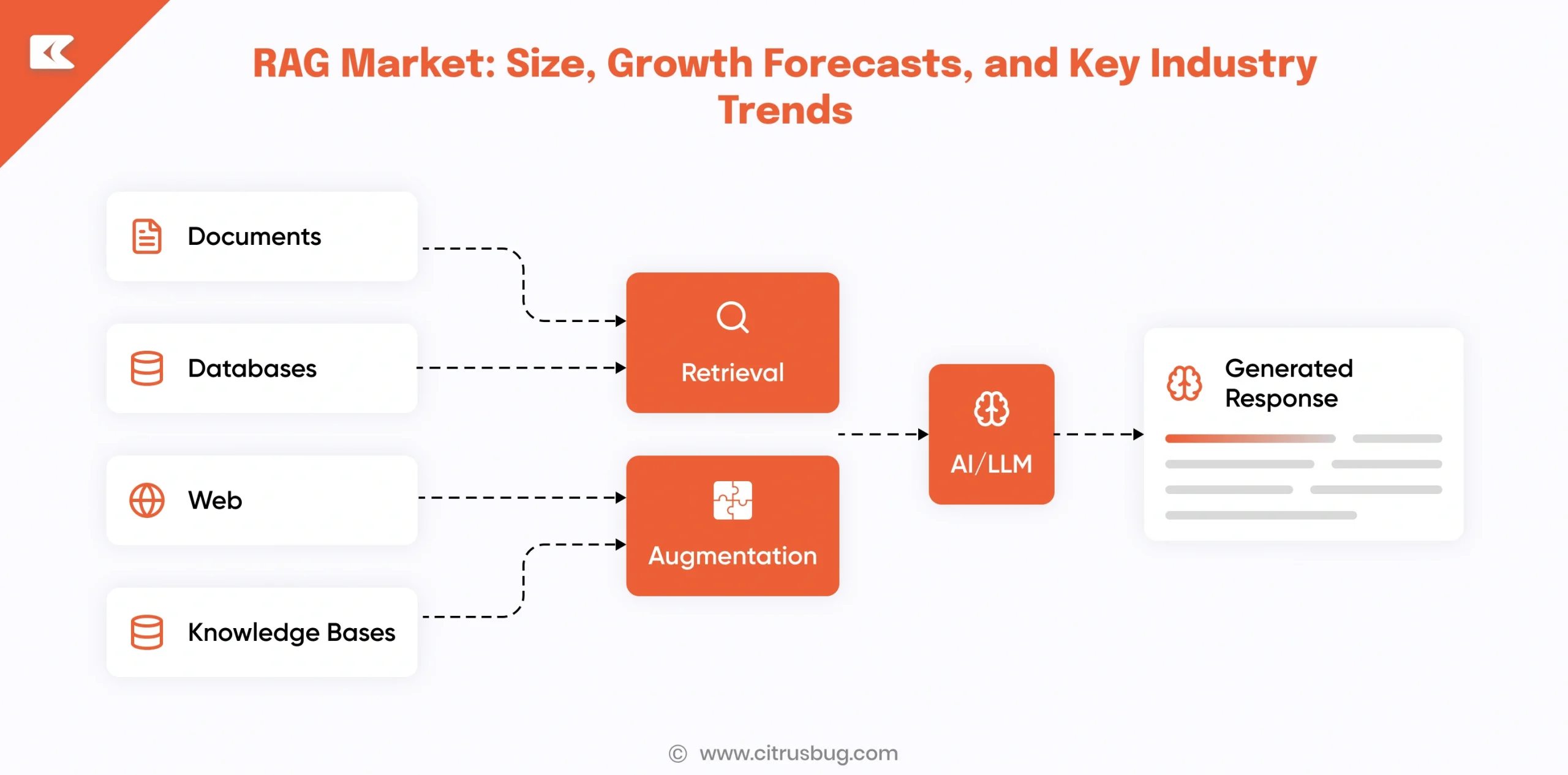
    RAG Market: Size, Growth Forecasts, and Key Industry Trends
    RAG Market: Size, Growth Forecasts, and Key Industry Trends Custom Software Development

    RAG Market: Size, Growth Forecasts, and Key Industry Trends

    Retrieval-Augmented Generation has moved from a niche AI architecture to a foundational infrastructure layer for enterprises requiring accurate, context-aware language model outputs. The RAG market is expanding at a pace…

    Read Article →
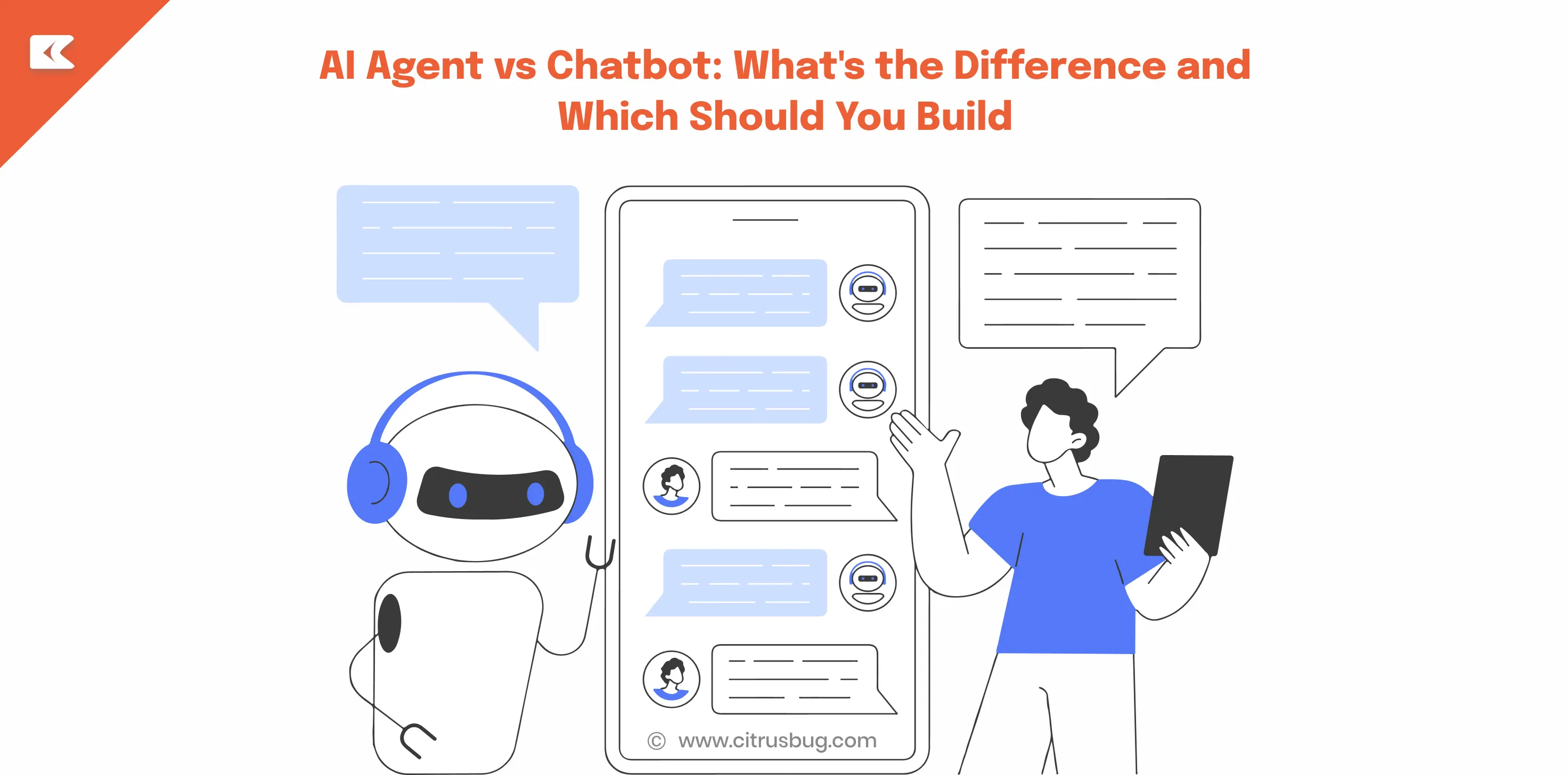
    AI Agent vs Chatbot: What’s the Difference and Which Should You Build in 2026
    AI Agent vs Chatbot: What’s the Difference and Which Should You Build in 2026 Chatbot Development

    AI Agent vs Chatbot: What’s the Difference and Which Should You Build in 2026

    A chatbot answers questions inside a fixed script. An AI agent reasons across your systems, decides what needs to happen next, and takes the action itself, without a human closing…

    Read Article →

    FAQs About RAG Development Services

    What determines the cost of a RAG development engagement?

    Data complexity, number of source systems, compliance requirements, and whether an evaluation harness and access control layer are needed from day one.

    How is RAG different from just using a longer context window?

    Long context still means paying to reprocess your entire corpus on every query. RAG retrieves only what is relevant, stays cheaper at scale, and keeps citations traceable.

    Can you rescue a RAG pilot that already exists but isn't performing well?

    Usually yes. Most failing pilots need two or three specific pipeline stages fixed, not a full rebuild. Our RAG development services start with a corpus audit before recommending anything.

    Which vector databases and embedding models do you support?

    Pinecone, Qdrant, Weaviate, and pgvector, alongside both commercial and self-hosted embedding models, selected based on your scale and data residency needs.

    How do you evaluate whether a RAG system is actually working?

    Automated scoring on retrieval recall, answer faithfulness, and citation accuracy, run against real queries from your domain, not a generic benchmark set.

    Do we own the retrieval pipeline and evaluation suite after delivery?

    Yes. Chunking logic, prompts, architecture documentation, and the evaluation suite itself transfer to you at delivery with full source code ownership.

    Can a RAG system run entirely in our own infrastructure?

    Yes. We build cloud, hybrid, and fully self-hosted deployments for organizations with strict data residency or compliance requirements.

    How long does a production RAG build take?

    Most builds take 8 to 14 weeks from kickoff to production. A retrieval audit on an existing pilot takes 1 to 2 weeks.
    How does RAG handle regulated or sensitive data?

    Access control is enforced at query time so retrieval respects existing permissions, and documents can stay entirely within your infrastructure rather than passing through a third party.

    Get an Honest Read on Your RAG Project

    Whether you are starting from zero or rescuing a stalled pilot, we will tell you what it actually needs.