
 Back
Back







Key Takeaways
- The global home healthcare software market reached $5.08 billion in 2026, growing at a 12.74% CAGR through 2031.
- Home health agencies account for over 60% of end-user demand, the primary operational buyers of scheduling and billing tools.
- Cloud-based solutions captured 58.1% of market share in 2024, while skilled nursing led service demand at 43.1%.
- 88% of healthcare providers now use at least one SaaS application to manage patient data and administrative workflows.
- Over 26% of caregivers globally lack basic digital proficiency, reducing the operational return organizations get from software investments.
The home healthcare software market has reached a defining point as care delivery increasingly moves from hospitals and traditional clinics toward the home environment. Software platforms that manage patient data, clinical documentation, caregiver scheduling, and billing have become central to how agencies and health systems handle large patient volumes outside conventional facility walls.
Demographic shifts, including a rapidly aging global population and the rising prevalence of chronic conditions, have made digital infrastructure for home-based care both operationally necessary and financially strategic. Governments in North America, Europe, and Asia Pacific have introduced telehealth reimbursement policies and national digital health programs that actively encourage software adoption across skilled nursing, therapy, and non-clinical care settings.
Together, these forces have created measurable market momentum with clear implications for technology investment decisions across agencies, hospitals, and software vendors operating in this space. Understanding these healthcare trends provides valuable context for evaluating the market’s long-term direction.
What is Home Healthcare Software?
Home healthcare software is a category of digital platforms designed to manage clinical and administrative operations for care delivered in patients’ homes. These tools cover functions such as electronic visit verification, care planning, scheduling, billing, and real-time data exchange between caregivers and clinical teams.
Beyond record-keeping, these systems give care organizations the infrastructure to manage complex patient needs at scale. They connect remote monitoring devices, streamline compliance documentation, and enable outcomes tracking across large patient populations without requiring patients to attend in-person clinical visits.
Home Healthcare Software Market Size and Growth
The global market has moved well beyond early adoption, establishing a clear growth trajectory backed by consistent provider investment and broad deployment across home health agencies, hospitals, and community care networks. Cloud migration and the integration of remote monitoring capabilities have accelerated the pace of expansion across all major provider categories, making this one of the more consistently performing segments within healthcare technology.
Global Market Valuation
The market has attracted sustained investment from both dedicated home care software vendors and large healthcare IT organizations expanding into the home setting. The overall category scale, measured across clinical and nonclinical segments, continues to rise year over year with increasing momentum tied to chronic disease management needs and post-acute care transition programs.
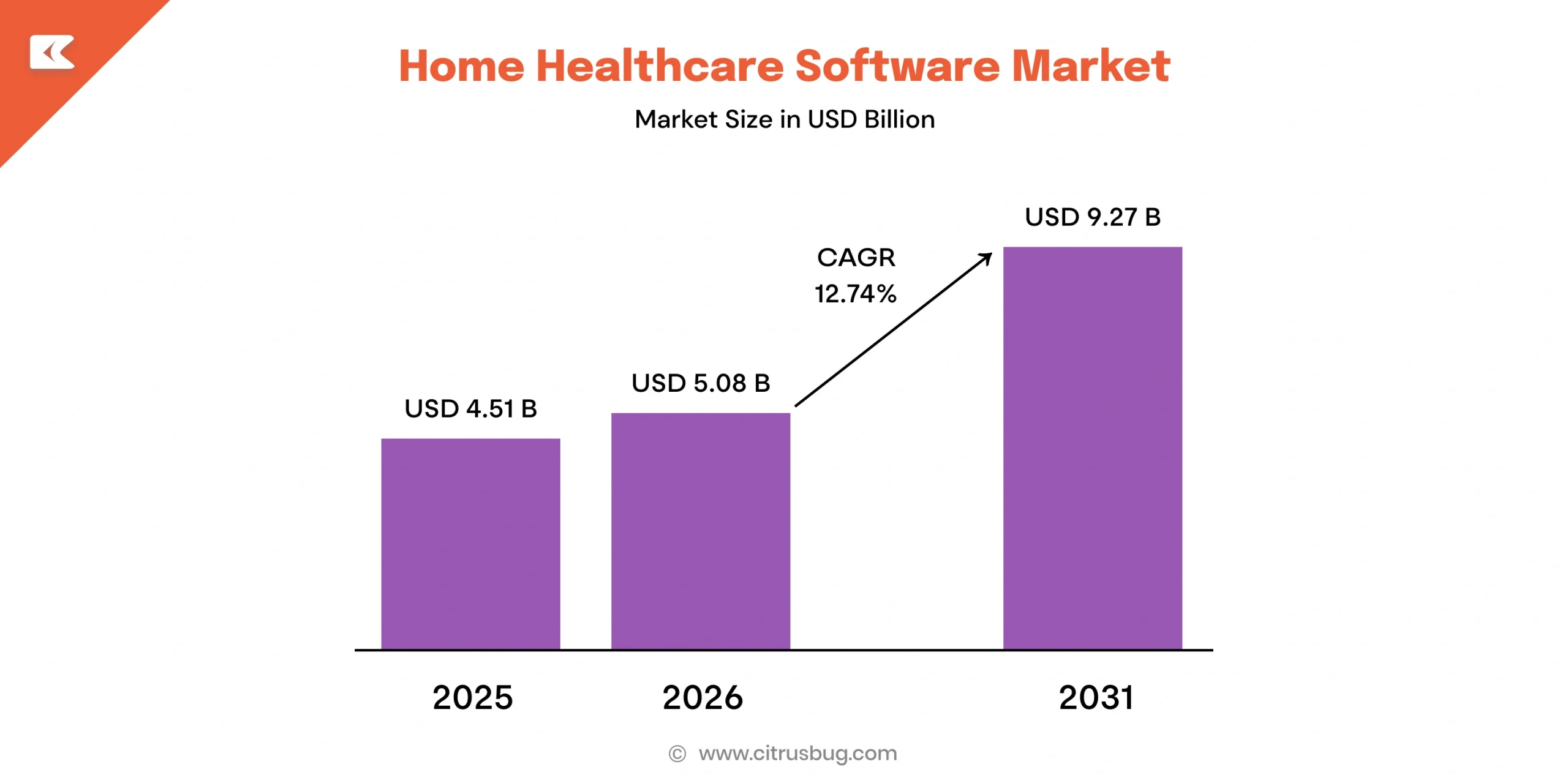
- The global home healthcare software market was valued at USD 4.51 billion in 2025 and reached an estimated USD 5.08 billion in 2026, reflecting steady acceleration in digital care infrastructure spending across agencies, hospitals, and home health providers managing chronic and post-acute care populations.
- Growth is expected to continue at a CAGR of 12.74% through 2031, driven by the expanding chronic disease burden, an aging global population, and the structural shift in healthcare financing toward outcomes-based care models that incentivize managing patients outside hospital settings.
Platform and Service Composition
The internal structure of the market reflects clear deployment preferences and a concentration of demand within the service categories that carry the highest volume of home care activity. Providers have shown consistent preference for cloud-based infrastructure and have concentrated their platform usage around skilled nursing workflows, both of which shape the commercial priorities of software vendors competing in this space.
- Cloud-based solutions captured 58.1% of the total market share in 2024, reflecting strong provider preference for scalable, remotely accessible infrastructure that reduces on-premise costs and enables real-time data access across distributed care teams and field-based caregiver workforces.
- Skilled nursing remained the leading service segment, accounting for 43.1% of total service demand in 2024, driven by the high concentration of post-acute care patients who require regular clinical oversight, medication management, and wound care coordination in home environments following hospital discharge.
How Providers Are Adopting Home Healthcare Software
Adoption patterns across this market reflect the growing scale of home care operations and the organized shift toward digitally managed workflows across both clinical and non-clinical functions. Demand is concentrated among home health agencies and hospitals, while platform preferences and commercial delivery models continue to evolve toward mobile-first and subscription-based approaches that better match operational realities in the field.
End-User Demand Across Provider Types
Adoption across provider categories reveals the breadth of organizations that now depend on digital tools to coordinate care outside clinical facilities. Home health agencies, hospitals managing post-discharge patient populations, and clinical homecare providers each represent growing and measurable segments of platform demand.
- Home health agencies account for over 60% of global end-user demand for home care software platforms in 2025, reflecting their foundational role as the primary operational buyers of scheduling, billing, documentation, and compliance tools within the broader home care ecosystem.
- Hospitals represent 48.9% of end-user demand in 2026 through discharge coordination programs, post-acute follow-up workflows, and the integration of home-based monitoring into care pathways for high-risk patients transitioning out of inpatient settings.
- Clinical homecare systems, which support visit planning and patient documentation for clinical staff, are expected to account for 52.0% of total usage demand in 2026, confirming that the clinical workflow management layer remains the most heavily utilized functional category within home care software platforms.
Platform and Deployment Preferences
Beyond provider type, the market’s adoption profile reveals clear preferences in how software is accessed on the ground and licensed commercially. Mobile-first delivery and subscription-based pricing have both gained significant ground as providers prioritize operational flexibility and lower upfront technology spend.
- Handheld devices and smartphones accounted for 46% of access layer demand for home healthcare software in 2024, driven by the widespread adoption of mobile health applications for monitoring, scheduling, and teleconsultations among field-based caregivers who operate outside office or facility settings.
- The SaaS deployment model recorded 33% uptake growth across European home healthcare organizations in 2024, as reduced upfront licensing costs, lower IT maintenance burden, and access to continuous platform updates made subscription-based delivery the commercially preferred model for agencies of all sizes across the region.
Key Technology Trends Reshaping Home Healthcare
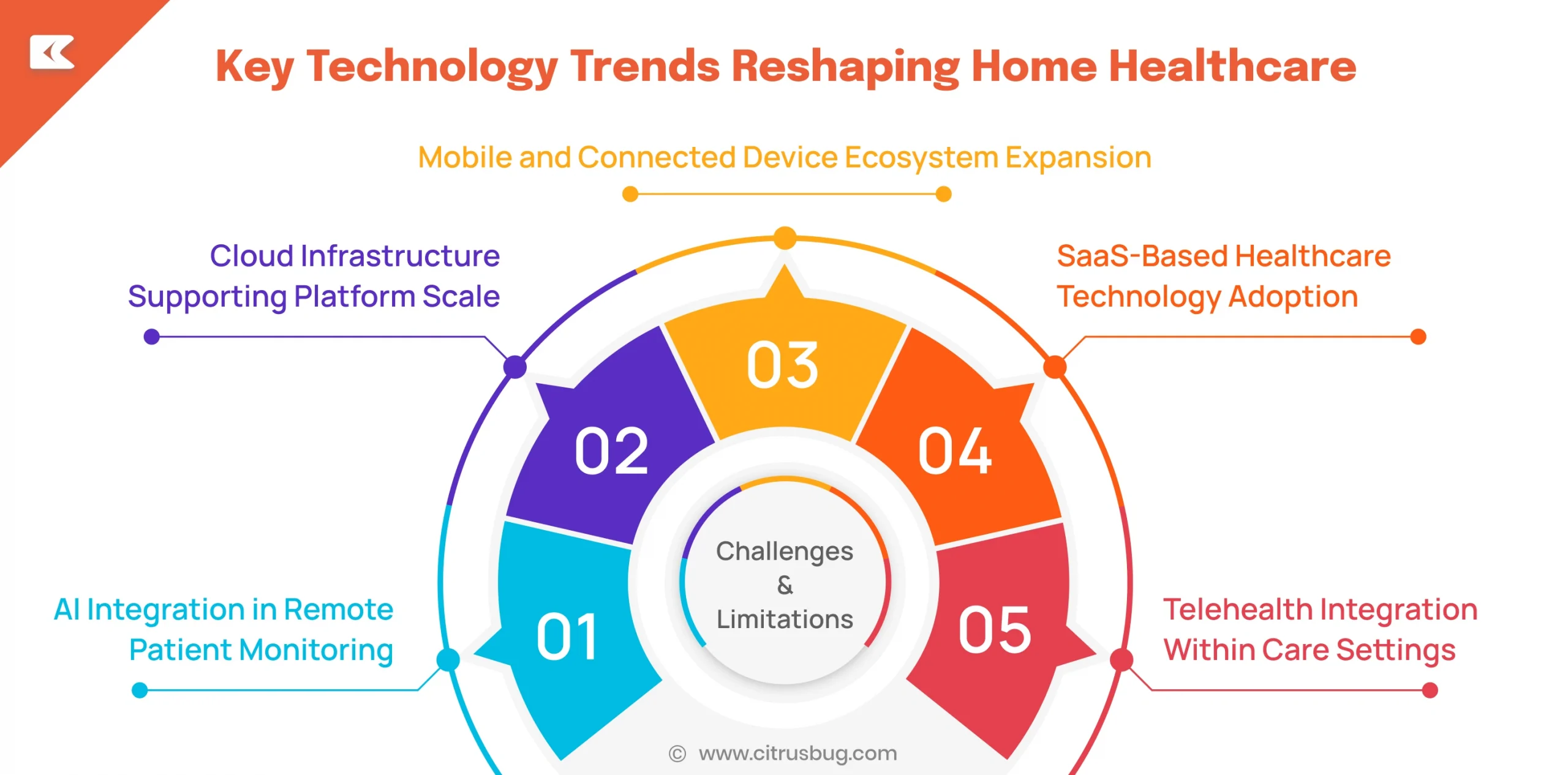
The technology landscape of this market is shifting steadily, with artificial intelligence integration, cloud infrastructure expansion, mobile-first delivery, and telehealth adoption each playing a distinct role in reshaping how home care software platforms are built, scaled, and deployed across diverse care environments. These are not isolated developments; they reinforce one another and together define where the market is heading.
AI Integration in Remote Patient Monitoring
AI-enabled capabilities have moved from experimental additions to core platform components, particularly within remote patient monitoring applications where continuous data streams from home-connected devices require automated analysis, pattern recognition, and alert generation that would be impossible to manage manually at scale.
The global AI in remote patient monitoring market was valued at USD 1.99 billion in 2024, marking the rapid progression of AI-enabled home care software from conventional monitoring toward predictive analytics and automated clinical decision support that reduces clinician workload while improving response times for deteriorating patients.
Cloud Infrastructure Supporting Platform Scale
Healthcare organizations across all provider types have accelerated their migration toward cloud-native infrastructure, and home healthcare software platforms are direct beneficiaries of the investment, standardization, and interoperability progress this shift has produced at the infrastructure level.
The global healthcare cloud computing market reached USD 38.50 Billion in 2025, creating the backbone for scalable, interoperable home care platforms that manage large volumes of patient data, device feeds, and caregiver workflows without requiring significant on-premise IT capacity from the agencies or hospitals deploying them.
Mobile and Connected Device Ecosystem Expansion
The growth of smartphone-based care delivery and connected remote monitoring hardware has created a large and expanding installed base that depends on integrated software platforms for data management, clinical documentation, workflow coordination, and regulatory compliance across increasingly distributed care environments.
The remote patient monitoring devices market, which generates the clinical data streams that home healthcare software platforms are built to manage, reached USD 26.2 billion in 2025, demonstrating the scale of the connected hardware ecosystem that drives sustained and compounding software platform demand.
SaaS-Based Healthcare Technology Adoption
Subscription-delivered software has become the standard delivery model across healthcare broadly, and home care is no exception to this shift. The widespread migration toward SaaS-based tools reflects both the cost structure advantages for smaller agencies and the operational benefits of continuously updated, vendor-managed cloud platforms for larger health systems.
88% of healthcare providers currently use at least one SaaS application to manage patient data and administrative workflows, establishing the foundational commercial infrastructure and organizational comfort that makes cloud-based home healthcare software both viable and adoptable across provider types of all sizes.
Telehealth Integration Within Care Settings
Telehealth capabilities are being embedded directly into home healthcare platforms as providers look to reduce in-person visit frequency while maintaining the clinical oversight and documentation standards required for high-acuity patients receiving care at home. This integration is no longer an optional feature for competitive platforms.
Telehealth module adoption rose 49% across skilled nursing facilities in 2025, demonstrating the rapid and measurable integration of virtual care capabilities into the software platforms that home health and long-term care providers rely on most heavily to manage clinical staff workflows and patient populations.
How the Market Breaks Down by Segment
The home healthcare software market divides across several distinct functional categories, each reflecting a different dimension of care delivery and a separately measurable commercial opportunity. Clinical software, nonclinical management tools, equipment-integrated platforms, and adjacent long-term care solutions each represent meaningful and independently growing portions of total market activity.
Clinical Homecare Systems
Clinical homecare systems form the operational core of the market’s software composition, supporting visit planning, patient documentation, care plan management, and real-time compliance tracking for clinical staff delivering services directly in patients’ homes. Their dominant position within the software type breakdown reflects both the regulatory documentation requirements and the clinical complexity of home-based care.
Clinical management systems held 37.5% of the software type segment in 2024, reflecting their foundational importance in supporting the clinical workflows that underpin home care agency operations. These platforms typically integrate with electronic health records and billing systems to provide end-to-end visibility across care episodes and support accurate reimbursement documentation for payers.
Nonclinical Homecare and Equipment Segments
Beyond clinical platforms, a substantial share of market activity is concentrated in nonclinical tools and equipment-linked software categories that do not require clinical functionality but are essential to the operational management of large-scale home care programs.
The equipment segment, covering remote patient monitoring devices and diagnostic tools integrated with home healthcare platforms, generated USD 9.55 billion in revenue in 2024, reflecting the scale of connected hardware investment that creates downstream and ongoing software platform demand.
Long-Term Care Software
Long-term care software represents an adjacent and frequently overlapping segment with home healthcare platforms, as many organizations manage both home-based and facility-based long-term care using shared or integrated technology systems. The boundaries between these categories are increasingly blurred as providers consolidate technology investments.
Starting at USD 2.31 Billion in 2026, the global Long-term Care Software Market is set to witness notable growth. By 2035, it is projected to reach USD 7.41 Billion. The market is expected to expand at a CAGR of 14% throughout the forecast period from 2026 to 2035.
This convergence creates a meaningful commercial opportunity for home healthcare software vendors that serve both home-based and facility-based care providers through unified management platforms.
Regional Market Share and Growth Insights
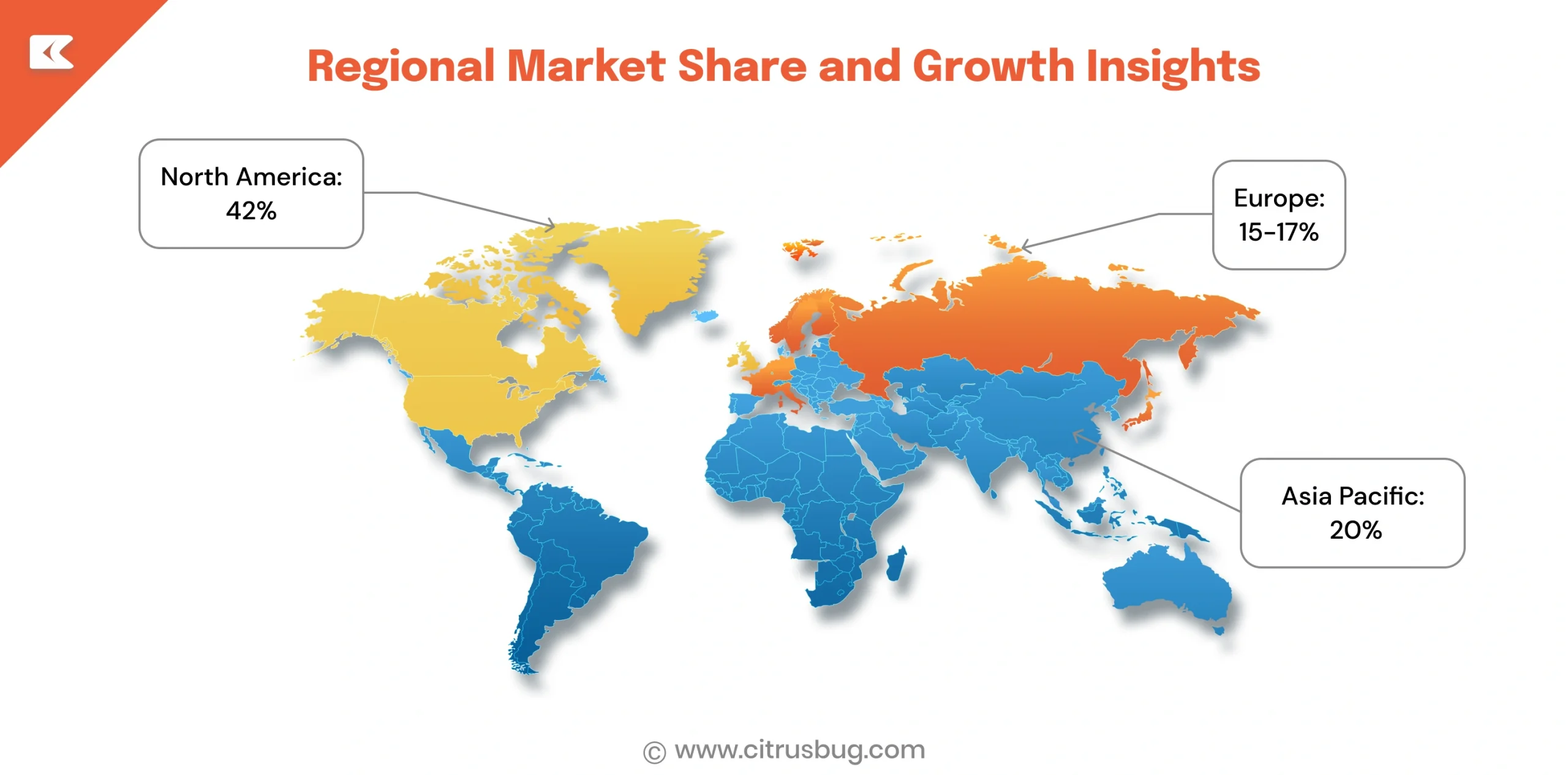
Growth in the home healthcare software market varies significantly by region, shaped by differences in healthcare system maturity, demographic aging rates, telehealth reimbursement policy frameworks, the availability of connected care infrastructure, and the pace of national digital health investment programs that directly influence provider software adoption.
North America
- North America captures approximately 42% of global home healthcare software market share in 2026, supported by a highly developed healthcare IT ecosystem, widespread telehealth adoption, and favorable insurance and reimbursement policies for home-based care. The depth of connected infrastructure supporting this position is evident in the U.S. remote patient monitoring devices market, which reached USD 10.2 billion in 2025, reinforcing the scale of device deployment that drives software platform demand across the region.
Europe
- Germany holds 15-20% of European home healthcare software market value, while the United Kingdom accounts for 15-17% of regional revenue, with both markets shaped by EU-wide interoperability requirements including GDPR and the European Health Data Space framework, as well as NHS digital transformation priorities in the UK that create consistent policy-level demand for integrated care software.
Asia Pacific
- Asia Pacific is the fastest-growing regional market, recording a 20% uptick in software adoption specifically targeting geriatric care in 2025, driven by rapid demographic aging in China and India, expanding smartphone penetration, and government-backed digital health investment programs. The region is projected to maintain a CAGR of 9.00% through 2032, making it the highest-velocity growth market globally for home healthcare software adoption.
Challenges and Barriers to Wider Adoption
Growing the home healthcare software market requires overcoming several operational, technical, and regulatory obstacles that continue to slow uptake across different provider types, geographic markets, and care settings. These challenges exist alongside strong growth momentum and are important for both vendors and adopting organizations to understand.
- Caregiver Digital Literacy Gaps: Over 26% of caregivers globally lacked basic digital proficiency in 2024, leading to underutilization of core software features including mobile scheduling, incident documentation, and electronic visit verification, which reduces the operational return organizations can extract from their platform investments and slows full-scale adoption.
- Healthcare IT Integration Complexity: 19% of nonclinical homecare providers reported significant challenges integrating their platforms with broader healthcare IT systems in 2024, particularly in rural and lower-resource settings where existing infrastructure does not support reliable data exchange with hospital systems or electronic health records.
- Regulatory Complexity in High-Growth Segments: The mental health and behavioral monitoring segment of AI-enabled remote patient monitoring is projected to grow at a CAGR of 28.9% from 2024 to 2030, creating both significant market opportunity and mounting compliance demands for home healthcare software platforms that must continuously adapt to evolving mental health data regulations, consent frameworks, and cross-jurisdictional privacy standards.
Future Market Outlook and Opportunities
The home healthcare software market is positioned for substantial multi-year growth as structural forces including an aging global population, rising chronic disease prevalence, and increasing healthcare cost pressure continue to make home-based digital care delivery more financially viable than facility-based alternatives. The forecast data across clinical software, nonclinical tools, AI-integrated platforms, and adjacent device ecosystems all point toward a market that will be considerably larger and more diversified by the early 2030s.
- The home healthcare software market is projected to reach USD 12.54 billion by 2032 at a CAGR of 11.75% between 2026 and 2032, as expanding provider adoption, growing platform diversity, and sustained reimbursement support for remote care delivery across North America and Europe drive consistent long-term growth in the core software category.
- The global AI in remote patient monitoring market is expected to reach USD 8.51 billion by 2030 at a CAGR of 27.98% from 2025 to 2030, placing AI-integrated home healthcare software at the center of the market’s highest-growth technology segment and establishing AI capability as an increasingly non-negotiable feature for competitive platforms.
- The nonclinical homecare software market is projected to grow from approximately USD 6.89 billion in 2024 to USD 16.81 billion by 2031, reflecting a 13.6% CAGR, driven by increasing demand for scheduling, billing, caregiver management, and compliance solutions.
- When including integrated software products and related professional services, the broader home healthcare technology market is forecast to grow from USD 13.61 billion in 2024 to USD 37.22 billion by 2032 at a CAGR of 13.4%, reflecting the combined commercial scale of software platforms, implementation services, training programs, and ongoing managed support across enterprise health system deployments.
- The therapeutic equipment segment, which drives software platform demand through its requirements for data capture, remote monitoring, and clinical workflow integration, is projected to grow at a CAGR of 23.1% from 2025 to 2032, driven by rising demand for home-based rehabilitation, chronic condition management, and remote therapy services that require integrated software infrastructure to operate effectively at scale.
- The cardiovascular disorder and hypertension segment within home care software is forecast to reach USD 5.39 billion by 2032, reflecting the outsized demand for digital monitoring, medication management, and care coordination tools among the large and growing population of patients managing heart conditions in home settings with support from connected clinical platforms.
Conclusion
The data across this analysis confirms that the home healthcare software market is growing rapidly and structurally, shaped by demographic shifts, technological advancement, and healthcare system reform rather than short-term demand cycles. From clinical management platforms to nonclinical scheduling tools and AI-integrated monitoring systems, the sector spans multiple functional categories all experiencing consistent and compounding growth.
For healthcare organizations, software vendors, and investors evaluating this space, the trajectory points clearly toward a market that will be substantially larger and more technologically capable by the early 2030s.
Digital home care infrastructure is becoming foundational to how chronic and complex patient populations are managed cost-effectively, and purpose-built home healthcare software gives organizations the operational and clinical tools needed to deliver coordinated care at scale. Healthcare providers and businesses looking to build patient-focused digital solutions can leverage professional healthcare app development services to create secure, scalable applications aligned with evolving home care needs.