
 Back
Back







Key Takeaways
- A two-week AI sprint can produce a working prototype, but no major AI coding tool (Cursor, Copilot, Lovable) currently signs a HIPAA Business Associate Agreement.
- The moment real patient data touches a BAA-less tool during development, a HIPAA exposure exists before the product even launches.
- Retrofitting HIPAA-compliant architecture after development typically costs 3-5x more than designing for compliance from the first sprint.
- SaMD classification (triggered by diagnostic or treatment-recommendation features) requires a 510(k) submission taking 10-17 months and $250,000-$900,000.
- Realistic healthcare app timelines range from 3-5 months for admin tools to 14-24 months for FDA-regulated SaMD products with full clinical validation.
AI healthcare app development is moving faster than ever, but faster isn’t the same as deployable, especially in a regulated industry. Every week, you may read a new post claiming someone shipped a clinical app in two weeks using AI tools. In most software categories, that’s genuinely impressive. In healthcare, it’s the beginning of a much harder conversation, regardless of the types of AI in healthcare being implemented.
This article maps exactly what those builds do and don’t account for: the compliance layers, the technical architecture, the regulatory landscape, and the real timelines that AI medical app development for production-grade healthcare software actually requires, layer by layer.
The Conversation Happening Right Now Across the Internet
What Developers Are Actually Saying (Real Examples)
The developer community is having a genuinely split conversation about AI-assisted development:
The Optimist Side:
- Tools like Cursor, Bolt, Lovable, and Replit Agent have meaningfully compressed the time it takes to go from idea to functional prototype
- Costs are collapsing; non-coders are shipping systems that would have required full engineering teams two years ago
The Realist Side: from engineers who have shipped real products:
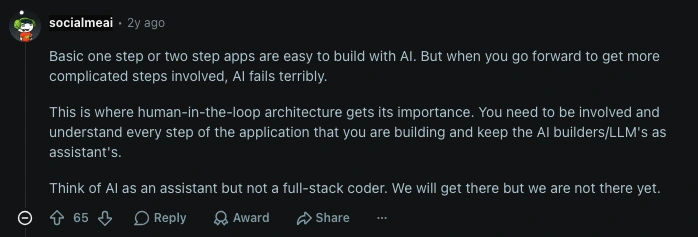
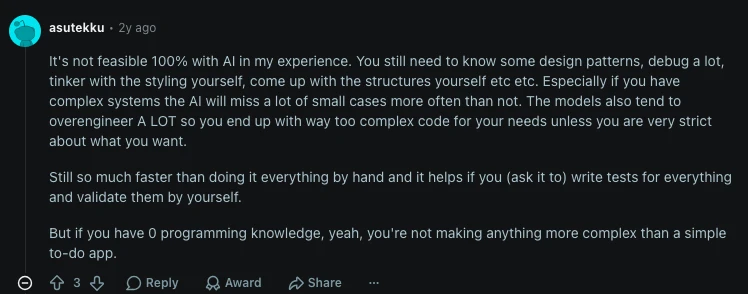
What these real-world examples confirm:
- The human-in-the-loop constraint isn’t a philosophical preference; it’s a practical ceiling that shows up in every complex multi-step system
- Healthcare workflows are almost entirely composed of complex, exception-heavy multi-step processes, so that ceiling appears early and consistently
- Zero programming knowledge caps the output at a to-do app level
- AI-generated code may be functional in isolation; it will miss exception handling, clinical state machine complexity, and the workflow branching that makes clinical software safe to operate
The Non-Coder Who Built a Multi-Agent System (And What That Actually Means)
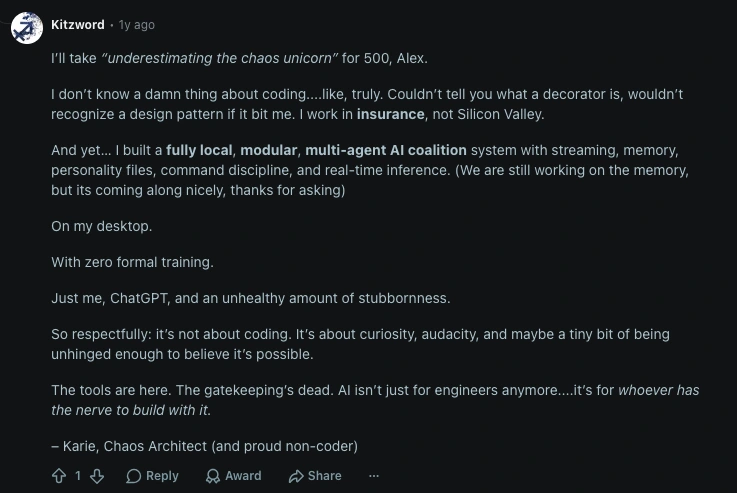
That’s a legitimate achievement. But here’s the critical qualifier:
- The system contained no patient data
- Had zero HIPAA surface area
- Had no clinical workflow dependency
- The “stubbornness and domain knowledge” that made it work was sufficient for an insurance productivity system
In healthcare, those same qualities are necessary, but structurally insufficient.
The $450 vs. $65,000 Build – What the Numbers Don’t Show
A solo builder documented their full cost for a functional application:
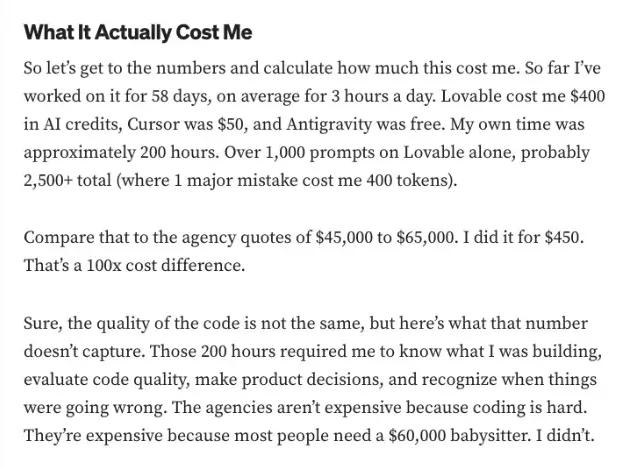
The cost headline is real. A solo builder documented their full cost breakdown for a functional application: $450 in AI tools, 200 hours of their own time, over 1,000 prompts on Lovable alone. The agency quotes for equivalent scope came in at $45,000–$65,000. The builder is correct that the difference is not primarily about coding ability.
The builder is right in generic SaaS. In healthcare, the babysitter analogy transforms into strategic and structural roadmap:
- The expertise you cannot replace isn’t project management
- It’s your HIPAA compliance architect, your HL7 FHIR integration engineer, your clinical validation specialist, and your regulatory counsel
- None of them have AI substitutes
- The cost of removing them from the equation isn’t a larger bill, it’s an operating license, a patient safety incident, or a federal enforcement action
Now Apply That Same Mindset to Healthcare. Here’s Where It Breaks.
- The economics, speed, and democratization of AI development are real, up to a very precise line
- Failure modes in a productivity tool cost time
- Failure modes in clinical software cost patient safety and your organization’s operating license
That’s the line. Everything that follows in this article is a map of what lives on the other side of it and what responsible AI healthcare app development requires from the very first sprint.
What AI Can Actually Build in 2 Weeks, and What That Gets You
The Legitimate Output of an AI-Assisted Sprint
A two-week AI sprint in healthcare can produce real, useful output:
- A functional frontend with clinically appropriate UX patterns
- A CRUD backend with basic authentication and role separation
- LLM API integration for note generation, patient intake, or structured summarization
- Cloud deployment with basic monitoring and logging
What these deliverables are good for:
- Investor demos
- UX validation with clinical staff using synthetic data
- Workflow testing in controlled environments
- Proof-of-concept reviews with potential hospital partners
Research has found that AI can accelerate software development tasks, with one enterprise-based randomized controlled trial involving 96 Google engineers estimating a 21% increase in development speed. The effect varies by task, developer, and AI tool, however, so faster code generation does not necessarily mean production-ready software, especially in healthcare, where security, compliance, testing, and clinical requirements add additional constraints.
The Exact Moment It Becomes a Compliance Liability
The prototype becomes a compliance liability the moment any real Protected Health Information (PHI) enters the system:
- Not when you add a clinical feature
- Not when you submit to app stores
- The moment any patient data, even a single test record, touches a service or developer tool lacking an active Business Associate Agreement (BAA), you have a HIPAA exposure
- That exposure predates your launch and cannot be remediated retroactively
A prototype that functions correctly is not a product that’s safe to ship, in AI healthcare app development, meeting compliance requirements is what separates the two.
The gap between “it runs” and “it can ship” is an entire engineering discipline:
- HIPAA-compliant architecture
- PHI de-identification protocols for any AI training or retrieval pipeline
- Comprehensive audit logging
- Granular access controls
- Clinical validation
- In some cases, FDA regulatory clearance
The gap between them is not a checklist, it’s a structural commitment that must begin at the architecture phase.
Technical Stack the Demo Never Shows
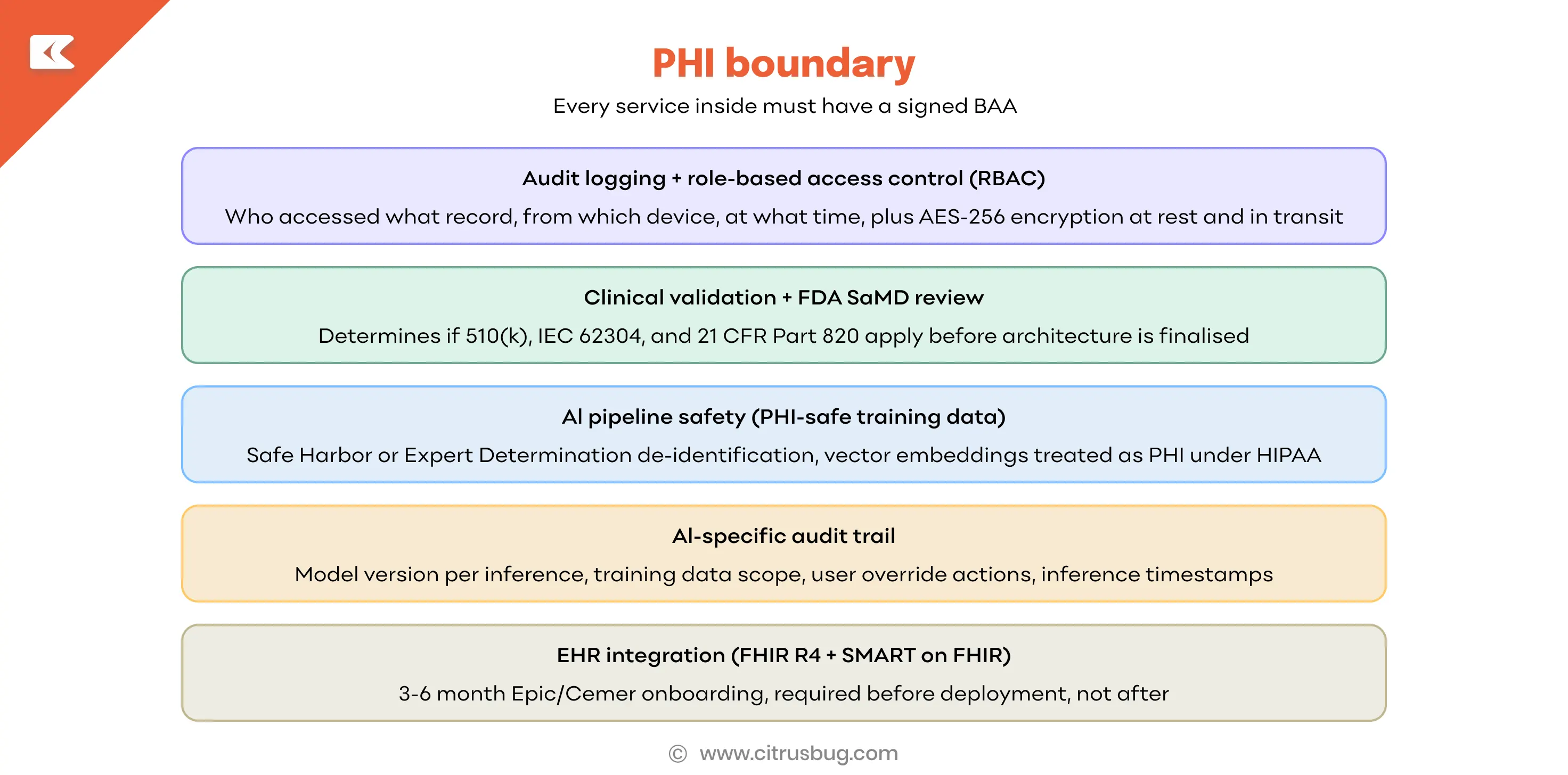
Encryption, RBAC, and Audit Logging Are Architecture, Not a Sprint Task
Security and compliance infrastructure isn’t a feature you add to a prototype. It’s an architectural commitment that shapes every downstream decision:
- AES-256 encryption required at rest and in transit across every service that could touch PHI, including logging systems, analytics platforms, model inference endpoints, and vector databases
- Granular role-based access control distinguishing clinician, administrator, biller, and patient roles, not just authenticated vs. unauthenticated states
- Session management beyond standard web patterns:
- Automatic timeout on inactivity
- Concurrent session controls
- Re-authentication for sensitive operations
- Audit logging that records who accessed what record, from which device, at what time, and in what clinical context
Retrofitting core architectural concerns after development has begun is generally far more expensive than designing for them from the outset. Research on architectural technical debt shows that postponing foundational design decisions increases maintenance costs, slows future development, and makes remediation progressively more difficult.
No Major AI Coding Tool Signs a BAA, And That’s Already an Exposure
This is one of the most consequential and least-discussed risks in AI-assisted healthcare development:
- Cursor, GitHub Copilot, Bolt, Lovable, and Replit currently do not offer Business Associate Agreements
- The underlying LLM APIs do provide BAA pathways for enterprise customers
- The developer tooling sitting on top of those APIs does not
- If real patient context, even a single record used to debug a feature, passed through any BAA-less tool during development, that exposure exists before you launch
HIPAA-ready application development practices require documenting this boundary explicitly before any development tooling is selected.
PHI Memorization in Fine-Tuned Models, The Risk Nobody Mentions
Training AI models on raw EHR data is among the most common and costly mistakes in healthcare AI development:
- Fine-tuned language models can reproduce patient-specific information through model inversion vulnerabilities
- HIPAA provides two compliant pathways for PHI de-identification:
- Safe Harbor — removal of 18 identifier categories
- Expert Determination — documented statistical analysis
- Vector embeddings generated from patient data are currently interpreted as PHI under HIPAA guidance
- The most current AI trends in healthcare show these regulatory interpretations are tightening, not loosening.
What a Defensible AI Audit Trail Actually Requires
Standard HIPAA audit logging is the compliance baseline. AI-specific requirements go substantially further:
- The model version for each inference event
- The scope of source training data
- Every user review and override action on AI-generated outputs
- Precise inference timestamps
This shapes your data model and database schema from day one and must be designed into the system before the first clinical feature is built by any AI healthcare software development company.
EHR Integration: Where the Timeline Claim Fully Collapses
Connecting to Epic Is Nothing Like Plugging Into Stripe
| Stripe | Epic | |
| Documentation | Publicly available REST docs | Formal onboarding process |
| Sandbox access | Instant | Requires institutional sponsorship |
| Technical support | Responds in hours | Months-long hospital IT procurement cycle |
| Timeline to live data | Days | 3–6 months from initial contact |
Effective EHR integration services require understanding these institutional dynamics as a core competency, not as a project variable to be managed around.
HL7 v2, FHIR R4, and the ONC Information Blocking Rule
- HL7 v2 remains dominant in legacy clinical systems, notoriously inconsistent across vendors, with edge cases that only appear with real clinical data
- FHIR R4 is mandated under the 21st Century Cures Act for any EHR read/write operations, with SMART on FHIR as the authorization layer
- The ONC Information Blocking Rule means your integration architecture can create a regulatory violation independent of your product’s intent
Why HIPAA Compliance Alone Won’t Get You Into a Single Hospital
HIPAA compliance is a legal necessity. It is not a deployment credential.
Hospitals operate on an independent evaluation framework that includes:
- Documented clinical validation
- Workflow integration within the EHR environment clinicians already use daily
- Security reviews that exceed HIPAA baseline standards
- Change management considerations for clinical staff adoption
- In many cases, clinical champion sponsorship within the institution
EHR integration is a deployment prerequisite, not a post-launch feature.
FDA SaMD Classification: The Layer Most AI Healthcare Builders Miss Entirely
The SaMD Line, Drawn Specifically for AI Features
Software as a Medical Device (SaMD) classification does not depend on whether your product is called an app, a platform, or a tool, or clinical decision support software. It depends on what the software does in a clinical context and the degree to which its output informs clinical decision-making.
| Software Function | Classification |
|---|---|
| Scheduling, billing, patient communications | Not SaMD |
| Clinical documentation assistance | Generally not SaMD |
| Risk stratification from clinical data | SaMD |
| Diagnostic suggestions | SaMD — 510(k) required |
| Treatment recommendations | SaMD — 510(k) required |
What SaMD Classification Actually Triggers
- A 510(k) or De Novo submission takes 10–17 months and costs $250,000–$900,000 in preparation, testing, clinical evidence collection, and submission fees
- Quality management system requirements under 21 CFR Part 820 govern every aspect of the development lifecycle
- IEC 62304 software lifecycle documentation is required for Class II and Class III devices, specifying mandatory artifacts at every stage
These are not documentation tasks performed after the product is built. They define the methodology by which the product must be built.
Why IEC 62304 and Vibe Coding Are Structurally Incompatible
IEC 62304 mandates:
- Documented planning before any code is written
- A requirements traceability matrix
- Architecture documentation
- Unit and integration testing artifacts
- Change management records for every release
“Vibe coding”, generating code iteratively through LLM prompts without formal documentation, produces none of these artifacts.
- Compliance is a methodology requirement, not an output quality requirement
- The SaMD classification decision must be made at design phase, before architecture is finalized
Engaging healthcare AI consulting services at project inception is the only reliable way to prevent the most expensive reclassification and rebuild scenarios.
The Real Healthcare AI Development Timeline, By Product Type
Benchmarks Across Five Categories
The realistic AI healthcare app development timeline varies significantly by product type, regulatory pathway, and integration scope. These benchmarks reflect what compliant, production-grade development actually requires:
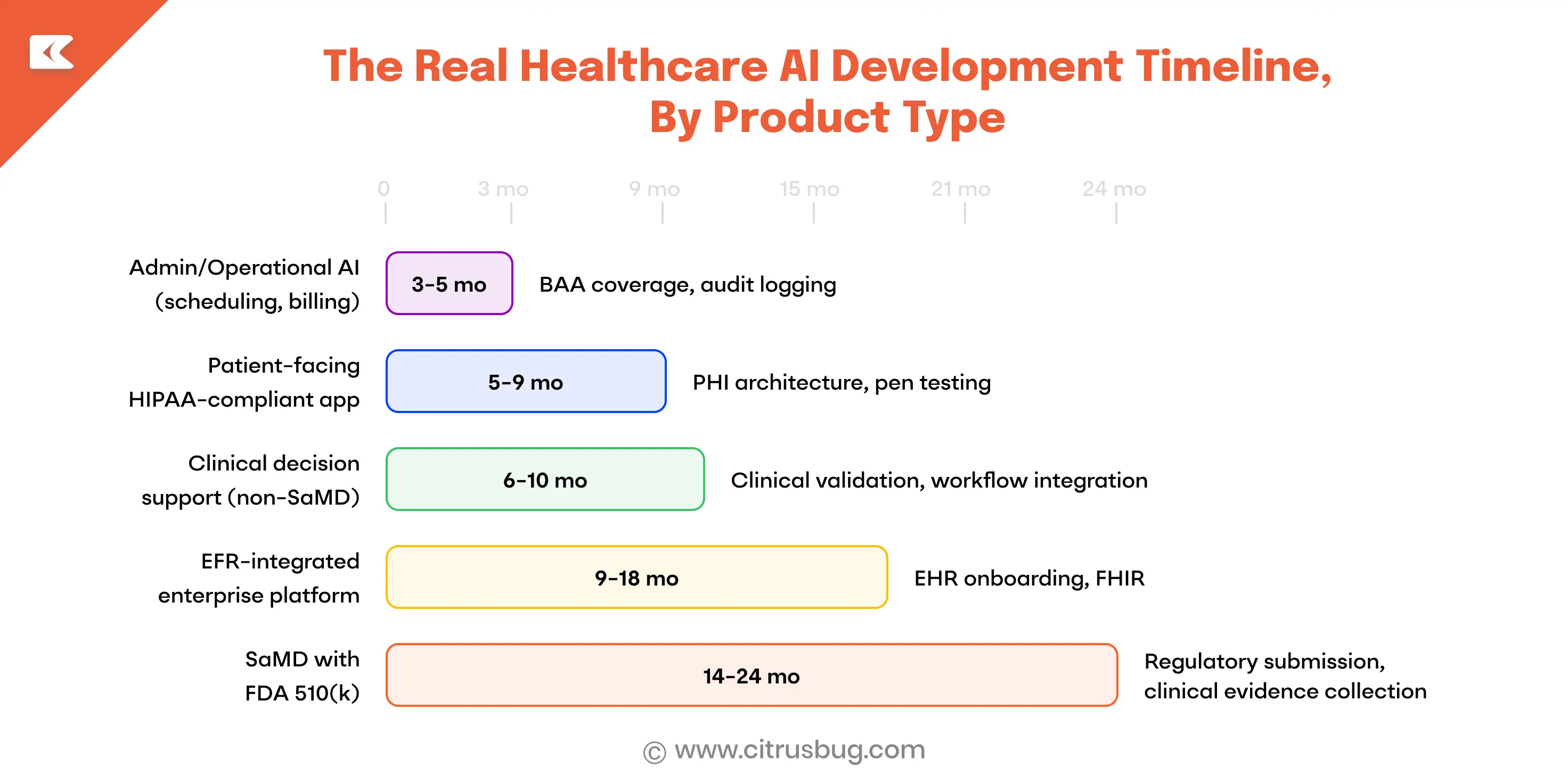
| Product Type | Realistic Timeline | Primary Bottleneck |
|---|---|---|
| Admin / operational AI (scheduling, billing, comms) | 3–5 months | BAA coverage, audit logging |
| Patient-facing HIPAA-compliant app | 5–9 months | PHI architecture, pen testing |
| Clinical decision support (non-SaMD) | 6–10 months | Clinical validation, workflow integration |
| EHR-integrated enterprise platform | 9–18 months | EHR onboarding, FHIR compliance |
| SaMD with FDA 510(k) | 14–24 months | Regulatory submission, clinical evidence |
Where AI Genuinely Compresses Healthcare Development Time
AI is a genuine accelerant in AI healthcare app development, in specific, bounded areas where outputs can be verified against known requirements:
- FHIR test data generation — compresses from weeks to days using PHI-safe synthetic patient populations
- IEC 62304 documentation drafting — traceability matrices, risk tables, software requirements specifications can be substantially accelerated when underlying requirements are already defined
- Compliance code scanning — for unencrypted PHI handling and missing audit logging calls
- Operational AI tooling built on existing compliant infrastructure, 4–12 weeks is achievable
Where AI Provides Exactly Zero Shortcut
Some timelines are not compressible by AI, regardless of tool or prompt quality:
- BAA negotiations — involve legal review and commercial risk evaluation on both sides
- EHR vendor onboarding and sandbox access — gated by institutional governance on hospital IT calendars
- Clinical validation studies — require IRB approval and FDA-standard statistical analysis
- FDA regulatory review timelines — fixed by the agency itself
- Hospital IT procurement cycles — driven by capital planning and governance structures
- Third-party penetration testing — performed by independent firms on their own schedules
These are not software problems. AI cannot shorten them.
Five Questions to Answer Before Writing a Line of Healthcare Code
Use this as a pre-build checklist. If any answer is “not yet,” that answer is your starting point, not your codebase. These questions must have documented answers before architecture is finalized.
- Where does your PHI boundary sit?
Map every service, model, cache, log, and third-party tool that could touch patient data. This defines your BAA scope, encryption surface, and audit logging requirements.
Red flag: your compliance perimeter is undefined, any tool in your stack is a potential exposure.
- Is your AI output classified as SaMD?
Get a regulatory opinion before architecting any clinical-facing feature. This determines whether FDA 510(k), IEC 62304, and 21 CFR Part 820 apply to your product.
Red flag: you build a diagnostic feature, ship it, then discover it needed FDA clearance 14 months ago.
- Is your training data pipeline PHI-safe and auditable?
Your de-identification method must be documented and defensible. This affects model safety, regulatory defensibility, and re-identification risk.
Red flag: your model was trained on raw EHR data, the model itself is now a PHI exposure vector.
- What is your EHR integration path?
Know which EHRs your customers run, which FHIR resource types you need, and your sandbox access status. This sets your integration timeline, FHIR compliance scope, and hospital IT requirements.
Red flag: EHR integration gets scoped as a post-launch feature and becomes a 6-month deployment blocker.
- Does every tool in your stack have a signed BAA?
Cloud provider, LLM API, logging service, analytics platform, full audit. This defines your legal liability boundary and technical access control scope.
Red flag: Cursor or Lovable touched patient context during development, the exposure exists before you’ve shipped a single line to production.
What AI Readiness in Healthcare Actually Means
The Predictable Cost of Build-First, Comply-Later
- Retrofitting HIPAA-compliant architecture after development typically costs 3–5× more than designing for compliance from sprint one, a key argument for starting with a compliance readiness assessment
- Compliance requirements affect data models, API contracts, logging infrastructure, and access control patterns, all expensive to change post-build
- The compliance review itself becomes a 3–6 month launch bottleneck, with security audits, penetration testing, and policy documentation running in parallel
- The 2025 HIPAA Security Rule updates add new ongoing operational requirements:
- Comprehensive asset inventories
- Network segmentation documentation
- 6-month vulnerability scanning cycles
- Annual penetration testing
AI Accelerates Execution. It Cannot Substitute for Architecture.
The $450 build and the two-week prototype are legitimate achievements, for validation:
- They demonstrate a concept is feasible
- They show users respond positively to a workflow
- They confirm core logic operates as expected under controlled conditions
They are not production-ready healthcare products.
AI readiness in healthcare means:
- The underlying architecture is mature enough that AI-generated code is deployable into a compliant production environment
- Not just functional in a development sandbox
- The speed of code generation is irrelevant if the compliance foundation isn’t present
The Difference Between a Fast Prototype and a Deployable Product
| Decision Point | Fast Prototype | Deployable Product |
| Compliance | Treated as a launch blocker, discovered at the end | Treated as a design constraint from day one |
| Pre-build checklist | Skipped or deferred | Five questions answered before writing code |
| EHR integration | Scoped as a post-launch feature | Built into the initial architecture decisions |
| Infrastructure selection | Chosen for features first | Chosen based on BAA availability first |
| Regulatory pathway | Figured out after building | Determined before building any clinical features |
| Role of AI tools | Used to move fast around the framework | Used to move faster within the framework |
The framework was never optional. It was the prerequisite that made everything else deployable. That’s what AI readiness actually means in healthcare: the infrastructure is already there, and AI accelerates execution within it.
Conclusion
The conversation online is real; developers are building faster than ever with AI healthcare app development tools, costs are collapsing, and non-coders are shipping systems that would have required full engineering teams two years ago. In every other software category, that’s an unambiguous win. In healthcare, the same speed applied without the right compliance and technical foundation creates liabilities that no AI tool can fix retroactively.
The prototype is the beginning of the work, not the end of it. The compliance layers, regulatory pathways, and EHR integration requirements that clinical-grade software requires aren’t obstacles to move fast around; they’re a core part of digital transformation in healthcare and the engineering discipline that separates a demo from a product that can actually reach patients. That’s what Citrusbug builds.