
 Back
Back







Key Takeaways
- The global CDSS market reached $6.4 billion in 2025, projected to grow at an 11.8% CAGR through 2033.
- EHR-integrated platforms lead deployment with 47.4% market share, prioritized for surfacing guidance directly at the point of care.
- A hospital-level study found a 50% reduction in total medication errors following CDSS implementation, particularly for drug-drug interactions.
- North America commands 45.1% of global CDSS revenue, backed by deep EHR penetration and value-based reimbursement structures.
- Alert fatigue remains a major barrier, as most CDSS alerts are overridden by clinicians, eroding trust in the system over time.
The clinical decision support system market has moved beyond its early experimental phase. Hospitals and health systems now incorporate these platforms as standard clinical infrastructure, with investment accelerating across acute care, ambulatory practices, and specialty settings. Demand for real-time, evidence-based point-of-care guidance is expanding steadily as clinical complexity and patient volume continue to grow.
Regulatory pressures tied to reimbursement, the rising burden of chronic disease management, and sustained focus on preventable error reduction have collectively pushed clinical decision support from a discretionary add-on to a care delivery standard.
The integration of artificial intelligence, cloud-based delivery, and near-universal electronic health record adoption is reshaping what the clinical decision support system market can deliver at scale.
What is a Clinical Decision Support System?
A clinical decision support system is a digital health technology platform that processes patient data in real time and delivers recommendations to clinicians at the point of care.
It integrates patient records, drug databases, clinical guidelines, and laboratory values to generate alerts, dosage checks, and diagnostic guidance.
These tools reduce the cognitive burden placed on clinicians during high-volume care situations and lower the risk of preventable medical errors.
By embedding evidence-based protocols directly into EHR workflows, they support faster, more consistent clinical decisions across hospitals, physician practices, and long-term care facilities.
Clinical Decision Support System Market Overview
The global market for clinical decision support systems reflects deepening institutional commitment to patient safety, evidence-based care delivery, and workflow automation.
Broad EHR mandates, value-based payment reform, and the increasing availability of cloud-hosted AI tools are driving consistent growth across established and emerging healthcare markets.
Global Market Size and Growth Rate
Strong demand from health systems integrating AI-powered clinical tools within existing EHR environments has driven sustained market expansion over the past two years. These reflect the current global valuation and the compound growth rate projected through 2031.
- Market Valuation in 2025: The global clinical decision support system market reached USD 6.4 billion in 2025, driven by sustained investment from hospital systems and specialty providers accelerating AI-powered tool adoption across both acute and ambulatory care environments.
- Compound Annual Growth Rate: The market is expected to expand at a CAGR of 11.8% from 2026 to 2033, supported by tightening quality benchmarks, expanded cloud AI capacity, and the broader institutional push toward automated clinical protocols across major healthcare systems worldwide.
How Clinicians Are Adopting CDSS Platforms
Clinical adoption of decision support tools is accelerating across product types, care settings, and clinical applications. The data below reflects where platform integration is occurring, which application categories attract the most deployment activity, and how post-implementation outcome evidence is reinforcing broader organizational investment decisions.
EHR-Integrated Platform Deployment
Health systems are prioritizing CDSS solutions that embed directly within electronic health record environments. This ensures clinical guidance surfaces at the point of care without requiring clinicians to leave their primary workflow or access separate systems during patient encounters.
- EHR Integration Leads Deployment Choices: The integrated EHR with CDSS segment held 47.4% of the global CDSS market in 2025, driven by health system preference for tools that provide real-time patient context and enable high-value safety checks within existing clinical platforms.
Application-Level Deployment Patterns
Beyond platform selection, adoption data reveals which specific clinical applications are attracting the most deployment activity. Order-entry safety tools and prescribing guidance modules lead across hospital networks and integrated delivery systems.
- CPOE Integration Leads Application Deployment: The integrated CPOE with CDSS product segment holds a 39.6% share of the global CDSS market in 2025, driven by the tool’s ability to automate order entry, reduce prescribing errors, and enforce adherence to clinical guidelines at the precise moment of clinical decision-making.
Clinical Evidence Supporting Adoption
Post-implementation data from hospital studies and specialty care programs is reinforcing institutional investment decisions, with measurable improvements in prescribing safety and medication appropriateness providing tangible evidence of clinical return on technology investment.
- Medication Safety Improvements Post-Implementation: A hospital-level study found a 50% reduction in total medication errors following CDSS implementation, with the most significant reductions in drug-drug interaction and allergy-related prescribing errors. This outcome demonstrates the direct impact of clinical decision support on patient safety at the facility level.
- Geriatric Prescribing Safety: In elderly care settings, CDSS-driven protocols achieved an 18% reduction in potentially inappropriate medication initiation, with intervention groups reaching a 55.4% PIM discontinuation rate. These results demonstrate clinically meaningful improvements in prescribing appropriateness for high-risk older patients.
Regional Market Share and Growth Insights
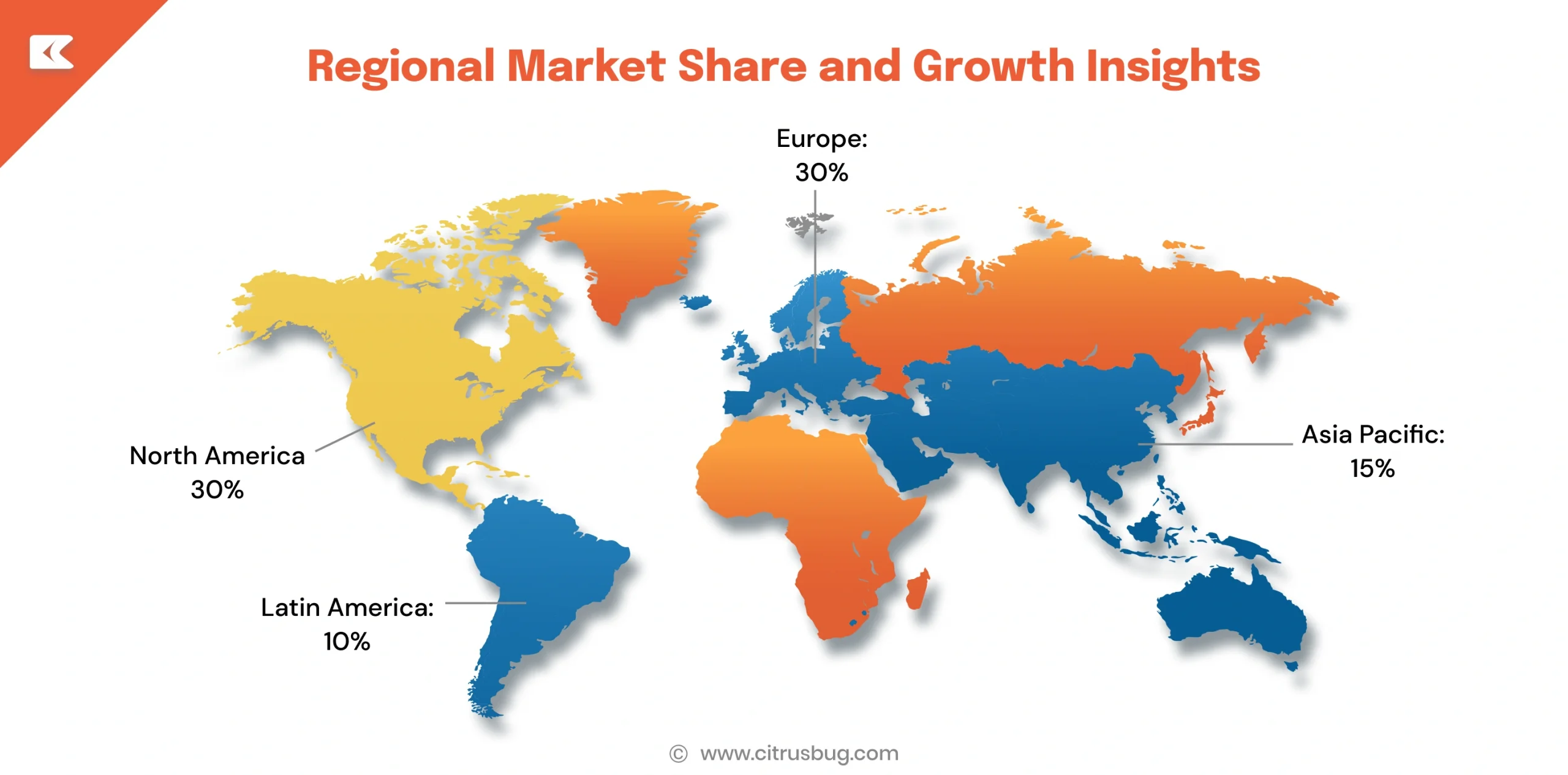
CDSS adoption varies considerably across global regions, shaped by differences in EHR infrastructure maturity, regulatory frameworks, government investment programs, and healthcare system capacity. The breakdown below reflects current market share distribution and growth dynamics across the four primary global regions.
North America
North America commanded 45.1% of global CDSS market revenue in 2025, supported by deep EHR penetration, value-based reimbursement structures, and regulatory mandates that hold health systems accountable for measurable quality and patient safety outcomes.
The U.S. market specifically was valued at USD 2.14 billion in 2024, with strong growth projected through 2034 driven by Medicare quality benchmarks, national patient safety initiatives, and the dominant presence of major CDSS platform vendors including Epic Systems and Oracle Health serving hospital systems and ambulatory networks.
Europe
Europe accounted for 30% of the global CDS market in 2024, driven by digital health transformation across major national health systems, the European Health Data Space regulatory framework, and growing demand for interoperable health IT infrastructure that enables cross-border patient data sharing and clinical workflow standardization.
Leading markets including the United Kingdom, Germany, and the Nordics are at the forefront of institutional adoption, with regulatory compliance and data sovereignty shaping procurement priorities across public hospital networks and private care providers.
Asia-Pacific
The Asia-Pacific region held approximately 15% of the global CDSS market in 2024 and is the fastest-growing region at a CAGR of 13.82% through 2034, propelled by government-led AI health programs, rapid cloud infrastructure expansion, and a large underserved patient population in countries including China, India, and Japan, where demand for scalable clinical decision tools is substantial and growing.
Rest of World
The Middle East, Latin America, and Africa collectively contributed 10% of the global CDSS market share in 2024, with growth expected to accelerate as healthcare infrastructure matures, government-backed digital health programs expand access to health IT platforms, and mobile-first clinical approaches begin bridging existing gaps in care data access across under-resourced settings.
Clinical Decision Support System Market by Segment
By Component
The market is divided into three core components software, hardware, and services. Software leads the segment, powered by AI-driven algorithms that enhance clinical workflows and reduce diagnostic errors.
Hardware enables real-time data processing at the point of care, while services covering implementation, training, and support ensure smooth deployment.
Together, these components form the backbone of modern healthcare decision-making infrastructure.
By Deployment Mode
Healthcare organizations can deploy these systems either on the cloud or on-premises, depending on their operational needs. Cloud-based solutions are gaining momentum for their scalability, lower upfront costs, and ease of updates.
On-premise setups remain a strong choice for institutions with strict data governance policies. Hybrid models are also emerging, giving providers the flexibility to balance accessibility with security across their IT environments.
By Application
From drug interaction alerts and diagnostic support to chronic disease management and preventive care, the application landscape is broad and rapidly evolving.
Drug safety tools and diagnostic aids currently hold the largest share, helping clinicians reduce errors and improve patient outcomes.
Meanwhile, AI-powered support across specialties such as oncology, cardiology, and radiology is opening new growth avenues in healthcare settings worldwide.
Factors Accelerating Clinical Decision Support System Market Growth
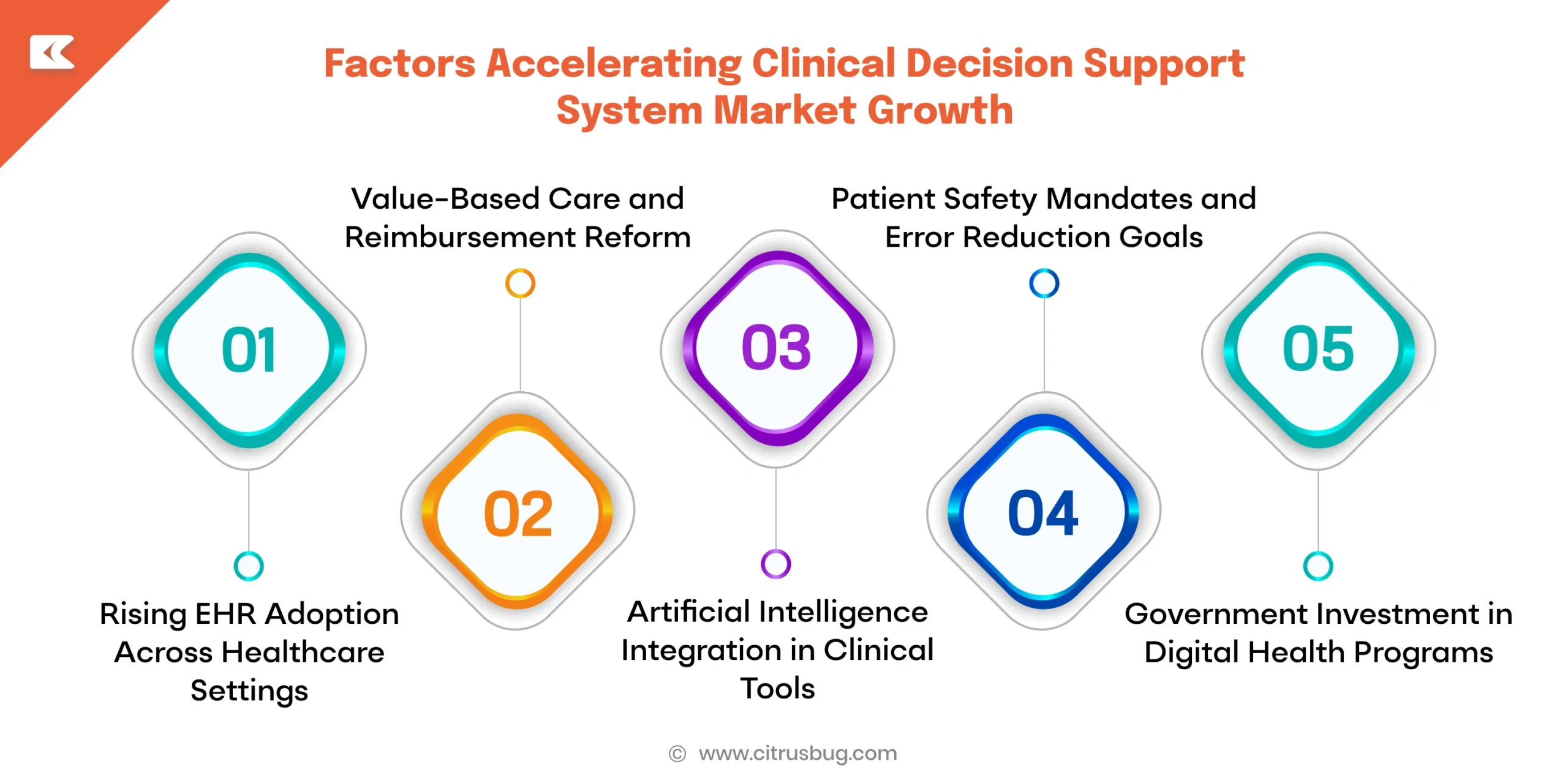
Several structural forces are reinforcing demand for clinical decision support tools across health systems, payer organizations, and government health programs globally.
These factors are shaping investment priorities and directly influencing how quickly adoption moves from pilot programs to enterprise-wide deployments.
Rising EHR Adoption Across Healthcare Settings
High electronic health record penetration across physician offices and hospital systems has created a natural deployment environment for embedded CDSS tools.
As EHR adoption expands into smaller practices and specialty settings, the installed base available for CDSS integration grows proportionally.
This growth reduces the infrastructure overhead required to bring new clinical teams onto decision support platforms without significant technology investment.
Value-Based Care and Reimbursement Reform
The transition from fee-for-service to value-based payment models has changed how hospitals prioritize clinical technology spending.
Health systems operating under quality and outcome benchmarks need tools that identify patient risk, flag protocol deviations, and document guideline adherence in ways that are traceable and auditable.
Clinical decision support fits this framework directly by reducing avoidable costs tied to medication errors, unplanned readmissions, and preventable adverse events.
Artificial Intelligence Integration in Clinical Tools
New generations of CDSS platforms now integrate AI and machine learning capabilities that enable predictive alerts and real-time risk stratification well beyond what traditional rule-based engines provide.
These capabilities improve alert specificity, reduce clinician alert fatigue, and allow platforms to adapt to institutional data patterns over time.
The pace of AI integration is accelerating both new CDSS deployments and upgrades to existing clinical platforms across major health systems.
Patient Safety Mandates and Error Reduction Goals
Regulatory frameworks in multiple markets hold organizations financially accountable for preventable patient safety events.
Medication errors, readmission events, and diagnostic oversights carry direct financial consequences under these structures.
CDSS tools address these risks by automating safety checks at the point of ordering, flagging contraindicated drug combinations, and supporting clinical teams with protocol-based guidance that reduces the likelihood of error during high-pressure care situations.
Government Investment in Digital Health Programs
Public sector investment in national digital health programs is accelerating CDSS adoption in both developed and emerging economies.
France’s health innovation investment plan committed substantial funding toward digital care infrastructure.
This investment supports AI-powered clinical tools at the population scale and establishes unified data environments for evidence-based care delivery.
In the Asia-Pacific region, government-backed programs are funding cloud health platforms in markets where large patient populations and specialist shortages make scalable clinical decision support an immediate priority.
Challenges Limiting Clinical Decision Support Adoption
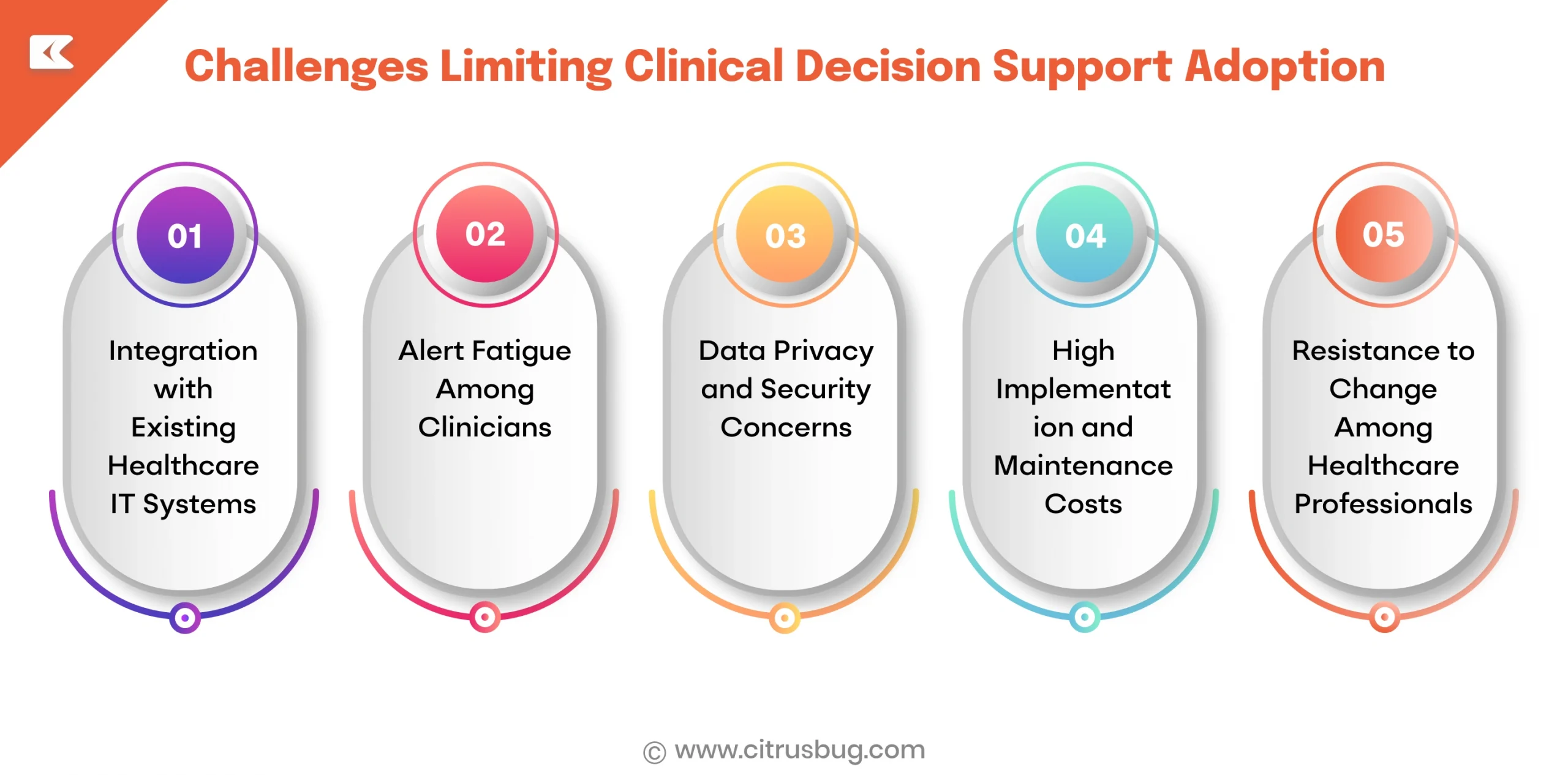
- Integration with Existing Healthcare IT Systems
- Legacy EHR platforms are not built to communicate with modern CDSS tools.
- Inconsistent data formats across systems create significant interoperability gaps.
- Extensive customization requirements push implementation timelines and costs higher.
- Routine software updates on either side can break previously functioning integrations.
- Smaller facilities often lack the IT expertise needed to manage complex deployments.
- Fragmented data pipelines delay alerts, reducing their clinical value.
- Alert Fatigue Among Clinicians
- Excessive alerts cause physicians to dismiss notifications without proper review.
- Most CDSS alerts are overridden, raising concerns about real-world effectiveness.
- Alerts lacking patient-specific context are treated as noise rather than guidance.
- Repetitive low-priority warnings gradually erode clinician trust in the system.
- Poor alert hierarchies make it difficult to distinguish urgent from routine notifications.
- Continuous algorithm tuning is needed but is rarely sustained by most organizations.
- Data Privacy and Security Concerns
- CDSS platforms handling sensitive patient data are prime targets for cyberattacks.
- Compliance with HIPAA, GDPR, and regional laws adds significant complexity to deployment.
- Cloud-based solutions raise concerns about data storage locations and access control.
- Weak encryption in older platforms can expose confidential health records.
- Third-party vendor breaches create serious liability risks for healthcare organizations.
- Balancing real-time data sharing with strict privacy requirements remains an ongoing challenge.
- High Implementation and Maintenance Costs
- Licensing, infrastructure, and customization costs are prohibitive for smaller providers.
- Ongoing training, updates, and support add substantial expenses beyond initial deployment.
- Total cost of ownership is frequently underestimated, leading to budget overruns.
- Short-term ROI is hard to quantify, making it difficult to secure funding approvals.
- Limited IT budgets in low-income regions make advanced CDSS largely inaccessible.
- Vendor dependency for upgrades drives long-term costs even higher.
- Resistance to Change Among Healthcare Professionals
- Many clinicians distrust algorithm-driven recommendations over their own judgment.
- Poor training during rollout leads to underutilization and staff frustration.
- Intrusive or poorly timed alerts create negative early impressions of the system.
- Deep-rooted clinical cultures slow organization-wide acceptance of new tools.
- Without visible leadership support, staff have little motivation to adapt their workflows.
Future Outlook for Clinical Decision Support Systems
Market projections across multiple research frameworks consistently point to robust growth for clinical decision support through 2032, driven by AI integration, expanding value-based care infrastructure, and continued government investment in digital health transformation. The forecasts below represent distinct projection windows with independent research methodologies and market scope definitions.
- Market Projected to Reach USD 4.94 Billion by 2031: The global CDSS market is expected to grow to USD 4.94 billion by 2031, driven by the outperformance of machine learning-based tools over traditional rule engines, particularly in high-volume clinical specialties such as radiology, pathology, and pharmacy.
Capital is expected to shift progressively toward subscription-based software platforms as health systems transition away from perpetual licensing models and toward scalable cloud delivery.
- Market Expected to Reach USD 6.5 Billion by 2035: At the near-term forecast boundary, the global CDSS market is projected to reach USD 6.5 billion by 2035, sustained by AI integration, expanding EHR mandate coverage, and rising institutional demand for value-based care analytics across both established and high-growth healthcare markets.
North America and Europe are expected to account for a substantial portion of this expansion during the period.
Conclusion
The clinical decision support system market is entering a sustained growth phase backed by measurable clinical outcomes, accelerating AI capabilities, and expanding electronic health record infrastructure across global health systems. Adoption is moving well beyond large academic medical centers into community hospitals, specialty networks, and outpatient practices in every major region.
For healthcare organizations building or scaling digital care infrastructure, purpose-built clinical decision support software remains one of the clearest paths to aligning patient safety goals with financial performance. Platforms that integrate tightly with existing clinical workflows and deliver actionable real-time intelligence will continue to lead adoption and generate demonstrable value across diverse care environments worldwide.