
 Back
Back







Machine learning and generative AI are two terms that appear side by side in almost every technology conversation today, yet they describe fundamentally different capabilities. Machine Learning and generative AI both are subset of AI and both are powerful tools. These both have different purposes and fundamental approaches. In this article we will see the overview of Machine Learning and Generative AI, their use cases in various industries and the key difference between them.
First things first, you need to know what these two AI subfields are and what their guiding principles are before you can actually understand the differences between gen AI vs machine learning.
Tracking the top AI trends is useful context; knowing which branch of AI applies to your problem is the more actionable next step. This guide breaks down both technologies, how each works, where each excels, and the scenarios where one choice clearly beats the other.
Understanding Generative AI
Generative AI is a subset of artificial intelligence focused on creating new content. The technology uses generative models designed to generate data that reflect the distribution of a particular dataset. Once trained, These models can generate new data points statistically similar to the training data. This innovation can extend to text, images, audio, and video, giving people new ways to be creative and solve problems.
Generative AI uses deep learning networks, like Generative Adversarial Networks (GANs) and Variational Autoencoders (VAEs).
- Generative Adversarial Networks (GANs): Comprise of two neural networks that cooperate to produce new content. The first network produces tests and the other network assesses the tests and gives feedback.
- Variational Autoencoders (VAEs): Utilize a probabilistic approach to learn a compressed representation of the input data and produce new examples from this representation.
ChatGPT, Jasper Chat, and Google Bard are some of the best examples for generative AI in content generation. The field of content generation has reached new heights thanks to advanced language models. These AI applications use natural language processing (NLP) to compose essays, write poems, tell jokes, and conduct human conversations at the user’s command.
Generative AI development sits at the intersection of deep learning, transformer architecture, and massive compute, making it one of the most resource-intensive engineering disciplines in practice today, and one of the fastest-moving.
Pros and Cons of Generative AI
| Pros | Cons |
|---|---|
| Produces human-quality text, images, and code without domain-specific fine-tuning for many tasks. | Hallucinations, confidently stated but factually wrong outputs, remain a significant reliability risk. |
| Reduces the time and cost of content creation, copywriting, and documentation. | Training foundation models from scratch requires compute budgets in the tens of millions of dollars. |
| Enables rapid prototyping by generating boilerplate code, UI mockups, and test data. | Outputs lack a built-in source of truth, making quality control time-intensive. |
| Can be fine-tuned on proprietary data to build specialised assistants for specific industries. | Fine-tuning and inference on large models carry ongoing cloud compute costs that scale with usage. |
| Multimodal models handle text, image, and audio in a single pipeline. | Copyright and IP ownership of AI-generated content remains legally unresolved in most jurisdictions. |
| Summarises documents, drafts reports, and translates languages at scale and speed. | Models inherit biases and potentially harmful patterns from large, unfiltered training datasets. |
| Lowers the technical barrier for AI features through prompt engineering alone. | Prompt injection and adversarial inputs can manipulate model behaviour in production. |
| APIs from OpenAI, Anthropic, and Google let teams ship AI features in days. | Output consistency is not guaranteed, the same prompt can yield different results across runs. |
| Enables conversational user experiences that static software interfaces cannot replicate. | Governance frameworks for generative AI outputs are still maturing in regulated industries. |
Real-world Use cases of Generative AI for different industries
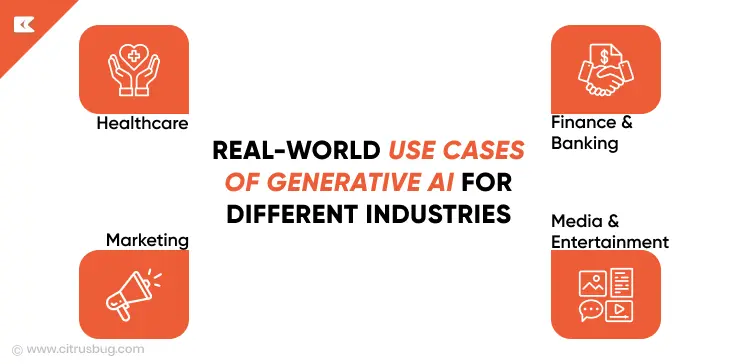
Healthcare: Assist clinicians reach an early diagnosis by assisting radiologists with identifying cancer spots in medical images. Gen AI is exceptional at understanding huge, unstructured information to identify anomalies quicker and better than a human. As indicated by Accenture, AI might possibly improve 40% of healthcare providers’ functioning hours. Generative AI is also powering advanced audio to text tools, enabling healthcare businesses to quickly transcribe conversations, and consultations into searchable text, which boosts productivity and accessibility.
Generative AI can create a personalized treatment plan for each patient by taking into account a large amount of patient data, such as medical images and genetic testing.
Finance & Banking: Generative artificial intelligence in finance and banking has empowered another extent of outstanding advancement, for example, a better comprehension of financial literacy and improvisation of fundamental fakes.
As per statistics, revealed by Market research, the assessed market valuation of Generative AI in financial service is around $1.85 billion in 2023 and is projected to reach $9.48 billion by 2032.
Marketing: Generative AI in marketing enables advertisers to create significant, convenient, and reliable customer experiences easily. From discovering segmentation insights to creating client journeys, producing content, and automating two-way unstructured conversations, generative AI streamlines the process, empowering marketers to convey revenue-boosting campaigns within minutes rather than days.
Generative AI offers advertising and marketing professionals a multitude of solutions, such as generating the text and images required for marketing purposes and AI coding tools that help developers generate and refine code more efficiently.
Media and Entertainment: Companies in the media and entertainment industries are already making use of virtual reality (VR) and augmented reality (AR) technologies. Generative AI has the potential to make these endeavors more seamless and successful. Media companies can use generative AI to create captivating experiences that blur the lines between reality and fiction in the metaverse.
According to IDC, enterprises have spent over $19.4 billion on generative AI in 2023 and will spend more than double this year.
Understanding Machine Learning
Machine Learning is a subset of AI that analyzes and draws inferences from patterns discovered within data. It includes preparing algorithms on datasets, allowing them to recognize designs, make predictions, and work on their performance over time. Machine Learning is a sort of limited or weak AI, intended to perform a particular task, like image grouping, speech recognition, or natural language processing.
Developed commercially through the 1990s and 2000s, it became the backbone of modern recommendation engines, spam filters, and credit-scoring models. Core approaches include supervised learning, unsupervised learning, and reinforcement learning. Google’s search ranking, Netflix’s recommendation engine, and Tesla’s driver-assistance features all rely on well-engineered AI and ML development services. At its core, machine learning is a prediction and classification engine, it answers questions like “Will this customer churn?” or “Is this transaction fraudulent?”
Types of Machine Learning Algorithms
- Supervised Learning: The algorithms learn from labeled data, where the correct output is provided for a given input.
- Semi-supervised Learning: Semi-supervised learning is very much like supervised learning, yet rather utilizes both labeled and unlabeled information. Labeled data is basically data that has significant labels so the algorithm can understand the information, while unlabeled data comes up short on data.
- Reinforcement Learning: Reinforcement learning centers around regimented learning experiences, where a machine learning algorithm is given a set of actions, boundaries and end values.
- Unsupervised Learning: The unsupervised learning algorithm is trained on unlabeled data, and it must identify patterns or relationships on its own. The algorithm tries to describe the structure of that data by organizing it in some way.
Pros and Cons of Machine Learning
| Pros | Cons |
|---|---|
| Extracts patterns from large structured datasets that humans would miss. | Requires large volumes of high-quality labelled data to train effectively. |
| Interpretable models like decision trees let teams audit and explain predictions. | Deep neural networks can be difficult to explain to non-technical stakeholders. |
| Fast, low-cost inference at scale once a model is trained and deployed. | Retraining is required when the underlying data distribution shifts over time. |
| Works exceptionally well for tabular data in finance, logistics, and healthcare. | Performance degrades significantly when training and production data differ substantially. |
| Mature tooling, scikit-learn, XGBoost, PyTorch, reduces development time. | Selecting algorithms and tuning hyperparameters demands specialist expertise. |
| Models can be updated incrementally without full retraining in many frameworks. | Data preparation typically consumes 60–80% of total project time. |
| Proven track record across industries reduces adoption risk for new deployments. | Edge cases are often underrepresented in training data, creating blind spots. |
| Scales horizontally on cloud infrastructure with predictable cost curves. | Models can encode and amplify biases present in training data without validation. |
| Enables real-time decisions in fraud detection and dynamic pricing systems. | Maintenance burden grows as the number of deployed models in an organisation increases. |
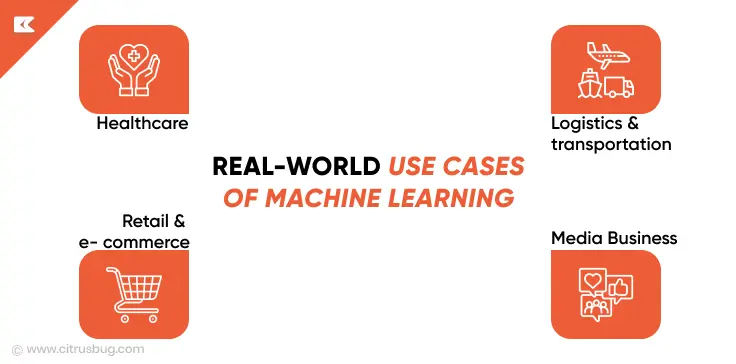
Real-World Use Cases of Machine Learning:
Because ML technology is so ingrained in our daily lives, you might not even notice it in the technologies we use every day. It is exciting to see how it is supporting faster and more effective execution of some business operations and industries, revealing patterns that humans are likely to miss, and improving our quality of life. If we look at machine learning trends, Many of the technologies you use every day are driven by ML models, and they have been doing so for years, from recommendation systems like those used by Netflix and Amazon to speech recognition systems like Siri and Alexa.
The following are real-world use cases of machine learning in our day-to-day lives that add value in a variety of ways, some large and some small.
Healthcare: Machine Learning supports diagnosing diseases by analyzing medical images or patient records more proficiently than human specialists. When evaluating mammograms for breast cancer, doctors miss 40% of cancers which ML can detect and help improve that figure.
Logistics & Transportation: Software that is based on machine learning development uses automated route building and better demand forecasting to cut costs and make operations even better. In the McKinsey study, organizations report their logistics costs further developed by 15% subsequent to executing automation technologies.
The best example of ML in transportation is Google Maps, which makes use of machine learning algorithms to check the conditions of the current traffic, choose the fastest route, suggest places to “explore nearby,” and estimate arrival times. ML is also used by ride-sharing apps like Uber and Lyft to match riders and drivers, set prices, look at traffic, and, like Google Maps, look at real-time traffic conditions to make the driving route more efficient and estimate how long it will take to get there.
Retail & e-commerce: By presenting the right crowd with customized offers, ML assists organizations with ROI improvement, increasing customer engagement and driving sales.
By identifying the offerings that might satisfy a particular customer’s interests, ML also contributes to the development of personalized marketing strategies. After that, it can tailor marketing materials to those interests.
Media Business: Machine Learning applications in the media business incorporate substance proposal, sentiment analysis, and customized advertising. Like retail and e-commerce ML use cases, the innovation helps media organizations identify behavioral trends in clients. Then, this information transforms into insights for personalization.
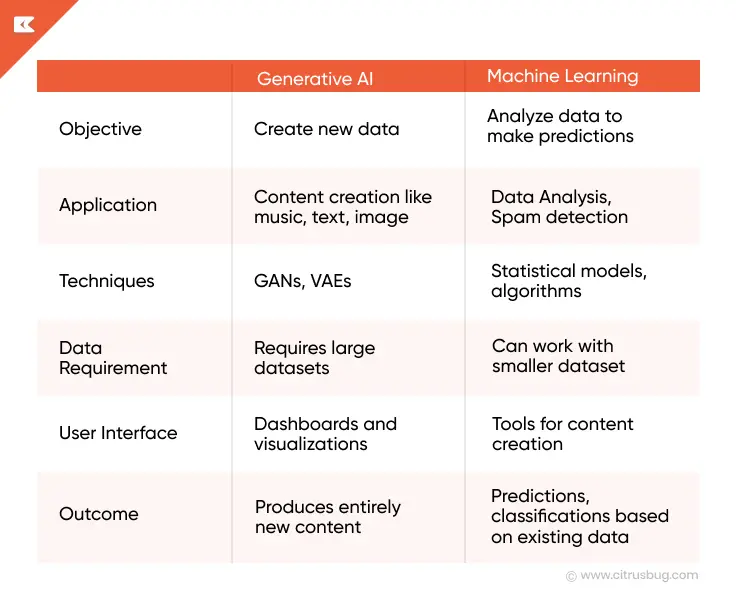
Key Difference: Machine Learning vs Gen AI (Generative AI)
Despite the fact that gen AI and ML are both subsets of AI, their objectives, approaches, and applications are vastly distinct.
Objective
The objective of Generative AI is to create new data resembling the training set whereas the objective of ML is to learn from data to make predictions or decisions.
Applications
Both generative AI and ML have a wide number of applications, yet each of them excels at something different. ML can be used in predictive maintenance, fraud detection and recommendation systems. Generative AI can be used for creating content including text, image and video, synthetic data generation, creative problem solving and product design.
Techniques
Generative AI relies heavily on GANs and VAEs, dual learning networks. While machine learning can be categorized in different strategies like supervised, unsupervised, and reinforcement learning
Data Requirement
Generative AI can handle various formats including unstructured data to generate new content. On the other hand, ML can often work with smaller datasets for specific tasks. Plus, ML can use annotated data to have a structure for the data, making it more understandable for technology and more accessible to use in editing and conducting creative work.
User Interface
The ML application usually involves dashboards and visualizations that display analytical results, predictions, and trends. Generative AI interface generally includes tools for content creation like image creator or text editor.
Outcome
Probably the most significant difference among ML and generative AI is their individual purposes. ML is a tool for making decisions or predictions based on existing data. Generative AI models produce completely new data/content and work more as a creative assistance.
Machine Learning vs Generative AI: When to Use Which?
- Choose machine learning when your problem involves predicting, classifying, or scoring structured data, fraud detection, demand forecasting, and churn prediction are natural fits where ML delivers high-accuracy outputs with auditable decision logic.
- Choose generative AI when your product needs to create or synthesise new content, customer support chatbots, automated marketing copy, and code-completion tools all benefit from the fluency and versatility of large language models.
- Use machine learning when regulatory requirements demand explainability, such as credit-scoring or clinical triage, where a gradient-boosting model with feature importances is far easier to audit than a billion-parameter LLM.
- Combine both when your application needs prediction and generation together, for example, an e-commerce platform that uses an ML model to identify a customer’s likely intent, then calls a generative model to produce a personalised product recommendation in natural language.
Industry Uses of Machine Learning and Generative AI
Machine learning has deep roots in sectors that run on structured data. In financial services, ML models underpin real-time fraud detection, algorithmic trading, and credit underwriting. In healthcare, machine learning in healthcare covers everything from diagnostic imaging analysis to patient readmission risk scoring. In production environments, machine learning in manufacturing adds predictive maintenance that flags equipment failures before they cause costly downtime.
Generative AI is cutting across those same sectors at a different layer. Generative AI in software development is reshaping how engineering teams write, document, and test code, AI pair-programmers have moved from novelty to standard tooling at many companies. In retail, generative AI in e-commerce powers dynamic product descriptions, visual search, and conversational shopping assistants that adapt to each user in real time.
In most enterprises today, ML handles the analytical backbone, the scoring, classification, and prediction layer, while generative AI handles the interface and content layer on top of it. The two technologies are increasingly complementary.
Conclusion
In summary, after comparing gen AI vs machine learning, we understand that both technologies are important in the modern business world, each with their own strengths: machine learning excels at extracting insights from existing data to improve decision-making, while generative AI pushes the boundaries of creativity by creating entirely new data, content, and possibilities.
For most modern AI-driven products, the answer is not one or the other, it’s knowing when to reach for each. Start with a clear problem definition: if your application needs to output a number, a label, or a probability, machine learning vs generative AI resolves clearly in ML’s favour. If it needs to output a sentence, an image, or a block of code, generative AI is the better fit. The most capable teams are the ones combining both, assigning each task to the model type it is built for, and that clarity begins with understanding the core difference between the two.
FAQs
What is the main difference between machine learning and generative AI?
Machine learning predicts, classifies, or scores inputs based on learned patterns. Generative AI creates new outputs, text, images, or code, that mirror the statistical structure of its training data. One answers questions; the other produces content.
Can machine learning and generative AI be used together in the same application?
Yes, and many production systems already do. A common pattern uses an ML model for intent detection or personalisation, then routes specific tasks to a generative model for natural-language response or content creation.
Which is better for a startup: machine learning or generative AI?
For most startups, generative AI via API offers faster time-to-value and lower upfront cost than custom ML pipelines. If the core product depends on proprietary structured data, financial risk, logistics, invest in custom ML from day one.
Which technology is better for healthcare applications?
Healthcare uses both. ML dominates diagnostic imaging, clinical risk scoring, and claims processing. Generative AI is gaining ground in clinical documentation and patient communication. Regulatory requirements often favour ML for its explainability.
What industries are adopting generative AI the fastest?
Technology, media, financial services, and retail lead adoption. Software teams benefited early through code-completion tooling. Regulated industries like healthcare and insurance are moving more carefully due to ongoing compliance and liability questions.
How do I decide which technology my project needs?
Define the desired output first. If your application needs a number, label, or probability, use machine learning. If it needs a sentence, image, or code block, use generative AI. For both, design a hybrid pipeline.