
Ecommerce

 Citrusbug Healthcare →

 ISO 27001
 SOC 2
 HIPAA
Trusted by industry leaders














Certifications and Accreditations

From launching new products to improving existing systems, Citrusbug helps Los Angeles businesses turn software requirements into practical business outcomes. Each service can stand alone or fit into a larger project, with continuity from discovery through deployment and ongoing support.

Internal tools, client portals, and line-of-business platforms modeled on how your team works. We handle custom software development from data model to deployment, so approvals, pricing rules, and reporting follow your own process.

Browser-based products built on React, Next.js, Node.js, or Django, with role-based access, audit logs, and API layers ready for future integrations. Performance budgets and accessibility checks against WCAG 2.2 run in every sprint.

iOS and Android apps in Swift, Kotlin, React Native, or Flutter, with the framework chosen around offline use, device features, and release cadence. Push notifications, in-app payments, and analytics are wired in from the first release.
LLM features such as document Q&A, drafting assistants, and support copilots, built on models from OpenAI, Anthropic, or self-hosted Llama and grounded in your own data with retrieval and permission controls.
Our AI/ML development work covers demand forecasting, churn scoring, fraud flags, and pricing models trained on your historical data, deployed with MLOps monitoring so drift is caught and models retrain on schedule.
Older .NET Framework, PHP, or on-premise systems moved to supported stacks in phases, with the strangler pattern keeping current operations running while modules are replaced and data migrates under validation checks.
AWS, Azure, or Google Cloud environments defined in Terraform, with CI/CD pipelines, container orchestration on Kubernetes or ECS, and cost tagging set up early so monthly spend stays predictable as usage grows.
Production bugs, failing builds, slow queries, and outdated dependencies handled under agreed response windows, with each fix covered by a regression test so the same defect does not return.
Share your product goals or current technical challenges. Our team will help identify the right approach, key priorities, and practical next steps for development.
Discuss Your ProjectAI creates business value when it reduces repetitive work, improves access to information, or helps teams make better decisions. Citrusbug integrates generative AI and machine learning into business applications, connecting AI features to systems such as CRMs, ERPs, and EHRs through APIs and appropriate access controls.
Generative AI can summarize documents, draft content, and answer questions, while machine learning models forecast demand, identify patterns, and score risks. As a software development company in Los Angeles, Citrusbug combines these capabilities to address specific workflow challenges and connect AI features to practical business goals.
Help employees find answers across contracts, standard operating procedures, product documentation, and support tickets. Our RAG development services connect language models to relevant business information, with source references and permission controls where supported by the implementation.
Reduce manual handling of routine tasks by connecting AI agents to approved business tools. An agent can review an incoming email or form, retrieve relevant account or inventory data, and prepare a recommended action for human approval, with scoped permissions and activity logging.
Convert invoices, bills of lading, intake forms, and lease agreements into structured data for downstream workflows. OCR and language models can extract key fields, validate them against business rules, and route uncertain results for human review.
Assess AI outputs before release and monitor performance in production. Depending on the use case, evaluation can cover accuracy, prompt-injection resistance, access controls, response quality, and cost per request, helping teams identify issues and manage ongoing model expenses.
Stakeholder discussions, workflow reviews, and system assessments establish business goals, user needs, and technical constraints. The outcome is a prioritized backlog with documented requirements, acceptance criteria, integration dependencies, and a defined scope for the first release.
Wireframes and interactive prototypes help validate user journeys before development begins. The team then defines the technology stack, system architecture, data model, and hosting approach around your product requirements, security needs, expected usage, and budget.
Development progresses through short sprints, with working features available for review in a staging environment. Code reviews and automated tests help maintain quality, while regular demos give your team visibility into progress and a structured way to reprioritize requirements.
Functional, integration, regression, and performance testing help identify issues before release. Security checks, dependency scanning, accessibility reviews, and cross-device testing are selected according to the application's risks and requirements, followed by user acceptance testing with your team.
Deployment planning covers release sequencing, monitoring, rollback procedures, and any required data migration. Cloud infrastructure and alerting are configured for the target environment, while migration rehearsals and validation checks help reduce disruption during launch.
After launch, the team addresses issues identified during the agreed stabilization period and helps resolve early operational problems. Your handover can include source code, architecture documentation, runbooks, and access to project repositories and environments, giving your team a foundation for ongoing maintenance and future development.
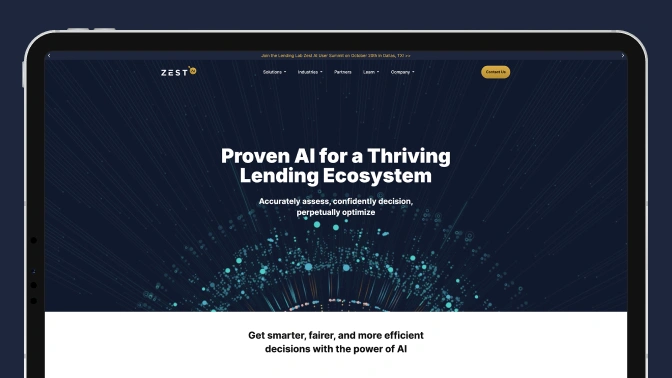
Zest AI is a leading AI-powered lending technology company helping banks, credit unions, and financial institutions make faster, smarter, and more inclusive credit decisions. By leveraging machine learning, predictive analytics,…
View Case Study →
Two projects with similar feature lists can land at very different budgets. These factors explain most of the gap, and each one is sized during discovery before an estimate is issued.
A login and dashboard take days, while multi-role permissions, offline sync, and complex reporting take weeks. The number of user roles and workflows is usually the single largest cost variable.
Each API integration with an ERP, CRM, payment processor, or carrier platform adds design, testing, and error handling. Undocumented or rate-limited APIs add more, which is why they are tested early.
LLM features add prompt design, retrieval setup, evaluation, and per-request model costs. Custom machine learning adds data cleaning and training cycles, so data quality shapes both price and timeline.
HIPAA, PCI DSS, or SOC 2 obligations add access controls, audit logging, encryption, and documentation work. Drawing the compliance boundary early keeps that effort limited to the systems that need it.
A responsive web app runs on one codebase. Native iOS and Android apps, an admin panel, and a public API each add build and QA effort that compounds across every release.
A fixed launch date may call for a larger parallel team, raising monthly spend while shortening calendar time. A flexible timeline lets a smaller team deliver the same scope at a lower burn rate.
California’s updated CCPA regulations introduce requirements for applicable businesses around automated decision-making, privacy risk assessments, and cybersecurity audits. Depending on your business and data practices, Citrusbug can account for relevant privacy and security requirements during software design and development, in coordination with your legal advisers.

Privacy Request Workflows: Support applicable consumer requests, including opt-out handling and processes for managing personal information.
Automated Decisionmaking: Include relevant notices and decision records where required for covered uses of automated decisionmaking technology.
Privacy Risk Assessments: Document data flows and processing activities to support applicable assessment requirements.
Security and Audit Trails: Implement appropriate access controls, security logging, and documentation to support audit and accountability needs.
Their agile way of working, competence, and friendliness are impressive.December 7, 2024
Citrusbug Technolabs handles a data extraction project for an education company. They're also responsible for managing an AI generation project for the client.
Citrusbug Technolabs has laid out and followed a clear project outline and consistently met deadlines. The team communicates well and demonstrates a strong understanding of the client's vision and goals. Their agile approach, high level of competence, and personable approach stand out.
 Read More
Their communication and ability to capture exactly what I was asking for were impressive.November 14, 2024
Citrusbug Technolabs built an automated system for a veteran medical company. The system needed to collect and store user data, generate customized letters based on surveys, and use AI to summarize reviews.
Citrusbug Technolabs delivered a functional automated system that successfully organized the client's records and auto-generated statements. The team was quick to respond, addressed all roadblocks, and communicated effectively. Overall, their ability to understand the client's needs stood out.
Read More
They were very calm and talented, and they did bring some of their own ideas.January 28, 2025
Citrusbug Technolabs has developed an MVP for a freight and capacity marketplace. The team has created three different interfaces for three market segments.
Citrusbug Technolabs has successfully developed an effective MVP. The team has delivered the project on time and almost within budget. Moreover, their responses have been timely. Overall, the team has been calm, talented, and innovative. This has led to the client's satisfaction.
Read More
What stood out most about them was their personalized approach and sense of ownership in every aspect of the project."February 27, 2024
Citrusbug Technolabs built a Flutter cross-platform mobile app for an education company. They also developed two web apps and an admin panel and provided DevOps support for the client's infrastructure.
Citrusbug Technolabs' support successfully boosted the client's user engagement by 8x, resulting in an 85% retention rate. The reliable team demonstrated a dedication to delivering on time and promptly responding to concerns and adjustments. Their personalized, client-centric approach stood out.
Read More
They didn't like the phrase "impossible to do", which made them very solution-oriented.February 19, 2024
A healthcare company hired Citrusbug Technolabs to design and develop a user-friendly application. The team provided tailored assistance to meet the client's requirements.
Citrusbug Technolabs successfully delivered an application that was ready for market. The team was highly professional and well-organized; they stayed focused throughout the engagement and were receptive to changes. Overall, they stood out for their trustworthiness and commitment to excellence.
Read More
They're 100% on time and transparent throughout each stage of the project.February 24, 2024
A financial technology company has hired Citrusbug Technolabs to build a custom web application. The team handles the development and design of the app.
The project is ongoing, but the client has been satisfied with Citrusbug Technolabs' services. The team is very professional — they always respect timelines and provide regular updates to ensure everyone's on the same page. Also, their transparent approach makes them a trustworthy partner.
Read More
"I do believe they are exceptional at where they stand."
Citrusbug Technolabs took on a mobile app development project for a Singapore-based development house. They were provided with UX designs to execute. Currently, they're finalizing and fine-tuning the product.
Citrusbug Technolabs contributed to the successful launch of the product, which has garnered over 10,000 users in just three months. The product has also received support from investors. They consistently followed-up with their progress and delivered at a speedy rate. The team is truly stellar.
Read More
DEFINED SCOPE, SET BUDGET
EVOLVING SCOPE, FLEXIBLE PACE
LONG-TERM ROADMAP, STABLE TEAM
Custom software projects typically start around $30,000 for a focused application and can exceed $150,000 for multi-system platforms with AI and compliance scope. Share your requirements for a phased estimate.
Your business retains source code and intellectual property ownership under the agreed contract terms. Repository access and technical documentation give your team the ability to maintain, extend, or transfer the software as business needs evolve.
AI features are tied to specific workflows and measurable objectives, from reducing manual processing to improving forecasting and information retrieval. This keeps implementation focused on practical business value, with performance and operating costs considered alongside functionality.
Regular progress updates, sprint demos, and project tracking help your team review working software and stay informed about decisions. Clear communication makes it easier to address changing priorities and keep development aligned with business goals.
Software needs ongoing attention after release. Maintenance and support can cover bug fixes, performance issues, dependency updates, and future enhancements, with service levels and response times agreed according to your project's needs.
 Custom Software Development
In today’s rapidly evolving business landscape, selecting the right software solution is critical for operational efficiency and scalability. Businesses often face a dilemma when choosing between custom software development and…
Read Article → Custom Software Development
Every software project faces uncertainty. Changing requirements, tight deadlines, or new technologies can easily disrupt progress. This is the reason why risk management in software development is necessary. It assists…
Read Article → Custom Software Development
Custom software development is the process of developing software for specific users. In today’s era of technological transformation, one software solution is not fit for everyone. Due to this Custom…
Read Article →Pricing from a software development company in Los Angeles depends on scope. Focused applications typically start around $30,000, and multi-system platforms can pass $150,000. User roles, integrations, and platforms drive the difference.
Timeline depends on scope, integrations, and team size, and it is committed to in writing after discovery. Larger platforms release in phases, so users get working features before the full roadmap is complete.
Yes. A takeover starts with recovering repository and cloud access, then a code audit showing what to keep, refactor, or replace. You receive a dated launch plan before any large rework is approved.
Your company does. Work is covered by an NDA from the first conversation, and full source code, documentation, and environment access transfer to you at delivery.
Both. The same team builds the application, data pipelines, and models, so LLM features and predictive models share one architecture, one security model, and one release process.
Usually, yes. AI features connect through APIs to your existing CRM, ERP, or internal tools, so a pilot can run on one workflow while the rest of the platform stays as it is.
Software can be designed with consent handling, opt-out flows, and decision logging that support CCPA obligations. Whether a rule applies to your business, and whether you comply, is determined with your legal counsel.
Yes. Daily updates, sprint demos, and planning calls are scheduled within Pacific Time business hours, and your project manager stays reachable through Slack or Teams.
